
“You can’t do without it. Supposing you wanna hear Jack Benny, see? But you can’t be at home at that hour. So you tell the maid to turn the radio on when Jack Benny comes on, and this automatically goes on with the radio. . . .” That is how big shot Howard Wagner goes on about his new wire recorder—shortly before giving his old employee the ax. The employee is Willy Loman, the scene from Death of a Salesman. It is one of the references that came as a surprise to me yesterday morning when I reread the play I thought I was done with by the time I left college. At the time he wrote this Pulitzer Prize-winning piece, Miller had not long gotten out of the radio game and was rejoicing in his newfound artistic freedom; so he gives the speech—and the speech recording device—to the bad guy. Having previously gone on record to dismiss radio as commercial and corrupt, Miller now suggested how the medium was about to get worse—that is, farther removed from live theater, from the immediate, the communal, and the relevant.
This “wonderful machine”—for which Mr. Wagner is ready let go of “all [his] hobbies”—is a metaphor for the selfishness of a society that was moving so fast, it could not even give the time of day to its most beloved entertainers—let alone a tired old man like Willy Loman. If Mr. Benny wanted to talk to Howard Wagner, he, like everyone else, had to wait for the hour appointed to him by the big noise.
“You can come home at twelve o’clock, one o’clock, any time you like, and you get yourself a Coke and sit yourself down, throw the switch, and there’s Jack Benny’s program in the middle of the night!”—all for “only a hundred and a half,” an amount for which Willy Loman is willing to work for three weeks and a half.
For decades to come, it was the industry that benefitted most from this new recording technology. Bing Crosby could walk into the studio when it suited his own schedule, rather than having to be there for the public who sat by the radio, as of old, to hear his program go on the air. Nowadays, the Willy Lomans are in charge of scheduling, of making time for whoever vies for their attention.
I would not go so far as to say that I “can’t do without” the latest recording software. It sure makes it easier for me to enjoy more of what I enjoy, though. The BBC’s iPlayer has greatly changed my listening habits and increased the number of plays, documentaries, and musical selections I take in. Currently, I am listening to “The Better Half,” a cheeky if dated sex comedy by Noel Coward. Written and performed in 1922, the unpublished one-acter about “modern” marriage (in the traditional sense we can’t seem to get past) was not staged again until 2007. Earlier this week, it had its broadcast debut on BBC Radio 4.
Okay, so the leading lady is not Gertrude Lawrence (star of radio’s Revlon Revue back in 1943)—but at least I won’t have to listen to Mr. Wagner’s precious offspring (“Listen to that kid whistle”) while begging for a moment of his time. After all, most of us don’t get the impression that, as Noel Coward puts it in “This is a Changing World” (with which the radio adaptation of “The Better Half” opens), “[t]ime is your tenderest friend.” So, it feels good to push a few buttons and get the better of it . . .
Related recording
“Meet Gertrude Lawrence,” Biography in Sound (23 January 1955)

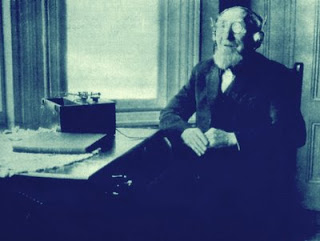
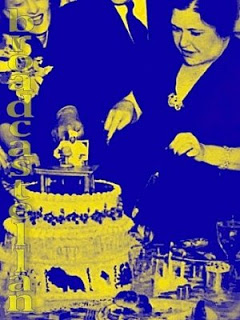 As I add another candle to the cupcake set aside for the celebration of my fourth blogging anniversary and to be consumed in the solitude of my virtual niche, I am once again wondering whether I should not have taken a scandal sheet out of Louella Parsons’s cookbook. You know, serving it while it’s hot, with a pinch of salt on the side. Dishing it out in a bowl the size of China, a tidbit-craving multitude hanging on your gossip-dripping lips. As the first name in name-dropping, Louella (seen below, cutting her own birthday cake, anno 1941) might have done well as a webjournalist, just as she had on the air, despite a lazy delivery that piled fluffs on fluff and a flat voice that makes Agnes Moorehead sound like a Lorelei by comparison. Her hearsay went over well all the same, its nutritional deficiencies giving none cause for contrition.
 Last night, I felt like an old queen. Granted, that is not an uncommon feeling for me; but the Queen in this case was none other than Victoria, who, in the last years of her reign, enjoyed partaking of live opera without actually having to leave for the theater at which it was presented. Her royal box was a contraption called the Electrophone, a special telephone service that connected subscribers with the theaters from which the sounds of music and drama could be appreciated while being seated in whichever armchair one designated as a listening post. Today, we may be accustomed to live—or, wardrobe malfunctions notwithstanding, very nearly live—broadcasts of sounds as well as images; but last night’s event felt as new and exciting to me as it must have been picking up the electrophone or dialing in to those experimental theater relays during the 1890s and 1920s, respectively.

 Harry Heuser