In Clover . . . or Out?

“Broadway. It’s a swamp that’ll drag you, breath by breath, into its shadowed pools. Or it’s a meadow shining with golden light. It’s a place and a time and a loneliness that reaches out for you, then beckons you into an airless room and locks the door. You get out or you don’t. Either way, it’s Broadway, my beat.” That was the opening of the final episode of Broadway Is My Beat, which ended its run as a summer replacement for The FBI in Peace and War on this day, 25 August 1949. Final episode? Not in hindsight, of course.

The series (which I previously discussed here) would return to CBS radio, eventually, and run for another five years; but most of the listeners tuning back on that evening in August had no clue. “You get out or you don’t.” Was detective Danny Clover going to get out of the black hole of summer, the “airless room” that was the slot allotted to programs on probation while the shows that sold were on hiatus?

A man dies in silence and in dark, and a city sets up a shrieking clamor, and you’re part of it.  You ride a scream through the crowded, heat-heavy streets.  And then you hit a dead end, and it’s a building, and a room at the top of the building.  And it’s a man lying in the center of the room while other men take notes on the history of his dying.

Executives, no doubt. Is Danny Clover to vanish into the dark of the city, to be silenced in the shrieking clamor of the network schedule, hard hit as it was by the coming of television, on which sponsors were ever more likely to lay their bet. It is hardly a coincidence that writers Morton Fine and David Friedkin concocted for their final outing that summer a story involving the death of a popular yet generally despised author—a murder perpetrated in a locked room, bolted from the outside.

To eat or not to eat. That was the question in the “Val Dane Case.” His room was “like a tomb,” Clover comments; except that it was “loaded with food, all jarred.” Canned food, waiting to be consumed. Food, food, everywhere, but the author “died of starvation.” Even his ghost has to laugh at this irony. Dane’s ghost writer, Lyle Brooks, that is, who is in “convulsions of hilarity” about the conclusion of the whole rotten business of penning The Great Fake, Dane’s latest piece of fiction, without receiving the credit promised to him. “What does it matter if his exact words are remembered?” a yogi observes with a equal lack of remorse about the dead man’s career.

The shady mystic who was Dane’s titular Fake is mum about the outcome of the case, a case of a murder whose victim was not blameless in the death of his own child. Only the ratings could tell whether the Beat should go on; and when the less-than-neat case is considered done and dusted, the narrating detective muses: “How do you fill it in reports, how do you make statistics out of it and file it in a ledger? How do your write sorrow as a number? How?”

Fine and Friedkin’s Broadway Is My Beat was known for its fanciful rhetoric; but “The Val Dane Case” was all metaphor . . .

. . . but Grandmother Was a Radio

I am, in the words of a fellow webjournalist, “a child of television.” Being a latchkey kid, the TV set was a surrogate parent to me. It was around. It talked to me. And when it began to bore or annoy me, I had sufficient force in my little finger to evade its glare. True, during my early childhood, Germany had only two television channels (father and mother, you might say) and programming did not start until mid-afternoon; but it still came home earlier than my parents. At night, when I was assumed to be sleeping, I re-enacted what I had seen and played out stories with whatever I could lay my hands on. And those hands were greedy enough to grab at straws, or less.

When separated from my folks during a three-months stay at a sanatorium (I was a sickly child suffering from chronic bronchitis), I was so thirsty to satisfy my artistic impulses that I used saliva to draw images on the bed linen, for which offense I was rebuked by the nurses who, lacking both the imagination and the sense of humor to appreciate such spitting images, accused me of having wetted my quarters. I could have done that by crying; it was the only sound to penetrate the nightly silence.

Breathless as I was, I retreated into an inner world, imagining my ear to be a knob at the turning of which I could talk to the animals. Stuffed animals, that is. No sounds were made; we communicated without utterance. That way, I did not have to speak on their behalf, but could believe them to be responding without feeling quite so pathetically lonely. For the most part, my imaginings remained non-aural. I created motion pictures using rolls of adding machine paper my mother brought home from work; I invented cartoon characters and penned stories the moment I learned to make letters add up to words.

It was only after we moved into our own house, the house my father built for us, that I got intimately acquainted with that old-fashioned kind of television for which you supplied the picture. I got a radio. Not the enormous console that stood in my grandparents’ dining room, but a portable one with a built-in tape recorder. Soon I got carried away by sounds and thrilled to foreign voices.

I was not easily weaned off TV, though.  Once in a while, when I was assumed to be sleeping, I attempted to watch television through my binoculars (ours was an L-shaped house, and from my window I could peep into the living room); but gradually I learned to make the most of the wireless. Before my English was good enough to understand what was being said, I tuned in to the British Forces Broadcasting Service; I intercepted citizens’ band radio conversations and went dxing in search of faraway stations.

Yet what really awakened my love for the drama of sound was not the radio at all—it was a gadget my father insisted on installing in our house. It was an intercom. Now, our bungalow was hardly large enough to warrant such a device; but Papa was a professional electrician and avid hobbyist, aside from being somewhat of a show-off. While we were certainly not above shouting at each other, the family had to have an intercom (and, come to think of it, we had it before we got our first phone). It did not make us communicate any better; but it was certainly an interesting feature.

One night, when the wallpaper in my room (my very own room!) had not yet lost the smell of incomplete attachment, my father was ready to put the talking machine to the test it. He went into the kitchen, the control center from which we could all be summoned to the table and, I became aware later, monitored in our doings, provided we weren’t hush-hush about them or dared to switch off, suggesting we had something to conceal. Then he pressed a button and started talking to me as I was lying in bed. We chatted for a while; but, knowing my father close by and not being used to holding longer conversations with him, the novelty of the exchange soon wore off . . . until Papa hit on an exciting idea.

He went “off the air” for a while, during which time he rummaged through the kitchen drawers. I could hear as much through the closed doors; but my ear was fixed on that cream-colored box on the wall. Then it went on again; and the next sound I heard was not my father’s voice, but . . . what? The splank of a spoon in a pot, the sploshing of water in a glass, the swooshing of a tea towel being flung through space? Sounds. Mundane yet suddenly magical. And while I was invited to guess their origins, I also imagined their destination. I heard a church bell where others saw a pot, found an ocean in a cup, and saw, not a tea towel, but a dragon spreading its giant wings.

It was this little sound effects quiz that brought home a new world to me. Once I realized that there did not have to be a single right answer to those sonic puzzles, there opened up a realm of noisy possibilities. Sounds divorced from their maker, ready to be imbued with a new, almost independent life. Sounds waiting to be taken in like stray kittens, to be dispatched like carrier pigeons. Those were the sounds of latchkey child longing . . .

All Washed Up: A Lament for Those Soap Sisters

“Poor Old Helen Trent,” a fellow webjournalist exclaimed the other day. It is right and proper to join in this lament; not only was she single, middle-aged, and beset by troubles into which she was drawn each quarter hour to tease but never quite satisfy those members of the radio audience who had the morbid curiosity that is a requisite for serial listening. She now has very little to show for all those years of turmoil. While still recalled by many who used to follow her getting nowhere fast, she is very nearly silenced today, with only a few chapters of the long-running serial readily available to anyone desirous to catch up. Even worse is the fate of Stella Dallas (pictured), who does not get a single mention in Robert C. Allen’s Speaking of Soap Operas (1985), one of the books I consulted for the occasion.

When I began to research American radio drama and narrative (there is something dissatisfying to me in the term “radio drama,” considering the importance of the narrator in most of these fictions), I wondered whether I would ever get to hear the programs I had hoped to write about. In my recovery efforts, I went so far as to dig up MA theses and dissertations written during the 1930s, ‘40s, and ‘50s, if only to marvel at the material accessible to a student tuning in back then. Sure, I could have asked some of the old ladies whose Manhattan apartments I was cleaning back then; but, my memory being less than elephantine, I have come to distrust the recollections of others and much rather consult contemporary sources. One such is “The Radio Serial,” an unpublished thesis by Stanley Robert Rowe, who received his MS in 1949 from Boston University.

As Rowe puts it, his “treatise is based upon six weeks of regular listening in July and August 1948 to all the dramatic serials offered by the two radio networks which broadcast them [i.e. NBC and CBS].” Can you imagine? Six weeks with Stella Dallas, Helen Trent, and Ma Perkins! These days, one has to make due with isolated chapters; and, in some cases, with less.

In the summer of 1948, over thirty daytime serials were being broadcast each weekday over CBS and NBC alone. Beginning at 10:30 AM and concluding at 5:45 PM, NBC presented, in order of their broadcast time, the serials Road of Life, Joyce Jordan, MD, This Is Nora Drake, We Love and Learn, Lora Lawton, Claudia, Today’s Children, Light of the World, Life Can Be Beautiful, Ma Perkins, Pepper Young’s Family, Right to Happiness, Backstage Wife, Stella Dallas, Lorenzo Jones, Young Widder Brown, When a Girl Marries, Just Plain Bill, and Front Page Farrell.

CBS began airing its line-up of serials at 11:45 AM; by 3:15 PM, listeners could tune in to Rosemary, Wendy Warren, Aunt Jenny, Helen Trent, Our Gal Sunday, Big Sister, Ma Perkins, Young Doctor Malone, Guiding Light, Second Mrs. Burton, Perry Mason, This Is Nora Drake, Evelyn Winters, David Harum, and Hilltop House.

Now, why would anyone be willingly subjected to such programs? Why, to have something to say about them, of course. Stating his “reason for wanting to listen to all the serials,” Rowe explained:

First, I hoped to have as many examples as possible to substantiate and illustrate any conclusions I reached; and also, I wished to be able to write authoritatively about all the serials offered on a nation-wide network and determine the range and variety they represented. Far too much criticism is made of radio which is based on too little actual knowledge of the medium and its programs. In auditing all the radio serials, I hoped to be able to avoid sweeping generalizations which overlooked significant exceptions.

Yes, this is how writing about radio needs to start: with listening. Which, alas, is precisely why I have to remain silent about poor Stella Dallas and her sudsy sisterhood . . .

Pop-cultural Auscultations: Dr. Poggioli in the Murder Clinic

I am wont, in these posts, to drop the kinds of names few of my contemporaries would bother to pick up—at least not here, in this cobwebbed corner of the net, so unlikely to restore luster to the no longer illustrious. Who, though, is concerned with luminaries these days? Luster does not denote excellence; it merely means to have a reflective surface, one in which the nameless try to find themselves as they glide toward oblivion. Ignominy is to have no name; for the purposes of today’s fame claiming, even a bad one will do.

A good name, in turn, is worthless if it is not on the tongues of the multitude whose gossipy repetitions translate into the notorious business of celebrification. What kind of name, then, is Dr. Poggioli? What kind of place is the Murder Clinic, where I came across it first?

Dr. Poggioli in my library

You don’t need to check into a Clinic to find out that Dr. Henry Poggioli is the name and title of an American psychologist with a penchant for solving crimes committed in places rather more exotic than Ohio, where he earned his PhD. T. S. Stribling came up with the name, the man, and all that befell him. Stribling. Now, there’s another name not much talked of these days. Apparently, even a Pulitzer Prize is no guarantor of a lasting reputation or a prolonged lifespan in print.

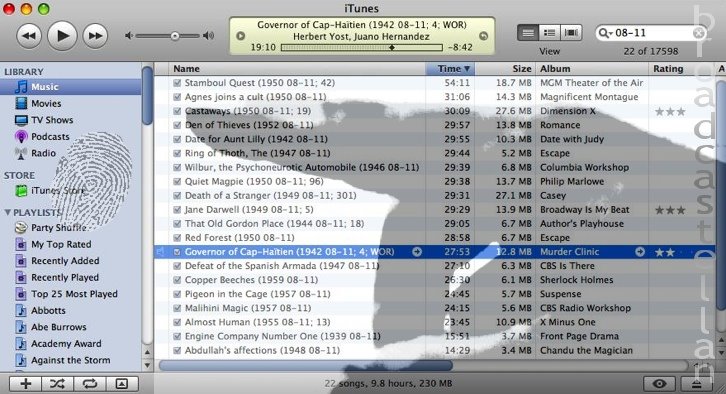
On this day, 11 August, 1942, the name Poggioli reverberated in the halls of the Mutual network’s Murder Clinic, itself a by now forgotten institution set aside for the keeping alive of fictional criminologists, if only in the memory of the public. Owing to the efforts of Mssrs. Ellery Queen, who kept publishing Stribling’s stories, Dr. Poggioli still had the benefit of a pulse; but his circulation had been healthier in the 1920s. In the Clinic, Poggioli was somewhat feebly resuscitated by one Herbert Yost, an actor known as Barry O’Moore before pictures and radio began to talk. During his encounter with “The Governor of Cap-Haïtien,” Yost kept stumbling over his lines as if he had come across them for the first time in the very moment they crossed his lips.

His name notwithstanding, the Clinic‘s Poggioli is equipped with little amounting to personality. Heard in the more memorable title role, a black governor beleaguered by the practitioners and believers in voodoo, is character actor Juano Hernandez (whom I recently saw in Trial and Ransom!, two thrillers starring Glenn Ford).

The governor was “quite a guy,” the host of Murder Clinic commented at the conclusion of the broadcast, set aside for a brief interview with the “Voodoo inspector.” “If you don’t mind my saying so,” the man from the Clinic remarked, “I think we should have had him here instead of you.”

Now, I’m not sure whether that trip to the Clinic did Poggioli any good; but a mere six weeks later he was back on the air in ”A Passage to Benares” as dramatized on Suspense (23 September 1942). On that occasion, Paul Stewart infuses him with some vigor, even though Stribling insisted on drugging him and had something altogether different in mind than the character’s well-being, as becomes apparent in the story’s startling conclusion.

As is often the case, the radio served as an introduction, however dubious, to an author and his creation. I followed up the listening experience with the perusal of the first Poggioli story I could lay my hands on. Originally published in 1932, “The Cablegram” was reprinted in the aforementioned anthology Rogues’ Gallery, which previously introduced me to another forgotten pulp hero by the name of Thubway Tham. It was while reading “The Cablegram” that I appreciated Stribling’s creation, his irony and humanity: “[T]here is no tyranny so inescapable and so difficult to prove as that of the police department,” Stribling permits the ostensible villain to proclaim as he outsmarts Poggioli and gets away with it, along with his crime.

Radio did not exactly give detective fiction a bad name, even though it was often accused of doing just that. It was more successful at heralding and advertising than in creating well-crafted whodunits. Provided those amateur sleuths and private eyes had made a name for themselves in print, radio could do much to keep it (or its author’s) in the public ear.

Stribling’s own voice was heard at least once on the air, as you may glean from this clipping. Such promotional efforts are more effective than any good word I could put in here for anyone or thing. Even so, I shall go on flinging those slippery handles into the air, the very element that once turned them into household names. In the days and weeks to come, I am going to concern myself with the more obscure titles in my newly restored library of recordings; that is, with plays, playwrights and personalities as yet unnamed in this journal.

Meanwhile, for another one of Stribling’s radio-readied tales, I refer you to ”Green Splotches,” as adapted for Escape and broadcast on 31 March 1950.

A Fine Kettle of Fish

My visit to Canajoharie

These past few days, I’ve been trying to keep my eyes shut—as if the medication had not already made it well-nigh impossible to keep them open. The more they are watering, the more inflamed they get. And what with all this gasping for air, I hardly feel in my element. Allergies. My mother used tell me they are just a state of mind as she insisted that I mow the lawn—which is one reason I have not laid eyes on her in about two decades. State of mind, my bloodshot eye! Anyway. If I am not reaching for tissues or fishing for the inhaler, I am digging into my library of radio recordings, which I am spending an inordinate amount of time cataloguing. Otherwise, I would simply lose sight of what I have yet to hear.

Our Freedom’s Blessings was one of the titles to which I never gave a thought, let alone lend an ear. Lending a hand in its return to the air—or its turning up on the internet—turned out to be somewhat of a headache. So be it. After all, there is little use and less joy in going on about something without giving anyone else at least half a chance to follow.

My visit to Canajoharie

Little is known about Our Freedom’s Blessings, other than that it was produced by the New York State Department of Commerce. No recordings of it are currently available online. So, I set up a new site for the sharing of programs [now defunct].

Since the crash of my last Mac back in November 2007, I have been unable to edit my old pages; and, itchy eyes notwithstanding, it is only now that I can face the prospect of starting from scratch. You might well argue that an episode of Our Freedom’s Blessings titled “The Little Jars of Canajoharie” was not worth all this effort. Ah, but have you been to Canajoharie?

As Uncle York, the narrator of Our Freedom’s Blessings tells us, Canajoharie is an Indian name meaning “the kettle that washes itself.” The “little town with the funny name,” we learn,

lies smack in the middle of the Mohawk valley.  In 1890, Canajoharie was hardly more than a crossroads, still half country.  Well, it was a leisurely kind of life, quiet days of wagon wheels on dirt streets, the tingling smell of hickory smoke in a cow crossing in the main part of the town.  But Canajoharie folks wasn’t asleep.  Far from it.  Couple of fellas that smoked their own hams and bacon started to sell them to other folk.  And before you knew it, there was a full-fledged little company operating, one that took for itself a homespun kind of name: Beechnut.

Well, we did not listen to Uncle York on our travels through upstate New York when we happened upon Canajoharie—after an unwelcome detour—and that despite the fact that the Mac on which the recording is stored went along for the ride. Had we done so, we might have learned a little something about the fortunes of the town. We did insist on seeing the “kettle,” not heeding the warnings of a local that it was little more than a hole in the ground.

Equipped though we were with hand-drawn map handed to us at a tourist information booth that suggested we were not the only ones eager to seize the opportunity to gawk at a pothole, we did not encounter anyone else on along the way on that warm June morning. We got lost, passing derelict factory buildings and warehouses that bespeak the town’s heyday, the days of which Uncle York speaks.

When I came across the name of “Canajoharie” in my recordings library, I just had to tune in. Never mind that “Little Jars” turned out to be little more than a juvenile infomercial about the makers of baby food. Somehow, whatever flotsam drifts toward me on the airwaves seems to belong in my life. It is never an altogether different kettle of fish.

The Earl Next Door

Montague, our Jack Russell terrier, had a visitor this morning. A sheepdog from the neighboring farm took time off from her daily chores and made her way up the lane to our cottage. A mere quarter of a mile—but what a giant leap into the lap of relative luxury. I wonder about the old lass. You can tell by her coat that she isn’t a pet; she’s strictly the below-stairs kind of gal. And that would be the front steps. No lounging around in the conservatory at all hours of the day, no ball games in the garden, no treats from the table, no trips to the beach. If she weren’t dead tired from doing her work, she might be daydreaming about how the other half lives. Perhaps, that is what did in the last dog who held the job. The poor thing was run over by the tractor under whose wheels it rested. Shades of Thomas Hardy.

I was reminded, too, of Norman Corwin’s “association” with Nick, an English setter who “lived down the hill,” but, having had a “falling out with his owners,” insisted on being taken care of and paid attention to elsewhere. That same “Grand Hotel of fleas” achieved the next best thing to immortality in Corwin’s radio play “The Odyssey of Runyon Jones.” Our neighbor’s sheepdog, on the other paw, was rather less demanding. After an hour’s visit, she went dutifully back down the hill. Now it is Montague’s turn to dream about that life beyond the fence. . . .

Entire industries are devoted to reminding us that the grass is greener elsewhere, to sowing the seeds of discontent and to suggesting we’d settle for a pair of binoculars and a box of weed killer to improve our lot. In this racket of showing us the other half and telling us that, with some slight and low-priced adjustments, our own ain’t half bad, the quarter-hours known as soap operas take the booby prize. Some fifty, sixty years ago—but at just about the time of day that Montague was entertaining his not-a-lady friend—a string of tangled yarns like Our Gal Sunday would roll into America’s kitchens and living rooms, or wherever radio sets were positioned and tuned in for that chance at a ready-made getaway.

“Sunday,” as James Thurber put it, “started life as a foundling dumped in the laps of two old Western miners” but managed to move on up to become the “proud and daggered wife” of “England’s wealthiest and handsomest young nobleman.” Was it safe on the other side? Was it wise to make that leap? According to Thurber, that was a question asked by most of the so-called washboard weepers:

Can a good, clean Iowa girl find happiness as the wife of New York’s most famous matinee idol? Can a beautiful young stepmother, can a widow with two children, can a restless woman married to a preoccupied doctor, can a mountain girl in love with a millionaire, can a woman married to a hopeless cripple, can a girl who married an amnesia case—can they find soap-opera happiness and the good, soap-opera way of life?

The answer, of course, was a resounding “no.” The denizens of “Soapland” remained “up to their ears in inner struggle, soul searching, and everlasting frustration.”

Sure, we’ve all got those. I’m never sure, though, just what the other half might be for me. It’s not that I know my place; I just came to know a lot of places. What is the use of an elusive realm of otherness to a squarely queer working-class boy with a PhD, a cottage in the country, and a suitcase that is always half full (or half empty)? I am either here or there, and the elsewhere is neither here nor there to me. I guess I’m just not prone to nostalgia.

Meanwhile, on this partly cloudy afternoon, my better half and I are off to spend a night at Powis Castle. We won’t flop in the recently restored state bedroom, mind you, but in the timbered cottage to the right of the Welsh fortress once known as “Y Castell Coch” (“The Red Castle”). Further to the right is where the present Earl of Powis resides. So, I am spending the night between the riches amassed by the aforementioned Clive of India and the home of a demoted nobleman. Our Gal Sunday and her kind can take a half-day . . .

Twice Behind the High Wall; or, It’s Not the Sane on the Radio

Every once in a while I catch a sound and solid studio era thriller that has heretofore escaped me. One such welcome find is the Curtis Bernhardt-directed High Wall (1947) starring the dark and deadly serious Robert Taylor as an amnesic who finds himself in an asylum for the criminally insane for a murder he may or may not have committed. Initially refusing treatment for fear of having his guilt confirmed along with a sanity that could prove the death of him, he is soon faced with evidence convincing him that he is not beyond hope and sets out to mount the titular structure and leave no stone unturned in an attempt to emerge a free, upright man and levelheaded parent.

In this process of tearing down the wall that silences him, Taylor’s character is supported by a member of the staff (Audrey Totter), but all the while impeded by the to him unknown schemer who laid those bricks and is determined to make them insurmountable (Herbert Marshall).

In the architecture of High Wall, the three figures operate with the predictability of trained mice. We know—and are meant to know—that Taylor is innocent, that Totter will be so unprofessional as to confess her love for him, and that Marshall has erected the High Wall to cover up his own guilt. Knowing as much makes us the privileged observers of a neat and well-staged rehabilitation drama, a character study of the three mice in a maze that begins to crumble and lose some of its high tension only after the wall has been taken. A solid suspense drama, nonetheless.

Suspense. That is precisely where I had previously hit upon this High Wall, or, as it turned out, some rudiments thereof. The title rang a bell loudly enough to make me check for such a radio connection. Produced on 6 June 1946, eighteen months prior to the release of the film, “High Wall” presents a similar situation but an altogether different outcome.

Both radio version and screen adaptation were based on a story and play by one Bradbury Foote (the motion picture also credits Alan R. Clark). Subsequently, the film that was a radio play that was a stage play and story was reworked anew as a radio play. Starring Van Heflin and Janet Leigh, the remake was soundstaged in Lux Radio Theater on 7 November 1949.

Unlike, say, Sorry, Wrong Number, the property remains sound whether it is thrown onto the big screen or pulverized into thin air. Nothing about the motion picture suggests that what we see has been remodeled from a stage set; likewise, the radio play is so much in keeping with the Suspense formula that it might well have been an original radio drama, written especially for the series.

Those at work in structuring and reconstructing both High Wall, the film, and “High Wall,” the radio play, clearly understood the limitations and potentialities of the media for which the product was headed. Whatever his initial idea, Foote did not insist that his words were written in stone.

So, rather than arguing which version is superior, I noted the differences between the Suspense drama and the screen thriller. On the air, the story is decidedly more noir than on the screen. It is more concerned with the demoralizing than with morals; less involved in the cure than in the kill. It draws us in, behind that wall, without signaling a way out. No outline of romance and redemption; no hope foreshadowed. Just the shadow of which we are puppets.

Whereas High Wall is concerned with a man’s struggle to clear his name, “High Wall” deals with a man who barely remembers it. That he is telling us his own story does not make him any less suspicious. Why did he end up in an asylum? Or is he merely stonewalling? We need to know that before we can feel at ease about taking his side.

The omniscient film narrative provides us with a villain whose workings are clear to us before they become known to the main character. In the radio play, we don’t know any more than an apparent amnesiac whose mental state and progress are uncertain. As it turns out, what he doesn’t know might just kill you!

Thank you for being . . . Sophia Petrillo

Today, 25 July 2008, would have been the 85th birthday of Estelle Getty, who passed away last Tuesday. Since I was unable to share my thoughts here on that night, I shall do so now. The actress was on my mind that very night, before I even learned about her death. There is nothing uncanny about that, though. I often think, talk about—even talk like—Ms. Getty and the Girls. As I have related here previously, I owe much to Getty and her memorable television character, the feisty octogenarian Sophia Petrillo. To commemorate the anniversary of her birth, I have been going through old diaries to determine just when Sophia entered my life.

Picture it. New York City. The summer of 1989. I was on a six-month visit designed to delay my return to what I feared might be a lifetime of office work for which I, despite a three-year apprenticeship, was entirely unsuited. It would take nearly another year before I finally found the nerve to pack my scant belonging and move to Manhattan. Anyway. The Golden Girls were already in syndication when, staying at a friend’s place, I happened upon the series one morning while channel-hopping onto the fledgling Fox network.

I was unaware then, but nonetheless sensed, that Getty was a gay icon. She had played Harvey Fierstein’s mother in Torch Song Trilogy. Sophia wasn’t quite one of the Girls, who went off with their assorted beaux, shopped for condoms at the supermarket, entertained a lesbian friend, a closeted gay brother, or faced an Aids scare in their very midst. There was hardly room enough for that “fancy man” of a cook in Blanche’s kitchen, even though he, according to Sophia, was “an okay petunia.” Initially, I even mistook Bea Arthur for a drag queen.

While at the very center of it all, the Sicilian spitfire was, for the most part, a bystander who poked fun at the crazy going-on around her. Unless, of course, there was a Japanese gardener around, or Cesar Romero stopped by. “I’m tired of being the Tonto of the group,” she complained. She was like me, in that respect, wanting to be one of the girls.

So, I woke up to those Girls every weekday morning, week after week, and learned about American culture, about Jerry Falwell and Harvey Milk, about Tammy Faye Baker and Anita Bryant. I will surely “sehr vermissen” the Girls when I’m back in Germany, I noted in my diary on 14 September, shortly before my return to the stultifyingly bourgeois world I was at once desperate and terrified to leave behind.

I recall the first time I got one of Sophia’s zingers. I was learning English back then and struggled with those one-liners, with words not in my pocket dictionary and proper nouns for which I had no image in my head, over which went many of the cultural references for the appreciation of which today’s viewers, like me back then, require a few footnotes. It was easier for me to pick up the odd noun watching Family Feud, which I did.

Zsa Zsa Gabor, after all, was still enhancing her dictionary by following the spinning Wheel of Fortune. The words and phrases I picked up watching the girls were far more rewarding than those to be gleaned from whatever “survey says.” Slut. Yutz. Queen. Botchagaloop? And “Floozy.” Inexperienced as I was, I lived in constant hope of warranting such a moniker one day.

“Get some Windex!” Sophia exclaimed. It was her response to the vain, delusional, middle-aged Blanche, who thought it was “just like looking in a mirror” to see her niece, an oversexed adventuress half her age. Luckily, I had just come across a bottle of Windex somewhere in the bathroom cabinet while trying to get the thick coating of Aquanet from the floor to which my socks had gotten stuck. In my native Germany, references to commercial products were not permitted, which made the sarcastic remark all the more startling and memorable to me. Not permitted? That woman could say just about anything! And did. Ahh, to have her mouth, I thought. And that perfect excuse for saying anything you like.

Watching the Girls at times takes me back to those days in 1989, when I was anxious to arm myself with a few choice words from Sophia so as not to be tongue-tied when confronted with the wolves roaming the Big Potato (okay, that was Rose). New York wasn’t Disney World back then. I can still “picture it.” Batman and Indiana Jones ruled the box office, an African American Democrat was about to make history by taking office, and I was glad not to be stuck in an office. Hey, it’s like looking in a mirror. I know, I know, “Get some Windex!”

Scotland Backyard

Right now, there are some 17,500 files in my iTunes library, ranging from 2 ½-hour productions of Shakespeare’s Cymbeline and Tom Stoppard’s Rock ‘n’ Roll to clips of speeches by Himmler and Goebbels.  I was a little concerned about those speeches when last I traveled to the US.  Just days prior to my departure, it was announced that, outrageous as it sounds, the US reserves the right to inspect any laptop and download its content for inspection.  What might those Nazi soundbytes have told some officious, uniformed ignoramus about myself, my politics, and my objectives once on American soil?

Anyway, I don’t even know just what kinds of trash or treasure are stored in my archive of sounds, given the vast number of recordings on my hard drive.  Most of these files I assume to have little or no connection to my everyday life here in Wales.  Much of it is commercial and, commercials aside, rather generic pulp.

Last weekend, though, while going through and editing those titles in my library, I came across a surname of a character in a thriller program that reminded me of a framed drawing on display in our living room.  How strange it seems, pulling the blinds in the morning (if I get up that early) to be looking at the image of an axe murder; but there he is, the notorious Buck Ruxton, right before my eyes whenever I glance to the left of our view of the Welsh hills.  And there he is again, in my virtual library, alongside Our Miss Brooks and The Lone Ranger.

The play in question was produced in the late 1940s or early 1950s as part of the syndicated series The Secrets of Scotland Yard.  It tells of an Indian physician who murdered his wife and chopped her into what the narrator describes as “two hundred all but unidentifiable parts.”  When last I was up in Lancaster, the English town where the not-so-good doctor lived and practiced, I even came across a pub named after him.

Now, we happen to have in our collection two of Eric Fraser’s original ink drawings for the “Case of the Jealous Doctor,” an article about the Ruxton case that was published in the 12 November 1949 issue of Leader Magazine.  The case itself dates back to 1935.  Fraser, as you can see, relished in the sensational character of the murder and the trial, but, unlike the producers of Secrets of Scotland Yard approached his commission with a wry, dark sense of humor.

Listening to the dramatization, I was amazed just how minutely the murder—its background, execution, cover-up and detection—was being reconstructed.  To be sure, it features one of the worst impersonations of an Indian, which is about as sensitive as the Leader article in its claim that, “behind” the Ruxton case “lay the failure of an Oriental to adapt himself to the Western world.”  In other respects, though, the writers and producers of the radio play seem determined to be as painstakingly accurate as possible.

I don’t suppose any American listener to Secrets (produced in Britain, but sold to international markets) would have appreciated this kind of attention to historical, regional detail.  Nor would I, had I not heard about the murder after being subjected to the image.  I would have assumed this radio play to be just another piece of sensational melodrama whose kernel of truth is drowned in a bucket of blood.

Most of all, though, I marvel at the link between the drawing and the recording.  Perhaps, I am still compartmentalizing my worlds too much, keeping apart what is distinct yet kindred.  I strikes me that, whatever subject you pursue, whatever object you admire, remote it may seem from your present surroundings (an apartness, perhaps, that attracted you to the subject to begin with), should not be assumed to have no relation to your everyday.

Sometimes it takes more of an effort to make the connection, and sometimes the efforts seem not worth your making; but every so often (as in this instance, or the time we went in search of a rock in a painting that now hangs in our bedroom or spotted that actress in a Hitchcock movie whose likeness we have on a piece of paper), you—or, I should say, I—get this thrill of being able to relate to an artifact in unexpected, even intimate ways.  It is then that I most appreciate the work of all those nameless or forgotten artists, writers, and researchers engaged in producing what you might dismiss as impersonal or workaday . . .

Blood, Sweater Girl, and Tears: “A Night with Johnny Stompanato”

I’ve just been tuning in to “A Night with Johnny Stompanato,” an original radio play by British director-playwright Jonathan Holloway, which you may access via BBC’s iPlayer until 18 July 2008. Based on “real events, newspaper reports, and FBI files from the years 1957 and 1958,” this hourlong docudrama recounts a sordid chapter in the life of screen legend Lana Turner, whose teenage daughter, Cheryl, stabbed to death the titular character, the star’s possessive mobster boyfriend. “Real events?” Turner purrs. “Yeah, I guess. Personally, I’ve rarely met a man who could tell the truth when a lie would do.” So, this time around, Lana gets to tell her own story. With us, the radio audience as jury, she is going to court for us—which is to say, she’s going to court us—all over again.

Can Turner give the performance of her life now that her own life is at stake? Let’s be frank, the former Sweater Girl was neither known for her realist acting nor for her vocal talents, as I previously remarked here. Tuning in to Turner is not likely to make you turn on to her. There wasn’t enough “It” in her timbre to make Lana’s figure appear before your mind’s eye as you listen to Suspense thrillers like “Fear Paints a Picture.” In this Imitation of Lana, Laurence Bouvard is ably substituting—and, I found, vocally improving on—the departed screen icon, who never sounded as confident behind the microphone as she looked in front of the camera. You might say that Bouvard sounds more convincing than Turner—even though, to me, “the real Lana” has an oxymoronic ring to it.

Now, my days of thrilling to trash like Hollywood Babylon are long gone, as are my experimentations in hairstyles inspired by Lana’s late 1950’s coiffure. Still, I was looking forward to this racy little number. Unfortunately, it turned out to be rather dull—which is quite a feat, considering the material.

On the face of it, “A Night with Johnny Stompanato” is not unlike one of those femme fatale yarns produced by Suspense, in which tough-talking dames give you the lowdown on a crime they were involved in, until the first-person narration makes way for a dramatization of past events. In short, the past becomes present at pivotal moments in the story. The same formula is used by Holloway, except that the playwright dramatizes the court scenes, which in themselves are retellings, with Turner commenting on the proceedings. In other words, he lets the leading lady attest too much, so that we are told what has happened rather than permitted to overhear it.

One of the most dramatic moments of “A Night with Johnny Stompanato” involves Turner, then shooting Another Time, Another Place in London, attempting to have her increasingly violent lover deported. From her dressing room at the studio, Turner calls Scotland Yard but, “as bad luck had it,” Stompanato was trying to reach her “at the same time.” Sorry, Wrong Number came to mind; but that was my mind, not the playwright’s. Instead of dramatizing this potentially thrilling call, Holloway has Turner recall it for us in retrospect:

The dumb English broad on the switchboard opened the line for him, and he listened in on everything I said to the police. The detective put down the phone, and John’s voice came straight out of the earpiece. I practically dropped dead on the spot.

The dropping dead, though, is acted out for us, with prolonged gurgling and some heavy breathing. Stompanato’s silencing comes as a relief. As impersonated—or caricatured—by John Guerrasio, he sounds about as charming and enigmatic as Allen Jenkins.

“You know,” Turner confides in us at the conclusion of her report,

the most amazing thing about the whole Johnny Stompanato business? That I didn’t learn from it. Just kept right on getting involved with men . . . and having a really bad time getting uninvolved. I never learned from my mistakes, which, I am told, is what makes us different from the animals. Nope. I just kept right on making them.

The same goes for radio playwrights, I suppose; “instead of being dramatic, with action in the now,” aforementioned writing instructor Luther Weaver complained about 1940s radio serials, their narration “offers a post-mortem on what already has happened.” Don’t get me wrong. I am grateful to the BBC for trying to keep radio drama alive (a new adaptation of Cheever’s short story “The Enormous Radio” is being broadcast on Wednesday); but, as “A Night with Johnny Stompanato” demonstrates, dialogue alone does not constitute drama. There’s more tension in one of Lana’s discarded sweaters.