Mr. Benny Gets the Key to Baldpate

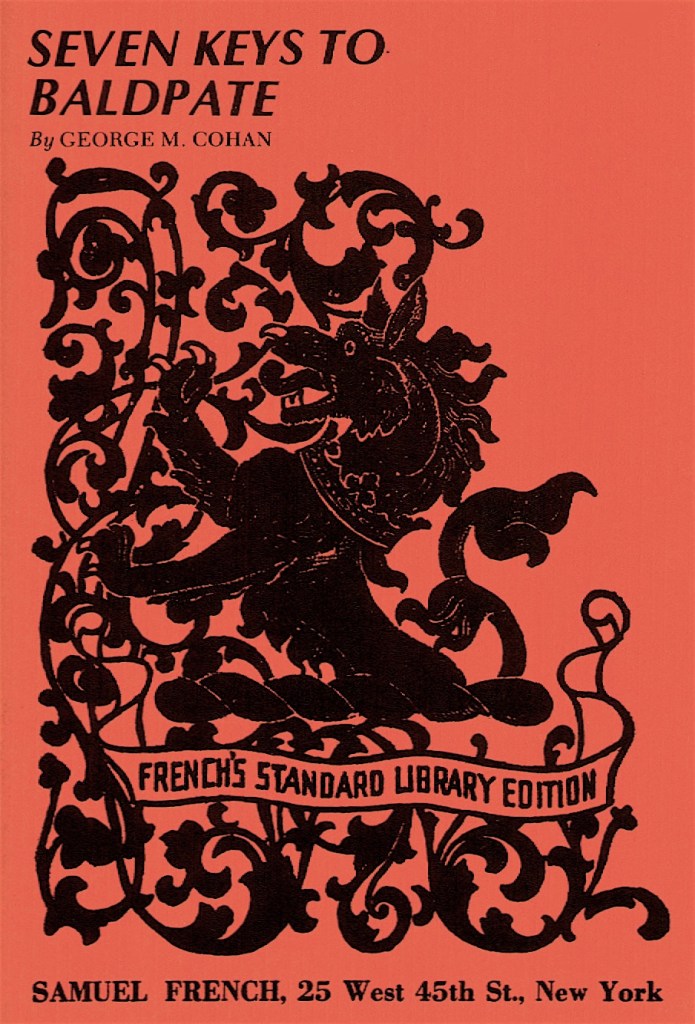
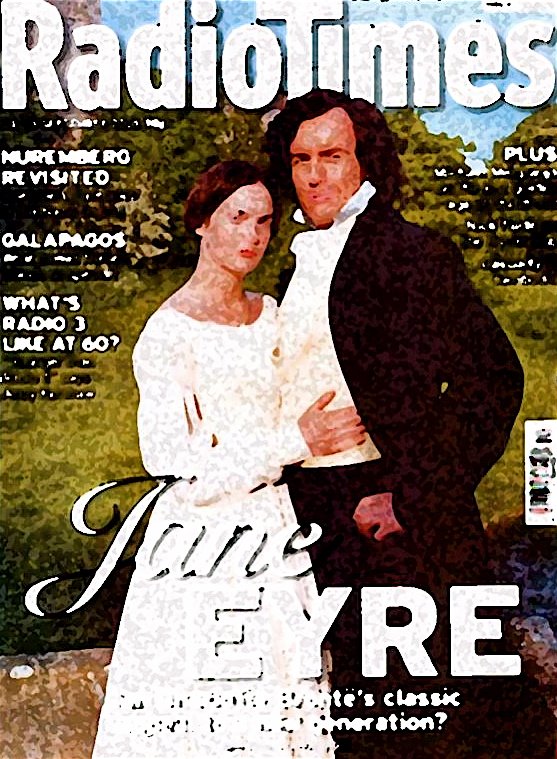
Well, I feel rather less prickly than yesterday. My cold seems to be on its way out and, having spent some time out of doors in the warmth of the autumn sun, I feel somewhat more serene and benevolent. Speaking of doors (a transition more creaky than the farce I am writing about today): Having complained previously (and elsewhere) about the conventional and therefore superfluous adaptation of Jane Eyre now flickering in weekly installments on British television, I am going to mark the anniversary of a decidedly more inspired variation on what was once a similarly familiar work of fiction, Seven Keys to Baldpate, a crowd-pleaser that was revived for radio on this day, 26 September, in 1938.

Granted, it is easier to rework a piece that does not warrant the reverence befitting a literary classic such as Jane Eyre, a respect that can be artistically stifling when it comes to revisiting or revising what seems to demand fidelity rather than felicitous tinkering. A mystery novel conceived by Earl Derr Biggers, the creator of Charlie Chan, Seven Keys opened many more doors after going through the smithy of theater legend George M. Cohan. Unlike Biggers, Mr. Cohan did not play it straight, but turned the thriller into what he then sold as a “Mysterious Melodramatic Farce”—starring himself.

In Cohan’s farce, the thriller writer Bill Magee accepts the $5000 challenge of a friend who dares him to pen a novel within twenty-four hours. To achieve this, the author is being given what he believes to be peace and quiet—the only key to a remote resort shut down for the winter.

During his night at Baldpate Inn, the supposedly single guest is disturbed by an assortment of singular strangers, lunatics and villains, until his friend shows up to confess that the bizarre goings-on were a practical joke designed to illustrate the ridiculousness of the author’s improbable plots. The epilogue of Seven Keys discloses, however, that the action of the play was a dramatization of the novel Magee actually managed to complete that night. He won the wager by fictionalizing the challenge.

Opening on 22 September in 1913, the play became an immediate and oft-restaged favorite with American theatregoers. It was subsequently adapted for screen and radio. When, some twenty-five years after its premiere, the producers of the Cecil B. DeMille hosted Lux Radio Theatre got their hands on this potboiler, they slyly revamped it as a commercial property fit for the latest medium of dramatic expression.

In his introductory remarks, DeMille promises the listener a “special treatment” of the play—and that, for once, was no overstatement. As I have discussed at length in Etherized Victorians, my study on old-time radio, the broadcast revision is not so much a rehash as it is an media-savvy update of the original.

Whereas Cohan’s version celebrates the victory of popular entertainment, of readily digested pulp fictions churned out for a quick buck, Lux writer-adaptor George Wells transforms Seven Keys into a radio story—a story about radio that parodies the anxiety of former vaudevillians-turned-broadcast artists to achieve lasting success, to be remembered long after the shows in which they starred week after week had gone off the air—to become cultural icons despite their invisibility. And those keys to uncertainty were handed to the man who had been through it all and stayed on top by knocking himself down, fall guy comedian Jack Benny.

Instead of a successful novelist, the artist now up for a crazy night at Baldpate is Jack Benny, as “himself,” a frustrated thespian who accepts the challenge of developing a suitable dramatic vehicle for himself after having been turned down for serious dramatic parts time and again. Benny’s challenger is no other than Mr. DeMille, who, in a rare stunt, not only introduces and narrates the play, but acts in it, and that without having to drop his director-producer persona. Throw in a few Lux Flakes and it comes out a clever bit of promotion all round.

The unpretentious yet self-conscious reworking of a play as old hat as Baldpate into a comment on the recycling business of radio entertainment—and a demonstration of how to lather, rinse, and repeat successfully—is one of Lux‘s most ingenious and engaging productions.

Eyrebrushing: The BBC’s Dull New Copy of Charlotte Brontë’s Bold Portrait

Well, I could blame it on the medication. Or it might be this holiday souvenir of a cold that is dulling my senses. I sure haven’t been able to savor my meals lately. So why should I thrill to yet another warmed over helping of Jane Eyre, a story I have read, written about, and taught, that I have heard and seen more often than any other work of English fiction? Why should anyone get excited about such a much chewed on and oft-reconstituted chestnut? Save college students, perhaps, who may take the BBC’s new television production as an occasion to keep their assigned editions unopened and to watch the plot unravel in four readily digested hour-long installments. If I sound cantankerous, it is neither bronchitis nor Ms. Brontë, I assure you: it is Sandy Welch’s bland rehash of one of the most daring and delicious growing-up stories ever concocted.

So, what’s wrong with this version, apart from production values and camera work reminiscent of 1970s television, apart from plain Jane’s sculptured eyebrows (brought to the job by Rossetti-lipped Ruth Wilson) and swarthy Rochester’s Darcyish looks (courtesy of Toby Stephens), apart from its skimming of some ten chapters (or eight years) and the half-hearted rendering of the novel’s relished if easily overcooked gothic mystery? Perhaps I had expected something rather more dynamic and radical after last year’s sensational adaptation of Bleak House.

Jane Eyre, to be sure, is not a Dickensian novel. It does not depend on bathos and caricature to elicit our responses; it relies instead—and succeeds in relying—on the intimacy of its portrait, the self-portrait of an inexperienced, self-conscious young woman who is given a voice to tell her tale.

That was radical in 1847—and it is still remarkable today, despite millions of blogs reveling in or bogged down by the mundane. Indeed, readers of Brontë’s pseudonymously published tale wondered whether this was fiction at all, or whether it was, perhaps, a thinly veiled if highly romanticized version of a real governess (in the employ of Mr. Thackeray, perhaps?). They wondered, too, whether this story was penned by a woman, considering its frank account of a socially unequal and as such questionable relationship.

Adaptations of Jane Eyre—any reworking worth our while—should make an effort to recreate this sense of realism, which is not found in the novel’s gothic situations, in the screaming but otherwise voiceless character of the presumably mad, Sargasso Sea-swept Bertha, in the fire that consumes Thornfield Hall and temporarily blinds its owner, or in the telepathic connection that reunites a mature Jane with her now helpless and emasculated master. The realism lies in the first-person narration, in the observations of a woman who has the nerve to tell her story, a story of teenage angst filled with humiliation, unease, and doubt. In short, a real story.

Voice-over narration, so closely associated with film noir, assists viewers to reach where the novel invites us to go: under the surface of conventions, beyond appearances, and as straight as Victorians could possibly permit themselves to pry into the heart and mind of a woman whose story is taken from her once she is not permitted to tell it herself.

Even radio, the medium best suited for the exploration of Jane’s mind, often resorted to an omniscient narrator such as this one by Walter Hackett, as performed in the US by the Yankee Players and broadcast in the early 1950s over the Yankee-Mutual Network:

The courtyard of the King George at Millcote is deserted with but the exception of the young girl standing at the entrance. She shivers as the rawness of the late November afternoon strikes through her thin cloak. Suddenly the door of the inn opens and a large-boned, powerfully-built, sullen-featured woman walks across the cobblestones toward the young girl.

It is time to return the story to that “young girl”—or leave it with Charlotte Brontë, who tells it so well. So, would-be dramatists of radio, film and television, take heed: let Jane Eyre speak up, or shut up!

On-the-Air Travel: Meeting A Man Named Jordan at the Café Tambourine

Well, I am off to Istanbul tomorrow; and instead of studying my travel guide or practicing my language skills for the inevitable bartering, I am once again delving into popular culture for some dubious impressions of my destination. Earlier this year, I picked up Daphne Du Maurier’s Jamaica Inn to learn about Cornwall. I shall probably comment on that reading experience later this fall, considering that I recently found a contemporary article on the release of the film version starring Maureen O’Hara. Last summer, I watched Charlie Chan in Eran Trece to prepare for my trip to Madrid. Once again, I learned little and ended up eating tapas for a week.

Tuning in for some make-believe Turkish delights as offered to American radio listeners in the 1940s and early 1950s, I had my share of unreliable travel companions. I would have enjoyed going astray with Marlene Dietrich in her radio adventures at the Café Istanbul. Yet unlike its follow-up, the globetrotting romance Time for Love, the Café is no longer open for inspection; nor was it located in the city from which it took its name. A Man Called X (played by wooden-legged Herbert Marshall) ventured to Istanbul on at least one occasion and there is an episode of The Chase called “Flight to Istanbul.” The most obvious choice for some Istanbul escapes, however, is A Man Named Jordan, the serialized precursor of the episodic Rocky Jordan adventures.

Starring Jack Moyles and airing from January 1945 to April 1947, A Man Named Jordan took listeners to the Café Tambourine, which was initially located in Istanbul before being relocated to Cairo. That alone should suffice in answering any questions about the authenticity of such adventures set in a world gradually becoming open once more to tourists, rather than the military. That it was still an uncertain world seems to have been exploited by the spy thrillers of the day, cloak and dagger adventures that not so much romanced the world as relied on and fostered the audience’s suspicion of foreign places.

“In those places in the world where intrigue and danger still go hand in hand, where death and disaster are the rewards of weakness—in such places will be found, A Man Named Jordan,” the announcer-narrator introduced each installment. The location was as easily set as it was later changed. In those early days, Jordan’s establishment, the Café Tambourine, was to be found in “a narrow street of Istanbul’s Grand Bazaar not far from the Mosque Valide Sultan.” The Bazaar, more Byzantine than the plot of the serial, was established some five hundred years before Jordan opened his fictional Café there, a hazardous locale “clouded with the smoke of oriental tobaccos, crowded with humanity, alive with the battle of many languages.”

No doubt, I am going to have my share of linguistic challenges and will fail as miserably as on my trip to Morocco many years ago to negotiate the streets or haggle with the peddlers with dignity and success. Once back at the hotel Tash Konak, I shall pick up my iPod to compare notes with Rocky and that Man Called X before filing my report at the end of next week.

Where Silent Partners Join for Noisy Crime

White trousers may be out of fashion; but there are still a lot of ways to tell that summer is officially over. And I am not even talking about the mist rolling in from the Irish Sea this afternoon. After all, I am reporting from New York City, even though my reports are filed a few weeks late and some three thousand three hundred miles away.

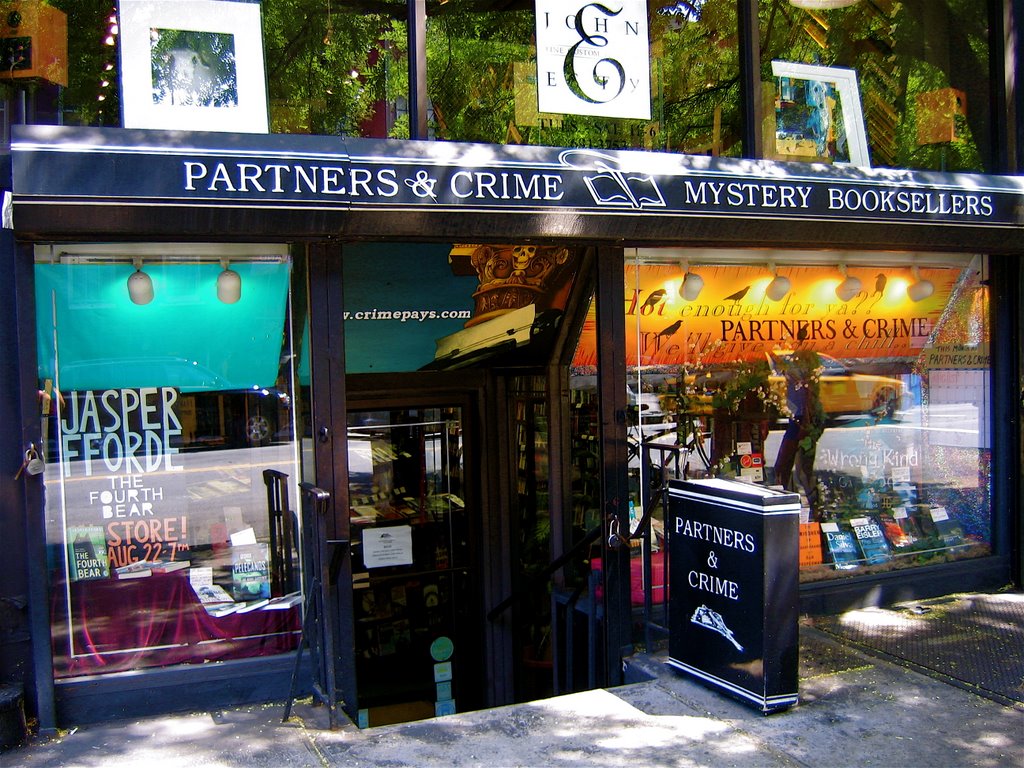
In the United States, the summer season traditionally ends on the first weekend in September, a time when millions of college students abandon beaches for bookstores and a certain band of players reclaims its space behind the shelves. Unlike those students I used to teach during my ten years of adjunct lecturing in the metropolis, the W-WOW! troupe only frequents one exclusive—if academically less than sound—venue: the Partners & Crime bookstore in the West Village.

Ever since the mid-1990s, when the city that presumably never sleeps still bore a slight resemblance to the bawdy and raucous town it had been before naps (and a lot else) became mandatory or derigueur, the W-WOW! players have been gathering on the first Saturday of each month (summer excepting) to re-enact the cases of Sherlock Holmes, Harry Lime, Philip Marlowe, and The Shadow as they were heard on US radio during the 1940s and early 1950s. You know, those days when the city had so much character to spare that a shadier one of it could be knocked off and tossed into the East River without causing more than a RIP-ple. Those days when the city was divided into distinct and clashing neighborhoods rather than being homogenized for the purpose of corporate milking. Those pre-television days during which keeping ones eyes shut to the world to share an imagined one was a national pastime rather than a geo-political hazard.

Anyway. Partners & Crime is a terrific store, one of the few sites that somehow managed to withstand the pressures imposed by chains like Borders or Barnes and Noble. One day, when the millennium was still very young and terrorism something that, from an American perspective, happened mainly to people in Europe and the distant Middle East, I discovered that Partners & Crime had become somewhat of an old-time radio institution—without ever going on the air. In short, it was an intriguing anachronism in a town about to trade in its past for clean facades and the promise of crime-free streets. I’d rather look at the scar above my left eye, dating back to a nightly stroll anno 1989, than walk what now goes for 42nd Street. But, back to fictitious felonies . . .

I was probably browsing for an old copy of Seven Keys to Baldpate or some such chestnut brought to light in my dissertation, when, much to my astonishment and joy, I spotted a microphone at the back of the store. As it turned out, there was an entire studio in the tiny, windowless backroom, a space modelled after station WXYZ in Detroit, as the playbill informed me.

I don’t suppose the goings-on behind the shelves do much for the sales at Partners & Crime. I, for one, immediately forgot all about the volumes around me and inquired about the microphone and its purpose. I was thrilled to learn that it was not set up for a reading of a contemporary crime novel, but for some old-fashioned radio mystery, to be performed for the benefit of a small group of theater-of-the-mind goers who eagerly squeezed into this nook beyond the books. I joined them, of course.

The W-WOW! players recreate old-time radio thrillers—commercials ‘n all—by placing their audience inside the make-believe Studio B of the equally imaginary W-WOW Broadcast Building. It may not further or elevate the art of radio drama and be done largely for camp (a way of misreading I can do without); but watching the performers as audiences once watched live broadcasts over at Radio City is nonetheless an enjoyable experience, particularly if you happen to eye the sound effects artist eager to elicit a few laughs while playing to the onlookers.

It is unfortunate that the W-WOW! troupe, unlike the Gotham Radio Players, do not go on the air to put their skills to the ultimate test of prominent invisibility. Theatrical training insures that some of the voices are fit for radio; and the actors are passionate even when the scripts are ho-hum. One among them, a certain Darin Dunston, not only appeared in a production of Under Milk Wood, but was the lead in Radioman, an award-winning student film about drama.

For a mere five bucks (less than one tenth of the cost of a half-price theater ticket), you may still take in a double feature of thrillers, transcribed from original recordings. Never mind that most of those in attendance at Partners & Crime seem more interested in the corny sales talk than in the plot of the mysteries or in the history of radio dramatics. I, for one, often listen to audio plays to get lost in sound instead of bothering to find much sense in them; and the noise made in the back of that West Village bookstore is quite in keeping with the shots, thuds, and wisecracks heard on US radio during the 1940s.

“Dark World”: Arch Oboler Makes Paralysis Sound Like Paradise

Nothing ends a joyful gathering more abruptly than an emergency phone call. We were taking in the sun on this mild afternoon here in Ceredigion when one in our party was being told that her mother had a wasp in her tea and was rushed to the hospital. I refrained from relating the story I had been told a few months ago during our trip to Cornwall, where I heard that the same dietary supplement had meant the end of a beloved pet. Best wishes and hopes for a speedy recovery was all I could impart at parting. True, I prefer looking on the bright side and make light of dark matters—an approach to life it has taken me decades to adopt. Still, sometimes the bright side is downright garish and irritating, a neon artifice that cons or comforts none. Take the story melodramatist Arch Oboler shared with US radio listeners on this day, 3 August, in 1942.

The play was “Dark World” and was soundstaged for the anthology program This Is Our America. Heard in the leading role was screen actress Kay Francis, who is enjoying considerable critical attention these days and is being celebrated in one of my favorite webjournals, Trouble in Paradise. On that August day back in 1942, Ms. Francis had several million Americans in her spell—but what a dizzying one it was.

As might be expected, particularly given the title of the series in which it was featured, “Dark World” is a comment on the horrors of warfare. It certainly was a change from the jingoism of the day, delivered by the creator of the fiercely pacifist and similarly themed “Johnny Got His Gun,” adapted by the same playwright. And yet, Mr. Oboler was one of the chief advocates of hate as a motivator in wartime; and “Dark World,” which was first produced nearly two-and-a-half years prior to the attack on Pearl Harbor, is ambivalent, which is the academic term for murky and muddled.

“Dark World” opens as two nurses lean over and contemplate the body of a dead patient, the paralytic Carol. “I just don’t get it!” one nurse tells the other. “All the time you’ve been on the staff, I’ve never seen you act this way over losing a case! And especially this one—blind—paralyzed—helpless. . . .” “That’s just it!” her colleague responds. “For twenty-five years—from the hour she was born—Carol Mathews had nothing but loneliness and misery! And then to die like this—never having known anything but darkness—it isn’t fair—it isn’t fair!” Has Carol’s existence been worthless? Is her death a relief? It is the dead woman herself who has the last word on the matter:

Hello, Amy. . . .  Hello, Amy. . . .  No, you can’t hear me, can you? And yet I must speak—while I’m still here close to you.  You said I’d never known anything but darkness. . . . You’re very wrong, Amy.  There was never any darkness in my world. How cold there be? The skies that I saw never clouded.  The flowers never faded.  The trees were always green and fresh.  I saw a lovely world in my darkness, Amy—lovely. . . .

It was a world inhabited by the words of Victor Hugo and Joseph Conrad, “and all the rest,” Carol insists; “theirs weren’t just words printed on white pages as you read them to me! They were white, flaming magic that carried me so far away from here—to the sea. . . .” It was a “world of space and freedom, where each man had a dignity of self so great the he could not bear the hurt of other men who are all as himself.”

Carol’s friends were the “Brownings—oh, such charming people—and Shakespeare—I used to argue with him! And Keats”; and “Walt Whitman—yes, he was here, too. . . . He taught me not to be afraid!” and “Schubert and Brahms and Mozart and Tschaikowsky—all of them—my friends!”

Carol claims to have “made a world” in her” darkness,” a world “where everyone walk in loveliness—where things were as they might some day be.” Thanking the nurse for her pity, she reminds her that “pity is for those who have nothing—and I had a world where all was beauty.”

Is “Dark World” advocating isolationism? Is it a perverse escape fantasy in which passivity, however involuntary, is deemed preferable to resistance and strife? In the triumph of mind over matter, Oboler’s play celebrates the medium; and in its sentimentalizing of inaction, it takes the side of the radio audience, those having stories read to them, stories that take on a life in the imagination of each receptive listener. It was the very passivity and solitary play that most propaganda drama, including Oboler’s own, worked hard to combat.

Dark is the world in which a case of paralytic blindness may be presented as a prelapsarian vision.

Many Happy Reruns: Herman Melville and M. R. James

Well, August is coming across a lot like autumn. Fierce winds, cool temperatures, and short intervals of rain put an end to the July heat here in Ceredigion, Wales. Undoubtedly, I will return to hothouse climes next week, when I am back in New York City, where, on this day, 1 August, in 1819, a child was born that would eventually become one of the most celebrated authors of the 19th century: Herman Melville. Moby-Dick, his most famous work—a story everyone knows but a book hardly anyone reads—was filmed, starring Gregory Peck, not far away from here in the Welsh town of Fishguard, where, last summer, I had the misfortune to drown a cellular phone.

Losing a chance to keep in touch with humanity—that is not altogether un-Melvillian. Melville’s yarns, apart from his early Omoo and Typee, are not primarily seafaring adventures. They are stories of the forlorn, of friendlessness and frustrated ambitions. Teaching American literature in New York, I once assigned Melville’s novel Redburn, a devastatingly triste tale of a young man unable to establish meaningful and fulfilling personal relationships. It is a subject to which Melville returned frequently in his work, his Kafkaesque story “Bartleby, the Scrivener” being a prime example. It is also a fine example of literature being well served by radio; and such instances are quite rare.

Those adapting literature for the airwaves were often asked to synopsize popular pieces of 19th-century fiction, to produce hurried rehashes that rarely captured the varied aspects, let alone the experience of epic tomes like Moby-Dick. The far shorter story of “Bartleby,” however, was well translated for radio by the creative team of Jerome Lawrence and Robert E. Lee. As the host of the series, Ronald Colman, told listeners of Favorite Story back in the late 1940s (the series was transcribed and syndicated, rather than broadcast live on network radio), “The Strange Mr. Bartleby” was an obscure work of fiction. It was owing to actor Robert Montgomery, who allegedly chose it as his favorite, that the story was picked up by Favorite Story and dramatized starring William Conrad and Hans Conried (as Bartleby).

As a short story, it is far more suitable for a twenty-minute dramatization than the novels that were generally bowdlerized in the process. Despite the changed title (the word “scrivener” being deemed rather too quaint and alienating, no doubt), Favorite Story‘s rendering of “Bartleby”—a dark tale in which communication failure is having a “dead letter” day—is probably the most satisfying and faithful Melville adaptation heard on American radio.

A similar success in adaptation may be reported in the case of another author born on this day (in 1862), a spinner of a very different sort of yarn: M. R. James, who shares his first name with our terrier, Montague (pictured). Still somewhat outside the canon of western literature—a canon that now includes Frankenstein and Dracula—James is a highly regarded teller of antiquarian ghost stories.

A decade before it was adapted for the movies, his “Casting the Runes” was readied for radio by Irving Ravetch and John Dunkel. With a score composed by the recently deceased Cy Feuer (commemorated here), it was heard on the thriller anthology Escape on 19 November 1947. Unlike Tourneur’s Night of the Demon, which exists in two versions and points up the Curse of visualizing terror as horror, the sound-only adaptation is both literate and liberating, depending on the listener’s imagination rather than showy yet inadequate special effects.

was often and not unjustly accused of playing fast and loose with literary classics. It reduced novels like Moby-Dick to skeletons best left in the closets of those who were commissioned to strip the meat from the bones of such meaty fictions. Shorter works like “Bartleby” and “Casting the Runes,” concentrating on one central idea and exploring a key situation involving a few main characters, fared considerably better on the air. These two plays are worthy of the men who conceived them without a microphone in mind.

"Chained" to the Mike: Joan Crawford Goes Live Reluctantly

Well, they come to the remotest of spots, spreading their words—or the word—undaunted by the indifference or hostility with which they are greeted. Jehovah’s Witnesses, I mean. This morning, I’ve been listening for about an hour to two of these travelling preachers, one of whom likened our lack of receptiveness and knowledge to sitting in front of a broken television set. Actually, the two reminded me of radio announcers: hawkers with a mission who come into your home (or as near as you let them) to sell you ideas and convince you to tune in tomorrow—a tomorrow so protracted it might have been conceived by a soap opera writer if it weren’t quite so blissful.

Radio announcers, of course, were being paid for delivering promotional messages they did not compose; and it sufficed for them to feign conviction and enthusiasm in their pushing of ideas, services and products. Rather than turning the dial or twisting the doorknob on those Witnesses and their ill-concealed prejudices, I kept listening to their mythological broadcastings, even though my life at present is so serene that I do not long for another or any hereafter.

We are being sold so many mass-marketed keys to happiness that, when one of them finally fits into the lock, the confounded peddlers and their less-than-satisfied customers importune us to question whether we’ve got the right door. Once achieved, happiness is reduced to a token of stupor or proof of lacking ambition, a mark missed rather than hit. After all, there is business in creating desire and none in realized contentment.

Now, the elusive happily ever after is an illusion often smashed to great effect. The creators of melodrama, the theater of the contested status quo, turned the struggle for a joyous or secure future into a chief generatrix of storylines. The characters of melodrama often seek happiness by looking for something not belonging to them and find it by discovering that what they want is close by, however obscured by conventions or removed from their everyday by the chains of society. In all this strife, melodrama often insists on destiny, on a path chosen not by us, but for us, a path to be discovered instead of forged.

On this day, 27 July, in 1936, Joan Crawford stepped behind the microphone she dreaded to struggle against such conventions—and succumb to others—by recreating her role of Diana (or Dinah) Lovering in Chained, which was adapted for a production of the Lux Radio Theater.

Diane is a secretary of a well-to-do, “middle-aged, but attractive steamship magnate.” She vows to marry him—once his wife consents to set him free. In the meantime, she falls in love with a younger man, played by Crawford’s husband, Franchot Tone, a man who poses a challenge, rather than showering her with affections. There is little excitement in the triangle, a routine love affair in which Crawford is blandly smooth, rather than edgy. Perhaps the greatest achievement of Crawford’s performance is that the actress, reputedly uneasy about speaking live before an invisible audience of millions (as previously mentioned here), displays no audible signs of mike fright.

Setting the scene with an apposite if contrived Hollywood legend, Lux Radio Theater host Cecil B. DeMille explains that Crawford and Tone, whom he had never before met professionally, were meant for each other by virtue of their ancestry. “Their romance, which began in 1933, was more than a courtship,” he suggests. “It was a coincidence which had its beginnings in 1798, when an undecided Corsican named Bonaparte was lighting the fuse that was to explode all Europe and an Irish patriot named Wolfe Tone was enlisting French aide in a revolt against England.” Sure, Ms. Crawford, who married the descendant of said Wolfe Tone, was born Lucille LeSueur; but the “little French girl” was born closer to Paris, Texas, than to the French capital.

Aided by the continuity writers of the Lux Radio Theater, DeMille was able to craft a compelling theme out of such historic strains, even if it meant to strain historic facts in the crafting. For all his vision, though, DeMille was no seer. Between the second and final acts of “Chained,” the famed director introduces Helen Burgess, one of his recent discoveries for the screen. She might have been groomed for stardom, but, as Billips and Pierce remind us in Lux Presents Hollywood, the on-air promotion was futile. The promising starlet died on 7 April 1937, shortly before her twenty-first birthday.

Crawford, meanwhile, kept returning to the microphone, relieved, no doubt, when the era of live radio drama came to an end in the late 1940s.

Dark of Day: "Danger" and the Drama Invisible

Well, it was a scorcher of a day—the first I experienced here in temperate Wales. The unexpected heat brings back memories of my many summers in New York City and will prepare me for my return to the asphalt jungle this August. Moving to rural Wales from that bustling metropolis took more of an adjustment than adding a few layers of clothing; but anyone ready to weave life according to E. M. Forster’s motto “Only connect,” which is not a bad motto to live by, there is the comfort of that web of relations that, however remote or isolated you might believe yourself to be, will place you smack in the middle of the world, like a spider resting in the assurance that flies are bound to drop in, by and by.

Here is one such moment in the web in which I find myself. You might have to stretch your antennae a bit to get caught up in it.

Picture this: New York City, on this day, 18 July, in 1936. It’s the premiere of The Columbia Workshop, the most experimental and innovative of all the radio dramatic series produced during the so-called “golden age” of old-time radio. For that first broadcast, the Workshop revived what is generally considered to be the first original play for radio: The Comedy of Danger, by British playwright-novelist Richard Hughes, better known for A High Wind in Jamaica (1929), an adventure story that has been ranked among the hundred best novels of the twentieth century.

Danger is a sort of Poseidon Adventure staged in utter darkness; a spectacular melodrama of disaster involving three people about to drown in a collapsed coal mine. It is a scenario mined for the theater of the mind, evoked by sounds and silence alone. Danger was first produced by the BBC on 15 January 1924, but was still a novelty act when the Workshop chose it for its inaugural broadcast more than twelve years later. Back in 1924, US radio had no use for such theatricals, Hughes remarked in an article about “The Birth of Radio Drama”:

A few months [after the BBC production], finding myself in New York, I tried to interest American radio authorities in the newborn child.  Their response is curious when you consider how very popular radio plays were later to become in the States.  They stood me good luncheons; they listened politely; but then they rejected the whole idea.  That sort of thing might be possible in England, they explained, where broadcasting was a monopoly and a few crackpot highbrows in the racket could impose what they liked on a suffering public.  But the American setup was different: it was competitive, so it had to be popular, and it stood to reason that plays you couldn’t see could never be popular.  Yet it was not very long before these specially written “blind” plays (my own “Comedy of Danger” among them) began to be heard in America, and on the European continent as well.

Other than creating a situation in which the characters are as much bereft of sight as the audience, Danger has no artistic merit. It purports to be philosophical about death; but the fifteen minutes allotted for this piece of melodramatic hokum are hardly time enough to probe deeply, and much of the dialogue is ho-hum or altogether laughable.

What makes this seemingly generic if radiogenic play more personally meaningful to me is that it was written by a Brit of Welsh parentage, by a man who chose to live in a Welsh castle, and who chose, for this, his first dramatic piece for radio, a story set not far from the very hills where I found myself after these long years of writing in New York City about American radio drama. Is it a coincidence that I came home to the birthplace of radio drama?

“Goodness knows!” exclaims one of the trapped visitors,

I’d expect anything of a country likes Wales! They’ve got a climate like the flood and a language like the Tower of Babel, and then they go and lure us into the bowels of the earth and turn the lights off! Wretched, incompetent—their houses are full of cockroaches—Ugh!

In the background, Welsh miners face their fears by singing “Aberystwyth”—the name of the town near which I now reside. The Welsh, of course, are known for their oral tradition, for their singing and poetry recitals; their most famous poet is Dylan Thomas, author of the best know of all radio plays, “Under Milkwood.” It is here that American radio drama is still being thought of and written about: Rundfunk und Hörspiel in den USA 1930-1950 (1992), for instance, by fellow German Eckhard Breitinger, was written here, as was Terror on the Air, by Richard J. Hand, published in 2006. It is here, in Wales, that I started communicating with radio dramatist Norman Corwin; and it is here that, after a short break from my journal, I will continue my visits to the theater of the mind.

Yes, it is a web all right, even though I am not sure whether it was woven by or for me. I am merely discovering connections that, upon reflection, are plain to see and comforting to behold.

On This Day in 1945: An "Undecided Molecule" Becomes a Matter of Radio Activity

Well, if I said it once, I’ve said it a thousand times. Maybe I should say it a thousand times more and keep on saying it. Recently, the British equivalent of the destructive piece of ill equipment now installed at the White House managed to revive what might very well put an end to civilization: nuclear energy. As I looked across the fields at the green hills of Wales, some of which vistas are spoiled by clusters of wind farms, I thought what I would do if an atomic power station were to rise there. I don’t suppose leaving behind the deceptive serenity that is our garden (pictured above) would be forceful enough a statement, since moving would not bring about any change for the environment that is going to suffer at the greedy hands of narrow minds who think that today’s economy is more important than the ecology of tomorrow.

I can and will get passionate about nuclear energy, and, in this one matter, I accept neither counter-argument nor levity. That is why I fail to get much of enjoyment out of “The Undecided Molecule,” a “rhymed fantasy concerning dangerous developments among the elements” that was presented on US radio on this day, 17 July, in 1945. With a cast including Groucho Marx, Vincent Price, and Sylvia Sidney, it was given a lavish production by Columbia Presents Corwin under the direction of its author, Norman Corwin—the very man who just a few days ago offered me further advice regarding my writings about old-time radio.

“The Undecided Molecule” is a courtroom drama, of sorts. At the center of it is X, the titular molecule charged with endangering the universe by failing to find its place in the animal, vegetable, or mineral kingdoms. At the suggestion of the Defense, the representatives of each kingdom are called forward to assist X in making up its mind.

Now, the play is a charming piece of nonsense, nonsense of the kind made meaningful and literarily respectable by Victorian poet Edward Lear. To call it utter “nonsense,” in short, does not in any way belittle such joyful wordplay. And yet, I feel that Corwin’s play is belittling a matter of life and death. To do so was not his intention, as he assures readers of one of his anthologies of radio plays, in which the script of “The Undecided Molecule” was published.

“The atomic bomb was several weeks east of Hiroshima when this was first broadcast,” Corwin pointed out; “so it wasn’t that which got me writing about Mr. X.” Yet the testing of such nuclear might in New Mexico was already a thing of the past when the play went on the radioactive air. However they were conceived or intended, these cheerful lines are burdened by a history of destruction:

Oh, dear! Oh, dear!
The cosmic alarm!
Which means, I fear,
Some woeful harm
Is afoot or awing
In the universe.
Some deplorable thing,
Some active curse
Like a falling sky
Or a new star-cluster,
Been banged up by
A cluster-buster.

Thus cries Corwin’s Vice President in Charge of Physiochemistry when the alarm is sounded that the order of the universe has been disturbed. It is a wake-up call that might be suggesting

[. . .] a dried-up sea
Or another Ice Age for a spell,
Or maybe it’s only a freezing hell.
On the other hand it might possibly be
That Hitler is alive and well.

Hitler, of course, was good and dead. Two months earlier, Corwin had invited Americans to dance around his grave. It was in this atmosphere of relief that the Atomic Age was welcomed and the trifle of Uranium comically exploited. Soon after, this new instrument of horror and psycho-terror would inaugurate the cold war with a blast some believed could end all wars. How disillusioned many who fought the Second World War must have felt when they realized that there was no end to destruction, the preparation, prevention and clean up of which is such lucrative business. I was reminded of this last night, watching the post-war drama The Best Years of Our Lives. I am reminded of it now, as I look out into the fields, in awe of molested molecules that might decide our future or what there is of it.

In “The Undecided Molecule,” things turn out all right for the kingdoms of nature; but the matter is rather too heavy to be made light of in this way. With nuclear trouble mounting, it seems dangerous to make a molehill out of a molecule.

Bringing It Home: Arch Oboler’s "Visitor from Hades"

There will be seven of us tonight. For the first time since I moved into the small house halfway up in the Welsh hills (back in the autumn of 2004), these walls and the hedge surrounding the garden will encircle something approaching a crowd. Unless, of course, one subscribes to the view that three suffice to form such a gathering, an adage suggesting that any two people enjoying each other’s company will find a third party to be an intrusion on their happiness—or their private misery. The American melodramatist Arch Oboler played around with this idea in “The Visitor from Hades,” a thriller broadcast on this day, 13 July, in 1943.

“The Visitor from Hades,” which is no comment on the reception of that noted (and, some think, notorious) world leader during his stopover in Germany today, tells the story of a married couple who are less than embracing of each other. They have quarrelled too much in quarters too close not to be visited by doubts about their relationship. On the day Mr. Oboler chose to dramatize, the two are ready to murder one another, or at least threaten as much in their fierce argument.

Now, you might expect that some such attempt will be made in the course of the play. Whether to clarify positions or simply to captivate its audience, relies on violent confrontations, on concrete manifestations of differences that, in many a radio thriller, were settled with guns—the implement eight out of ten sound effect artists recommend. Okay, so I made up that piece of statistic; but firearms sure were popular in dramas depending entirely on sound—on speech, noise, and silent intervals just long enough to make you wonder who among the duelling debaters went down and who might have succeeded in making this most definite of statements.

“The Visitor from Hades” forgoes such a connubial shootout. The violence is audible, all right; but it is the sound of smashed glass that puts an end to the name calling between Dora and her husband, Sam. In a domestic dispute, anything handy may serve as a missile when remarks seem to miss the mark. Has Dora been hurling something more tangible than insults? Has Sam beaten her to it? Or has some third party, fed up with the bad-neighborly bickering, smashed one of their windows? Perhaps, as is so often the case in the deus-ex-machinations of the melodramatist, the intervening force has been coincidental to this fight. Just what kind of story does this sound tell?

The listener is given some time to speculate about this turn of events, ambiguities that generally make for the most thrilling moments to be enjoyed in the theater of the mind. Two things are certain at this stage in the play: the couple have heard something crash and, as a result of this disruption, have stopped confronting each other. You might say, if such puns are acceptable to you, that they have been soundly defeated. Now, they are forced to face the intruder, the titular “Visitor.”

The two are terrified by his presence. It is a voiceless, soundless presence that prolongs the listener’s sense of uncertainty about what exactly is happening between or to them. The shocking experience of discovering an intruder in their none-too-happy home, the play suggests, is teaching Dora and Sam a lesson about their marriage; confronting the depth of their hatred is helping them to rekindle their love.

I have never been an admirer of Mr. Oboler’s work, partly because he was so immodest about its artistic merits and social significance. Such pretensions aside, he was an efficient craftsman and propagandist whose plays succeeded in the aural medium precisely because they were made for it. ”The Visitor from Hades” is one of Oboler’s smarter performances. It goes beyond the claptrap of many of his sonic potboilers, whether they were written, like this particular piece, for the thriller series Lights Out! or for one of his more sober anthologies of propaganda dramas. Its premise, at least, is perfectly suited to the medium; it is entirely radiogenic in its conjuring up of a menacing presence that is not only invisible but soundless (and as such difficult to contain and conquer).

It is a play in which an idea can take center stage. Despite its perfunctory dialogue and an insistence on doing away with its intriguing ambiguities in a rather graceless and overstated manner, it generates something else besides mere surprises and is more lasting in its effect on the listener’s imagination.

To my mind, however, it also generates some doubt as to the sincerity of its sentiment. After all, it was Oboler who, during those war years, insisted on raising the spectre of hatred and unleashing it in the living rooms of America. It was the hatred toward what might destroy us that Oboler argued to be essential to victory, an approach to wartime propaganda that made him quite a few influential enemies and, according to him, caused the sudden cancellation of one of his play cycles. Oboler counted too much on American’s potential for hatred to be demonstrating the triumph of love.