โ€œโ€ฆย an America that must never happenโ€”thatย willย never happen!โ€: Revisiting US American Anti-Third Reich Propaganda in the Second Age of MAGA

The script for “Chicago, Germany” as it appeared in the June 7-13 issue of Radio Life

Delving into the โ€œDraft and Ideasโ€ folder set aside for this blog, I came across a fragment titled โ€œโ€˜Chicago, Germanyโ€™: A 1940s Radio Play for Our Parallel Universe.โ€  It was intended for posting on 10 November 2016 as a response to a โ€œTrump administration having become a reality.โ€  The draft was abandoned, but no other piece of writing was published in its place.  

In fact, the next entry in this journal did not appear until 15 May 2017, and it coincided with the opening of Alternative Facts, an exhibition I staged with students at the School of Art, Aberystwyth University, in Wales.

As the abandoned fragment and the ensuing hiatus suggest, the โ€œrealityโ€ of the Trump presidency had so rattled me that I could not bring myself to continue a blog devoted to the popular culture of yesteryear, as much as I had always tried to de-trivialize bygone trifles not only by examining them in the context of their time but also by relating them to the realities of the present day.

The exhibition project that kept me busy in the interim, had similar aims.  Alternative Facts provided me, as a curator and educator, with an opportunity creatively to engage with the outrage of MAGA by appropriating a phrase that encapsulated the duplicity and travesty of those early days of spurious swamp-draining.

Fast forward to 20 January 2025, the day that Trump returned to office, by the popular demand that is a product of his populist brand, with the singular and single-minded vengeance of a MAGA-loomaniac.  Pardon the execrable pun, but I find no words other than that crass neologism adequately to describe a US President who pardons rioters storming the Capitol and defecating on democratic principles, much to the Nazi-salute inspiring enthusiasm of enabling, super-empowered and quite literally high-handed oligarchs who, I suspect, will, rather than Elon-gate this reign, eventually assume the gilded letโ€™s-lay-democracy-to-rest-room that, in the interim, is the seat of Trumpโ€™s throne,

It struck me that the time was ripe forโ€”and indeed rotten enoughโ€”to pick up pieces of that draft in light or dimness of the current and perhaps irrevocably changed political climate, which, far from incidentally, is the only human-made climate change we are likely to hear about from the US government for the duration, as dramatically shortened for our species and for most lifeforms on our planet as that time may have become in the process.

As a melodramatist who staged the end of the earth both on radio and for the movies (in the 1951 nuclear holocaust thriller Five), Arch Oboler would have much to say about all thisโ€”except that what Albert Wertheim has called his โ€œpenchant for altered realityโ€ was being โ€œmarried to his anti-fascist zealโ€ in propaganda plays sponsored by or at least aligned with the objectives of the US government during the FDR years.

Continue reading “โ€œโ€ฆย an America that must never happenโ€”thatย willย never happen!โ€: Revisiting US American Anti-Third Reich Propaganda in the Second Age of MAGA”

The Pink Standard: Legally Blonde at Aberystwyth Arts Centre

Okay, I am blond, gay and European. So it isnโ€™t all that difficult for me to relate to this yearโ€™s summer season offering at the Arts Centre here in Aberystwyth. โ€œPositiveโ€ and โ€œOmigod You Guys,โ€ itโ€™s Legally Blonde: The Musical. Ever since I relocated, for love and legal reasons, to this little Welsh town โ€“ from an island, no less, that has Broadway running through it โ€“ I have not missed a single one of these seasonal spectaculars. After all, they are often the only indication that summer actually takes place here. And since that very first show โ€“ which was Oliver! back in 2005 โ€“ I have been coming back to the scene it would be a crime to miss.

Iโ€™ve also seen the summer season grow up over the years, and the characters along with it, from a criminally mistreated but dutifully hoofing and oh-so-adorable Victorian orphan to a stylish, twenty-first-century Harvard Law graduate who seems to be fighting a lost cause but ends up winning her first case and her true love besides.ย 

Inย Legally Blonde, justice is served as in Dickensian days, except that what you deserve is no longer dished out as a helping of destiny. I wonโ€™t say that either way is โ€œSo Much Betterโ€ than the other โ€“ for entertainment purposes, at least โ€“ but it sure is about time to have, at the heart of it all, three persevering females who donโ€™t have to suffer Nancyโ€™s fate so that the Olivers of this world can enjoy the twist of their own.

Legally Blondeย does its part to โ€œBendโ€ if not quite โ€œSnapโ€ the long string of boy-meets-girl plots of theatrical yesteryear; at the same time, it cheekily pays tribute to the ancient laws of Western drama, right down to its cheerleading Greek Chorus. The conventions are not discarded here but effectively โ€œWhipped Into Shape.โ€ And what it all shapes up to be is an updated fairytale of boy meets girl in which girl ditches boy since boy doesnโ€™t meet the standards girl learns to set for herself.

The lads, meanwhile, perform parts traditionally forced upon the ladies: they are the chosen or discarded partners of the women taking charge. Unless they are objectionable representatives of their sex, like the opportunistic Warner Huntington III (convincingly played by Barnaby Hughes), the men ofย Legally Blondeย are mainly paraded as sex objects, flesh or fantasy. ย Exhibit A: stuff-strutting Kyle (inhabited by a delivering Wade Lewin). ย Exhibit B: gaydar-testing Nikos (gleefully typecast Ricardo Castro, returning to Aberystwyth after last yearโ€™s turn as Pabloย in the divineย Sister Act). ย Come to think of it, even the two dogs in the show are male โ€“ and how well behaved these pets are in the hands, or handbags, of the women who keep them.

Not that it looks at first like the women have a clue or a fighting chance. I mean, how can a gal be oblivious for so long to the connubially desirable qualities of gentle, reliable if fashion-unconscious Emmett Forrest (played by David Barrett, who was unmissable as Mr. Cellophane in the Aberystwyth production ofย Chicago)? That Elle Woods ultimately finds her way and gets to sings about it is the so not gender-blind justice ofย Legally Blonde.

And that we side with the spoiled, seemingly besotted sorority sister is to a considerable degree owing to Rebecca Stenhouseโ€™s ability to make Elle mature in front of our eyes, from bouncily naรฏve and misguided to fiercely determined yet morally upright. And, as her character gets to prove, a valedictorian is not just Malibu Kenโ€™s girlfriend in a different outfit.ย Legally Blondeย demonstrates beyond the shadow of a doubt that you can be pretty and โ€œSeriousโ€ in pink, even though I, personally, have failed on both accounts.

Depending on Elleโ€™s success in getting her act together is the life and career of Brooke Wyndham (energetically played by endorphin-level raising Helena Petrovna), a celebrity on trial whose fitness empire is endangered by a dirty secret of a potential alibi. And if you are a cynic out for a hanging, just wait and see what Brooke (and Petrovna) can do with a piece of rope.

As it turns out, Brooke does not have to make a case for orange being the new pink, which of course was the old black. Ultimately, not wardrobe but a serious case of TTP saves the day, for which the production hairdresser can take some credit. Follicles play nearly as big a part inย Legally Blondeย as inย Hairspray, to name another property Aberystwyth Arts Centre has laid its skilled hands on in recent years. And if that production had a showstopper in โ€œbig, blonde and beautifulโ€ Motormouth Maybelle,ย Legally Blondeย has down-but-not-out stylist Paulette Bonafonte, a role Kiara Jay makes her own with warmth, knowing and extensions in her voice that reach from here to “Ireland.”

Legally Blondeย is not without its share of injustices. It takes a seasoned professional like Peter Karrie to accept a plea bargain of a part that allows him to be the villain of the piece but denies him the moment his Phantom-adoring followers may have been hoping for. It was Karrie I saw in that memorableย Oliver!ย production, and he is back here as Professor Callahan, a suave shark with a nose for โ€œBlood in the Water.โ€ Like Fagin, he is a law unto himself; but unlike Fagan, the professor is ill served by a book that bars him from tunefully โ€œReviewing the Situation” once he gets his just deserts. Not that you won’t be gasping at the scene that constitutes his downfall.

Now, had I a Manhattan-sized โ€œChip on My Shoulder,โ€ I could object that, if โ€œWhat You Wantโ€ to produce is a musical, you might consider putting a few instruments back into the pit. I mean, with sets as swanky as Acapulco, why should the singing be practically a cappella? The overture out of the way, any such objections are largely overruled, given the plain evidence that these troupers hardly depend on orchestral crutches. “Break a leg” to all of them โ€“ dancing, skipping and rollerskating โ€“ for keeping the pace brisk and makingย Legally Blondeย such an infectiously high-spirited show.

This was the first season I attended as a legally married blond, gay European โ€“ and I think it is no overstatement to say that, for all their heterosexual pairings, shows likeย Legally Blondeย have helped to take on patriarchal bullies, to rethink masculinity and what means to โ€œTake It Like a Man.โ€ Itโ€™s not the American flag alone that is prominently on display here. Whatever your angle, I can bear witness to the fact that, by any standard โ€“ gold, platinum blonde, or otherwise โ€“ the Aberystwyth Summer Season is in the pink.

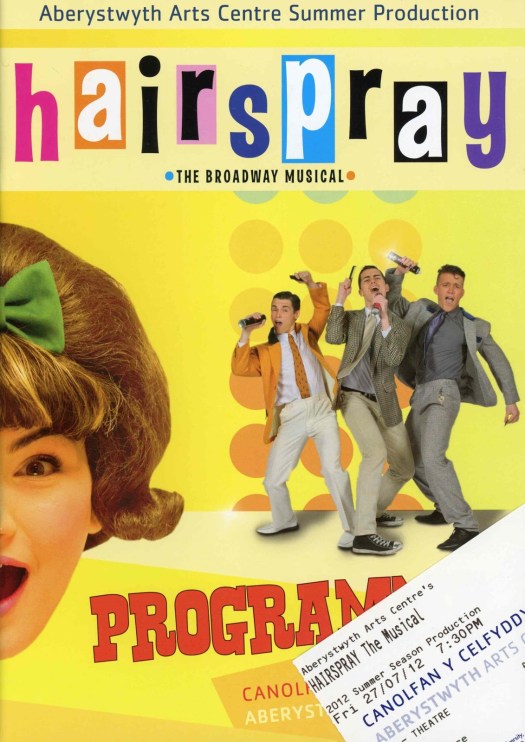
Stiff Competition: A Hairspray to Defy the West End Elements

Funny thing about prejudice: if you let it take hold, it can deprive you and those around you of a real good time.ย  That, in a shiny Aqua Net shell, is the message of Hairspray, the musical.ย  And, boy, did I deprive myself . . . until now.ย  Sure, others around me still had that good time, but when Hairspray hit Broadway back in 2002, I was as set as an untamed cowlick. ย I would have none of it. My Aqua Net days were long behind me by then, and I was not going to splash out on a rehash of a late-1980s cult comedy about early 1960s culture-clashing teenagers, told in songs that a Porter and Gershwin kind of guy like me is not inclined to hum while wearing a shower cap. Well, Kiss my Kate! Last Friday, I finally woke up and smelled the coiffing.ย  “Good morning, Baltimore!” Andโ€”oh, never mind โ€œbeautifulโ€โ€”what a colorful morning it is.

Funny thing, too, that I only had to travel about half a mile to learn that musical lesson; no subway ride down to 42nd Street, no walk through Londonโ€™s West End via Leicester Square (and TKTS).  Just up the hill, to Aberystwyth Arts Centre, where each summer a musical is staged that, as a tourist attraction, is far more reliable than our windswept seaside.  Over the years, I have seen eight of those summer seasons come and go, from Oliver! to Chess.  Boasting a cast whose list of combined Broadway and West End credits is way longer than I am in the tooth, this yearโ€™s production tops them all.

Its readily translatable story of teenage rebellion aside, Hairspray may not be the easiest piece of Americana to transplant to Wales.  Never mind references to Allen Funt, Jackie Gleason, and the Gabors, names not likely to ring for todayโ€™s young, British audiences the bells I and Tracy Turnblad can hear.  The Director’s Note in the program about Rosa Parks, whose image flashes on a big screen during one of the numbers, fills in some of the blanks.  This, after all, is American history, no matter how much John Waters it down.

Then again, it may not be the easiest thing, either, to translate the Civil Rights Movement into a musical riot without becoming as crude or politically incorrect as John Waters used to be.  But, whatever your own sense of otherness and experience of xenophobia might beโ€”and โ€œI Know Where Iโ€™ve Beenโ€โ€”Hairspray gives you enough of a whiff of those ill winds to make you investigate whence they blow.  โ€œRun and Tell Thatโ€: if any production can communicate a shakeup without making anger the primary colour of the emotional rainbow, Unholy Waters! this can can.

You might expectโ€”and forgive, tooโ€”any glitches or leftover curlers on opening night; but there were none here: upon pulling the lid, this Hairspraywas as solid as a freshly lacquered beehive.  Andrew Agnew is marvelous as Edna Turnblad, a part I identified so much with the fabulous Divine that I couldnโ€™t face watching John Travolta in a latex mask.  Agnew makes you forget bothโ€”and he plays Edna in such an understated way that her big number โ€œ(Youโ€™re) Timeless to Meโ€ makes you understand what, to someone of my certain age, is the warm heart of this show.  Itโ€™s a heart whose Beat youโ€™d canโ€™t stop without making Hairspray lose its maximum hold.

Edna might have missed every boat except the one she pours the gravy from; but she is not too old to kissโ€”and kickโ€”the past goodbye and say โ€œWelcome to the 60โ€™s.โ€  This transition requires more than a new do or a swift costume change; and Agnew achieves it by centering Edna in the 1950s, a woman who loves Lucy though she might not like Ikeโ€”and who not only loves Tracy from the remove of a generational gap but gets her, too.

Tracy, of course, is her daughterโ€”the embodiment of that new ageโ€”and Jenny Oโ€™Leary inhabits the role with the confidence and youthful energy for which it calls.  Tracy may not quite grasp just how seismic the event is in which she plays her part, an eventโ€”this much she knowsโ€”far bigger than “Negro Night” on the Corny Collins Show; but she approaches integration with the I-donโ€™t-get-it naivety that has many of todayโ€™s youngsters baffled at their parentโ€™s definition of marriage as a strictly segregated affair.

Hairspray leaves no doubt as to who โ€œThe Nicest Kids in Townโ€ are; โ€œniceโ€ simply ainโ€™t.  It is self-serving conventionality, a meanness of spirit that lingers under the neat surface like something you fight with lice shampoo.  How else to approach โ€œMiss Baltimore Crabs,โ€ Velma Von Tussle, a nasty piece of work done justice by Lori Haley Foxโ€”and done in by the sheer force of Motormouth Maybelle, a woman who, like Edna, has seen better days, but whose better days were lived in times much worse.  

Marion Campbell, who plays Maybelle, comes on stage late to belt out her showstopper of a numberโ€”and her presence hits you like, say, Mahalia Jacksonโ€™s in Imitation of Life: a voice to be reckoned with, especially in a fight for equality.

Though the actress playing Tracy Turnblad receives top billing, it would be wrong to call the rest of the cast โ€œsupporting.โ€  Hairspray demands a great many good voices as it gives most of its characters the chance and challenge to shine, and everyone in this cast is living up to that challenge: Arun Blair Mangat as Seaweed, Samantha Giffard a Penny Pingleton, Morgan Crowley as Wilbur Turnblad, Hugo Harold-Harrison as Corny Collins . . .

The list is longer than thatโ€”but I’d be bald by the time I were done honor roll calling.  Besides, if I’m counting anything it’s the days until my next trip to the salon for another hit of Hairspray. Yes, funny thing about prejudice: once confronted, it can yield such eye-opening, ear-popping surprises.

So, toodle-oo to stiff upper lip! Stiff up yer quiff instead.

Blind Manโ€™s Stuff: Alec Templeton in Time and Space

Last night, I had the good fortune to hear the music of Alec Templeton. Live and by proxyโ€”and right here in town. Templetonโ€™s compositions, among them barrier-obliterating and class-unconscious numbers like “Bach Goes to Town” and “Debussy in Dubuque,” were performed at the National Library of Wales, Aberystwyth. Pianist Simon Crawford-Phillips was ably assisted by Templeton himself, whose voice and ways on the keyboard were heard in a variety of radio recordings from the 1930s, โ€˜40s, and โ€˜50s.

Why here? Why now? Well, Templeton was a Welshman by birth, a fact that seems to have eluded most of the Welsh who pride themselves to be a nation of song. So, last night was as good and as high a time as any for his countrymen and women to acknowledge Templeton’s remarkable against-almost-all-odds career, even if the will to embark upon it took the composer-pianist as far West from the West of Britain as Hollywood. The countrywoman who did the acknowledging was Rhian Davies, teller of Templeton’s life in words and images. Davies, who generously acknowledged as well all the support and assistance her project received from broadcasting buffs and music lovers around the inter-networked world, has known about Templeton practically all her life. Eager to share her readily transmitted enthusiasm, she brought home to us, the assembled audience, that it is always Alec Templeton Time.

Templetonโ€™s life is the stuff of legend. Born blind, he developed an ear so keen and a wit so sharp that he was destined to play tunes made for the cutting of rugs. That he was an expert at middlebrow musical culture has a lot to do with the fact that the eyes beneath his brows saw nothing and that his ears saw nothing but potential. Others, left in the dark yet accustomed to light, might have seen an insurmountable impediment.

The mindโ€™s eye of Alec Templeton saw no such manifestations of doubt. He saw, say, Lower Basin Street … and took it. It may be that sightless people, who sense space by feeling their way around and listening intently, are not so much impressed by the walls facing them as their seeing contemporaries, not so much concerned with apparent boundaries, be they cultural or national.

โ€œI understand,โ€ a writer for Radio Guide remarked in 1936, โ€œwhy his friends, when you start glooming about his sightless eyes, smile superciliously and say: โ€˜Save your sympathy for someone who needs it.โ€™โ€

The stuff sighted folks concern themselves with is so much nonsense to a man like Templeton. Sensing a universe where others might imagine chaos, he crossed the waves and made a home for himself on the airwaves, authoring an etherized existence.

โ€œRadio,โ€ Templeton reportedly said, โ€œis to me the greatest miracle of manโ€™s ingenuity. My ears are my eyes, and I tune in at every opportunity, listening to everything from Vic and Sade to Toscanini.โ€

Hearing Templetonโ€™s music performed live and seeing his career celebrated was a thrill. Yet as pleased as I was that all this happened in the little Welsh town where I now live, I wonder what claim Wales has to her native son. After all, the place of his birth, like his blindness, was not of his choosing. Indeed, he chose to unfurl his pinions, take to the air, and come to live for all willing to be all ears, in a medium whose art is not limited by space but that is instead the stuffโ€”the no-matterโ€”of time.   Make that Alec Templeton Time.

"I started Earlyโ€”Took my Dog . . ."

“. . . and visited the Sea.” I have not read the poetic works of Emily Dickinson in many a post-collegiate moon; yet, as wayward as my memory may be, I never forgot those glorious opening lines. You might say that is has long been an ambition of mine to utter them, to experience for myself the magic they evoke; but, until recently, I have failed on three accounts to follow Emily in her excursion. That is, I had no dog to take along; nor did I never live close enough to the sea to approach it on foot, at least not with the certain ease that might induce me to undertake such a venture.

Now that there is Montague in my life and Cardigan Bay practically at our doorsteps, the only thing that prevents me from having such a Dickinsonian moment is a habitual antemeridian tardiness. If โ€œAllโ€™s right with the worldโ€ when โ€œMorningโ€™s at seven,โ€ as Robert Browning famously put it, then I might as well roll over and let it bask in its easterly lit serenity. It is for the early birds to confirm of refute such a Browning version of bliss.

Besides, as Victorian storyteller Cuthbert Bede once remarked, it is โ€œwell worth going to Aberystwith [. . .] if only to see the sun set.โ€ So, Iโ€™m starting late instead and take my dog for evening visits to the sea. No โ€œMermaidsโ€ have yet come out of the โ€œbasementโ€ to greet me; nor any of those bottlenose dolphins that are on just about every brochure or poster designed to boost the townโ€™s tourist industry. They are out there, to be sure; but unlike Ms. Dickinson, Iโ€™m not taking the plunge to get up close and let my โ€œShoes [ . . .] overflow with Pearlโ€ until the rising tide โ€œma[kes] as He would eat me up.โ€

Not with Montague in tow. Dogs are not allowed on the beach this time of year. It is a sound policy, too, given that Montague frequently manages to confound me by squatting down more than once, especially when I am only equipped with a single repository with which to dispose of the issue. Is it any wonder that Iโ€™d much rather start late, preferably under cover of night?

On this sunless Tuesday morning, though, I started just early enough to keep Montagueโ€™s appointment with the veterinarian. No walk along the promenade for the old chap, to whom the change of schedule was no cause for suspicion. Now, I donโ€™t know what possessed me to agree to his being anesthetized to have his teeth cleaned, other than Montagueโ€™s stubborn refusal to permit us to brush them. I trust that, once he has forgiven me for this betrayal of his trust, that we have many more late starts to meet and mate with the sea . . .
โ€œ. . . and all the ships at seaโ€: A Kind of Homecoming

This is not going to be one of those โ€œthe dog ate my homeworkโ€ sort of posts, which are as much an excuse for not writing as they are a woeful excuse for writing anything at all. Besides, I could hardly blame Montague, our terrier, for keeping me from keeping my journal. Rather, it is the home work that has done the biting, gnawing and tearing at the hours I would otherwise earmark for sinking my incisors into stale pop-tartsโ€”you know, those cultural marginalia with which I am wont to occupy my mind.

While I have rarely been all at sea when it comes to the leisurely pursuit of gathering and examining pop-cultural jetsam, my mind does not take to creative recycling when my limbs are aching after having performed some burdensome chore; and these past three months, my limbs have had quite a workout. We have been readying our late-Victorian house in the Welsh seaside town of Aberystwyth for its present trio of occupants, only the four-legged one of whom appears to be as blithe and sprightly as of old, albeit saltier.

We have moved in at last; and even though much remains to be done to make and keep the place shipshape, especially now that the house guests are checking in and up on our work, the sofas and easy chairs are in place from which to let out a defiant โ€œLater!โ€ and take off instead in further explorations of the airwaves or some such neglected channel.

The waves! Even though you would have to climb to the top floor of our house to get a glimpse of the bay, the surf and the seagulls are very much part of the enveloping soundscape. I suspect that the sights and sounds of the sea are going to feature prominently in subsequentโ€”and decidedly more frequentโ€”entries. It was not quite so easy for me to work the business of scraping wallpaper into my reflections; but the sea is another kettle of fish altogether.

So, โ€œGood evening Mr. and Mrs. America, from border to border and coast to coast and all the ships at sea,โ€ as famed newscaster and lexicon-artist Walter Winchell used to sayโ€”and which greeting I extend to Mr., Mrs., and Ms. Internet surfer the world overโ€”โ€œLet’s go to press . . .โ€


Related writings (featuring Walter Winchell or an Impersonator)
โ€œBeing But Blogmad North-Northwestโ€
โ€œAmelia Earhart Is Lateโ€
โ€œOld-time Radio Primer: B Stands for broadcastellanโ€

Another Manโ€™s Ptomaine: Was โ€œThe Undertakerโ€™s Taleโ€ Worth Exhuming?

Bury this. Apparently, it was with words not much kinder that the aspiring but already middle-aged storyteller Samuel Clemens was told what to do with โ€œThe Undertakerโ€™s Tale.โ€ Written in 1877, it was not published until this year, nearly a century after the authorโ€™s death. The case of the premature burial has not only been brought to light but, thanks to BBC Radio 4, the disinterred matter has also been exposed to the air (and the breath of reader Hector Elizondo). So, you may ask after being duly impressed by the discovery, does it stink?

To be sure, even the most minor work of a major literary figure is deserving of our attention; and โ€œThe Undertakerโ€™s Taleโ€ is decidedly minor. It derives whatever mild titters it might induce from the premise that one manโ€™s meat is another manโ€™s poison or, to put it another way, one manโ€™s dead body is anotherโ€™s livelihood.

โ€œWe did not drop suddenly upon the subject,โ€ the narrator ushers us into the story told to him by his โ€œpleasant new acquaintance,โ€ the undertaker, โ€œbut wandered into it, in a natural way.โ€ We should expect slow decay, then, rather than a dramatic exitโ€”and, sure enough, there is little to startle or surprise us here.

There isnโ€™t much of a plot eitherโ€”but a lot of them. The eponymous characterโ€”one Mr. Cadaverโ€”is a kind-hearted chap who cheers at the prospect of an epidemic and who fears for his family business whenever the community is thriving. To him and his lovely, lively tribe there can be no joy greater than the timely demise of an unscrupulous vulture (some simulacrum of a Scrooge), whichโ€”death ex machina and Abracacaver!โ€”is just what happens in the end.

In its time, “The Undertaker’s Tale” may have been dismissed as being in poor taste; what is worse, though, is that it is insipid. To bury it was no doubt the right decision as it might have ended Clemens’s literary career before it got underway by poisoning the public’s mind against him. A death sentence of sorts.

It may sound morbid, but, listening to this unengaging trifle, I drifted off in thoughts of home. My future home, that is. No, I am not about to check out; but within a few days now I am going to move to a town known, albeit by very few, as Undertakerโ€™s Paradise.

Back in 2000, the Welsh seaside resort of Aberystwyth served as the setting for a dark comedy thriller with that title. Starring Ben Gazzara, it concerns an undertaker rather more enterprising than Mr. Cadaver in the procuring of bodies. Like Twainโ€™s story before it, the forgotten film is waiting to be dug up and appreciated anew. Unlike Twainโ€™s story, it has no literary pedigree to induce anyone to pick up a shovel. Shame, really. Itโ€™s the better yarn of the two.


Related writings
“Mark Twain, Six Feet Underโ€
“What Those Who Remembered Forgot: Don Knotts (1924-2006) on the Airโ€

Never Mind "Local Color"โ€”That’s a Bruise!

Last week, my best friend was in town for a visit. Ever since I left our native Germany some twenty years ago to live abroad (first in the US, now in the UK), our time together has been short and rare. I have learned to accept the brevity of our reunions; but treating them as special occasions has often bothered me. Not that it would be a waste of time just to flop and chat; then again, that is what we do apart almost daily while on the phone with each other. So, as if our get-togethers werenโ€™t special enough, I somehow feel obliged to make my friendโ€™s journeys here worthwhile by planning something out of the ordinary.

This time around, though, there was less time and still less money for the โ€œspecial,โ€ given that most of our hours and pounds are being spent on renovating our house in town. Okay, so I tried to pass off a seven-hour roundtrip in a van to pick up a bathtub as a sightseeing tourโ€”but much of my German friendโ€™s visit was passed in the appreciation of local color: the blue bells, the silvery sea, and the lush greenery of nearby Hafod, a Picturesque, man-made landscape that was an inspiration to Britainโ€™s Romantic poets.

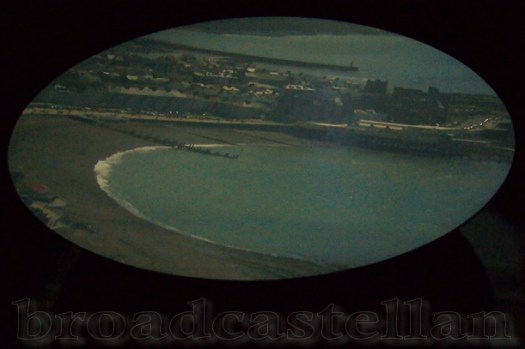
Then there was a hike up Constitution Hill just behind our future home to look through the lens of the camera obscura (pictured), presumably the biggest in the world. Yes, there is plenty to see in Aberystwyth. As one Victorian traveler expressed it, it is worthwhile coming here just to see the sunset.

So much for the daytime highlights. What about evening entertainment? How fortunate, I thought, that the local cinema was screening films of local interestโ€”a Welsh-language picture about a 1970s comedy act that hit it big in the Valleys but dreamed of Vegas (Ryan a Ronnie) and a British biopic about Michael Peterson, a man born in this very town. Not a dignitary, mind, but a celebrity nonethelessโ€”a nonentity of guy who, lacking all other ambitions, reinvented himself as Charles Bronson, thug.

Nicolas Winding Refnโ€™s Bronson (2009) is not a traditional biography. It is no more a character study than Friday the 13th, even though it is more concerned with its own glamour than with the ugliness of its subject. The film does not attempt to debate whether nurture or nature (the radioactive Irish Sea, say) turned a boy into a beast, to explain what went wrong along the way to a maturity unreached.

Bronson makes no mention of Petersonโ€™s birthplace, which, given the violent subject, must be a relief to those engaged in trying to sell the town as a seaside resort. Besides, the home Peterson made for himself is solitary confinement, in which he spent most of his life. Thirty years and countingโ€”without a murder charge to his discredit.

The filmโ€™s homophobia asideโ€”its muscular, naked, supposedly โ€œunadulteratedโ€ violence comes across as less freakish than the cultured, artistic and presumably fey who seek to entrap, educate, or exploit Petersonโ€”Bronson is most disturbing in its refusal either to accuse or excuse the man. It simply displays, thereby giving its yet living subject precisely what itโ€”along with the publicโ€”appears to crave most: celebrity. It is a nightmarish picture of a good-for-nothing who achieves fameโ€”like a roid-raging Paris Hilton (High-security Hilton?)โ€”without doing anything deserving of our notice, let alone our praise.

Bronson is the anti-Elephant Man: โ€œI am not a human being,โ€ he seems to insist, โ€œI am an animal.โ€ He is a sideshow act entirely satisfied with his own conspicuous marginality.

If the film argues anything, it is that our inability to pin Peterson down is what terrifies us most, what compels us to watch and forces the authorities to keep him under lock and key. With this makeshift thesis, the shallow if stylistically intriguing Bronson, which favors art direction over the use of a moral compass, attempts to justify its approach, making a virtue out of its superficiality by denying us access into the mind it is incapable of penetrating.

I took my visitor to see Bronson in hopes of catching a glimpse of our little town and of learning something about its darker past. Instead of shades of local color, though, I was dealt a rather nasty shiner.

For the Love of Brian; or, The Gospel According to Judith Iscariot

In a few weeks, all going according to plan, I shall be moving west, to the Welsh seaside town of Aberystwythโ€”a short move long in the making. Once in town and halfway settled, I shall set out to uncovering whatever pop-cultural past it hasโ€”you know, Liz Taylor slept here, Ben Gazzara filmed there; that sort of thing. When it comes to broadcasting, the prized hobbyhorse in my imaginary stables, no connection shall be too tangible to warrant my far-fetching it.

The other day, I missed out on a fine opportunity to introduce the place when BBC Radio Wales aired โ€œAberystwyth Mon Amour,โ€ an adaptation of the comedy-noir thriller by Malcolm Pryce, the first in a series that continued fancifully with Last Tango in Aberystwyth and Donโ€™t Cry for Me Aberystwyth. Dazzled by the likes of Carmen Miranda and Lucille Ball, I neglected to study the Radio Times for something of local interest.

Some travel notes and theater reviews aside, my life in Wales has not as yet been a significant aspect of my writings. All the same, it gave life to this journal. Not long after relocating here from New York City, when I did not seem to figure in the landscape, let alone signify in the culture, I decided in my isolation and estrangement to share what I knew or cared to rememberโ€”and it has been a comfort to me.

A few years ago, I posed here with my copy of The Unbearable Lightness of Being in Aberystwyth. Back then, what felt unbearable was the burden of my own lightness, the feather-weightiness of my existence in the relative obscurity of a rural community to which I could or would not relate. Being here did not exactly feel light; but the town made some effort to lighten up a bit today.

After thirty years, Aberystwyth lifted a ban on the screening of the supposedly blasphemous Monty Python satire Life of Brian, currently ranked among the top 250 films on the Internet Movie Database. According to the BBC, its decriminalizing will be celebrated with a charity event attended by three members of the cast: Terry Jones, Michael Palin, and Sue Jones-Davies. It was Jones-Daviesโ€”the love of Brian, Judith Iscariotโ€”who made it happen. After all, she is the mayor of the town now; and by lifting the ban on her screen image, she also improved the image of Aberystwyth as a place that isnโ€™t too heavy-handed in its dealings with the lighthearted and the irreverent. Thatโ€™s some relief to me . . .


Related writings
โ€œMining Culture: The Welsh in Hollywoodโ€
โ€œLittle Town Blues; or, Melting Awayโ€
How Screened Was My Valley: A Festival of Fflics (October 25-27)

"By [David], she’s got it"; or, To Be Fair About the Lady

Having spent a week traveling through Wales and the north of Englandโ€”up a castle, down a gold mine, and over to Port Sunlight, where Lux has its originsโ€”I finally got to sit down again to take in an old-fashioned show. That show was My Fair Lady, a production of which opened last night at the Aberystwyth Arts Centre, where each summer a musical is put on for the amusement of the locals and the visitors to the seaside town a few miles east of which I now reside. These productions, the aforementioned Oliver!, Fiddler on the Roof, and West Side Story among them, tend to be quite ambitious in their choice of Broadway and West End fare, titles likely to raise expectations higher than any theatrical curtain falling on them, whether to the relief or regret of the assembled crowds. The present Lady is no exception.

According to lore shared by Michael Kantor and Laurence Maslon in Broadway: The American Musical, even Oscar Hammerstein gave up on the idea of showtuning Shawโ€™s Pygmalion, advising fellow songwriter and radio alumnus Alan Jay Lerner against it. โ€œJust You Wait,โ€ the librettist thought and, to the delight of millions, he and his partner, Frederick Loewe, got on with the show that not only opened on Broadway in 1956 but refused to close for several seasons, proving an enduring popular and critical success.

Now, I did not expect a performer equal to Julie Andrews or Audrey Hepburn when I took my seat and glanced at the program. Indeed, I was never fond of the former or of the film version starring the latter. I had read in the local paper that two leading ladies were taking turns during the month-long run and that the showโ€™s director, Michael Bogdanov, was yet to determine which one of them would perform on opening night. The Lady in question was Elin Llwyd, a graduate of the Royal Welsh College of Music and Drama. Sure, a Welsh lead for a part requiring a Cockney accent transformed into an English that would both please and fool high society as being the genuine article. Iโ€™m a far more โ€œOrdinary Manโ€ than Professor Higgins professes to be; but, having lived among the Welsh for some time now, I can tell a Cymru tongue from an English one when it is stuck out at me from a reverberating stage.

โ€œThe English have no respect for their language,โ€ the Irish playwright (heard here introducing himself) deplored in his Preface to Pygmalion. Neither have theatrical directors, it seems; or, rather, they do not appear to have much respect for the ear by which they mean to drag audiences into the realm of make-believe. Mind you, the production is being coy about the filiations of Eliza, casting fellow Welshman Ieuan Rhys as her father and throwing in a few self-conscious references about the culture and language. Still, no matter how ably supported and otherwise capable, the slate-hewn Galatea taking center stage faces the well-nigh impossible task of faking not one accent, but two; and, as her acting became more energetic and engaging during the second act, Welsh got the better of the flower girl from the slums of Lisson Grove, London, whom a conceited gentleman scholar wagers to unveil as one of his kind by chiseling at her accent. โ€œBy George, sheโ€™s got itโ€? By David, she couldnโ€™t get rid of it!

“Ah-ah-ah-ow-ow-ow-oo!” A few years ago, I was incapable of discerning what now spoke so clearly against the effort to suspend my disbelief. I have spent most of my adult life being cast as a foreigner based on the sound of my utterings. Often, I was made to feel like an imposter, earmarked as one supposedly pretending to be American or English while invariably exposed by a slip of my wayward Teutonic tongue. Given my accentual trials, I am drawn to stories like Eliza Doolittleโ€™s . . . or Elin Llwydโ€™s.

Patois may be less restricting and defining these days; but, for a play like Pygmalion or its tuneful remake to ring true, phonetic distinctions should not be leveled along with the social discriminations they beget. In this case, equal opportunity spells a missed one. Besides, it just ainโ€™t fair to the memory of the vernacularly challenged ladies and lads whose speech was not equal to their ear.