โ€œ. . . reduced, blended, modernisedโ€: The Wireless Reconstitution of Printed Matter

Nearly two centuries ago, young Rebecca Sharp marked her entrance into the world by hurling a book out of a coach window. That book, reluctantly gifted to her by the proprietress of Miss Pinkertonโ€™s academy for young ladies, was Johnsonโ€™s dictionary, a volume for which Ms. Sharp had little use, given that she was rarely at a loss for words. By the time her story became known, in 1847, words in print had become a rather less precious commodity, especially after the British stamp tax was abolished in 1835, which, in turn, made the emergence of the penny press possible. Publications were becoming more frequentโ€”and decidedly more frivolous.

Gone were the days when a teenager like Mary Jones, whose story I encountered on a trip to the Welsh town of Bala last weekend, walked twenty-five miles, barefooted, for the privilege of owning a Bible. Sure, I enjoy the occasional daytrip to Hay-on-Wye, the renowned โ€œTown of Booksโ€ near the English border where, earlier this month, I snatched up a copy of the BBCโ€™s 1952 Year Book (pictured). Still, ever since the time of the great Victorian novelists, the reading public has been walking no further than the local lending library or wherever periodicals were sold to catch up on the latest fictions and follow the exploits of heroines like Becky Sharp in monthly installments.

In Victorian times, the demand for stories was so great that poorly paid writers were expected to churn them out with ever greater rapidity, which left those associated with the literary trade to ponder new ways of meeting the supply. In Gissingโ€™s New Grub Street (1891), a young woman assisting her scholarly papa is startled by an

advertisement in the newspaper, headed โ€œLiterary Machineโ€; had it then been invented at last, some automaton to [. . .] turn out books and articles? Alas! The machine was only one for holding volumes conveniently, that the work of literary manufacture might be physically lightened. But surely before long some Edison would make the true automaton; the problem must be comparatively such a simple one. Only to throw in a given number of old books, and have them reduced, blended, modernised into a single one for todayโ€™s consumption.

Barbara Cartland notwithstanding, such a โ€œtrue automatonโ€ has not yet hit the market; but the recycling of old stories for a modern audience had already become a veritable industry by the beginning of the second quarter of the 20th century, during which โ€œgolden ageโ€ the wireless served as both home theater and ersatz library for the entertainment and distraction craving multitudes.

A medium ofโ€”and only potentially forโ€”modernity, radio has always culled much of its material from the past, โ€œReturn with us nowโ€ being one of the phrases most associated with aural storytelling. It is a phenomenon that led me to write my doctoral study Etherized Victorians, in which I relate the demise of American radio dramatics to the failure to establish or encourage its own, autochthonous, that is, strictly aural life form.

Sure, the works of Victorian authors are in the public domain; as such, they are cheap, plentiful, and, which is convenient as well, fairly innocuous. And yet, for reasons other than economics, they strike us as radiogenic. Like the train whistle of the horse-drawn carriage, they seem to be the very stuff of radioโ€”a medium that was quaint and antiquated from the onset, when television was announced as being โ€œjust around the corner.โ€

Perhaps, the followers of Becky Sharp should not toss out their books yet; as American radio playwright Robert Lewis Shayon pointed out, the business of adaptation is fraught with โ€œartistic problems and dangers.โ€ He argued that he โ€œwould rather be briefed on a novelโ€™s outline, told something about its untransferable qualities, and have one scene accurately and fully done than be given a fast, ragged, frustrating whirl down plot-skeleton alley.โ€

It was precisely for this circumscribed path, though, that American handbooks like James Whippleโ€™s How to Write for Radio (1938) or Josephina Niggliโ€™s Pointers on Radio Writing (1946) prepared prospective adapters, reminding them that, for the sake of action, they needed to โ€œretain just sufficient characters and situations to present the skeleton plotโ€ and that they could not โ€œafford to waste even thirty seconds on beautiful descriptive passages.โ€

As I pointed out in Etherized, broadcast writers were advised to โ€œfree [themselves] first from the enchantment of the authorโ€™s styleโ€ and to โ€œoutline the action from memory.โ€ Illustrating the technique, Niggli reduced Jane Eyreโ€”one of the most frequently radio-readied narrativesโ€”to a number of plot points, โ€œbald statementsโ€ designed to โ€œeliminate the non-essential.โ€ Only the dialogue of the original text was to be restored whenever possible, although here, too, paraphrases were generally required to clarify action or to shorten scenes. Indeed, as Waldo Abbotโ€™s Handbook of Broadcasting (1941) recommended, dialogue had to be โ€œinvented to take care of essential description.โ€

To this day, radio dramatics in Britain, where non-visual broadcasting has remained a viable means of telling stories, the BBC relies on 19th-century classics to fill much of its schedule. The detective stories of Conan Doyle aside, BBC Radio 7 has just presented adaptations of Thackerayโ€™s Vanity Fair (1847-48), featuring the aforementioned Ms. Sharp, and currently reruns Trollope’s Barchester Chronicles (1855-67). The skeletons are rather more complete, though, as both novels were radio-dramatized in twenty installments, and, in the case of Trollopeโ€™s six-novel series, in hour-long parts.

BBC Radio 4, meanwhile, has recently aired serializations of Trollope’s Orley Farm (1862), Wilkie Collinsโ€™s Armadale (1866) and Mary Elizabeth Braddonโ€™s Lady Audleyโ€™s Secret (1862). Next week, it is presenting both Charlotte Brontรซโ€™s Villette and Elizabeth Gaskellโ€™s Ruth (both 1853), the former in ten fifteen minute chapters, the latter in three hour-long parts.

Radio playwright True Boardman once complained that adaptations for the aural medium bear as close a relation to the original as โ€œpowdered milk does to the stuff that comes out of cows.โ€ They are culture reconstituted. โ€œ[R]educed, blended, [and] modernisedโ€œ, they donโ€™t get a chance to curdle . . .

Note: Etherised Victorians was itself ‘reduced and blended,’ and published as Immaterial Culture in 2013.


Related writings (on Victorian literature, culture and their recycling)
โ€œHattie Tatty Coram Girl: A Casting Note on the BBCโ€™s Little Dorritโ€
โ€œValentine Vox Pop; or, Revisiting the Un-Classicsโ€
“Curtains Up and ‘Down the Wires'”
Eyrebrushing: The BBC’s Dull New Copy of Charlotte Brontรซ’s Bold Portrait”

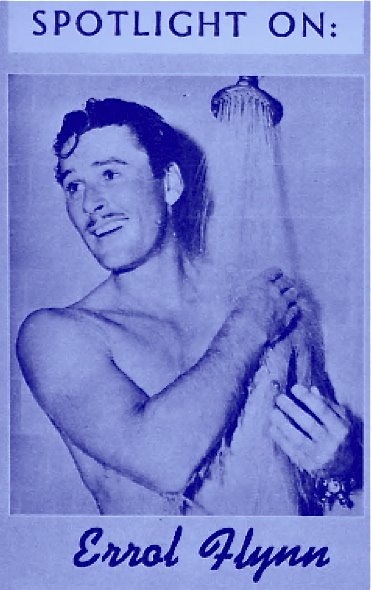
His Words, Her Voice: Errol Flynn, Olivia de Havilland, and the Resonance of โ€œEnoughโ€

“Oh, I have seen enough and done enough and been places enough and livened my senses enough and dulled my senses enough and probed enough and laughed enough and wept more than most people would suspect.” This line, as long and plodding as a life gone wearisome, was recently uttered by screen legend Olivia de Havilland, now in her 90s. You may well think that, at her age, she had reason enough for saying as much; but Ms. de Havilland was not reminiscing about her own experiences in and beyond Hollywood. She was reciting the words of one of her most virile, dashing, and troubled contemporaries: Errol Flynn, who was born one hundred years ago, on 20 June 1909, and apparently had โ€œenoughโ€ of it all before he turned fifty, a milestone he did not live to enjoy.

In her brief talk with BBC Radio 3โ€™s Night Waves host Matthew Sweet, de Havilland talks candidly, yet ever so decorously, about her swash-buckled, devil-may-careworn co-star, about his temperament, his aspirations, his fears. Hers is an aged voice that has a tone of knowing in it. A mellow, benevolent voice that bespeaks understanding. A voice that comforts in its conveyance not of weariness but of awareness, a life well lived and not yet spent.

I could listen for hours to such a voice. I might not care for, learn from or morally improve by hearing what is saidโ€”but the timbre gives a meaning to โ€œenoughโ€ that the forty-something Flynn never lived to express or have impressed upon him. It is the โ€œenoughโ€ of serenity, the โ€œenoughโ€ of gratitude, the โ€œenoughโ€ of not asking for more and yet not asking less . . . or stop asking at all.

My own life is marked and marred by a certain lack of inquisitiveness, it sometimes strikes me. Being blasรฉ is one of the first masks we don not to let on that we donโ€™t know enough, that we know as much, but donโ€™t know enough simply to ask. I wore such a mask of vainglory when I set out in life, the dullest of lives it seemed to me. My fellow employees had a nickname for me then.

It was my moustache that inspired it. Errol Flynn they called me. Little did they know that, even at age 20, I felt that I had โ€œenoughโ€ even though I so keenly felt that I had not had much of anything at all. I simply had enough of not even coming close to the glass of which I might one day have had my fill; but, for three long years, I did not have sense enough to leave that dulling life behind. No voice could talk me out of that barren existence but my own.

It was not easy for me to regain a sense of curiosity; it was as if the pores beneath the mask had been clogged after being concealed so long, my skin no longer alive to the breeze and its promises. I had brushed off more than I dared to absorb. One morning, I took a walk around Central Park with one of Errol Flynnโ€™s leading ladies, Viveca Lindfors, and was neither startled nor thrilled; nor did I not seize the opportunity to inquire about her past or permit her to draw me into her presence as she offered me advice and assistance.

Instead, I preserved the sound of her voice on the tape of my answering machineโ€”like a butterfly beyond the magic of flightโ€”her words saying that she had enough of me was dispensing of my humble services as her dog walker. I am left with canned breath, quite beyond the chance of living what might have been a great story.

Enough of my regrets. I can only hope that, when next I feel that I had โ€œenough,โ€ the word will sound as if it were uttered in what I shall henceforth refer to as a de Havilland sense, with dignity, insight and calmโ€”and an acceptance that is not resignation.

Tonight at 8:30 (or Whenever It’s Convenient)

“You canโ€™t do without it. Supposing you wanna hear Jack Benny, see? But you canโ€™t be at home at that hour. So you tell the maid to turn the radio on when Jack Benny comes on, and this automatically goes on with the radio. . . .โ€ That is how big shot Howard Wagner goes on about his new wire recorderโ€”shortly before giving his old employee the ax. The employee is Willy Loman, the scene from Death of a Salesman. It is one of the references that came as a surprise to me yesterday morning when I reread the play I thought I was done with by the time I left college. At the time he wrote this Pulitzer Prize-winning piece, Miller had not long gotten out of the radio game and was rejoicing in his newfound artistic freedom; so he gives the speechโ€”and the speech recording deviceโ€”to the bad guy. Having previously gone on record to dismiss radio as commercial and corrupt, Miller now suggested how the medium was about to get worseโ€”that is, farther removed from live theater, from the immediate, the communal, and the relevant.

This โ€œwonderful machineโ€โ€”for which Mr. Wagner is ready let go of โ€œall [his] hobbiesโ€โ€”is a metaphor for the selfishness of a society that was moving so fast, it could not even give the time of day to its most beloved entertainersโ€”let alone a tired old man like Willy Loman. If Mr. Benny wanted to talk to Howard Wagner, he, like everyone else, had to wait for the hour appointed to him by the big noise.

โ€œYou can come home at twelve oโ€™clock, one oโ€™clock, any time you like, and you get yourself a Coke and sit yourself down, throw the switch, and thereโ€™s Jack Bennyโ€™s program in the middle of the night!โ€โ€”all for โ€œonly a hundred and a half,โ€ an amount for which Willy Loman is willing to work for three weeks and a half.

For decades to come, it was the industry that benefitted most from this new recording technology. Bing Crosby could walk into the studio when it suited his own schedule, rather than having to be there for the public who sat by the radio, as of old, to hear his program go on the air. Nowadays, the Willy Lomans are in charge of scheduling, of making time for whoever vies for their attention.

I would not go so far as to say that I โ€œcanโ€™t do withoutโ€ the latest recording software. It sure makes it easier for me to enjoy more of what I enjoy, though. The BBCโ€™s iPlayer has greatly changed my listening habits and increased the number of plays, documentaries, and musical selections I take in. Currently, I am listening to โ€œThe Better Half,โ€ a cheeky if dated sex comedy by Noel Coward. Written and performed in 1922, the unpublished one-acter about โ€œmodernโ€ marriage (in the traditional sense we canโ€™t seem to get past) was not staged again until 2007. Earlier this week, it had its broadcast debut on BBC Radio 4.

Okay, so the leading lady is not Gertrude Lawrence (star of radioโ€™s Revlon Revue back in 1943)โ€”but at least I wonโ€™t have to listen to Mr. Wagnerโ€™s precious offspring (โ€œListen to that kid whistleโ€) while begging for a moment of his time. After all, most of us donโ€™t get the impression that, as Noel Coward puts it in โ€œThis is a Changing Worldโ€ (with which the radio adaptation of โ€œThe Better Halfโ€ opens), โ€œ[t]ime is your tenderest friend.โ€ So, it feels good to push a few buttons and get the better of it . . .

Related recording
โ€œMeet Gertrude Lawrence,โ€ Biography in Sound (23 January 1955)

Another Manโ€™s Ptomaine: Was โ€œThe Undertakerโ€™s Taleโ€ Worth Exhuming?

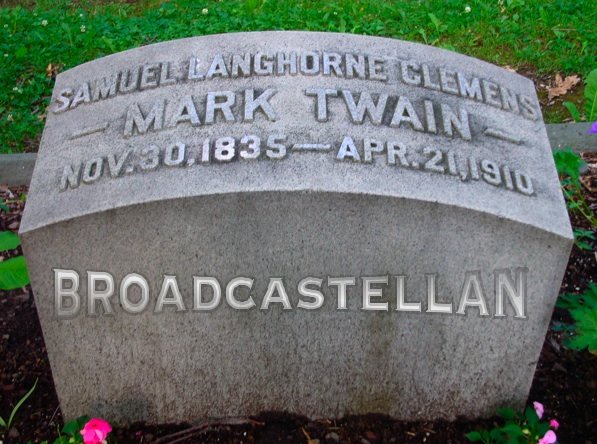
Bury this. Apparently, it was with words not much kinder that the aspiring but already middle-aged storyteller Samuel Clemens was told what to do with โ€œThe Undertakerโ€™s Tale.โ€ Written in 1877, it was not published until this year, nearly a century after the authorโ€™s death. The case of the premature burial has not only been brought to light but, thanks to BBC Radio 4, the disinterred matter has also been exposed to the air (and the breath of reader Hector Elizondo). So, you may ask after being duly impressed by the discovery, does it stink?

To be sure, even the most minor work of a major literary figure is deserving of our attention; and โ€œThe Undertakerโ€™s Taleโ€ is decidedly minor. It derives whatever mild titters it might induce from the premise that one manโ€™s meat is another manโ€™s poison or, to put it another way, one manโ€™s dead body is anotherโ€™s livelihood.

โ€œWe did not drop suddenly upon the subject,โ€ the narrator ushers us into the story told to him by his โ€œpleasant new acquaintance,โ€ the undertaker, โ€œbut wandered into it, in a natural way.โ€ We should expect slow decay, then, rather than a dramatic exitโ€”and, sure enough, there is little to startle or surprise us here.

There isnโ€™t much of a plot eitherโ€”but a lot of them. The eponymous characterโ€”one Mr. Cadaverโ€”is a kind-hearted chap who cheers at the prospect of an epidemic and who fears for his family business whenever the community is thriving. To him and his lovely, lively tribe there can be no joy greater than the timely demise of an unscrupulous vulture (some simulacrum of a Scrooge), whichโ€”death ex machina and Abracacaver!โ€”is just what happens in the end.

In its time, “The Undertaker’s Tale” may have been dismissed as being in poor taste; what is worse, though, is that it is insipid. To bury it was no doubt the right decision as it might have ended Clemens’s literary career before it got underway by poisoning the public’s mind against him. A death sentence of sorts.

It may sound morbid, but, listening to this unengaging trifle, I drifted off in thoughts of home. My future home, that is. No, I am not about to check out; but within a few days now I am going to move to a town known, albeit by very few, as Undertakerโ€™s Paradise.

Back in 2000, the Welsh seaside resort of Aberystwyth served as the setting for a dark comedy thriller with that title. Starring Ben Gazzara, it concerns an undertaker rather more enterprising than Mr. Cadaver in the procuring of bodies. Like Twainโ€™s story before it, the forgotten film is waiting to be dug up and appreciated anew. Unlike Twainโ€™s story, it has no literary pedigree to induce anyone to pick up a shovel. Shame, really. Itโ€™s the better yarn of the two.


Related writings
“Mark Twain, Six Feet Underโ€
“What Those Who Remembered Forgot: Don Knotts (1924-2006) on the Airโ€

” . . . the way of all flesh, material or imaginary”: Conan Doyle at 150

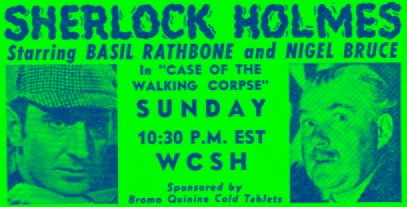
โ€œHad Holmes never existed I could not have done more, though he may perhaps have stood a little in the way of the recognition of my more serious literary work.โ€ That is how Arthur Conan Doyle, not long before his own death in 1930, announced to his readers that he would put an end to his most robust brainchild, the by now all but immortal Sherlock Holmes. Indeed, the figure continues to overshadow every aspect of Dr. Doyleโ€™s career, literary or otherwise. Perhaps, โ€œupstageโ€ is a more precise way of putting it, considering that the venerable sleuth was to enjoy such success in American and British radio drama from the early 1930s to the present day.

โ€œOne likes to think that there is some fantastic limbo for the children of imagination,โ€ Doyle assuaged those among his readers who found it difficult to accept that Holmesโ€™s departure was merely โ€œthe way of all flesh.โ€

To be sure, the earlier incident at the Reichenbach Falls suggested that Holmes was impervious to threats of character assassination, that he could reappear, time and again, in the reminiscences of Doctor Watson. Still, Doyleโ€™s intention to do away with Holmes so early in the detectiveโ€™s literary career had been no mere publicity stunt. Rather than feeling obliged to supply the public with the puzzles they craved, the author felt that his โ€œenergies should not be directed too much into one channel.โ€

One of the lesser-known alternative channels considered by Doyle has just been reopened for inspection. Today, 22 May, on the 150th anniversary of Doyleโ€™s birth in 1859, BBC Radio Scotland aired โ€œVote for Conan Doyle!โ€ a biographical sketch โ€œspecially commissionedโ€ to mark the occasion. In it, writer and Holmes expert Bert Coules relates how, in 1900, Doyle embarked on a career in politics. He decided to stand for parliament; but the devotees of Sherlock Holmes would not stand for it.

Coulesโ€™s play opens right where Doyle had first intended to wash his hands of Holmesโ€”at the Reichenbach Falls. No matter how sincere Doyle was in improving the Empireโ€™s image and the plight of the Britishโ€™s troops during the Second Boer War, the push hardly met with the approval of the reading public. โ€œHow could you!โ€ โ€œHow dare you!โ€ โ€œYou brute!โ€ the public protested.

Although it was not this perceived case of filicide that did him in, Doyle proved unsuccessful in his campaignโ€”and that despite support from Dr. Bell, who served as an inspiration for Holmes. After his defeat, Doyle โ€œbowed to the inevitableโ€”and back the man came.โ€

When the The Case-Book of Sherlock Holmes was published in 1927, Doyle dropped the man once more, albeit in a gentler fashion. To assuage loyal followers, he fancied Holmes and Watson in some โ€œhumble cornerโ€ of the โ€œValhallaโ€ of British literature. Little did he know that the โ€œfantastic limboโ€ in which the two were to linger would be that in-between realm of radio, a sphere removed from both stage and pageโ€”but nearer than either to the infinite โ€œOโ€ between our ears.

It hardly surprises that, Radio Scotlandโ€™s efforts to get out the โ€œVote forโ€ and let us walk โ€œIn the Footsteps of Conan Doyleโ€ aside, most of the programs presumably devoted to Doyle are concerned instead with โ€œThe Voice of Sherlock Holmesโ€ and the โ€œGameโ€ that is โ€œAfootโ€ when thespians like Cedric Hardwicke, John Gielgud, Carleton Hobbs and Clive Merrison approach the original. It is not Doyleโ€™s life that is celebrated in these broadcasts, but Holmesโ€™s afterlife.

True, to the aficionados of Doyle’s fiction, Sherlock Holmes has never been in need of resuscitation. Yet, as Jeffrey Richards remarked in “The Voice” (first aired in 1998),

[r]adio has always been a particularly effective medium for evoking the world of Holmes and Watson. The clatter of horses hoofs on cobbled streets, the howl of the wind on lonely moors, and the sinister creaks and groans of ancient manor houses steeped in history and crime.

The game may be afoot once more when Holmes returns to the screen this year; but, outside the pages that could never quite contain him, it is the โ€œfantastic limboโ€ of radio that kept the Reichenbach Falls survivor afloat. It is for the aural mediumโ€”the Scotland yardstick for fidelity in literary adaptationโ€”that all of his cases have been dramatized and that, in splendid pastiches like โ€œThe Abergavenny Murder,โ€ the figure of Sherlock Holmes has remained within earshot all these years.


Related writings
“โ€˜What monstrous place is this?โ€™: Hardy, Holmes, and the Secrets of Stonehengeโ€
โ€œRadio Rambles: Cornwall, Marconi, and the โ€˜Devil’s Footโ€™โ€
Old Sleuth Re-emerges in New Medium for American Ho(l)mes

So to Speke

When not at work on our new old houseโ€”where the floorboards are up in anticipation of central heatingโ€”we are on the road and down narrow country lanes to get our calloused hands on the pieces of antique furniture that we acquired, in 21st-century style, by way of online auction. In order to create the illusion that we are getting out of the house, rather than just something into it, and to put our own restoration project into a perspective from which it looks more dollhouse than madhouse, we make stopovers at nearby National Trust properties like Chirk Castle or Speke Hall.

The latter (pictured here) is a Tudor mansion that, like some superannuated craft, sits sidelined along Liverpoolโ€™s John Lennon Airport, formerly known as RAF Speke. The architecture of the Hall, from the openings under the eaves that allowed those within to spy on the potentially hostile droppers-in without to the hole into which a Catholic priest could be lowered to escape Protestant persecution, bespeaks a history of keeping mum.

Situated though it is far from Speke, and being fictional besides, what came to mind was Audley Court, a mystery house with a Tudor past and Victorian interior that served as the setting of Mary Elizabeth Braddonโ€™s sensational crime novel Lady Audleyโ€™s Secret. The hugely popular thriller was first serialized beginning in 1861 and subsequently adapted for the stage. Resuscitated for a ten-part serial currently aired on BBC Radio 4, the eponymous โ€œladyโ€โ€”a gold digger, bigamist, and arsonist whose ambitions are famously diagnosed as the mark of โ€œlatent insanityโ€โ€”can now be eavesdropped on as she, sounding rather more demure than she appeared to my mindโ€™s ear when reading the novel, attempts to keep up appearances, even if it means having to make her first husband, a gold digger in his own right, disappear down a well.

As if the house, Audley Court, did not have a checkered past of its ownโ€”

a house in which you incontinently lost yourself if ever you were so rash as to attempt to penetrate its mysteries alone; a house in which no one room had any sympathy with another, every chamber running off at a tangent into an inner chamber, and through that down some narrow staircase leading to a door which, in its turn, led back into that very part of the house from which you thought yourself the furthest; a house that could never have been planned by any mortal architect, but must have been the handiwork of that good old builder, Time, who, adding a room one year, and knocking down a room another year, [ … ] had contrived, in some eleven centuries, to run up such a mansion as was not elsewhere to be met with throughout the county […].

โ€œOf course,โ€ the narrator insists,

in such a house there were secret chambers; the little daughter of the present owner, Sir Michael Audley, had fallen by accident upon the discovery of one. ย A board had rattled under her feet in the great nursery where she played, and on attention being drawn to it, it was found to be loose, and so removed, revealed a ladder, leading to a hiding-place between the floor of the nursery and the ceiling of the room belowโ€”a hiding-place so small that he who had hid there must have crouched on his hands and knees or lain at full length, and yet large enough to contain a quaint old carved oak chest, half filled with priests’ vestments, which had been hidden away, no doubt, in those cruel days when the life of a man was in danger if he was discovered to have harbored a Roman Catholic priest, or to have mass said in his house.

Loose floorboards weโ€™ve got plenty in our own domicile, and room enough for a holy manhole below. It being a late-Victorian townhouse, though, the hidden story we laid bare is that of the upstairs-downstairs variety. At the back, in the part of the house where the servants labored and lived, there once was a separate staircase, long since dismantled. It was by way of those steep steps that the maid, having performed her chores out of the familyโ€™s sight and earshot, withdrew, latently insane or otherwise, into the modest quarters allotted to her.

I wonder whether she read Lady Audleyโ€™s Secret, if indeed she found time to read at all, and whether she read it as a cautionary tale or an inspirational oneโ€”as the story of a woman who dared to rewrite her own destiny:

No more dependency, no more drudgery, no more humiliations,โ€ Lucy exclaimed secretly, โ€œevery trace of the old life melted awayโ€”every clue to identity buried and forgottenโ€”except […]

… that wedding ring, wrapped in paper.  Itโ€™s enough to make a priest turn in his hole.

โ€œAlone Togetherโ€: A Portrait of the Artist as an Artistโ€™s Spouse

โ€œSo, here he is. My father. In a churchyard in the furthest tip of Llลทn. Eighty years old. Wild hair blowing in the wind. Overcoat that could belong to a tramp. Face like something hewn out of stone, staring into the distance.โ€ The man observing is Gwydion, the middle-aged son of R. S. Thomas (1913-2000)โ€”โ€œPoet. Priest. Birdwatcher. Scourge of the English. The Ogre of Wales.โ€ With this terse description opens Neil McKayโ€™s โ€œAlone Together,โ€ a radio play first aired last Sunday on BBC Radio 3 (and available online until 28 March).
The voice of the Nobel Prize nominated poet (as portrayed by Jonathan Pryce) is heard reading lines from his works, the words that are, to us, a stand-in for the man. None of them escape the commentary of his estranged son: โ€œYes, you could tell yourself this is him, the real R. S. Thomas,โ€ the observer, filial yet unloving, remarks. โ€œBut youโ€™d be entirely wrong.โ€ As his fatherโ€™s old voice keeps on reciting, he adds: โ€œOh, heโ€™d be happy enough for you to fall for it . . . and to fall for the version he tells of his own life.โ€

What compels the son to revise this โ€œversionโ€ of a life is the life of another, a figure that, to his mind, is concealed or mispresented in the autobiography of the father. The figure is Elsi, the Welsh poetโ€™s English wife (1909-1991), whose fifty-year-relationship with R. S. was compressed by him in these lines:

She was young;
I kissed with my eyes
closed and opened
them on her wrinkles.

Speaking of their first encounter, R. S. introduces Elsi as โ€œa girl who was lodging fairly close by,โ€ the kind of icy understatement with which Thomas, writing about himself in the third person, kept his distance from his readers, just as the people he knew and wrote about were turned into abstracts on a page. โ€œHe doesnโ€™t even give her a name,โ€ the son comments, โ€œand thatโ€™s where it starts to unravel.โ€

The churchyard in which we are introduced to the father is Elsiโ€™s burial place; it is Gwydionโ€™s ambition and quest to bring her to life for us, to let us see her in something other than the austere words of an introverted, discontented, and tormented manโ€”an Anglican rector who sought isolation in the remote west of “the real Wales,” who, advocating Welsh independence and separation from England, was consumed by what the Welsh call “Hiraeth”: a longing for home. In how far did this longing, this radical yet futile attempt at forging an identity alien to him, prevent R. S. from making a home for the two, the three, of them?

Searing, severe, yet profoundly moving, โ€œAlone Togetherโ€ is a compelling play at biography; listening to it, I was reminded of the above self-portrait of Elsi, who, as an artist, was known as Mildred Eldridge, respected and sought-after long before R. S. published a line of poetry. Until now, whenever I looked at it, hanging there on a wall of our home, I have never considered it as an autobiographical act.

Both their approaches to rendering the self seem indirect, his being the third person singular, hers a reflection. Eldridge does not assume the center of the frame; nor does she give us a close-up of the face in the looking-glass; and yet, her self-portrait, tentative as it may be, allows us a glimpse at her perception. The distant self in her husbandโ€™s performance, by comparison, seems a construct, the artifice of an entire controlled performance. Unlike her husband, Eldridge appears before us the first person singular, letting us see her as only she sees herself: a mirror image.

In how far are written or spoken words a path toโ€”or a vessel forโ€”the essence of the one writing or speaking? Is anyone knowable through the vocables that are a locum for self and experience? Cautioned not to take a fatherโ€™s word for whatever โ€œitโ€ amounts to verity, can we now trust the estranged son in his voice-over, his over-writing of the words he claims to be false or misleading?

โ€œAlone Togetherโ€ suggests that, for all his accomplishments as a writer, R. S. Thomasโ€”who yearned to be Welsh but could not speak it, who, as Elsi puts it, โ€œadopted the vowels of an Oxford Donโ€ to hide the shame of being, as he puts it, an โ€œignorant Taff from Cardiffโ€โ€”envied the ease with which his accomplished artist wife communicated in a language beyond words, expressed herself freely on a blank canvas . . . and felt at home there.

Under That Hat: The Life and Breath of Carmen Miranda

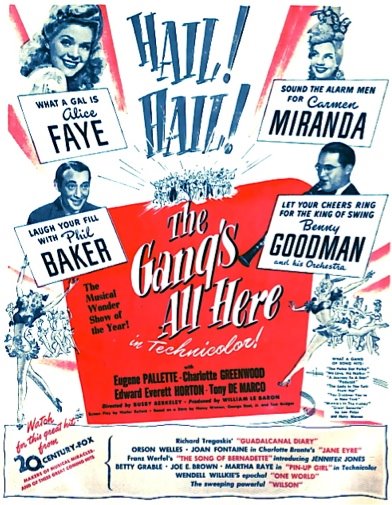
So iconic is this technicolorful Latina that she might not strike you, on the face of it, as the ideal subject for a sound-only documentary; but there she is, the life of Russell Daviesโ€™s โ€œCarmen Miranda: The Lady in the Tutti Frutti Hat.โ€ Once you remove that hat, you will find much to tip yours to as you listen to Ruby Wax, assisted by biographers Helena Solberg and Martha Gil-Montero, unravel the story of Maria do Carmo Miranda da Cunha, born one hundred years ago in the small town of Marco de Canaveses, Portugal. As Carmen Miranda, she came to represent not just her non-native Brazil, to which her family emigrated, but the whole of Latin America; and while what she became was larger-than-life, the โ€œBrazilian bombshellโ€ was not quite so large as to coverโ€”or levelโ€”quite so much ground. It is the leveling that those proud of their origins and culture resentโ€”and Brazilians, in particular, came to dismiss Hollywoodโ€™s All South-American girl as inauthentic, irregular, and downright ignominious.

The United States, of course, was counting on what it hoped to be a Pan-American appeal; it is what made the former millinerโ€™s apprentice such a sought-after commodity during the Second World War. At the end of the war, she was reputedly the highest paid woman in the United States.

A romance born of hardship and ingenuity, a glittering success tarnished by rejection, an identity challenged by dislocation and enfranchisement, a glamorous life culminating in early death, the one-of-a-kind yet kind of universal story of โ€œThe Lady in the Tutti Frutti Hatโ€ is the stuff of legend. Sure enough, that is what, according to the Internet Movie Database is what is about to come out of Hollywood any day now: Maracas: The Carmen Miranda Story.

The samba-infused first installment of this three-parter makes ample use of original recordings to highlight the performerโ€™s early musical career. Considering that the next chapter is going to transport listeners from Rio to Hollywood, I wonder whether it is going to draw on the one source that, aside from shellac, is best suited to the mediumโ€”the sounds of Carmen Mirandaโ€™s life on the air: her samba lesson for Orson Welles; her dramatic scenes with Charlie McCarthy, or her joking with Tallulah Bankhead, Judy Holliday and Rex Harrison on The Big Show. Never mind that hat. She was the Lady with the Tutti Frutti voice, which is why she had her own radio program down south.

Carmen Miranda died on 4 August 1955, within hours after suffering a heart attack while performing on Jimmy Duranteโ€™s live television program. Could it be that our demand for visuals, our insistence to be shown what can be heard and felt more keenly in darkness, is what caused Carmen Mirandaโ€™s heart to stop its rhythmic beatings? A program like โ€œThe Lady in the Tutti Frutti Hatโ€ offers us a chance to bring her into our presence, take her in as the voice, the breath that gave her life. We only need to make the effort to be all ears . . .


Related recordings
Hello Americans (15 November 1942)
The Charlie McCarthy Show (23 November 1947)
The Big Show (25 March 1951)

The Whole Ball of Wax: โ€œLife With Lucy and Desiโ€

โ€œShe wasnโ€™t the nicest person all the time,โ€ biographer Tom Gilbert puts it mildly; but to say even that much apparently triggers complaints from many Lucy lovers, to whom journalist Mariella Frostrup apologizes in advance. Frostrupโ€™s voice is enough to win anyone over, even though it might make at once forgive and forget what she is saying. Hers has been called the โ€œsexiest female voice on [British] TVโ€โ€”and the hot medium of radio only accentuates her seductive powers. So, where was I?

Right, โ€œLife With Lucy and Desi.โ€ It wasnโ€™t all love and laughterโ€”especially not for children. Actress Morgan Brittany recalls a scene on the set of Yours, Mine and Ours (1968) in which Ball lost her temper when one of the kids dared to laugh and ruin a difficult take. Native Americans in traditional garb and images of birds likewise irritated her, as did bodily contact. โ€œShe didnโ€™t like people being near her,โ€ Gilbert observes.

She wasnโ€™t funny, and she wasnโ€™t all that nice. Thatโ€™s what those stepping behind the microphone for a new hour-long BBC radio documentary have to say about the โ€œrealโ€ Lucille Ball, comedienne, businesswoman, and small-screen icon. Not exactly a revelation, to be sure; but you might expect less after reading the blurb on the BBCโ€™s webpage for the program, which revises history by calling I Love Lucy โ€œa zany television series which ran for twenty five years.โ€ Well, letโ€™s not heckle and jibe. The anecdotal impressions of those who can justly claim to have seen both sides of Ms. Ball make โ€œLife With Lucy and Desiโ€ a diverting biographical sketch, however moth-balled the gossip some twenty years after the actress’s death.

She seemed somewhat out of touch as well, even though she got to run the run-down RKO and signed off on Star Trek, a program she assumed, as Gilbert asserts, to be about performers entertaining the troops during the Second World War.

โ€œLifeโ€ is further enlivened by numerous recordings from Ballโ€™s career in television, film and radio. My Favorite Husband, I am pleased to note, has not been left out of this phono-biographic grab bag, even though the snippet from the radio forerunner to I Love Lucy airs without commentary; nor is it always clear what it is that we are hearingโ€”no dates or episode titles are mentionedโ€”the clip from My Favorite Husband, for instance, is not identified as being been taken from the 4 March 1949 episodeโ€”and the selections seem not merely random, but hardly representative of Ballโ€™s finest moments in this or any medium. When you hear her sing โ€œItโ€™s Todayโ€ (from the stage hit turned film dud Mame), youโ€™d wish someone would โ€œstrike the band upโ€ to drown out the wrong notes.

The argument this documentary seems to make is that Lucy would not have been Lucy if Desi had not been Ricky. Ball had talent, Brittany concedes, but might have ended up like โ€œBabyโ€ June Havoc, whom Brittany portrayed in Gyspyโ€”a fine performer who never quite reached stardom and who, though still living, is not nearly so well remembered today as to be celebratedโ€”or critiquedโ€”in a radio documentary of her own. She might just have remained the โ€œQueen of the Bโ€™s.โ€

The inevitable Robert Osborne aside, the lineup of folks who knew or at any rate worked with Ball also includes โ€œLittle Rickyโ€ Keith Thibodeaux, Peter Marshall (who walked out on a chance of working with Ball), Allan Rich (who played a Judge on Life with Lucy; not, as Frostrup has it, on the Lucy Show) and writer Madelyn Davis (formerly Pugh), who still gets fan mail for having created the durable caricatures that were โ€œLucy.โ€

No mention, of course, is made of Hoppla Lucy, viewings of which constitute my earliest television memories (Hoppla Lucy being the title of the German-dubbed Lucy Show). Long before I had breakfast with Lucy when truncated (make that mutilated) episode of her first and finest television series aired on New Yorkโ€™s Fox Five every weekday morning, a truncated version of myself sat down to watch Lucy bake a cake and making a mess of it. I havenโ€™t watched it since, but can still tune in the laugh it produced. Who cares whether or not what I saw was the real Ball. I sure was having one.


Related recordings
My Favorite Husband (4 March 1949)

Related writing
“Havoc in ‘Subway’ Gives Commuters Ideas”
“‘But some people ain’t me!’: Arthur Laurents and ‘The Face’ Behind Gypsy

Re: Boot (A Mental Effort Involving Distant Cousins)

Like many a woebegone youth of my generationโ€”once known as the No Future generationโ€”I entered the crumbling empire of Evelyn Waughโ€™s fictions by way of that lush, languid serial adaptation of Brideshead Revisited. It wasnโ€™t so much what I saw as what I had missed that made me pick up the book. Owing to my motherโ€™s loyalty to Dynasty, which aired opposite Brideshead on West German television back in the early 1980s, I was obliged to fill whatever holes our weekly appointment with the Carringtons had blasted into Waughโ€™s plot. Even more circuitous was my subsequent introduction to A Handful of Dust (1934).

In keeping with the titleโ€”and in poor housekeeping besidesโ€”a tatty paperback of it had been cast to steady a wonky table in the community room of a nurseโ€™s residence at the hospital where I carried out such duties as were imposed on me during the mandatory twenty-month stretch of civil service any boy not inclined to be trained for military action was expected to fulfill.

For twenty months, I, who ought to have been eating strawberries with Charles Ryder, served canteen slop and sanitized bedpans at a Cologne hospital. Was there ever a locality less deserving of the name it gave to the art of concealing our stenches, of which Romantic poet Samuel Taylor Coleridge once “counted two and seventy” in Cologne alone? My head was not held very high during those days, which probably led me to investigate just what propped up that misshapen piece of furniture. For once, though, I had reason to lament being downcast. A Handful of Dust turned out to be a rare find.

Counting the weeks to my release, I could sympathized with its anti-hero, the hapless Tony Last, trapped as he was in the wilds of the Amazon, forced to read the works of Charles Dickens to the one man who could have returned him to civilization but, enjoying his literary escapes, refused to release himโ€”a scenario familiar to regular listeners of thriller anthologies Suspense and Escape.) Like Mr. Last, I had gotten myself in an awful fixโ€”and up a creek that smelled the part.

So, when I think of Evelyn Waugh’s early fictions now, at a time in my life when I can more closely associate with his later Ordeal of Gilbert Pinfold, what comes to mind is the comparative misery of my youth and the pleasures derived from the incongruities at the heart of his late-1920s and 1930s novels, satires like Decline and Fall (1928), Vile Bodies (1930), and Black Mischief (1932). While not inclined to relive those days by revisiting such titles, I could not turn down the chance of another Scoop (1937), the first installment of a two-part adaptation of which is being presented this week by BBC Radio 4.

Ever topical, Scoop is a satire on journalism, war and the money to be made in the Hearstian enterprise of making the news that sells. Finding himself in the midst of it all is William Boot, whose sole contribution to the field of journalism is a โ€œbi-weekly half-column devoted to Nature.โ€ Decidedly not mightier than the sword, his pen produced lines like โ€œFeather-footed through the plashy fen passes the questing vole. . . .โ€ Not the rugged, muscular prose youโ€™d expect from a war correspondent.

It was all a deuced mistake, of course, this business of sending Boot to report on the crisis in Ishmaelia, a โ€œhitherto happy commonwealthโ€ whose Westernized natives no longer โ€œpublicly eat human flesh, uncooked, in Lent, without special and costly dispensation from their bishop.โ€ The chap who was meant and eager to go among them was Williamโ€™s namesake, one John Courteney Boot, a fashionable novelist who โ€œkept his name sweet in intellectual circles with unprofitable but modish works on history and travel,โ€ works like โ€œWaste of Time, a studiously modest description of some harrowing months among the Patagonian Indians.”

Absurd situations and wicked caricatures aside, it is Waughโ€™s proseโ€”the pith of impish phrases like โ€œstudiously modestโ€โ€”that makes a novel like Scoop such a font of literary Schadenfreude. โ€œAmusingly unkind,โ€ the London Times Literary Supplement called it. As it turns out, the jokeโ€™s on us once the narration is removed.

Condensing the wild plot in suitably madcap speed, Jeremy Front’s radio adaptation retains little of the narration, sacrificing not only wit but clarity to boot. What is left of the Waughโ€™s exposition may well lead the listener to believe that John, not William, is the central character. Indeed, like Waughโ€™s dimwitted Lord Copper, head of the Megalopolitan Newpaper Corporation, listeners are apt to (con)fuse the two.

Unlike Front, Waugh takes great pains to set up the farcical plot, dropping first one Boot, then another, and makes it clear just how the unequal pair are matched:

โ€œThe fashionable John Courtney Boot was a remote cousin [of William],โ€ Waughโ€™s narrator informs us, but they โ€œhad never met.โ€ Too eager to get on with the story, Front omits these line, relying solely on the juxtaposition of the two characters, who, during those first few minutes of the play, are little more than names to us.

However bootless the lament, I wish those stepping into the wooden O of radio today would put themselves in the shoes of their listener. Before experimenting with fancy footwork, they should consult a few classics to arrive at the proper balance between dialogue and narration. Otherwise, a potential Scoop can seem like such a Waste of Timeโ€”especially to those whose concentration is impaired by plot-obstructive reminiscences . . .


Related recordings
โ€œThe Man Who Liked Dickens,โ€ Suspense (9 Oct. 1947)
โ€œThe Man Who Liked Dickens,โ€ Escape (21 December 1952)