
Misinformation, Please: Earl Derr Biggers, Rex Stout, and Charlie Chan’s Sons

Earlier today, I added a few titles to our movie database, a list I try to keep up to date so as not to lose track of our collection. Yesterday, the fifth and final Charlie Chan box set arrived in the mail, containing the seven last entries into the 20th Century Fox series. Among them are some of my favorites: Charlie Chan at the Wax Museum, Castle in the Desert, and Dead Men Tell. Ever since I discovered these movies on German television—in German, mind you—I have been inordinately fond of the much-traveled sleuth, no matter how ramshackle to politically incorrect his vehicles.

As I shared here a few years ago, I never enjoyed a close relationship with my father, long since departed, and the Chan pictures somehow made me, an introvert teenager, long for the kind of bond grown-up sons number one and two maintained with their gentle and generous pop. Charmed by the series, I picked up Earl Derr Biggers’s Chan novels . . . and was greatly disappointed.

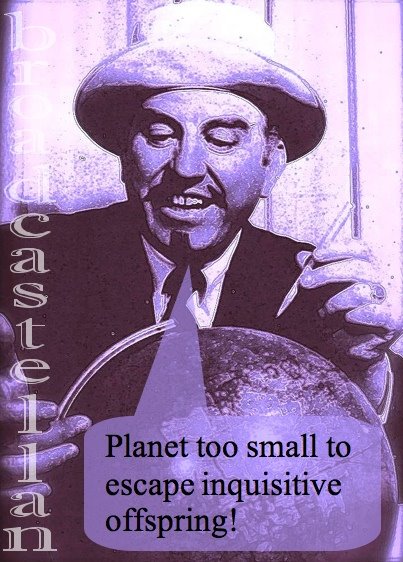
Biggers, whose Seven Keys to Baldpate was being presented on the Lux Radio Theatre on this day, 26 September, in 1938 (as already discussed here) may have been the father of Charlie Chan, but the brainchild, like Frankenstein before him, was passed around so often and given so many transformations that few recalled or bothered with his origins. After the author’s death, there followed such a long line of foster parents that hardly any of the family traits and characteristics can still be traced in the child. Shown above, for instance, is radio Chan Ed Begley (in a picture freely adapted from its source).

Some folks, though, remember. One of them was mystery writer Rex Stout. On this day in 1939, Stout appeared on the quiz program Information, Please! (discussed here) and, along with his fellow panelists, was called upon to answer a number of mystery related questions. In a task posed by a listener from Morristown, Pennsylvania, the panelists were to name heroes of crime fiction who were aided in their detective work by their fathers, their offspring, and their secretaries.

Clearly, this was a subject of which mystery writer Rex Stout could be expected to be familiar. Sure enough, the father of Nero Wolfe was quick to identify Ellery Queen’s paternal helpmate. “I’d hate to ask you to mention the actual titles of books by one of your rivals,” host Clifton Fadiman remarked, “but could you name, er, one or two of Mr. Queen’s books?” He should have said, Messrs. Queen, of course; but never mind.

At any rate, a straight answer from the competitor was not forthcoming, aside from the sly reply “The Adventures of Ellery Queen,” the title of the radio series based on the character but not penned by its creators.

When it came to naming a crime-solving father being assisted by his son, Stout shrouded himself in silence. It’s a “series of books,” Fadiman assisted, that had been successfully adapted for the screen. “Charlie Chan,” fellow panelist Carl Van Doren replied. “Quite right,” said Fadiman. To be sure, the word “assisted” is rather questionable; for, as Chan remarked in Murder over New York (also part of the abovementioned collection), “many cases would have been solved much sooner” had son Jimmy not insisted on getting involved.

Fadiman was ready to move on; but Stout voiced his disagreement. “Pardon me, Mr. Fadiman,” he interjected, “not in any of his books was he aided by his son, except that his son laced up his shoes or something for him.”

“That’s a help,” said the host, brushing aside the objection without giving it any consideration. “Korrektur bitte,” Chan’s German alter ego might well have protested, however mildly. Stout was right. The father-son relationship was created for the movies so as to give the rather austere Chan his Watsonian sidekick.

And very glad I am for this infidelity and the wayward child thus begot. “Does anyone help Nero Wolfe in your own series of stories, Mr. Stout,” Fadiman inquired. “I do, pretty often,” he quipped, missing out on a chance to give Archie Goodwin his due. Not long after the Information, Please broadcast, at a time when even Charlie Chan was enlisted into the Secret Service, Stout turned “lie detective” to expose the misinformation, spread through enemy propaganda, in a series titled Our Secret Weapon.
Mr. Benny Gets the Key to Baldpate

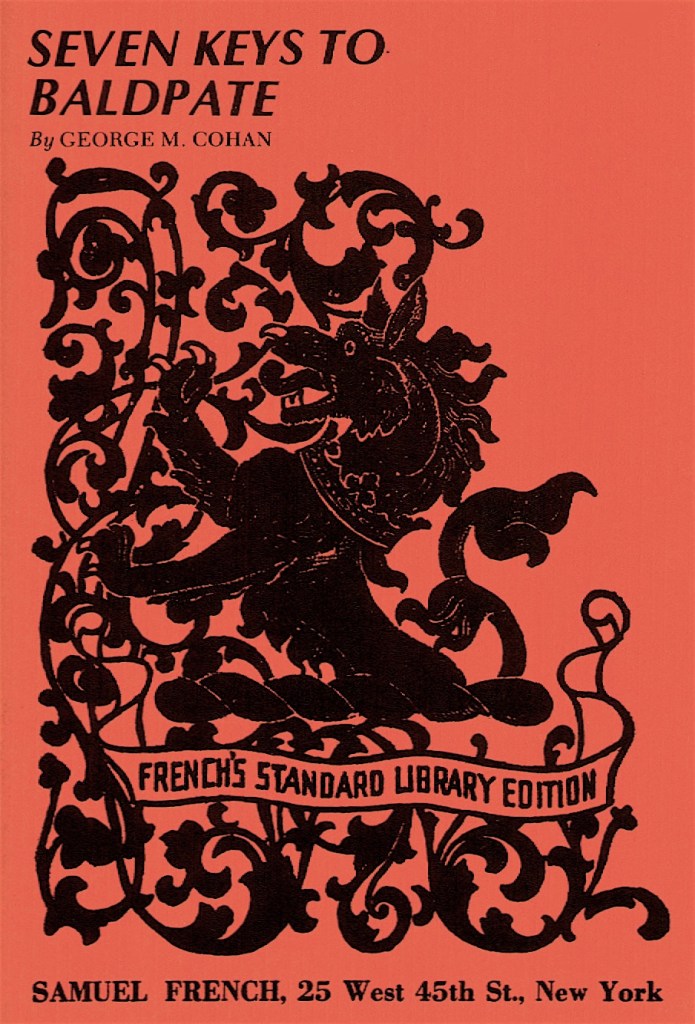
Well, I feel rather less prickly than yesterday. My cold seems to be on its way out and, having spent some time out of doors in the warmth of the autumn sun, I feel somewhat more serene and benevolent. Speaking of doors (a transition more creaky than the farce I am writing about today): Having complained previously (and elsewhere) about the conventional and therefore superfluous adaptation of Jane Eyre now flickering in weekly installments on British television, I am going to mark the anniversary of a decidedly more inspired variation on what was once a similarly familiar work of fiction, Seven Keys to Baldpate, a crowd-pleaser that was revived for radio on this day, 26 September, in 1938.

Granted, it is easier to rework a piece that does not warrant the reverence befitting a literary classic such as Jane Eyre, a respect that can be artistically stifling when it comes to revisiting or revising what seems to demand fidelity rather than felicitous tinkering. A mystery novel conceived by Earl Derr Biggers, the creator of Charlie Chan, Seven Keys opened many more doors after going through the smithy of theater legend George M. Cohan. Unlike Biggers, Mr. Cohan did not play it straight, but turned the thriller into what he then sold as a “Mysterious Melodramatic Farce”—starring himself.

In Cohan’s farce, the thriller writer Bill Magee accepts the $5000 challenge of a friend who dares him to pen a novel within twenty-four hours. To achieve this, the author is being given what he believes to be peace and quiet—the only key to a remote resort shut down for the winter.

During his night at Baldpate Inn, the supposedly single guest is disturbed by an assortment of singular strangers, lunatics and villains, until his friend shows up to confess that the bizarre goings-on were a practical joke designed to illustrate the ridiculousness of the author’s improbable plots. The epilogue of Seven Keys discloses, however, that the action of the play was a dramatization of the novel Magee actually managed to complete that night. He won the wager by fictionalizing the challenge.

Opening on 22 September in 1913, the play became an immediate and oft-restaged favorite with American theatregoers. It was subsequently adapted for screen and radio. When, some twenty-five years after its premiere, the producers of the Cecil B. DeMille hosted Lux Radio Theatre got their hands on this potboiler, they slyly revamped it as a commercial property fit for the latest medium of dramatic expression.

In his introductory remarks, DeMille promises the listener a “special treatment” of the play—and that, for once, was no overstatement. As I have discussed at length in Etherized Victorians, my study on old-time radio, the broadcast revision is not so much a rehash as it is an media-savvy update of the original.

Whereas Cohan’s version celebrates the victory of popular entertainment, of readily digested pulp fictions churned out for a quick buck, Lux writer-adaptor George Wells transforms Seven Keys into a radio story—a story about radio that parodies the anxiety of former vaudevillians-turned-broadcast artists to achieve lasting success, to be remembered long after the shows in which they starred week after week had gone off the air—to become cultural icons despite their invisibility. And those keys to uncertainty were handed to the man who had been through it all and stayed on top by knocking himself down, fall guy comedian Jack Benny.

Instead of a successful novelist, the artist now up for a crazy night at Baldpate is Jack Benny, as “himself,” a frustrated thespian who accepts the challenge of developing a suitable dramatic vehicle for himself after having been turned down for serious dramatic parts time and again. Benny’s challenger is no other than Mr. DeMille, who, in a rare stunt, not only introduces and narrates the play, but acts in it, and that without having to drop his director-producer persona. Throw in a few Lux Flakes and it comes out a clever bit of promotion all round.

The unpretentious yet self-conscious reworking of a play as old hat as Baldpate into a comment on the recycling business of radio entertainment—and a demonstration of how to lather, rinse, and repeat successfully—is one of Lux‘s most ingenious and engaging productions.