Once Upon a Time in Radioland: A Kind of Ruritanian Romance
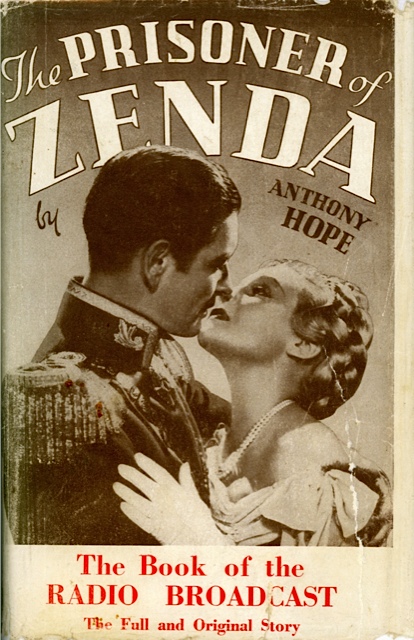
The other day, at my favorite bookstore here in Aberystwyth, I was caught in the eye by what struck me as a highly unusual cover for a 1938 edition of Anthony Hope’s fanciful pageturner The Prisoner of Zenda. Mind you, I’m not likely to turns those pages any time soon. I’m not one for Graustarkian excursions. That I found the old chestnut so arresting is due to the way in which it was sold anew to an audience of Britons to whom such a mode of escape from the crisis-ridden everyday must have been sufficiently attractive already. This was the 92nd impression of Zenda; and, with Europe at the brink of war, Ruritania must have sounded to those who prefer to face the future with their head in the hourglass contents of yesteryear like a travel deal too hard to resist.

Now, the publishers, Arrowsmith, weren’t taking any chances. Judging by the cover telling as much, they were looking for novel ways of repackaging a familiar volume that few British public and private libraries could have been wanting at the time.
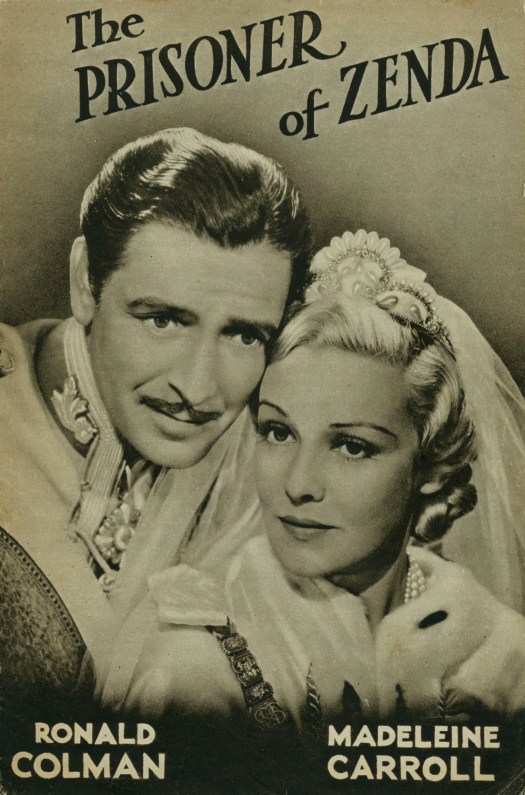
British moviegoers had just seen Ruritania appear before their very eyes in the 1937 screen version of the romance, which make dashing Ronald Colman an obvious salesperson and accounts for his presence on the dust jacket. It is the line underneath, though, that made me look: “The Book of the Radio Broadcast,” the advertising slogan reads. Desperate, anachronistic, and now altogether unthinkable, these words reminded me just how far removed we are from those olden days when radio ruled the waves.
“The Prisoner of Zenda was recently the subject of a highly successful film,” the copy on the inside states somewhat pointlessly in the face of the faces on the cover. What’s more, it continues, a “further mark of its popularity” was the story’s “selection by the BBC as a radio serial broadcast on the National Programme.” To this day, the BBC produces and airs a great number of serial adaptations of classic, popular or just plain old literature; but, however reassuring this continuation of a once prominent storytelling tradition may be, a reminder of the fact that books are still turned into sound-only dramas would hardly sell copies these days. Radio still sells merchandise—but a line along the lines of “as heard on radio” is pretty much unheard of in advertising these days.

“This book is the original story on which the broadcast was based,” the dust jacket blurb concludes. I, for one, would have been more thrilled to get my hands or ears on the adaptation, considering that all we have left of much of the BBC’s output of aural drama is such ocular proof of radio’s diminished status and pop-cultural clout.
Perhaps, my enthusiasm at this find was too much tempered with the frustration and regret such a nostalgic tease provokes. At any rate, I very nearly left Ystwyth Books without the volume in my hands. That I walked off with it after all is owing to our friend, novelist Lynda Waterhouse, who saw me giving it the eye and made me a handsome present of it. And there it sits now on my bookshelf, a tattered metaphor of my existence: I am stuck in a past that was never mine to outlive, grasping at second-hand-me-downs and gasping for recycled air . . . a prisoner of a Zenda of my own unmaking.
Double Hedda: Friel, Ibsen, and the Business of Giving It One’s Best Shot
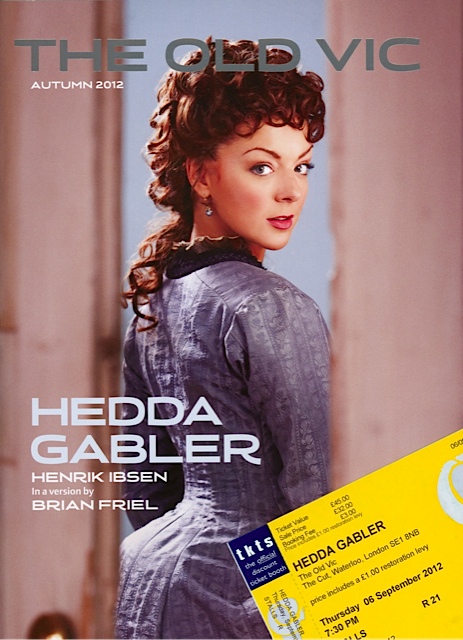
“I don’t think he’s written a line that’s unnecessary,” Adrian Scarborough remarked about Henrik Ibsen during rehearsals for the latest production of Hedda Gabler at London’s Old Vic, in which Scarborough plays the part of Hedda’s husband. The endorsement is peculiarly out of place, considering that the Old Vic’s Hedda hardly distinguishes itself by—or even strives for—a line-by-line fidelity to Ibsen’s original. Rather than a rewording of previous translations, Brian Friel’s “new version” puts a few new words into the mouths of the old, familiar characters created by his fellow playwright, adding a line here and there that left me questioning their necessity.
Now, few theatergoers around the world are in a position to compare Ibsen’s Norwegian to the translation in which they hear those lines performed; and whether a character (in this case Hedda) says “But of course one has to grow accustomed to anything new” or “New surroundings take a little getting used to” seems to make little difference. Are such substitutions worth the bother? What’s more, are they worthy of a playwright like Friel?
“But of course one has to grow accustomed to anything new.” That line can be found in the American-English translation by Rolf Fjelde, who, in an effort of doing “the very best [a translator] can do,” kept “a conscience-file of revision” in hopes of getting the opportunity “Finally [to] Get It Right.” Fjelde got that chance—and the result seems not particularly in need of further emendation. Playwright Friel, though, is not about to offer his services as a mute transcriber whose job is to interpret without drawing attention to the interpreter and the challenges or impossibilities of arriving at any one definitive text in a given or taken language. Friel does not claim his English version to be the last word—and, rather than having us take his word for it being faithful, wants to have a word with us about it.
To do so, Friel inserts hints of himself into the action, which, aside from Hedda’s quest to destroy, quite literally, the text of patriarchy, involves the contest between two published writers, both western and male. Most overtly, he does this by taking liberties with the lines spoken by the middle-aged Judge Brack who, in Friel’s version, confounds his listeners with Americanisms like “making whoopee” and provides a running commentary on the currency and lifespan of written and spoken language. “Philadelphia, there you go!” Friel seems to say to Fjelde, suggesting that Broadway and the West End may well require or at least warrant alternate versions of Ibsen and arguing that neither variant of English can or should be considered transcontinental, let alone universal.
Unlike Fjelde, Friel reminds us that we are in Norway, having characters drop names of places or remarking on the quality of “Norwegian air.” Yet, also unlike Fjelde, Friel reminds us, by foregrounding the novelty or datedness of words and debating their suitability, that we are not in any particular, definitive place at all but that we are instead in the contested, dangerous territory of language. It is a territory that Hedda seems to control for a while with her probing questions and scathing remarks but that nonetheless delimits and ultimately overmasters her.
As scholar Anthony Roche puts it, Friel demonstrates himself to be “concerned with updating the constantly changing English language that will always require new adaptations of Ibsen, while making subtle additions that perhaps deepen our understanding of the rich emotional lives of the characters.” Friel’s Hedda is almost as much about Ibsen’s characters as it is about the act of reading them … and of interpreting Ibsen. It is a self-conscious take on the act of taking on a classic that, in its reflexivity borders on the by now rather tiresomely postmodern. Give it your best shot, translator, I felt like responding, and let Hedda get her gun and do the rest.
That Hedda couldn’t quite do her job—and that Friel hadn’t quite done his—became apparent from the laughter in the audience even as Hedda was about to do away with herself in the ingenious glass coffin the Old Vic production had prepared for that purpose. “This is my first Ibsen,” commented actress Fenella Woolgar (who took on the part of Thea Elvsted), “and I’m discovering that he is a lot funnier than I anticipated.” Perhaps, that’s because this ain’t quite Ibsen and because Friel isn’t quite the Ibsen-minded processor anyone expecting a traditional Hedda interpretation is likely to expect.
“Translation,” as I said elsewhere (in an essay on the subject) is too mild a word to capture the violent process whereby a text written in one language and time is taken apart and rebuilt in another. Hedda is a violent play; but given that I find myself preoccupied with the making of this Hedda rather than with the unmaking of its nominally central character, I wonder whether Friel has not inflicted some harm, necessary or otherwise, on Hedda and Hedda alike …
Gotham/Gothic; or, A Tale of Two Strawberries

Much of what I know about English literature I learned in the Bronx. The peculiar indirection of my path—a German approaching British culture by taking the Lexington Avenue Express—did not escape me then; and even though I had no doubt as to the qualifications of those who taught me, I decided, upon finishing my Master’s thesis on the Scottish essayist-translator Thomas Carlyle, to go after something that, geographically speaking, lay closer to my temporary home.
Never one for obvious choices, I wrote my doctoral study on US radio drama, a subject that, however arcane, struck me as being rather more compatible with life in a Mecca for the enthusiasts of American popular culture among which I numbered. It also made it possible for me to take advantage of some of the resources particular to Manhattan, the isle of Radio City.
Not that I considered studying British culture so far removed from the Globe Theatre, the Scottish Borders, or the wilds of Yorkshire to be much of a disadvantage, being that I had adopted a subjective mode of reading that favors response over intention, that explores the reception of a written work rather than tracing is origins. Call it rationalizing, call it kidding yourself—I thought that I should make a virtue of vicariousness.
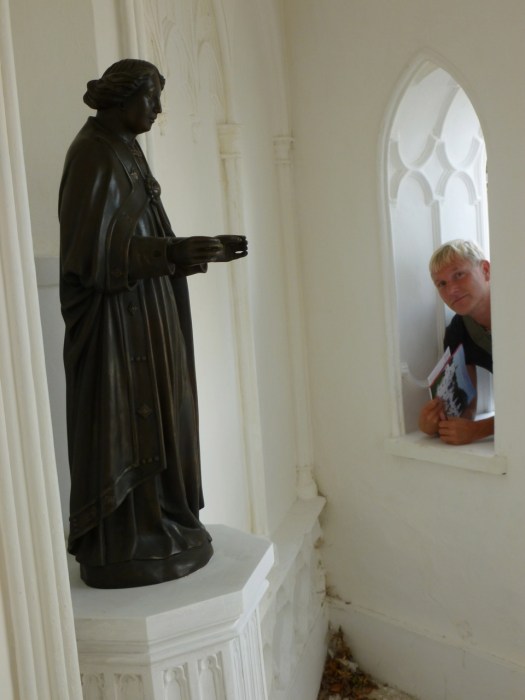
Living in Britain now, I am rediscovering its literature through the landscape rather than by way of the library; and I am finding my way back to those old books by stepping into even older buildings. One such book and one such building is Horace Walpole’s Castle of Otranto (1764), otherwise known as Strawberry Hill.

Originally a small cottage in rural Twickenham, Strawberry Hill was transformed by Walpole into a gothic castellino; it also housed the author’s own printing press, although Otranto was published in nearby London. The crenelated battlements were made of wood and needed to be replaced more than once in Walpole’s lifetime. “My buildings are paper, like my writings,” Walpole famously declared, “and both will blown away in ten years after I am dead.” This could well have happened; but, despite the relative weakness of his materials—a spurious medieval romance and the less than solid additions to Chopp’d Straw Cottage—both survive today as a testimony to Walpole’s enduring influence on popular tastes in architecture and literature.
And yet, however exciting the experience, walking around Strawberry Hill after all those years of living and studying so close to Strawberry Fields, Central Park, brought home nothing more forcibly than that getting to the heart of the matter that is art is not a matter of inspection but of introspection. Stripped of most of its furnishings, Strawberry Hill is a tease. Beyond the stained glass windows and the restored façade, there is little left of Walpole’s story or his antiquarian spirit. To be sure, even if Walpole’s library had not been emptied of the contents that makes and defines it, it would remain inaccessible to those looking around now without being permitted to touch and turn the pages.
Visitors to historic houses, like readers of fictions, must always be prepared to supply the fittings, to construct in their mind’s eye what the supposedly first-hand experience of seeing for ourselves can never make concrete and, therefore, never quite smash or supplant. Where, if not in our reading, dreaming, thinking selves does the spirit of literature reside?
The audio guide at Strawberry Hill is a self-conscious acknowledgment of this sightseeing conundrum; it plays like a radio drama—my studies of which have not gone to waste altogether—that teases us with the voices of the dead and the echoes of their footsteps. Our own footfall, meanwhile, is muffled by the protective plastic coverings provided for our shoes at the entrance to the site.
Walpole’s paper house has been given a permanence in the midst of which I am reminded of the paper-thinness of my own existence. What lingers is the anxiety of leaving here—or anywhere—without having left a trace at all.
Smoke Gets in Your Ears; or, What Price “Butch" and "George”?

The other day, Bob and I drove down to Leominster, England. The objective was to pick up a painting at a local auction house; but we made a day of it, during which we discovered Leominster to be a great town for antiquing. Now, when it comes to treasure hunts, my definition of “priceless” is “unvalued,” a label (or stigma) attached to objects that somehow don’t matter much and therefore sell for next to nothing. It is to those less prized items that I tend to be drawn—provided they have something to do with the undervalued performance art of radio.
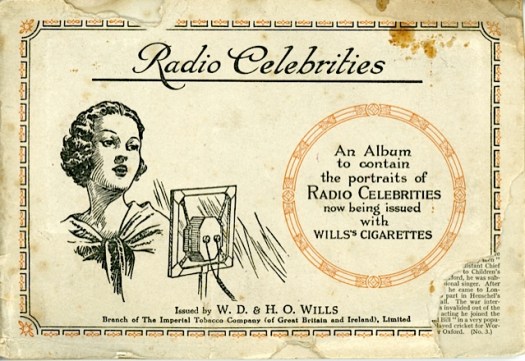
So, for about one hundredth of the cost of our latest oil, I took home a complete if somewhat tatty album of cigarette cards dating from 1934. Since it was issued in Britain (by W. D. & H. O. Wills), the “celebrities” displayed in it are all folks heard on the BBC at the time—and rarely heard of thereafter.
Unlike their American counterparts, whose voices or musical talents are preserved on recordings anyone can readily retrieve online, most of these BBC personalities would be truly forgotten today if they had not made a name for themselves in other media. Yet even if we remember the performer we are likely to be ignorant of the performance that brought them fame on the air.
A few years ago, Telegraph columnist Christopher Howse happened upon the same album now in my hands and remarked that the “world seen in [it] is as unfamiliar as the clipped tones of the celebrities it contains.” Flicking through these pages means facing indifference and neglect. How can we presume to know the 1930s if we can’t recall the names that then were household words, let alone put a voice to them?

Back then, the reverse was to be accomplished by those cigarette card collectibles: to put a face to the unseen visitors that millions welcomed into their homes. No doubt, the chief purpose was to sell tobacco products—but aside from fueling an addiction these albums satisfied the need to turn word to flesh and hold on to fleeting sound by way of printed image.
“For many years,” the “Radio Celebrities” album reminded the purchaser, anno 1934, “broadcasting artistes, announcers and speakers remained rather mysteriously aloof—in the air, as it were!” No more. The “Wireless” and their personalities were becoming “increasingly popular”; and the portraits to be collected and appreciated in this way were meant to “add a personal touch to names” that were already so “familiar to listeners.”
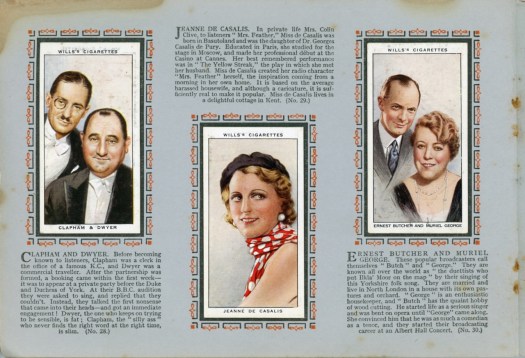
From time to time, I shall return to this album to report on the radio careers of Clapham & Dwyer, “Butch” (Ernest Butcher) and (Muriel) “George,” Jeanne De Casalis, and the forty-seven other “Radio Celebrities” that hit it big on the Beeb.
Down Memory Street; or, Thanks for the Sesame

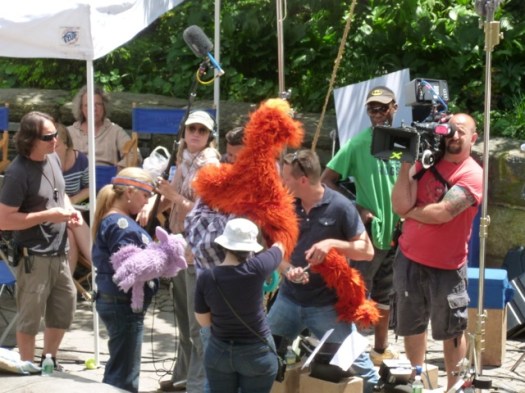
The sight was monstrous. There was shouting. They were shooting. Someone stood guard to keep strollers from trespassing while the action went on undisturbed. Few folks seemed to care, though, so familiar had such sights become in New York City. One could always catch up with it later, on television. Besides, this wasn’t a crime scene. It sure wasn’t Needle Park or Fort Apache, The Bronx. This was the peaceful, upmarket Upper East Side, for crying out not too loudly, and the wildly gesticulating savage in furs was of the Cookie Monster sort. Sesame Street was being filmed on location—and the location, on that May day, was Carl-Schurz Park in my old neighborhood of Yorkville.

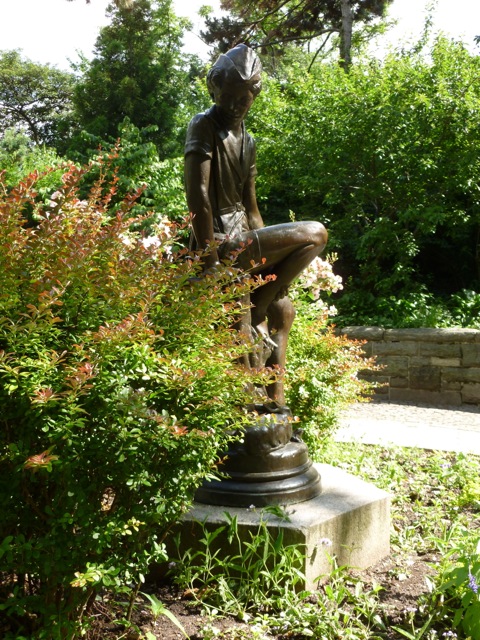
It seemed fitting that the beloved children’s television series should be shot here, right in front of Peter Pan, the bronze statue that, some fifteen years earlier—when the park had gone to seed other than Sesame—was violently uprooted and tossed into the nearby East River like an innocent bystander who, some thugs decided, had seen too much. It seemed fitting because Carl-Schurz Park is a tribute to German-American relations—and, in a long and roundabout way, I came to New York City from Germany by way of Sesame Street.
As a prepubescent, I spent a great deal of time in front of the television, a shortage of viewing choices notwithstanding. My parents were both working and I turned to the tube for company, comfort and the kind of guidance that didn’t come in the form of a command or a slap. West German television had only three channels until well into the 1980s, and the third one, back in the early 1970s, was still experimental, reserved mainly for educational programs aired at odd hours. Odd hours would have been anything before mid-afternoon, when regular programming commenced on weekdays.
So, there was literally nothing else on when I pushed the knob of our black-and-white set (a stylishly futuristic Wega) to come across Ernie, Bert, Oscar and the Cookie Monster—and they all spoke, growled or squeaked English. That is how I heard them first and how, several years before I was taught English at school, I got my first lessons in a foreign language.
I had just gotten through the alphabet and the numbers from one to ten when, without “Warnung,” Sesame Street turned into Sesamstrasse and the felty, fluffy foreigners became German, even though they changed neither looks nor scenery. Being beyond pre-schooling, I now tuned in chiefly for the puppetry and the antics of the Krümelmonster. That is the way the Cookie Monster crumbled. “Krümel” literally means “crumb,” suggestive of the state to which something solid could be reduced in the process of translation.
Educationally, the early dubbed version of Sesame Street was dubious, to say the least. Spoken and written words and images did not always match. Sure, “A” is for “apple” as well as “Apfel,” and “B” for “banana” and, well, “Banana.” But there was little use for “C,” since few words in the German language begin with that letter; at least they didn’t during those days before Computers. I remember watching a lesson on “A” that ended in “Alles am Arsch,” an expression only a tad short of the exclamation summed up in the last three letters of “snafu.” For once, even my parents took note.
Never mind, I remained loyal to Ernie and Bert, whose odd coupling I envied; and once the magazine accompanying the series was launched, with images of the puppets as centerfolds, the pair became my first pinups. If only Sesame Street (a pun that, too, is lost in German translation) had remained on the air in its original language. By the time high school started, and with it lessons in English—British, if you please—I had all but lost the enthusiasm; for the next nine years, I learned reluctantly and none too well, being that we were forced to go through joyless Grammar drills to arrive at the point of meaningful self-expression.
As a child, I never associated Sesame Street with any real place, let alone New York City, the seedy ways of which, back then, conjured scenes of violence and decay: the turf of gangs, the marketplace for drugs, and the inspiration for nothing except TV cop shows. It was just as difficult to get that image out of my head as it had been to get English into it.
Indeed, my first exposure to the Big Apfel demonstrated that image to be truer than the pictures of it in glossy travel brochures; no doubt, I had spent too much time eyeing the Carringtons of Denver, Colorado. That I fell in love with old, crime-ridden Gotham all the same had more to do with hormones than with anything we traditionally understand to be “tourist attractions.”
Since the mid-1990s, Manhattan has cleaned up its act, even though it wiped out much of the city’s character along with the crime—so successfully, in fact, that I once was slapped with a fine for dozing off on a bench opposite Peter Pan because I felt safe enough to rest my eyes.
Sesamstrasse, Carl-Schurz Park, and the old Wega set (images of which I had to google to remind myself): the neighborhood of memory sure gets crowded as you travel ever further down the road . . .
Some Like it . . . How? Youth, Vampires, and Marilyn Monroe

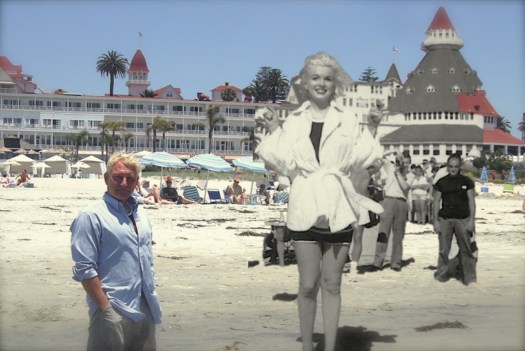
There I stood, in the shimmering sands of Coronado Beach, California. I had come, of course, to see the famous Hotel—and to share the views once taken in by Marilyn Monroe during the filming of Some Like It Hot. Marilyn was here. Now I was.
Footsteps. Sand. The old hourglass. I won’t indulge in such clichés here; but there is something pathetic about this kind of out-of-sightseeing, this belated catching up and impossible reaching out to which I am prone. The inclination to seek out what is long gone is more than morbid curiosity: it is an approach to life as a retreat from living in which even the here-and-now becomes dreamlike and chimerical. How did this get to be my way of not facing the world?
Marilyn Monroe died before I was born; yet her life and times became a fascination of my teenage years. Mine were not erotic fantasies. I did not long for her body. Nor did I think of her as being gone. She was never absent for long from the television screen, ever present on the iconic posters I pinned onto the wall above my bed. Records spinning on the old turntable, her voice filled my room. I had no regrets about never being able to meet her in the flesh; rather, it was a relief.
The wonder of her incorporeal existence made living in the body I loathed more tolerable; and it made the physical relationships I dreaded easier to contemplate in the abstract. Marilyn—and we call her by her first name because she is more familiar than famous, more girl than goddess—was not some facile paradox: “I Wanna Be Loved by You” and “I’m Through with Love” she sings in the same movie, expressing the hurt and hunger that are far from mutually exclusive.
Our teenage selves are preoccupied with the demands that both nature and society make on us, propositions and impositions captured in that horrible phrase haunting and taunting us until death: “grown up.” As a response to and rejection of the implied threat—the finality and premature stunting of our infinite potentialities—Marilyn’s afterlife was as much a reproof of society as it was a society-proof alternative: a twilight life, expired and undying, bright though snuffed out, a fragile, indomitable spirit-presence in whose shadowy glow I could luxuriate, just as many a young person nowadays revels in the gothic gloom inhabited by zombies and vampires, except that my imaginings transported rather than dispirited me.
No doubt, this twisted bent of casting myself into times preceding my birth is born of a desire to bring forth alternate selves of mine without having to bear the vagaries of the present or the uncertainties of the future. Like a life presumably squandered in reverie, bending the past to our will is a testament to a vestigial will power—or would-be power—in which the retrospective becomes invested with the prospect of an ever glimmering what if . . .
Undone and Dusted: The Long Art of Christopher Williams
“Glory be to God for dappled things,” Gerard Manley Hopkins famously exclaimed—in a poem, no less, that was first published some three decades after his death. The delayed recognition he received makes us now think of Hopkins as a modern poet rather than a Victorian one. Brought to light in the darkest of days, his words spoke to an inglorious post-World War world so different from the perfectly imperfect one he knew that he could hardly have anticipated it. And yet, anticipate us he did—and “[a]ll things counter, original, spare, strange.” Secure in his belief in the One “whose beauty is past change,” Hopkins could revel in all that is “fickle, freckled (who knows how?),” in a life that is protean, fleeting and undone—the ever unfinished and often dirty business of living reconciled to our longing for perfection, permanence, and the eternal.
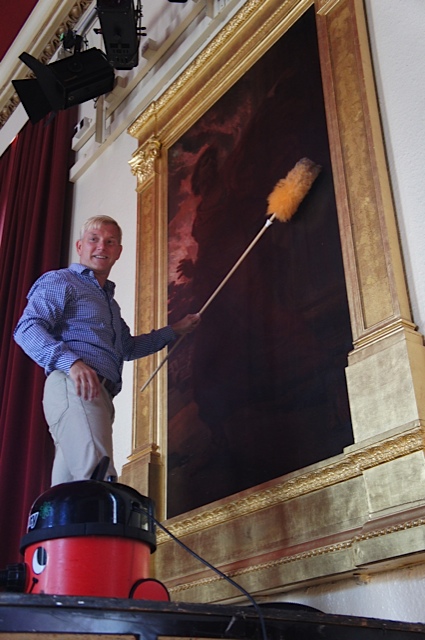
“Glory,” I wanted to shout, for dusty things, for art so long that no one in a single lifespan can ever be done with it—and for a chance to dust off works neglected and ignored to bring them to life anew. Not because they are perfect, not because they are classic or timeless—but because, in all their sketchiness, patchiness and almost-but-not-quiteness, they remind us—and glorify—the long and short of life: the clouds on the horizon, the waves hitting the rocks, the light of the ever setting sun on ancient mountains.
I was too busy tackling the dust (and keeping my mouth shut not to take it in) to wax philosophical and shout then—but I do think and feel it now when I look at some of the smaller canvases of Christopher Williams (1873-1934), a once well known artist, and native of Wales, whose forgotten and, in many cases, never before exhibited works I had a small part in putting back on public display here at the National Library of Wales in Aberystwyth.
Far more than Williams’s monumental paintings of momentous historical, mythological, and biblical themes, which belong to an age fast fading in his day, what is glorious to me are his studies of sea, sky, and rock—of the mutable majesty, the perennial transience of nature that he sought to encapsulate while working against time: the dying light of day, the waves against unwavering cliffs, the clash of the evanescent with the apparently everlasting.
A few years ago, when I knew little of Wales and less of Williams, I visited one of the spots along the coast he had painted and compared what I saw to what he had depicted. The rocks were the same all right, but the sea and the sky looked nothing like the painting. Had he painted what he wanted to see, wanted us to see, or remembered seeing? Years later, when I returned to the same scene, the sea was turquoise, the sky cerulean—it was as Williams had pictured it. Only then did I appreciate the long hours he must have spent studying the light and the colors it creates. What was before him was fleeting—what is before us is unfinished—but what his quick brush transported one hundred years into his future is the product of a study far from cursory. Perhaps it takes a knowledge of the presence of something past change to see past the unchanging and glory in the changeable.
And there they are now, on view for a short while (until 22 September 2012), these past glimpses of change, these small studies alongside his finished—staid, staged and stately—compositions I helped to ready for the big show. Not that the project is done and dusted, as, together with my partner, Robert Meyrick, the curator of the present retrospective, I shall be co-authoring a book on the artist’s life and work . . .
Stiff Competition: A Hairspray to Defy the West End Elements

Funny thing about prejudice: if you let it take hold, it can deprive you and those around you of a real good time. That, in a shiny Aqua Net shell, is the message of Hairspray, the musical. And, boy, did I deprive myself . . . until now. Sure, others around me still had that good time, but when Hairspray hit Broadway back in 2002, I was as set as an untamed cowlick. I would have none of it. My Aqua Net days were long behind me by then, and I was not going to splash out on a rehash of a late-1980s cult comedy about early 1960s culture-clashing teenagers, told in songs that a Porter and Gershwin kind of guy like me is not inclined to hum while wearing a shower cap. Well, Kiss my Kate! Last Friday, I finally woke up and smelled the coiffing. “Good morning, Baltimore!” And—oh, never mind “beautiful”—what a colorful morning it is.
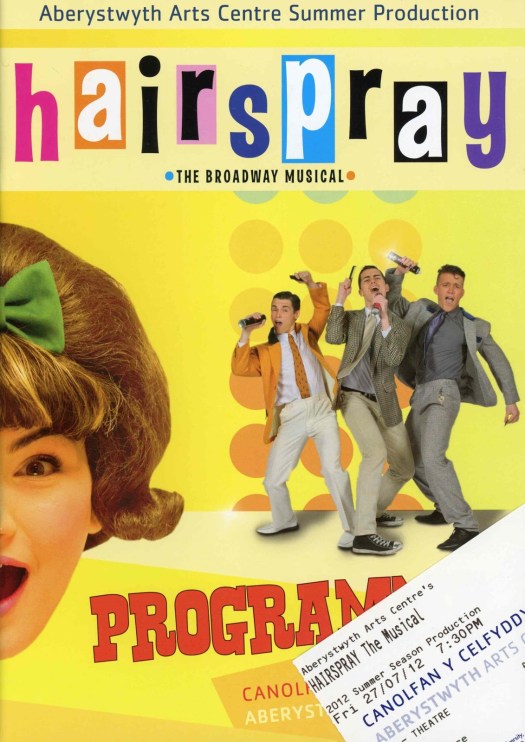
Funny thing, too, that I only had to travel about half a mile to learn that musical lesson; no subway ride down to 42nd Street, no walk through London’s West End via Leicester Square (and TKTS). Just up the hill, to Aberystwyth Arts Centre, where each summer a musical is staged that, as a tourist attraction, is far more reliable than our windswept seaside. Over the years, I have seen eight of those summer seasons come and go, from Oliver! to Chess. Boasting a cast whose list of combined Broadway and West End credits is way longer than I am in the tooth, this year’s production tops them all.
Its readily translatable story of teenage rebellion aside, Hairspray may not be the easiest piece of Americana to transplant to Wales. Never mind references to Allen Funt, Jackie Gleason, and the Gabors, names not likely to ring for today’s young, British audiences the bells I and Tracy Turnblad can hear. The Director’s Note in the program about Rosa Parks, whose image flashes on a big screen during one of the numbers, fills in some of the blanks. This, after all, is American history, no matter how much John Waters it down.
Then again, it may not be the easiest thing, either, to translate the Civil Rights Movement into a musical riot without becoming as crude or politically incorrect as John Waters used to be. But, whatever your own sense of otherness and experience of xenophobia might be—and “I Know Where I’ve Been”—Hairspray gives you enough of a whiff of those ill winds to make you investigate whence they blow. “Run and Tell That”: if any production can communicate a shakeup without making anger the primary colour of the emotional rainbow, Unholy Waters! this can can.
You might expect—and forgive, too—any glitches or leftover curlers on opening night; but there were none here: upon pulling the lid, this Hairspraywas as solid as a freshly lacquered beehive. Andrew Agnew is marvelous as Edna Turnblad, a part I identified so much with the fabulous Divine that I couldn’t face watching John Travolta in a latex mask. Agnew makes you forget both—and he plays Edna in such an understated way that her big number “(You’re) Timeless to Me” makes you understand what, to someone of my certain age, is the warm heart of this show. It’s a heart whose Beat you’d can’t stop without making Hairspray lose its maximum hold.
Edna might have missed every boat except the one she pours the gravy from; but she is not too old to kiss—and kick—the past goodbye and say “Welcome to the 60’s.” This transition requires more than a new do or a swift costume change; and Agnew achieves it by centering Edna in the 1950s, a woman who loves Lucy though she might not like Ike—and who not only loves Tracy from the remove of a generational gap but gets her, too.
Tracy, of course, is her daughter—the embodiment of that new age—and Jenny O’Leary inhabits the role with the confidence and youthful energy for which it calls. Tracy may not quite grasp just how seismic the event is in which she plays her part, an event—this much she knows—far bigger than “Negro Night” on the Corny Collins Show; but she approaches integration with the I-don’t-get-it naivety that has many of today’s youngsters baffled at their parent’s definition of marriage as a strictly segregated affair.
Hairspray leaves no doubt as to who “The Nicest Kids in Town” are; “nice” simply ain’t. It is self-serving conventionality, a meanness of spirit that lingers under the neat surface like something you fight with lice shampoo. How else to approach “Miss Baltimore Crabs,” Velma Von Tussle, a nasty piece of work done justice by Lori Haley Fox—and done in by the sheer force of Motormouth Maybelle, a woman who, like Edna, has seen better days, but whose better days were lived in times much worse.
Marion Campbell, who plays Maybelle, comes on stage late to belt out her showstopper of a number—and her presence hits you like, say, Mahalia Jackson’s in Imitation of Life: a voice to be reckoned with, especially in a fight for equality.
Though the actress playing Tracy Turnblad receives top billing, it would be wrong to call the rest of the cast “supporting.” Hairspray demands a great many good voices as it gives most of its characters the chance and challenge to shine, and everyone in this cast is living up to that challenge: Arun Blair Mangat as Seaweed, Samantha Giffard a Penny Pingleton, Morgan Crowley as Wilbur Turnblad, Hugo Harold-Harrison as Corny Collins . . .
The list is longer than that—but I’d be bald by the time I were done honor roll calling. Besides, if I’m counting anything it’s the days until my next trip to the salon for another hit of Hairspray. Yes, funny thing about prejudice: once confronted, it can yield such eye-opening, ear-popping surprises.
So, toodle-oo to stiff upper lip! Stiff up yer quiff instead.
So Long, Onslow

One of my too few regrets in life is that I did not manage to inspire any of my fellow students to make up a nickname for me when I was in high school. Not counting “Battle of the Sexes,” that is. That was more of a cut than a nick, and all because I didn’t seem quite ready to shave—or perhaps even to be beyond shaving—at least not where man folk is supposed to. It was much later in life that I earned a moniker, one that didn’t make me feel I should be called Monica, and without having to do much or make an effort to look like much to deserve it, if deserve it I do.
Onslow’s the name—a name that, to millions of television viewers, conjures up an image of a lazy slob in what is dead commonly referred to as a wife beater, a bad name given the kind of shirt I tend to don when the point of dressing up beats me, when reaching for a respectably casual shirt seems a waste of time, especially of daylight savings. Is it that shirt, or perhaps the silvery whiskers to the swift removal of which I do not always see soon enough now that I got them, at last? Else, it might just be those extra few pounds around my waist that just scream handle, luv! Handle, nickname, dishonorific, or what have you. It’s a name only an uppity so-and-so like Hyacinth Bucket would call a sobriquet.
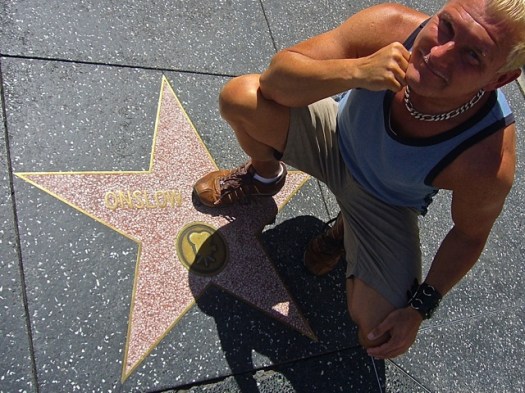
That I learned to live with—since that is so much easier than having to live up to anything else—can be readily demonstrated by the above shot taken on the Hollywood Walk of Fame. The star thus honored is, in truth, character actor Onslow Stevens; but I put my foot down to give the underachieving Onslows of this world their due, especially since I had already shed my shirt in the midday sun and was undressed for it.
Onslow, of course, was, like Ms. Bucket, a character in the Britcom Keeping Up Appearances, and Geoffrey Hughes was the actor who played the part, filling that undershirt better than I could ever hope or fear to do. Hughes died at the age of 68. And while I only knew him as Onslow—or Twiggy on The Royle Family—the fact that his passing topped news about the Olympics on the BBC website well before fatigue about that event set in even among High Jump (or Canoe Slalom or Trampoline or Water Polo) fanatics shows just how big a name he made for himself.