‘I Think or Not to Be’: Getting All Cogitative Halfway Through The Murder of My Aunt

So historical, I probably won’t finish it.

I have long come to the conclusion that I never quite know what I will say next.  I am determined however, that whatever I say last shall be more memorable than anything I said first or during any of the intervening years, which is probably not saying much.  

So that I don’t end up mouthing what has already been said, I am brushing up on notable quotations to discard.  Like ‘I think or not to be,’ for example, which has already been said first by at least two different people.

I also need to brush up on history – roughly from the Common Era to the somewhat less common Golden Age – which is decidedly more challenging, as history mainly consists of memorable things said by people who do not trouble themselves to say them memorably,  which is why I tend to recall facts largely fictitiously, to say the least.

The vast majority of histories, especially those I have not consulted, are altogether too long, I find.  Things are blow out of all epic proportions, with dates, names and crowned heads – some heavy, some severed – thrust at you, relentlessly (they) and unawares (you), in both quick and bloody succession, ‘succession’ often being synonymous with ‘bloody.’  The saying ‘Uneasy lies the head that facts wear thin’ comes to mind, if vaguely. 

At any rate, I am apparently not epicurean enough – or is ‘epidural’ the word? – which is to say that I have been numb to the pleasures of history since birth, an event that occurred so long ago that I have forgotten most of that, too (that last ‘that’ being different from any other ‘that’ in that sentence).  I am of an epigrammatical persuasion myself, although more so in my reading than in my writing, I have been told.

Speaking of which (reading, I mean): I was turning the pages of The Murder of My Aunt (1934) the other day (Thursday, I think), and I was reminded by its almost forgotten author, Richard Hull, of a history to end all histories – at least British ones, which used to cover more ground than latterly, with more shrinkage more likely than not.  To think that it took a work of detective fiction like Hull’s – which is not, by the way, a continuation of and fatal conclusion to Travels with My Aunt – to point me to a history in which wit is the very soul of brevity, to paraphrase somewhat!

Anyway, according to the narrating nephew of that titular relation, the latter, while yet living (in Wales, no less, to which I can relate, albeit reluctantly at times), had ‘been reading some absurd comic history of England, full, I gather, of elementary humour of the schoolboy variety.’  Apparently, the aunt enjoyed that ‘history’ so much that she named her two dogs after two men – the great and the good – mentioned therein. Just wherein that was the author lacks the accuracy and goodness to state.

The two dogs, meanwhile, are Athelthral and Thruthelthrolth.  After several failed attempts at spelling those names correctly, I scoured the internet, filthy place that it is, to discover that they refer to two ancient rulers that most histories have consigned to oblivion, a state that rulers generally make considerable efforts not to end up in, opting – vainly, as it turns out – for largely unread tomes instead.  

How could I have never heard of Athelthral and Thruthelthrolth, or, having heard, not recall them by name? I am not a native of any of the British Isles, I should point out in my defense – a word, incidentally, that I insist on not spelling with a ‘c,’ as many British people do, unless they are students of mine, in which case they generally do not concern themselves with spelling at all.

But I divagate, as only the Latin still say now.  The point is that the history the aunt made such good use of is 1066 and All That and that it is so good I am quite rooting for her now, even though her survival would make Hull’s ostensible Murder mystery somewhat less of one.  What I like most about 1066 – as a book, not a date – is that it is a) short, b) determined to be memorable (a word frequently used by the authors, Sellar and Yeatman), and c) interspersed with ‘tests’ to help me remember what I just read. 

About Athelthral and Thruthelthrolth, for instance, it asks readers:

Have you the faintest recollection of

1) Ethelbreth?
2) Athelthral?
3) Thruthelthrolth?

I puzzled for a while, but found the next question encouraging: ‘What have you the faintest recollection of?’ Indeed.

1066, somewhat confusingly, was written quite a few years later than its title suggests and published not until 1930, when it must have been hit so hard by the Depression (the great and not so good) that it disappeared under the rock it came to share with me, eventually.  Just before that happened, if ever it did, the book was highly regarded by H. V. Kaltenborn, who, in turn, was a big name in the history of radio, which is the only history that I have not only read but written, a fact that should be reassuring to at least someone, surely.

To get back to those last words of mine, for the breathing of which I am rehearsing at present without any particular urgency. Clearly, I need to cross out another two as unusable: Athelthral and Thruthelthrolth.  Had I thought of them to begin with, I would have been confident that they had not already been uttered.  Not that I am quite capable of uttering them, at least not with any great confidence or without a tissue to hand.

No matter.  I am undaunted by the challenge of having those last words ready for folks to go gentle on me on my last good night.  After all, who was it that said ‘Fools brush past where angels fear to sled’? Rosebud, I think.  Which reminds me to check whether he was Plantagenet or the House of Elsa Lanchester.  I am hoping 1066 and All That will have all the answers.

[This was my eight hundredth post. Most of the others are equal to however you might find this one to be, should you happen to find it at all.]
Destinées Imagined: Film Stills and Storylines

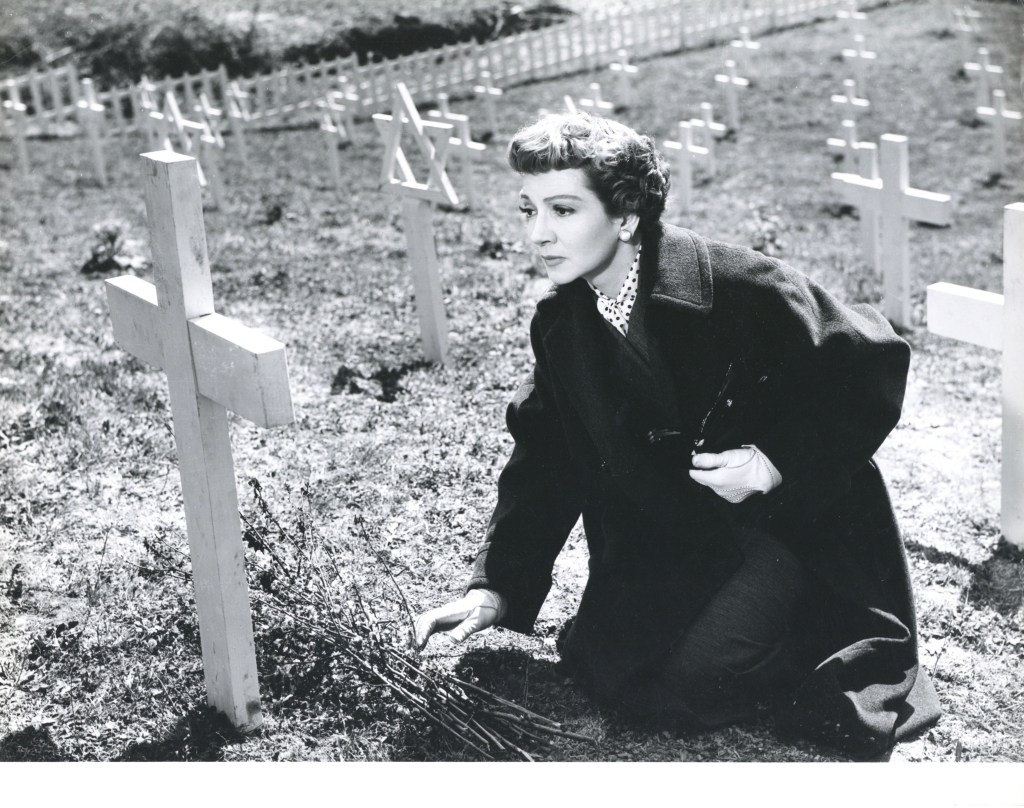
The most recent additions to my collection of movie memorabilia – and of images featuring the likeness of stage and screen actress Claudette Colbert (1903 – 1996) in particular – are stills for the 1954 motion picture Destinées.  The French-language film, released in Britain as Love, Soldiers and Women and in the United States as Daughters of Destiny, is one of the few works in the Colbert canon that I have not yet seen.  Rather than relying entirely on plot synopses provided by Colbert biographers William K. Everson, Lawrence Quirk, and Bernard F. Dick, I am imaging and imagining the film’s story, or, rather, the story told in one of the three vignettes that constitute Destinées.

Even before I determined on an order for the five film stills, what came across is that this is a story about absent men and relationships between the women they left behind.  From the image I chose to begin my stills-inspired version of the story, I can tell that Destinées is as much about the future as it is about the past: fate, fatality and a fatalism to be challenged.  The number of aligned grave markers, impersonal yet collectively inspiring awe, distinguish this site as a war memorial.  This woman might be a war widow.

What stands out in the field of Christian crosses is the prominently positioned star of David behind her, suggesting a memorial to those who were killed during the Second World War.  Either the narrative of this mid-1950s film is set in the recent past or Colbert’s character, for whatever reason, is only belatedly coming to terms with her loss.  She may have come to bury the past, or else to uncover it.  

Continue reading “Destinées Imagined: Film Stills and Storylines”

Forecasts in Hindsight: Wrongly Predicting the 1948 Presidential Election

As my motto ‘Keeping up with the out-of-date’ is meant to suggest, I tend to look toward the past; and yet, I resist retreat.  Retrospection is not retrogressive; nor need it be it a way of reverencing what is presumably lost or of gaining belated control over what back at a certain time of ‘then’ was the uncertainty of life in progress. I am interested in finding the ‘now’ – my ‘now’ – in the ‘then,’ or vice versa, and in wresting currency from recurrences.

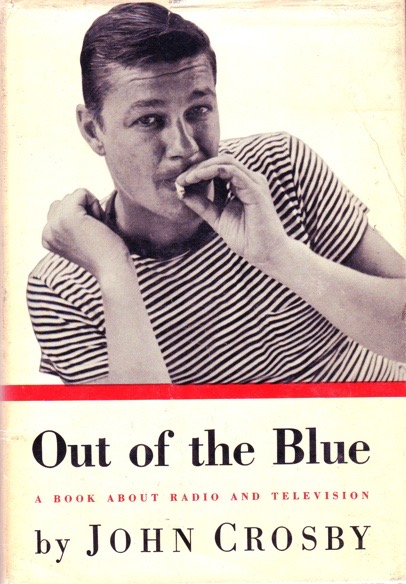
Many articles in Crosby’s column made it into this 1952 volume, which is on my bookshelf. The item discussed here did not.

I also tend to look at the ephemeral and everyday, the disposable objects or throwaway remarks we think or rather do not think of at all and dismiss as immaterial and obsolete, as too flimsy to carry any weight for any length of time.  Take an old syndicated newspaper column such as John Crosby’s “Radio in Review,” for instance.  Back in November 1948, Crosby, whose writing was generally concerned with programs and personalities then on the air, commented on a US presidential election that apparently no one, at least no one in the news media, had predicted accurately.  “Dewey Defeats Truman,” the headline of the Chicago Daily Tribune erroneously read on 3 November that year. Having listened to the words dispensed over the airwave on that day after – or, depending on your politics, in the aftermath of an election that paved the way for another term for President Harry S. Truman – Crosby noted:

‘Perhaps never before have such handsome admissions of error reverb[e]rated from so many lips with such a degree of humility as they did on the air last week.’  Truman had been in office since the death of Franklin D. Roosevelt in 1945; but in 1948, he had confirmation at last that the public – or the majority of those who made their views public and official – agreed that he belonged there.  As Crosby pointed out, even seasoned political commentators had predicted a Republican victory.

‘[T]here probably never has been an election post-mortem in which the words “I told you so” were not heard at all,’ the columnist remarked, adding that ‘if they were said, [he] didn’t hear them.’  To his knowledge, ‘[n]o professional commentators … told anyone so.’

Among those who, according to Crosby, got it more wrong than others was the ultra-conservative broadcaster Fulton Lewis Jr., an opportunist and influencer who, Crosby remarked, had gone ‘far beyond’ his fellow commentators by predicting ‘Republican victories in states where most observers foresaw a seesaw battle.’  

Speaking from the secular pulpit that was his radio program, Lewis ‘fully admitted his wrongness’ after the fact, Crosby noted, reading aloud the messages he received from listeners who ‘invited him to drop dead,’ to ‘throw himself’ into Chesapeake Bay, or to ‘go soak his head in a vinegar barrel.’  Far from remorseful or self-deprecating, such revelling in controversy is representative of right-wing provocation as we experience it to this day.  

A question not posed by Crosby is whether future Barry Goldwater supporter Lewis simply got it wrong – or whether he predicted wrongly to demoralise Truman’s supporters by suggesting that a Republican landslide was a foregone conclusion. Given Lewis’s known bias, the miscalculation was obviously not calculated to rattle Truman supporters out of complacency. So, a question worth asking now not how commentators got it so wrong, but why.

Lowell Thomas, a conservative commentator courting an audience of both major parties, insisted that he had not predicted the election but that he had merely ‘passed along the opinions of others.’  Thomas added, however, that, had he made a prediction, ‘he’d have been as wrong as everyone else.’  Unlike Lewis, this statement suggests, Thomas distinguished between reportage and commentary, the line between which was drawn no more clearly in 1948 broadcasting than it is in today’s mass media, discredited though they are as ‘legacy’ and presumably obsolete by the social media weaponizing political right.

Reporter Elmer Davis who, also unlike Lewis, was critical of then on-the-rise Senator Joseph McCarthy, a Democrat who turned Republican and opposed the Truman presidency for being soft on Communism,  provided this statement to his listeners: ‘Any of us,’ he said, ‘who analyze news on the radio or in the papers must hesitate to try to offer any explanation to a public which remembers too well the lucid and convicing explanations we all offered day before yesterday of why Dewey had it in the bag.’  Commentators had ‘beaten’ their ‘breasts’ and ‘heaped ashes’ on their heads since the election, Davis told his audience; but they still looked ‘pretty foolish’ and should probably wait some time before sticking their ‘necks’ out again.

‘Cheer up, you losers,’ veteran newscaster H. V. Kaltenborn declared on his radio program, ‘It isn’t so bad as you think.’  The peculiar mash-up of scoffing, commiserating, mind-reading and prognosticating did not escape Crosby, who wondered just what went on in the ‘mind’ of someone who, more than having misjudged who lost, might himself have lost it.

The ‘explanations as to why President Truman won were almost as identical as the pre-election prediction that he wouldn’t,’ Crosby observed, namely that the nation ‘liked an underdog.’  Just how much of an ‘underdog’ can a presidential incumbent be? Playing one on TV would prove a winning formula for Donald Trump, at least, and the kind of doghouse he managed to furnish for himself, which is so unlike the residence some of us envision as rightfully his, provides support of that theory.

Summing up the state of desperation among commentators, Crosby stated that ‘many’ of them derived rather ‘odd comfort’ from the fact that US ally turned adversary Josef Stalin, who likewise incorrectly predicted a win for Republican candidate Thomas E. Dewey, ‘had been just as wrong as they were.’

Sure, there is momentary relief in Schadenfreude, seeing those who got it wrong having to admit – or trying to avoid admitting – the fact that, in hindsight, they were demonstrably wrong, and, being wrong, on the wrong side of the future.  And yet, getting it wrong may also be evidence of wrongdoing, of deceit and deviousness.  As someone relegated to the sidelines, I can offer only one reasonable piece of advice to those who prefer a Truman over a Trump: pay attention to but do not trust folks who are determined to convince you that your vote does not matter much by declaring the game to be over when it is still afoot.

Believing in Labels; or Long-distance Travel, Hands On

I am somewhat of a ‘jacket potato,’ as my mother-in-law recently labelled a certain garden-variety of vegetables, soi-disant, that ostensibly thrive in domestic interiors.  A book-jacket potato, perhaps; but straitjacket comes to mind as well in these sport-jackets-are-for-hangers days of sitting none-too-pretty.  

Not that, in my case, being pomme-de-terrestrial is a recent development.  When I was a child, my mother-by-law used to admonish me for being what in my native tongue is called a Stubenhocker: someone not readily dissuaded from following an inclination not to venture beyond the threshold.

I was that all right; but persuading in other than laid hands-on ways was complicated by the fact that I grew up in one of the most unappealing and polluted parts of flat-as-tarmac North Rhine-Westphalia.  There’s a pre-industrial reference to that region in the opening paragraph of Candide, which the editors of Norton’s explain thus to the reader: ‘Westphalia is a province of western Germany, near Holland, and the lower Rhineland.  Flat, boggy, and drab, it is noted chiefly for its excellent ham.’  Voltaire himself, so the editors note, described the region as ‘vast, sad, sterile, detestable countryside.’  A frank enough assessment to cure any ham of homesickness.

Creating a new virtual home for myself was one of the projects this summer; and my Sitzfleisch (buttocks to you) was sorely tested as I was scanning items from my ephemera collection for online display.  Take these luggage labels, for instance, which I exhibited as part of my (Im)memorabilia exhibition back in 2014 and reserved another spot for in Travelling Through in 2018.  Their erstwhile collector, whose Latvia-to-London history of wartime displacement is still waiting to be told, probably did not visit most of these places and ‘palaces,’ but the labels may well have been a source of vicarious enjoyment as the trading of Glanzbilder – glossy pictures sold in sheets at the local kiosk for trading among pocket-money possessed youngsters – was for my former self in bleak Westphalia.

But I am in danger of veering off-topic, self-imposed and accommodating as it is.  I was speaking travel – a language that’s beginning to sound a lot like Latin.  There is so little of it this year that the aforementioned outing to Hay-on-Wye seemed like an exploratory mission to a Shangri-La of normalcy.  To think that, in 2019, I started out in Sydney and ended up in Lisbon, with extended visits to my old neighborhood in Manhattan and trips to Amsterdam, London, and Florence in between.  It’s the Stubenhocker in me that shall pull me through the pandemic; that, and lexical acrobatics.

I picked up some examples of these former suitcase adornments and searched online for the places they advertise.  Are any of them still operating, I wondered? Or might this year have dealt a final blow to yet another pile of real and conceptual bricks in the service of an industry that, for decades, naturalised and solidified our bourgeois divisions of home and abroad, work and leisure, of holiday and everyday?

Luggage label, Excelsior Hotel Ernst, Cologne, Germany

Cologne Cathedral caught my eye – natch – and brought back memories of countless walks past that sooty Gothic spire rising next to the main train station that was my terminal for entering and exiting the ancient city of Köln.  It’s a sight that, decades later, became a lingering presence in my Gothic Imagination lectures – the cathedral, I mean, not the station, although, come to think of it, the back then equally sooty and rather more mysteries-filled and fantasy-fueling Hauptbahnhof haunts my teaching as well.

The Excelsior Hotel Ernst was – and is – about as likely a place for me to flop as is the Tomb of the Three Magi that is housed in the cathedral nearby.  The only five-star hotel in the old part of the city, it is so close to Dom, in fact, as to warrant its domination of the label design.  On its booking website, the establishment claims to have been privately owned since 1863; but the original building, which predates the 1880 completion of the permanent construction site that is the cathedral, was torn down in 1909.   Two decades later, the rebuilt hotel was reserved for the British army, which occupied it and much else besides until 1926.  Another two decades after that, it was still standing, albeit not without damage, having survived, like the battered Dom, the air raids of the Second World War.  And, yes, it weathered the economic fallout of COVID-19, opening again in May 2020 after a brief shutdown.  The fragile label, meanwhile, has lost little of its gloss.

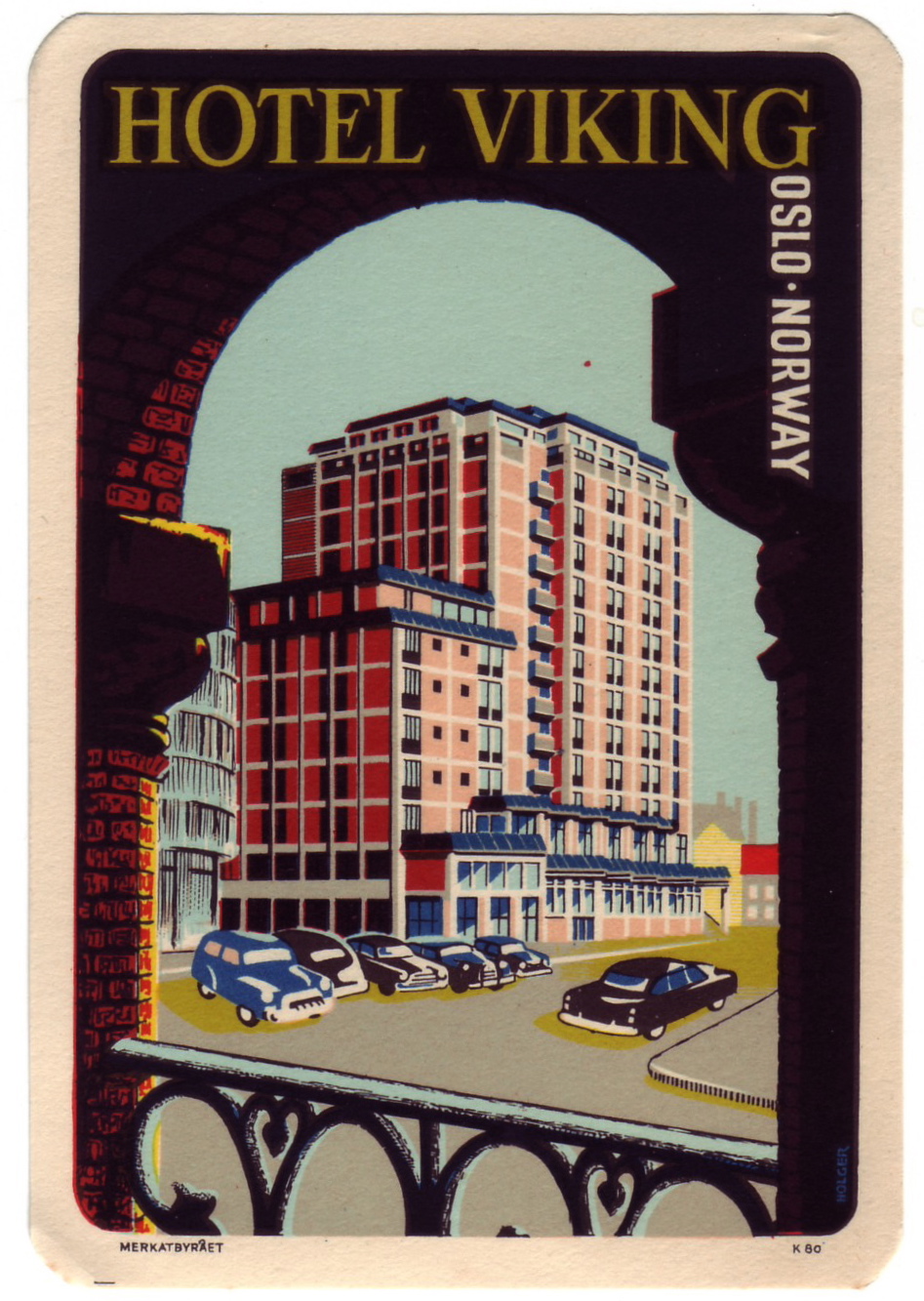
Luggage label, Hotel Viking (now Hotel Royal Christiania), Oslo, Norway

Resisting my cultural conditioning – the notion of vacationing, in my German childhood, being associated with going down south – I picked up the label promoting the Hotel Viking in Oslo.  It opened in 1951, an influx of visitors being expected in 1952, the year Oslo hosted the Winter Olympics; it was the first year in which Germany (both East and West) were permitted to participate since Berlin hosted in 1936.  Norwegians were not likely to relish the idea of uniformed German delegates and their concomitant supporters invading their capital.  The label design frames the new site in a traditional context, suggesting that, even when viewed from more venerable landmarks, it is a sight to behold. The hotel, now called the Royal Christiania – thus declaring itself traditional by referencing the erstwhile name of the city – is still open for business. The label drives home that the hotel was modern by declaring it to be approachable by car; these days, advertisers are less likely to turn the parking space into a feature.

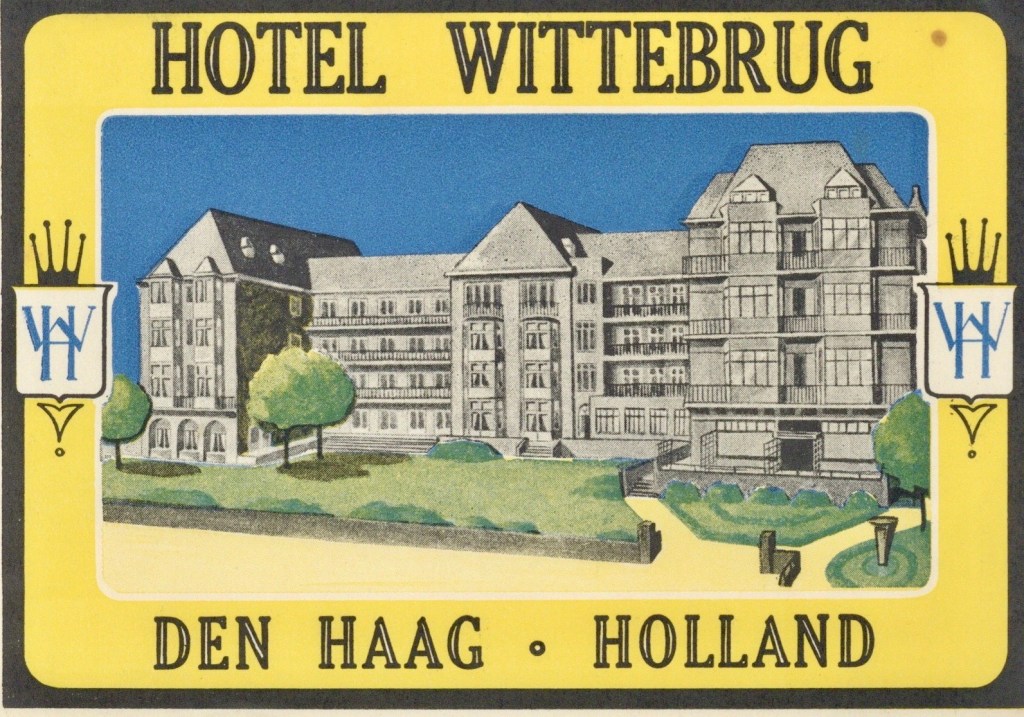
Luggage label, Hotel Wittebrug, Den Haag, Netherlands

Now, I have never been to Oslo; but on one of my most recent trips to the continent – if ‘recent’ is the word – my husband and I took the train from Amsterdam to spent a few hours in Den Haag, where I had never been until then.  I now lecture in landscape art, so seeing paintings of that genre right where they were created in the seventeenth-century Dutch Republic was as thrilling to me as the fantasy of time travel, dismissed as such pictures were by eighteenth-century academics, and many now still under their influence, as prosaic.  However, I would have looked in vain for the Hotel Wittebrug, which was torn down in 1972.

The labels are the stuff of daydreams for me at the moment; but they certainly invite further research.  Who designed them, and when? How does the design correspond with, or misrepresent, the site depicted? It is a project for someone who, like me, does not believe in the label ‘fine art’ and is not dismissive of products of culture that, like seventeenth-century Dutch landscapes, were commodities sold and bought on the market long before they ended up, removed from our everyday, in pay-to-enter venues set apart for our veneration of them and of the collections that now hold them.  

Handling these flimsy pieces of paper now, I am reminded most of all of what I am missing while the world is a world away.  Being out of touch does not quite feel as joyous when the sense of touch cannot be exercised occasionally by hugging an old friend or holding onto what seems more echt, or genuine, if it can be had, momentarily, for the holding …

Little Lady Hee-Haw; or, A Temple Fit for Goebbels

On my only trip requiring an overnight bag during this stay-at-home summer, my husband and I drove from our patch on the west coast of Britain to the thoroughly overcrowded Cotswolds and, upon my urging, made a stop-over at the Welsh town of Hay-on-Wye, an internationally renowned haven for second-hand book lovers.  Now, musty old volumes and COVID-19 do not quite go together – or so I thought – considering that retail spaces generally set aside for them are rarely supermarket-sized.  However, Hay, which depends on the trade, managed to make it work; and, meeting the moment by donning a mask, I got to enjoy an afternoon of socially distanced and sanitized hands-on browsing.

Not that I walked away with any tomes of consequence.  While at the Cinema bookstore – a shop not limited to publications related to motion pictures – I discovered a nook stacked with a curious assortment of ephemera: German movie programs of the 1930s.  I am not sure how they ended up in a Welsh bookshop – but that dislocation may well have extended their shelf life … until a German such as I came along and took an Augenblick to sift through them.

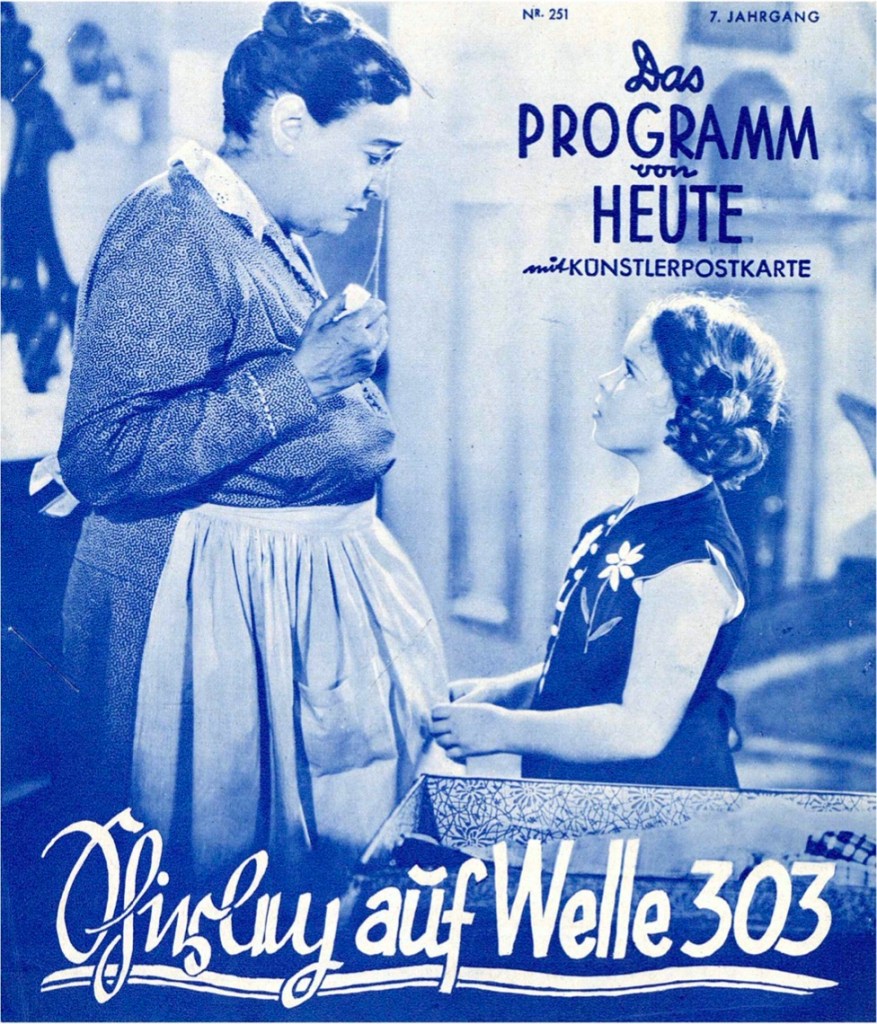
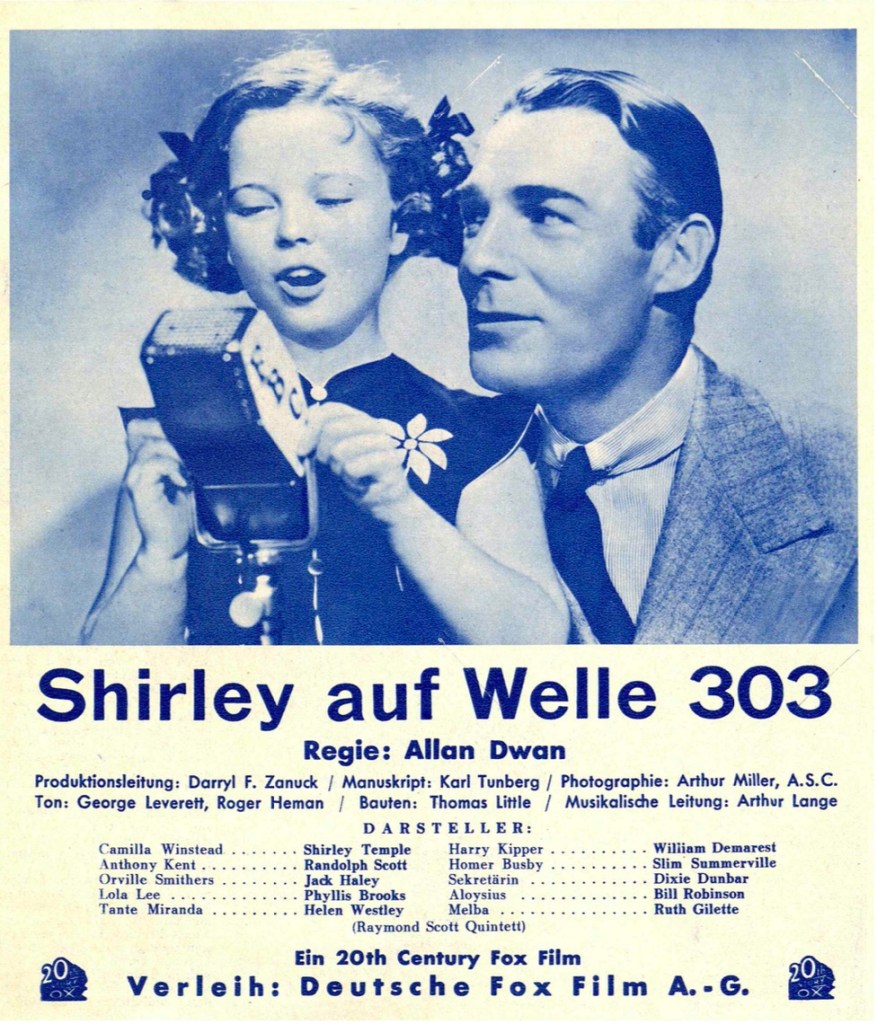
The program pictured above, dating from 1937, left me puzzled for a while.  I am familiar with many of Shirley Temple’s features – but I did not recall any among them bearing a title remotely like “Shirley auf Welle 303,” or “Shirley over Station 303.” So, I picked up this fragile brochure, and a few others besides, if mainly to tap their potential as pop cultural conversation pieces.

The film being deemed worthy of commemoration is Rebecca of Sunnybrook Farm, a DVD of which is gathering dust in my video library.  The title refers to an early twentieth-century children’s literature classic, although the movie version bears so little resemblance to it that it could hardly be considered an adaptation.  Not that the title of the novel would have resonated with German audiences. Meeting this challenge, the marketing people at Fox came up with a new one that might sound more relatable.

I suspect that the servants of the Nazi regime would have objected to the name of the titular character as well, being that Rebecca is Hebrew in origin, meaning “servant of God.” Shirley, on the other hand, was a household name, Ms. Temple having charmed audiences around the world since at least 1934. Like the titles of several other Shirley Temple vehicles released in 1930s Germany, the German version of Rebecca of Sunnybrook Farm therefore bears the first name of its star. Only Heidi stayed Heidi, rather than being translated into “Little Swiss Miss Shirley.”

A contemporary British program for the same film, also in my collection.

And yet, the effort to make the film seem more relatable to Nazi Germany’s picture-goers nonetheless resulted in a title that was out of touch with Fascist reality. In 1938, when the film was released in German cinemas, the idea of using radio transmitters for your purposes – or for the purpose of exploiting a child for your own purposes – was inimical to state-controlled broadcasting. On the air, it was always “Germany Calling,” a phrase famously used by the aforementioned Lord Haw-Haw beginning in 1939.

Germans would have struggled in vain to twist the dial and hit on a broadcast like Shirley’s, or they would have paid a price for such twisting.  Many of them listened via the Volksempfänger, a mass-produced receiver that was always tuned in to the Führer’s voice.  Imagine staying tuned to Fox News all day.  Then again, so many who do have the choice not to still do nonetheless, not unlike those who were complaisant during the rise of Fascism in Germany.

The change in title – and the recontextualization it achieves – is peculiar, and only a performer as innocuous as Shirley Temple could have gotten away with what otherwise would have been downright seditious: seizing the microphone and taking to the airwaves in a makeshift studio set up in a remote farmhouse.  Perhaps, the titular bandwidth – 303 – was to signal that Shirley’s broadcast had been sanctioned after all, 30 January 1933 being the date Hitler came to power. In the Third Reich, three was heralded as the charm.

For decades, the German film industry did wonders – or, rather, wilful damage – to international films with its dubbing of their soundtracks; voicing over and voiding the content of the source, there were many opportunities to ready a film more substantive than Rebecca for consumption in Nazi Germany.  I do not recall seeing this movie in my native language, although I do remember a festival of her films airing on West German television in the late 1970s.  Not that watching Rebecca of Sunnybrook Farm in the original is an experience I am eager to repeat, clobbered together a vehicle for an overhyped and overworked child star about to wear out her welcome that it is. Variety dismissed the film at the time as a “weak story,” “indifferently acted and directed,” while claiming its lead to be “at her best.”

The German program does little more than summarize the plot as well as state the principal actors and main players behind the scene of the production; I am sure someone checked whether producer Darryl F. Zanuck was Jewish, which he was not. What struck me about the program was that it mentions the word ‘propaganda’ twice in the first paragraph, where it was used as a substitute for advertising (in German, “Werbung” or “Reklame”).  Sending up the excesses of US consumerism while promoting the ostensible virtues of country living, this trifle of a film – distributed in Nazi Germany by the enterprising and accommodating “Deutsche” Fox – could serve as a vehicle for anti-American propaganda at a time when increasingly few US films were granted a release in Germany.

By making such trifles, and by marketing them for distribution in Nazi Germany, the US film industry contributed to the rise of Fascism, which, only after the attack on Pearl Harbor, Hollywood films began to confront with a suitably glossy vengeance. By that time, US films were banned in Germany, and Shirley Temple ceased to be a leading lady – at least in motion pictures.

Figured Speech: De-monstrating Lord Haw-Haw

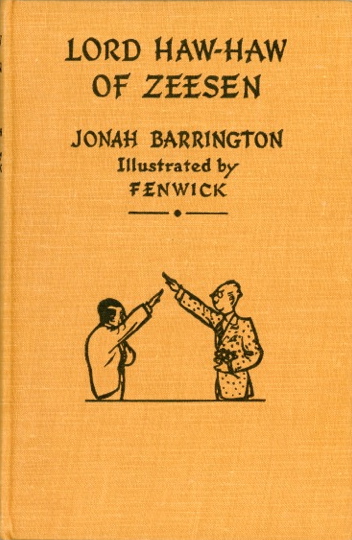
When I picked up this slim and curious volume, Lord Haw-Haw of Zeesen (1939), at an antiquarian bookstore in the Welsh border town of Hay-on-Wye, I was puzzled, to say the least.  I mean, I had heard about—and had listened to recordings of—the notorious Lord Haw-Haw, the fascist broadcaster whose role it was to demoralize the British, to make them turn against their own government by convincing them that to side with the so-called Third Reich was the safest, surest way to march forward. Yet here was a book—written pseudonymously by a journalist calling himself Jonah Barrington and cartoonishly illustrated by an artist who went by the name of Fenwick—that turned propaganda into satire by lending form and features to a voice of terror that was infiltrating the home front.

Yes, it is a curious performance—a biographical act of deflating a windbag, of knocking the stuffing out of a nameless, disembodied operative whose dangerous air of mystery was just plain hot by the time Barrington had laughed off the threat by calling it “Haw-Haw.”  Those in Britain who, like Barrington, had caught the bizarre broadcasts from station Zeesen in Germany began to speculate about the speaker.  In the absence of evidence, Barrington created a character that, to him, had already “become real”; and out of the polemics that “nightly pollute[d]” the British air, the journalist set out to weave “silly fancies.”

“Let me make one point perfectly clear,” Barrington added:

Although Fenwick and I have use our imagination in building up the home life and background of Haw-Haw and his fellow propagandists, the actual speeches credited here to them are given verbatim—exactly as broadcast from the stations Hamburg, Cologne and Zeesen (D.J.A).

Lord Haw-Haw of Zeesen defused a crisis by giving a ridiculous shape to uncertain things to come, by making preposterously concrete what had been potentially persuasive or at least dangerously ambiguous hearsay.  Filmmakers and journalists had parodied Nazi figures before—but the task of turning rhetoric into a figure of ridicule is a rather more complex strategy of counter-propaganda, especially since, in this case, print was rendering fictive what it had made definitive:

Haw-Haw in print needs stage directions, scene-setting and local colour.   And Fenwick needn’t think he’s going to sit back and do nothing, either.   You want the best of Haw-Haw, and we give it to you—drawings and all.

Best or worst, readers of Lord Haw-Haw of Zeesen were meant to get the better of him.

“. . . a dam’ good shake-up”: Death at Broadcasting House

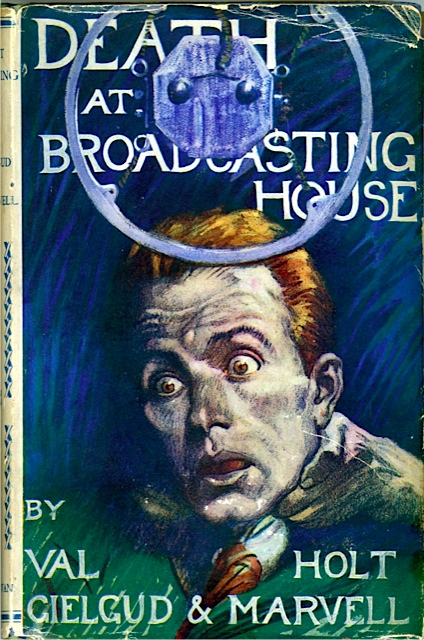
“Snobbish nonsense!” says one shabbily dressed young Londoner to another as they observe a man in a starched shirt and dinner jacket enter Broadcasting House.  The man, they reckon, is an announcer about to go on the air, unseen yet meticulously groomed and attired.  At the sight of which pointless and paradoxical propriety they sneer: “That whole place wants a dam’ good shake-up.”  A “dam’ good shake-up.”  That, in a coconut shell (to employ the most sound-effective nut in the business of radio dramatics), is what Val Gielgud and his collaborator Holt Marvell (the fanciful penname of fellow broadcaster Eric Maschwitz) set out to perform in Death at Broadcasting House (1934), a murder mystery set in and temporarily upsetting the reliable, predictable and frightfully proper BBC.  Although I had know about it for quite some time, I just finished reading it;  turns out, it’s a “dam’ good” page-turner, and a compelling commentary on the marginality, the relative obscurity of radio dramatics besides.
 
“There’s not a drop of good red blood about the whole place.  Robots engaged in the retailing of tripe! That’s broadcasting!” one of the above sidewalk critics of the tried and generally trusted institution declares.  It is clear, though, that Gielgud and Maschwitz did not side with the two self-styled “communists.”  The authors were BBC employees and not about to stage a revolution.  The “shake-up” was strictly a matter of maracas, a means of making some noise for their own undervalued accomplishments rather than spilling the beans without which those maracas would become utterly useless as instruments of ballyhoo.
 
Sure, broadcasting plays—minutely timed, meticulously rehearsed and intensely scrutinized—were far more mechanic than any other form of dramatic performance.  Yet, as Gielgud insisted in one of his many articles on radio drama, “[i]n spite of [its] machine-like qualities” and “in spite of the lack of colour and applause, the work has a fascination of its own.” That the multitude for whom these performances were intended showed so little gratitude was frustrating to an actor-director like Gielgud, who sarcastically remarked a few years earlier that dismissive reviews in the press suggested, at least, that the broadcast play had “passed the first and most depressing stage of development—the stage of being entirely ignored.”  By 1934, it had clearly not advanced to a stage that could be deemed legitimate.
 
What better way to gainsay those naysayers than to spill some of that “good red blood” or to stir it properly and to make it run hot and cold by turns.  “A killing! In Broadcasting House, of all places! Good God!” is the response of General Sir Herbert Farquharson, the corporation’s fictional Controller.  He has just been informed that an actor was done away with during the production of a live broadcast.  “My god, sir,” the director of that play exclaims, “do you realize that everyone who heard that play must have heard him die? That makes it pretty unique in the annals of crime.”
 
That most folks tuning in thought little of it—that they believed it to be part of the drama—is owing to the fact that the murder was committed right at the moment when, according to the script, the character played by the victim was scheduled to breathe his last.  A crime at once prominent and inconspicuous—like most radio dramas, performed as they were without a studio audience.  After all, even the Controller, at the time of the murder, was attending a variety program staged in the specially designed Vaudeville Studio instead.
 
Death at Broadcasting House is the self-conscious performance of two radiomen, Gielgud and Maschwitz, fighting for the recognition that, for the most part, eludes those working behind the scenes—especially the folks behind the scenes of a largely invisible business.  Their book, as they so slyly state, was “dedicated impertinently … to those critics who persistently deny that the radio pay exists, has existed, or ever can exist.”  Radio plays existed, all right, but, for the most part, they died as soon as they were heard, if they were heard at all.
 
Unless, of course, they were blattnerphoned. “Blattnerphone?” the puzzled inspector exclaims.  “Yes,” the BBC’s dramatic director, Julian Caird, explains:
 
“It’s a way of recording a programme on a steel tape so that it can be re-transmitted.  We have to do a good deal of it for Empire work.” […]
 
“You mean we can hear that actual scene over again?”
 
“We can hear that scene,” said Caird, “not only over again, but over and over again.  As often as you like.  I wonder if the murderer thought of that?”
 
Probably not.  Unless he numbers among the initiated few, folks like Caird—and Gielgud—who have their fingers at the controls, conjurers who don’t mind revealing some of their tricks to demonstrate just how powerful they are.
 
“The curious thing about the case what that it was both extremely simply and extremely complicated,” the inspector wraps up the business of detection.  “It was extremely complicated only because it took place under very remarkable conditions—conditions which you wouldn’t find repeated anywhere else, and for which, of course, there was absolutely no precedent.”  The same applies to Gielgud and Maschwitz’s fiction. However witty and engaging, the whodunit is entirely conventional. It is the setting, the broadcasting studio, that makes it unusual.  The setting, thus, becomes the star of the production—a star without whose presence the show simply could not go on.
 
Indeed, the crime depends on the complexity of British radio production to be in need of detection.  In American broadcasting, by comparison, all actors gathered in the same studio, a congregation that would render the unobserved strangling of one of them not only improbably but impossible.  At the BBC, however, plays were produced using a multiple studios, a complex approach Gielgud’s stand-in explains thus:
 
[T]he chief reasons why we use several studios and not one, are two.  The first is that by the use of separate studios, the producer can get different acoustic effects for his scenes….  Secondly, the modern radio play depends for its “continuity” … upon the ability to ‘fade’ one scene at its conclusion into the next.  You can see at once that there must be at least two studios in use for these “fades” to be possible.  In an elaborate play, therefore, the actors require as many studios as the varying acoustics of the different scenes require, while … sound effects have a studio of their own, gramophone effects one more, and the orchestra providing the incidental music yet another separate one.
 
Anyone who has ever listened to an American radio play of the 1930s, such as the ones produced by the Columbia Workshop, knows that no such complex arrangements are needed for the effective use of multiple fades and changes in acoustics.  Death at Broadcasting House is a defense of the British system.  It turns the multi-studio approach into something to be marveled at—an arcane system fit for a mystery, a puzzle whose solution requires the expertise of the initiated and thus vindicates the existence of the men masterminding the business with their hands firmly on that most complex of all pieces of broadcasting equipment: the dramatic control panel, which, Gielgud enthused elsewhere, enabled the director “to move at will, both in time and space, as simply as if he were travelling on the fabled magic carpet, and to take his audience with him.”

Once Upon a Time in Radioland: A Kind of Ruritanian Romance

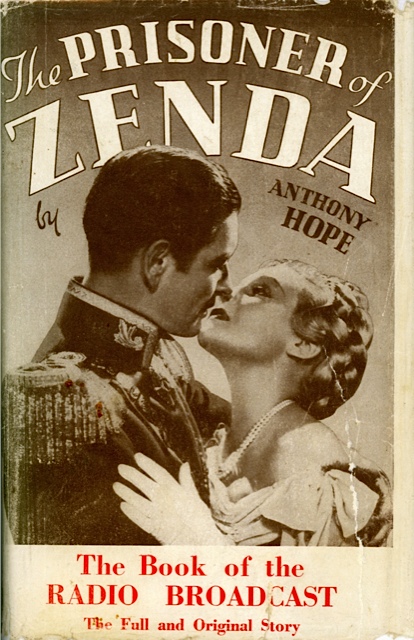
The other day, at my favorite bookstore here in Aberystwyth, I was caught in the eye by what struck me as a highly unusual cover for a 1938 edition of Anthony Hope’s fanciful pageturner The Prisoner of Zenda. Mind you, I’m not likely to turns those pages any time soon. I’m not one for Graustarkian excursions. That I found the old chestnut so arresting is due to the way in which it was sold anew to an audience of Britons to whom such a mode of escape from the crisis-ridden everyday must have been sufficiently attractive already. This was the 92nd impression of Zenda; and, with Europe at the brink of war, Ruritania must have sounded to those who prefer to face the future with their head in the hourglass contents of yesteryear like a travel deal too hard to resist.

My copy of the book

Now, the publishers, Arrowsmith, weren’t taking any chances.  Judging by the cover telling as much, they were looking for novel ways of repackaging a familiar volume that few British public and private libraries could have been wanting at the time.

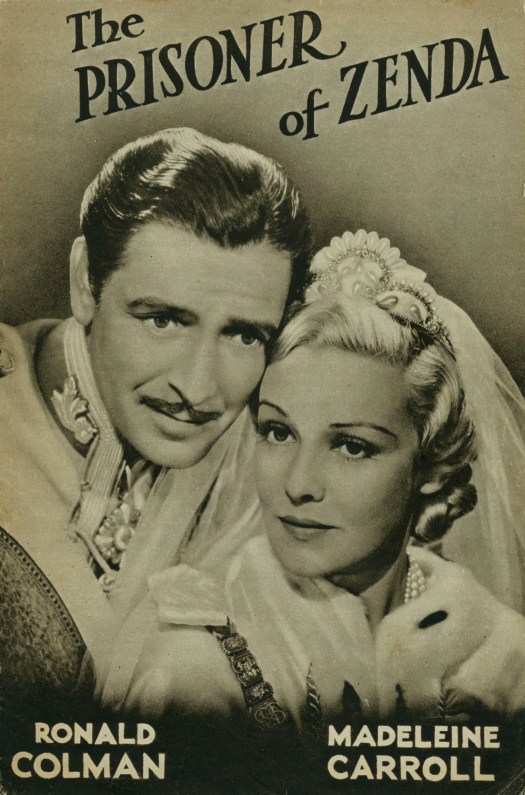
British moviegoers had just seen Ruritania appear before their very eyes in the 1937 screen version of the romance, which make dashing Ronald Colman an obvious salesperson and accounts for his presence on the dust jacket.  It is the line underneath, though, that made me look: “The Book of the Radio Broadcast,” the advertising slogan reads.  Desperate, anachronistic, and now altogether unthinkable, these words reminded me just how far removed we are from those olden days when radio ruled the waves.

The Prisoner of Zenda was recently the subject of a highly successful film,” the copy on the inside states somewhat pointlessly in the face of the faces on the cover.  What’s more, it continues, a “further mark of its popularity” was the story’s “selection by the BBC as a radio serial broadcast on the National Programme.”  To this day, the BBC produces and airs a great number of serial adaptations of classic, popular or just plain old literature; but, however reassuring this continuation of a once prominent storytelling tradition may be, a reminder of the fact that books are still turned into sound-only dramas would hardly sell copies these days.  Radio still sells merchandise—but a line along the lines of “as heard on radio” is pretty much unheard of in advertising these days.

From my collection of Cinegrams.

“This book is the original story on which the broadcast was based,” the dust jacket blurb concludes.  I, for one, would have been more thrilled to get my hands or ears on the adaptation, considering that all we have left of much of the BBC’s output of aural drama is such ocular proof of radio’s diminished status and pop-cultural clout.

Perhaps, my enthusiasm at this find was too much tempered with the frustration and regret such a nostalgic tease provokes.  At any rate, I very nearly left Ystwyth Books without the volume in my hands. That I walked off with it after all is owing to our friend, novelist Lynda Waterhouse, who saw me giving it the eye and made me a handsome present of it.  And there it sits now on my bookshelf, a tattered metaphor of my existence: I am stuck in a past that was never mine to outlive, grasping at second-hand-me-downs and gasping for recycled air . . . a prisoner of a Zenda of my own unmaking.

Sweetness and The Eternal Light

My bookshelf, like my corporeal shell, has gotten heavier over the years.  The display, like my waist, betrays a diet of nutritionally questionable comfort food—of sugar and spice and everything nice.   Now, I won’t take this as an opportunity to ponder just what it is that I am made of; but those books sure speak volumes about the quality of my food for thought.  There is All About Amos ‘n’ Andy (1929), The Story of Cheerio (1937), and Tony Wons’s Scrap Book (1930).   There is Tune in Tomorrow (1968), the reminiscences of a daytime serial actress.  There’s Laughter in the Air (1945) and Death at Broadcasting House (1934).  There are a dozen or so anthologies of scripts for radio programs ranging from The Lone Ranger to Ma Perkins, from Duffy’s Tavern to The Shadow.

My excuse for my preoccupation with such post-popular culture, if justification were needed, has always been that there is nothing so light not to warrant reflection or reverie, that dismissing flavors and decrying a lack of taste is the routine operation of the insipid mind.  That said, I am glad to have added—thanks to my better half, who also looks after my dietary needs—a book that makes my shelf figuratively weightier rather than merely literally so.

The book in question is The Eternal Light (1947), an anthology of twenty-six plays aired on that long-running program.  It is a significant addition, indeed—historically, culturally, and radio dramatically speaking.

In the words of Louis Finkelstein, President of the Jewish Theological Seminary of America, under whose auspices the series was produced, The Eternal Light was a synthesis of scholarship and artistry, designed to “translate ancient, abstract ideas into effective modern dramatics.”

In his introductory essay “Radio as a Medium of Drama,” Morton Wishengrad, the playwright of the series, defended broadcasting as a valuable if often misused “tool.” He did so at a time when, in the disconcerting newness of postwar opportunity and responsibility, radio was increasingly—and indiscriminately—dismissed as the playground of Hucksters, to name a bestselling novel of 1946 whose subject, like Herman Wouk’s Aurora Dawn (1947), was the prosperity and self-importance of the broadcasting industry in light of the perceived vacuity of its product. 

“An automobile does not manufacture bank-robbers,” Wishengrad reasoned, “it transports them.  It also transports clergymen.  It is neither blameworthy because it does the first nor is it an instrument of piety because it does the latter.  It is merely an automobile, a tool.

 What the medium needed—and what the times required—were writers who had “something to say about the culture.”

According to Wishengrad, there was “nothing wrong” with the techniques of radio writing.  He noted that serial drama, derided and reviled by “demonstrably incompetent” reviewers, had great storytelling potential: “Here are quarter-hour segments in the lives of people which could transfigure a part of each day with dramatic truth and an intimation of humanity instead of presenting as they now do a lolly-pop on the instalment plan.”

A  “lolly-pop on the instalment plan”! To paraphrase Huckster author Frederic Wakeman’s parody of radio commercials: love that phrase. Wishengrad is one of a small number of American radio dramatists whose scripts remain memorable and compelling even in the absence of the actors and sound effects artist who interpreted them.  Of the latter’s métier Wishengrad wrote: “Sound is like salt.  A very little suffices.”  He cautioned writers, in their “infatuation with its possibilities,” not to “drown” their scripts in aural effects.

Wishengrad’s advice to radio dramatists is as sound as his prose.  “Good radio dialogue,” he held, should come across “like a pair of boxers trading blows, short, swift, muscular, monosyllabic.”  Speeches, he cautioned, ought not to “be long because the ear does not remember.  There is quick forgetfulness of everything except the last phrase or the last word spoken.”

While Wishengrad made no use of serialization in The Eternal Light—as much as the title suggests the continuation and open-endedness of the form—his scripts bear out what he imparts about style and live up to his insistence on substance. 

Take “The Day of the Shadow,” for instance.  Produced and broadcast over NBC stations on 18 November 1945, the play opens: “Listen.  Listen to the silence.  I have come from the land of the day of the shadow.  I have seen the naked cities and the dead lips.  Someone must speak of this.  Someone must speak of the memory of things destroyed.”

The abstract gives way to the concrete, as the speaker introduces himself as the “Chaplain who stood before the crematorium of Belsen.”

I have buried 23,000 Jews.  I have a right to speak.   I stood the last month in Cracow when “Liberated” Jews were murdered.  I have no pretty things to tell you.  But I must tell you.

The “plain, and written down, and true” figures—appropriated from the “adding machines of the statisticians”—tell of the silenced.  But, the Chaplain protests, “[l]et the adding machines be still,” and let the survivors—the yet dying—speak; not of the past but of the continuum of their plight, of the aftermath that comes after math has accounted for the eighty percent of Europe’s Jewish population who were denied outright the chance to make their lives count.

At the time The Eternal Light was published, radio drama, too, was dying; at least the drama with a purpose and a faith in the medium.  To this date, it is a body unresuscitated; and what is remembered of it most is what is comforting rather than demanding, common rather than extraordinary.  Shelving the candy, resisting the impulse to reach for the sweet and the obvious—the lolly-popular—I realize anew just what has been lost to us, what we have given up, what we have forgotten to demand or even to long for . . .

You Can’t Take It With You; or, I Scan, Therefore I Am

I call them inventory days, those first few weeks of a new calendar year. It is a time when I play secretary to myself, when I organize and catalogue, shelve and throw away, when I look back at the places I’ve been to, the things I have done, the people I have met. Perhaps, I am getting it all wrong: the year is crisp—so, why am I rehashing what has been, obsessively reconstructing the past with the aid of notes in my calendar, correspondences, receipts and ticket stubs? I am not attached to the material evidence of my prior whereabouts and activities, mind. I jot down what I can glean from each scrap of paper and discard it posthaste. The records are gone, but my recordings of them remain. Such nonchalance is the prerogative of a diarist: not to feel obliged to prove—let alone account for—his or her existence to anyone else. I recount events in order to make them count rather than become accountable for them . . .

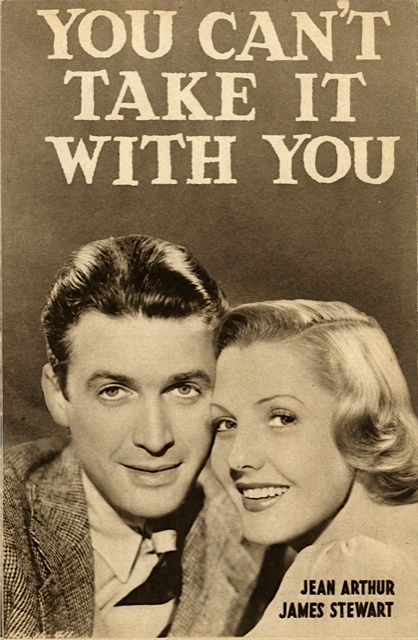
You can’t take it with you—but does that mean I should dispose of whatever I have consumed? I am not quite so indifferent when it comes to artifacts that, unlike my mind and body’s scant body of work, might be of consequence to posterity. I feel free to dispose of a photograph of myself after I scan it; but I am uneasy about doing the same to a piece of ephemera such as this souvenir program (from my collection of motion picture memorabilia). May the copy be a feast for greedy eyes as long as the original is removed from greasy fingers.

Sure, I enjoy surrounding myself with meaningful objects; but, my childhood teddy bear excepting, I am not attached to belongings. To have is utility; to hold, futility.

The chance of having and not holding is what attracted me to the immaterial world of radio dramatics. These days, I mostly collect what goes into one ear and, playing with it, delay the moment at which it comes out of the other. I amass what has no mass: digital recordings, not the physical vehicles on which they used to be stored (shellac, vinyl, magnetic tape).

Everything I have gathered is at my fingertips, nothing is filed away. My world and my vault are one. The files are backed up (this much I have learned from past losses)—but they are ready to go wherever I am. I can take it all with me; and doing so rather than storing things away enriches my life.

That said, I have to learn to cut short my inventory days; last year, they lasted for months. To cut a long time in storage short, I have booked a trip to New York this January. No doubt I will be both gathering new stuff for living and, as my past record tells me, look back and catch up. I know my failings. No saints need apply to preserve me.