Never Mind "Local Color"โ€”That’s a Bruise!

Last week, my best friend was in town for a visit. Ever since I left our native Germany some twenty years ago to live abroad (first in the US, now in the UK), our time together has been short and rare. I have learned to accept the brevity of our reunions; but treating them as special occasions has often bothered me. Not that it would be a waste of time just to flop and chat; then again, that is what we do apart almost daily while on the phone with each other. So, as if our get-togethers werenโ€™t special enough, I somehow feel obliged to make my friendโ€™s journeys here worthwhile by planning something out of the ordinary.

This time around, though, there was less time and still less money for the โ€œspecial,โ€ given that most of our hours and pounds are being spent on renovating our house in town. Okay, so I tried to pass off a seven-hour roundtrip in a van to pick up a bathtub as a sightseeing tourโ€”but much of my German friendโ€™s visit was passed in the appreciation of local color: the blue bells, the silvery sea, and the lush greenery of nearby Hafod, a Picturesque, man-made landscape that was an inspiration to Britainโ€™s Romantic poets.

Then there was a hike up Constitution Hill just behind our future home to look through the lens of the camera obscura (pictured), presumably the biggest in the world. Yes, there is plenty to see in Aberystwyth. As one Victorian traveler expressed it, it is worthwhile coming here just to see the sunset.

So much for the daytime highlights. What about evening entertainment? How fortunate, I thought, that the local cinema was screening films of local interestโ€”a Welsh-language picture about a 1970s comedy act that hit it big in the Valleys but dreamed of Vegas (Ryan a Ronnie) and a British biopic about Michael Peterson, a man born in this very town. Not a dignitary, mind, but a celebrity nonethelessโ€”a nonentity of guy who, lacking all other ambitions, reinvented himself as Charles Bronson, thug.

Nicolas Winding Refnโ€™s Bronson (2009) is not a traditional biography. It is no more a character study than Friday the 13th, even though it is more concerned with its own glamour than with the ugliness of its subject. The film does not attempt to debate whether nurture or nature (the radioactive Irish Sea, say) turned a boy into a beast, to explain what went wrong along the way to a maturity unreached.

Bronson makes no mention of Petersonโ€™s birthplace, which, given the violent subject, must be a relief to those engaged in trying to sell the town as a seaside resort. Besides, the home Peterson made for himself is solitary confinement, in which he spent most of his life. Thirty years and countingโ€”without a murder charge to his discredit.

The filmโ€™s homophobia asideโ€”its muscular, naked, supposedly โ€œunadulteratedโ€ violence comes across as less freakish than the cultured, artistic and presumably fey who seek to entrap, educate, or exploit Petersonโ€”Bronson is most disturbing in its refusal either to accuse or excuse the man. It simply displays, thereby giving its yet living subject precisely what itโ€”along with the publicโ€”appears to crave most: celebrity. It is a nightmarish picture of a good-for-nothing who achieves fameโ€”like a roid-raging Paris Hilton (High-security Hilton?)โ€”without doing anything deserving of our notice, let alone our praise.

Bronson is the anti-Elephant Man: โ€œI am not a human being,โ€ he seems to insist, โ€œI am an animal.โ€ He is a sideshow act entirely satisfied with his own conspicuous marginality.

If the film argues anything, it is that our inability to pin Peterson down is what terrifies us most, what compels us to watch and forces the authorities to keep him under lock and key. With this makeshift thesis, the shallow if stylistically intriguing Bronson, which favors art direction over the use of a moral compass, attempts to justify its approach, making a virtue out of its superficiality by denying us access into the mind it is incapable of penetrating.

I took my visitor to see Bronson in hopes of catching a glimpse of our little town and of learning something about its darker past. Instead of shades of local color, though, I was dealt a rather nasty shiner.
All Coming Out in the Time Machine Wash

Staying out of touch has never been easier. Weโ€™ve all got our personal teleporters to spirit us away from the here and now. Technology is making it possible for us to remove ourselves from our communities, to stay at home not watching the world go by. Instead, we can revel in bygone worlds. Hundreds of satellite channels are serving up seconds. Before you know it, you quite forgot what time it is that you just passed. Isnโ€™t it high time for Sally Jessy Raphaรซl to stop gabbing? Eight years ago she went off the air; but there she is, chatting away on British television, her owl glasses unscratched by the sand of time.
Keep your finger on the remote control long enough and youโ€™ll come across The Lone Ranger pursuing evildoers in perpetuity as if his name really were the Long-ranger. And there, cigarette holder in hand as in days of smoke-shrouded yore, is glamorous Lana Turner in the cliffhanger of Falcon Crest‘s second season; and these days, the hiatus will only last a few hours. Breakfast time will tell who ended up in that coffin (after twenty-five years, it will be new to me all over again).

โ€œI donโ€™t ask you to prepare for a new worldโ€”because I realize that a new world is here now.โ€ H. G. Wells said that during one of his 1940s radio addresses. I caught up with him listening to Philip Osmentโ€™s adaptation of The Time Machine, into which you might still enter online before that portal closes on 28 February. I have recorded it, for future listening. The new world here now is a world in which time is out of joint, as old Hamlet might have said. As a species, we might well be running out of time; but that only encourages us to amble in the continuum. We keep on moseying in the fourth dimension so as not to face the things to come. Such are the hazards of the Time Machine Age.

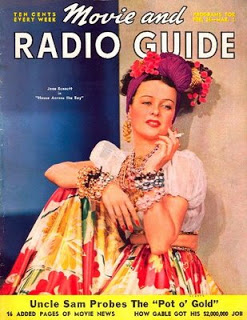
The Internet? Itโ€™s a regular world wide cobweb! A sticky tangle of threads from which it is difficult to extricate ourselves once we get caught. That, for the moment, must suffice to account for my spasmodic writings this month. I am spending a great deal of time flicking through magazines like Radio-Movie Guide, hundreds of which have been digitized and are being freely shared online.

From the above issue (24 February to 1 March 1940), for instance, I learned what Myrna Loyโ€™s masseuse rushed home to before Loy bought a portable radio to find out for herself (I Love a Mystery), how the Pot oโ€™ Gold became a matter for the Department of Justice, or what John Kieran let slip on Information Please (โ€œI frequently carry books on my person in strange placesโ€).

Yes, keeping up with the out-of-date has sure gotten easier. Getting back has not . . .

Under That Hat: The Life and Breath of Carmen Miranda

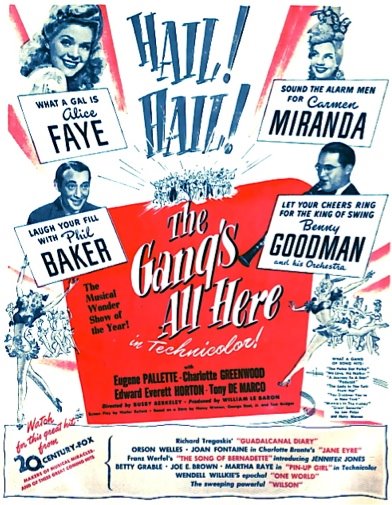
So iconic is this technicolorful Latina that she might not strike you, on the face of it, as the ideal subject for a sound-only documentary; but there she is, the life of Russell Daviesโ€™s โ€œCarmen Miranda: The Lady in the Tutti Frutti Hat.โ€ Once you remove that hat, you will find much to tip yours to as you listen to Ruby Wax, assisted by biographers Helena Solberg and Martha Gil-Montero, unravel the story of Maria do Carmo Miranda da Cunha, born one hundred years ago in the small town of Marco de Canaveses, Portugal. As Carmen Miranda, she came to represent not just her non-native Brazil, to which her family emigrated, but the whole of Latin America; and while what she became was larger-than-life, the โ€œBrazilian bombshellโ€ was not quite so large as to coverโ€”or levelโ€”quite so much ground. It is the leveling that those proud of their origins and culture resentโ€”and Brazilians, in particular, came to dismiss Hollywoodโ€™s All South-American girl as inauthentic, irregular, and downright ignominious.

The United States, of course, was counting on what it hoped to be a Pan-American appeal; it is what made the former millinerโ€™s apprentice such a sought-after commodity during the Second World War. At the end of the war, she was reputedly the highest paid woman in the United States.

A romance born of hardship and ingenuity, a glittering success tarnished by rejection, an identity challenged by dislocation and enfranchisement, a glamorous life culminating in early death, the one-of-a-kind yet kind of universal story of โ€œThe Lady in the Tutti Frutti Hatโ€ is the stuff of legend. Sure enough, that is what, according to the Internet Movie Database is what is about to come out of Hollywood any day now: Maracas: The Carmen Miranda Story.

The samba-infused first installment of this three-parter makes ample use of original recordings to highlight the performerโ€™s early musical career. Considering that the next chapter is going to transport listeners from Rio to Hollywood, I wonder whether it is going to draw on the one source that, aside from shellac, is best suited to the mediumโ€”the sounds of Carmen Mirandaโ€™s life on the air: her samba lesson for Orson Welles; her dramatic scenes with Charlie McCarthy, or her joking with Tallulah Bankhead, Judy Holliday and Rex Harrison on The Big Show. Never mind that hat. She was the Lady with the Tutti Frutti voice, which is why she had her own radio program down south.

Carmen Miranda died on 4 August 1955, within hours after suffering a heart attack while performing on Jimmy Duranteโ€™s live television program. Could it be that our demand for visuals, our insistence to be shown what can be heard and felt more keenly in darkness, is what caused Carmen Mirandaโ€™s heart to stop its rhythmic beatings? A program like โ€œThe Lady in the Tutti Frutti Hatโ€ offers us a chance to bring her into our presence, take her in as the voice, the breath that gave her life. We only need to make the effort to be all ears . . .


Related recordings
Hello Americans (15 November 1942)
The Charlie McCarthy Show (23 November 1947)
The Big Show (25 March 1951)

The Whole Ball of Wax: โ€œLife With Lucy and Desiโ€

โ€œShe wasnโ€™t the nicest person all the time,โ€ biographer Tom Gilbert puts it mildly; but to say even that much apparently triggers complaints from many Lucy lovers, to whom journalist Mariella Frostrup apologizes in advance. Frostrupโ€™s voice is enough to win anyone over, even though it might make at once forgive and forget what she is saying. Hers has been called the โ€œsexiest female voice on [British] TVโ€โ€”and the hot medium of radio only accentuates her seductive powers. So, where was I?

Right, โ€œLife With Lucy and Desi.โ€ It wasnโ€™t all love and laughterโ€”especially not for children. Actress Morgan Brittany recalls a scene on the set of Yours, Mine and Ours (1968) in which Ball lost her temper when one of the kids dared to laugh and ruin a difficult take. Native Americans in traditional garb and images of birds likewise irritated her, as did bodily contact. โ€œShe didnโ€™t like people being near her,โ€ Gilbert observes.

She wasnโ€™t funny, and she wasnโ€™t all that nice. Thatโ€™s what those stepping behind the microphone for a new hour-long BBC radio documentary have to say about the โ€œrealโ€ Lucille Ball, comedienne, businesswoman, and small-screen icon. Not exactly a revelation, to be sure; but you might expect less after reading the blurb on the BBCโ€™s webpage for the program, which revises history by calling I Love Lucy โ€œa zany television series which ran for twenty five years.โ€ Well, letโ€™s not heckle and jibe. The anecdotal impressions of those who can justly claim to have seen both sides of Ms. Ball make โ€œLife With Lucy and Desiโ€ a diverting biographical sketch, however moth-balled the gossip some twenty years after the actress’s death.

She seemed somewhat out of touch as well, even though she got to run the run-down RKO and signed off on Star Trek, a program she assumed, as Gilbert asserts, to be about performers entertaining the troops during the Second World War.

โ€œLifeโ€ is further enlivened by numerous recordings from Ballโ€™s career in television, film and radio. My Favorite Husband, I am pleased to note, has not been left out of this phono-biographic grab bag, even though the snippet from the radio forerunner to I Love Lucy airs without commentary; nor is it always clear what it is that we are hearingโ€”no dates or episode titles are mentionedโ€”the clip from My Favorite Husband, for instance, is not identified as being been taken from the 4 March 1949 episodeโ€”and the selections seem not merely random, but hardly representative of Ballโ€™s finest moments in this or any medium. When you hear her sing โ€œItโ€™s Todayโ€ (from the stage hit turned film dud Mame), youโ€™d wish someone would โ€œstrike the band upโ€ to drown out the wrong notes.

The argument this documentary seems to make is that Lucy would not have been Lucy if Desi had not been Ricky. Ball had talent, Brittany concedes, but might have ended up like โ€œBabyโ€ June Havoc, whom Brittany portrayed in Gyspyโ€”a fine performer who never quite reached stardom and who, though still living, is not nearly so well remembered today as to be celebratedโ€”or critiquedโ€”in a radio documentary of her own. She might just have remained the โ€œQueen of the Bโ€™s.โ€

The inevitable Robert Osborne aside, the lineup of folks who knew or at any rate worked with Ball also includes โ€œLittle Rickyโ€ Keith Thibodeaux, Peter Marshall (who walked out on a chance of working with Ball), Allan Rich (who played a Judge on Life with Lucy; not, as Frostrup has it, on the Lucy Show) and writer Madelyn Davis (formerly Pugh), who still gets fan mail for having created the durable caricatures that were โ€œLucy.โ€

No mention, of course, is made of Hoppla Lucy, viewings of which constitute my earliest television memories (Hoppla Lucy being the title of the German-dubbed Lucy Show). Long before I had breakfast with Lucy when truncated (make that mutilated) episode of her first and finest television series aired on New Yorkโ€™s Fox Five every weekday morning, a truncated version of myself sat down to watch Lucy bake a cake and making a mess of it. I havenโ€™t watched it since, but can still tune in the laugh it produced. Who cares whether or not what I saw was the real Ball. I sure was having one.


Related recordings
My Favorite Husband (4 March 1949)

Related writing
“Havoc in ‘Subway’ Gives Commuters Ideas”
“‘But some people ain’t me!’: Arthur Laurents and ‘The Face’ Behind Gypsy

โ€œHere is your forfeitโ€: Itโ€™s Hopkinsโ€™s Night As Colbert Goes Private

โ€œOur guest stars might well have been tailored for the celebrated parts of Peter and Ellie,โ€ host Orson Welles remarked as he raised the curtain on the Campbell Playhouse production of “It Happened One Night,” heard on this day, 28 January, in 1940. Quite a bold bit of barking, that. After all, the pants once worn by bare-chested Clark Gable were handed down to William Powell, who was debonair rather than brawny. โ€œMr. William Powell surely needs no alteration at all,โ€ Welles insisted, even though the material required considerable trimming. Meanwhile, the part of Ellie, the โ€œspoiled and spirited heiressโ€ whom Peter cuts down to size until he suits her, was inherited by Miriam Hopkins. It had โ€œcertainly never been more faultlessly imagined than tonight,โ€ Welles declared. Indeed, as I was reminded by Andre Soaresโ€™s interview with biographer Allan Ellenberger on Alternative Film Guide, Hopkins numbered among the leading ladies who had turned down the role and, no doubt, came to regret it, given the critical and commercial success of It Happened, which earned Claudette Colbert an Academy Award.

Now, Welles was prone to hyperboles; but, in light of Colbertโ€™s memorable performance, his claim that the part had โ€œnever been more faultlessly imaginedโ€โ€”in a radio adaptation, no lessโ€”sounds rather spurious. As it turns out, raspy-voiced Hopkins (whom last I saw in a BFI screening of Becky Sharp) does not give the spirited performance one might expect from the seasoned comedienne. Her timing is off, her emoting out of character, all of which conspires, along with the imposed acceleration of the script, to render disingenuous what is meant to be her character’s transformation from brat to bride; and while Powell, a few fluffed lines notwithstanding, does quite well as the cocky Peter Grant (it was โ€œWarneโ€ when those pants were worn by Gable), the only โ€œspiritedโ€ performance is delivered by Bernard Herrmann, the composer of the lively score.

In short, there is little to justify Welles’s introductory boast. Was the Wunderkind getting back at Colbert for standing him up two months earlier, when Madeleine Carroll filled her place in โ€œThe Garden of Allahโ€? Whatโ€™s more, Colbert appeared to have passed on the chance to reprise her Oscar-winning role for Campbell Playhouse, something she had previously done, opposite Gable in one of his rare radio engagements, for a Lux Radio Theater reworking of the old โ€œNight Bus” story.

That same night, 28 January 1940, Colbert was heard instead on a Screen Guild broadcast in a production of โ€œPrivate Worlds,โ€ in a role for which she had received her second Academy Award nomination. During the curtain call, Colbert was obliged to “pay a forfeit” after incorrectly replying “The Jazz Singer” to the question “What was the first full-length all-talking picture to come out of Hollywood?” For this, she was ordered to recite a tongue twister; but it wasnโ€™t much of a forfeit, compared to the sense of loss both Colbert and Hopkins must have felt whenever they misjudged the business by rejecting important roles or by risking their careers making questionable choices.

In The Smiling Lieutenant, the two had played rivals who ended their fight over the same man by comparing the state of their undies; now, Hopkins seemed to be rummaging in Colbertโ€™s drawers for the parts she could have had but was not likely to be offered again. Well, however you want to spin it, radio sure was the place for makeshift redressing, for castoffs and knock-offs, for quick alterations and hasty refittings. It catered to the desire of actors and audiences alike to rewrite or at any rate tweak Hollywood history. Go ahead, try it on for size.

Best in Show: Dean Spanley as Out-of-Homebody Experience

My records show that I watched some 250 films in 2008. They range from silent one-reelers to noisy epics, from British wartime propaganda to Third Reich comedy, from the obscure Lottery Man (1916), which I enjoyed, to the biggest blockbuster of the year (The Dark Knight), which I did not. For all this variety, the majority of the titles on my list (continued to the right of this journal entry) are Hollywood films of the studio era, many of them from the 1930s and 1940s. Conventional as I am in this, I concur with those who hold 1939 to be Hollywoodโ€™s best vintage.

Later decades, the present one excepted, are poorly represented in my annual account. There are two films from the 1990s (one of them a television movie about the inclusion of which the pedant in me had a long debate with myself); a lone film from the 1980s (the tonally misjudged if beautifully languid A Handful of Dust, based on one of my favorite novels of the 1930s); and less than a handful of 1970s pictures, two of them by one of the greatest directors of Hollywoodโ€™s golden age, Alfred Hitchcock. There is to me no surprise in these statistics; they are an adequate reflection of my cinematic tastes and predilections. Prejudices, you might say.

What distorts the picture are my travels. They broaden to the extent that, against the pertinacity I cannot bring myself to pass off as better judgment, something like Hulk (sat through in New York), The Day the Earth Stood Still (endured in London), or Midnight Meat Train (suffered in Riga) slips in. Still, if it werenโ€™t for those bouts of wanderlust, I probably would not have had the pleasure of catching Guy Maddinโ€™s hypnotic My Winnipeg, featuring noir dame Ann Savage, who passed away on Christmas day last year; nor would I have seen Tarsem Singhโ€™s stunningly surreal The Fall or Toa Fraserโ€™s quietly quirky Dean Spanley, a film I caught at the Little Theatre in Bath, England (pictured above).

Dean Spanley is based on a 1936 novella by Lord Dunsany, which has been republished with Alan Sharpโ€™s screenplay and commentary. It is more accurate to say that the film is inspired by My Talks with Dean Spanley, a casual, witty discourse on reincarnation and the transmigration of souls. Inspired it certainly is.

As the title slyly suggests, the heart, soul and center of these talks is a clergyman who, in a former life, was what an intoxicated person afflicted with temporary dyslexia might call a โ€œSpanley.โ€ Without resorting to puns as crude as mine, the narrative plays with the idea that a man who wears a dog collar might have been barking at the moon before he learned to preach; that a clergyman may have had a past existence entirely at odds with his preachings about the afterlife; and that, in order to arrive at the secret of a dull, reserved, and abstemious man, one must drink him under the table to get him to reminisce about a time when he belonged there:

It was [the] remark about the woods and the night, and the eager way in which he spoke of the smells and the sounds, that first made me sure that the Dean was speaking from knowledge, and that he really had known another life in a strangely different body. Why these words made me sure I cannot say; I can only say that it is oddly often the case that some quite trivial remark in a manโ€™s conversation will suddenly make you sure that he knows what he is talking about. A man will be talking perhaps about pictures, and all at once he will make you feel that Raphael, for instance, is real to him, and that he is not merely making conversation. In the same way I felt, I can hardly say why, that the woods were real to the Dean, and the work of a dog no less to him than an avocation.

The film much expands on the original material without evaporating any of its charm. Distilling its essence, screenwriter Alan Sharp turns the talks with the Dean (wonderfully portrayed by Sam Neill) into a story of self-discovery and healing in which the clergymanโ€™s secret, arrived at by way of methodically yet unscrupulously administered Tokay, into the key to the troubled relationship of the narrator (Jeremy Northam) with his cantankerous father (played by Peter Oโ€™Toole). Rather than exploiting it strictly for laughs, Toa Fraserโ€™s sensitive treatment of Lord Dunsanyโ€™s novella is a rare and winningโ€”and so rarely winningโ€”combination of wit and sentiment.

Yes, travel broadens. Coming back home, you might even look differently at your own dog as he gives you that โ€œand-where-have-you-been look of mingled joy and reproach . . .

Hollywood and the Three Rs (Romance, Realism, and Wrinkles)

A few months ago, I went to see a Broadway musical based on a television play by Paddy Chayefsky. Confronted with those keywords alone, I pretty much knew that A Catered Affair was not the kind of razzle-dazzler that makes me want to join a chorus line or find myself a chandelier to swing from. A Catered Affair is more Schlitz than champagne, more kitchen sink than swimming pool. Drab, stale, and too-understated-for-a-thousand-seater, it left me colder than yesterdayโ€™s toast (and I said as much then).

What made me want to attend the Affair was the chance to see three seasoned performers who, before being thus ill catered to, had been seen at grander and livelier dos: Faith Prince, Tom Wopat, and Harvey Fierstein, whose idea it was to revive and presumably update Chayefskyโ€™s 1955 original. Last night, I caught up with the 1956 movie version as adapted for the screen by Gore Vidal. Similarly drab, but without the clichรฉ-laden lyrics and with a more memorable score by Andrรฉ Previn; and starring Bette Davis, of course.

When we first see Davisโ€™s middle-aged mother on the screen, she is performing her hausfrau chores listening to The Romance of Helen Trent, a radio soap opera that encouraged those tuning in to dream of love in โ€œmiddle life and even beyond.โ€ It was probably the quickest and most effective way of establishing the character and setting the mood. After all, Davisโ€™s Aggie, whose own marriage is not the stuff of romance, is determined to throw her daughter the wedding that she, Aggie, never had. She is living by proxy, as through Trentโ€™s loves and travails, a fictional character that makes it possible for Aggie to keep on dreaming.

Once again, I was thankful for my many excursions into the world of radio drama; but I also wondered whether the aging Ms. Davis and her far from youthful co-star, Ernest Borgnine, are giving me what Helen Trent promised its listeners back then: an assurance that life goes on past 35 (which, in todayโ€™s life expectancy math, translates into, say, 45).

I rarely watch or read anything with or by anyone yet living. It is not that I am morbidโ€”it is because I prefer a certain kind of writing and movie-making. To me, whatever I read, see, or experience is living, insofar as my own mind and brain may be considered alive or capable of giving birth. So, when I followed up our small-screening of The Catered Affair by the requisite dipping into the Internet Movie Database, I was surprised to see that, aside from Andrรฉ Previn, three of its key players are not only alive but still active in show business.

The unsinkable Debbie Reynolds (no surprise there), the Time Machine tested Rod Taylor (next seen as Winston Churchill in Quentin Tarantinoโ€™s Inglourious Basterds), and the indomitable Mr. Borgnine, who has five projects in various stages of production. Not even cats can count on Borgnine lives. To think that, having played a middle-aged working man some five decades ago and still going strong today is both inspiring and . . . exasperating.

Why exasperating? Well, the media contribute to or are responsible for the disappearing act of many an act over the age of, say, fifty (or anyone who looks what we think of as being past middle aged, no matter how far we manage to stretch our earthly existence or Botox our past out of existence these days). You might repeat or even believe the adage that forty is the new thirty, but in Hollywood, sixty is still the same-old ninety. Sure, there are grannios (cameos for the superannuated) and grampaparts in family mush or sitcoms; but few films explore life beyond fifty without rendering maturity all supernatural in a Joan Collins sort of way.

Helen Trent and the heroines of radio were allowed to get old because audiences did not have to look atโ€”or pastโ€”the wrinkles and liver spots. High definition, I suspect, is only taking us further down the road of low fidelity, away from the age-old romance that is the reality of life.

Nyuk, Nyuk! Who’s Not There?

“Ladies and gentlemen. We take you now to New York City for the annual tree lighting ceremony: Click.” Imagine the thrill of being presented with such a spectacle . . . on the radio. You might as well go fondle a rainbow or listen to a bar of chocolate. Even if it could be done, you know that you have not come to your senses in a way that gets you the sensation to be had. I pretty much had the same response when I read that BBC Radio 4 was going to air a documentary on the Three Stooges.

According to the Radio Times, “The Three Stooges: Movie Maniacs” (first aired on BBC Radio 4 on 4 December in 2008) promises a “detailed overview” of the career of the comedy trio and its six (thatโ€™s right, six) members (not counting Emil Sitka). That there were six Stooges is about the only revelation of this half-hour program, other than that attempting an audio documentary on this most visual of slapstick comics is almost as dumb (but not nearly as funny) as anything the Three Stooges might be seen doing, if only they were to be seen.

There is a lot that radio can do better than television or the movies; but bringing home the appeal of physical comedy is not one of them. Matters are not helped by historian Glenn Mitchell, who delivers what Radio Times‘s David Crawford calls a “rather dry analysis” in a flat, humorless voice that makes you reach for a jug of water or, alternatively, for the proverbial off button of whatever device you use to tune in these days. Pratfalls never sounded this dull.

โ€œTheir wild knockabout and lunatic spirit continued to endear [the Three Stooges] to fans worldwide,โ€ Mitchell tells us, โ€œalbeit less so in Britain.โ€ Why? โ€œIt may be that British tastes run less to the direct brand of slapstick that was their stock in trade,โ€ Mitchell suggests, only to point out that โ€œthey were enormously popularโ€ in Britain during the 1930s and โ€˜40s. This โ€œlack of familiarityโ€ Mitchell attributes to the fact that the Stooges were rarely seen in Britain thereafter, whereas they have been television stalwarts in the US since the late 1950s. Obviously, those guys have to be seen to be appreciated. Heck, they have to be seen to be loathed.

Comparative obscurity aside, their disappearance from British screens seems to have translated into a lack of funding for a television documentary that might have contributed to a reappraisal of their work. Without visuals, you end up with explanatoryโ€”and rhetorically slipshodโ€”notes like this one: “It must be said that the Stooges films maintain a constant stream of slapping, eye-poking, and bashes over the head that some people find relentless to the point of irresponsibility.”

While clearly out of its element on the airwaves, “The Three Stooges: Movie Maniacs” is not an out-and-out dud. Tracing the comediansโ€™ career from their vaudeville beginnings to their work in pictures, big and small, the lecture is enlivened by numerous sound bites from films and television interviews. Among the voices youโ€™ll hear are those of Moe Howard, Larry Fine, Joe Besser, Curly Joe DeRita, and Lucille Ball.

For all its swift editing, the program still leaves you with that โ€œyou had to be thereโ€ feeling, the shrug that might have been a chuckle; and to take you there via radio takes consummate professionals like Edward R. Murrow or Ted Husing, or a Herbert โ€œOh, the humanityโ€ Morrison describing the Hindenburg go down in flames. This one simply deflates before your very ears.

Yola (Not Quite Lola); or, The Blonde Who Bombed

Germany. 1932. Another young screen actress is lured from the thriving UFA studios to the motion picture colony in California. Her name was Anna Sten. She was born one hundred years ago (3 December 1908) in what was then Russia. According to Deems Taylorโ€™s Pictorial History of the Movies, Sten was thought of as โ€œanother Banky [aforementioned], Garbo, or Dietrich.โ€ Highly, in short. The man who did the thinking was Samuel Goldwyn; and soon after, he must have thought, โ€œWhat was I thinking!โ€

European beauties were all the rage in the early 1930s Hollywood. It was a peculiarly anachronistic fad, considering that the talkies called for clear diction, however exotic the looks of the actress from whose mouth the sounds poured into the still imperfect microphones. Beauty, Taylorโ€™s 1948 update of his compendium to motion pictures conceded, Anna Sten โ€œundeniablyโ€ possessed; but her โ€œall-too-Russianโ€ accent was better suited to comedy than to tragedy.โ€ Surely, a Russian accent need not be no impediment to melodrama; rather, this non sequitur signals that, by the mid-1940s, Russians were deemed too dangerous or dubious to be romantic leads in Hollywood and were more safely marketable as so many eccentric cousins of Mischa Auer.

When Sten’s first three movies misfired, Goldwyn sensed that the eggs this Kiev chick laid were not golden. By 1935, her leading lady period was effectively over. Still, two years after her last Hollywood flop, the notoriously diction-challenged Sten was given another shot at stardom . . . by stepping behind the microphone of the most popular dramatic show on the air: the Lux Radio Theater. The showโ€™s nominal producer, Cecil B. DeMille, was called upon to remind an audience of millions (most of whom potential moviegoers) why Sten was still a star; no Banky, but bankable:

I first saw Anna Sten in one of the most effective scenes ever filmed.  It was in a foreign production with Emil Jannings [Robert Siodmakโ€™s Stรผrme der Leidenschaft (1932)].  Determined to place her under contract, I started negotiations for the service of this very young girl who had starved with her parents in the Ukraine to become one of Europeโ€™s most glamorous stars.  Then, one day, Samuel Goldwyn invited me to his office to ask my opinion of an actress he just signed.  The actress was Anna Sten.  I was greatly disappointed to lose her, but tonight have the privilege of presenting her in a DeMille production.

The โ€œproductionโ€ was an unusual one for Lux, a program best known for its microphonic telescoping of Hollywood pictures. Sten was cast in yet another variation on George Barr McCutcheon’s Graustark, that popular, sequel-spawning romance of the early days of the last century. Sten had not appeared in the screen version; indeed, the property was never revisited after the end of the silent era, when last it served as a vehicle for comedienne Marion Davies. By 1937, Graustark was pretty much grave stench. Was Sten being condemned to suffocate in it?

Not quite. The Lux version (8 February 1937) made no attempt at fidelity to the original. Like many romances written or rewritten in the wake It Happened one Night, Graustark was given a screwball spin. Clearly, this radio production was designed to test how Sten’s comic appeal. For this, the air waves were an economically safer testing ground than the sound stage. Besides, it forced the foreigner to prove her command of the English language, albeit in a role demanding an eastern European accent. Sten is delightful (and altogether intelligible) in the role of Princess Yetive; but the broadcast did nothing for her career.

Commemorating Stenโ€™s 100th birthday (she died in 1993), I am turning to her final pre-Hollywood effort, the musical comedy Bomben auf Monte Carlo (1931), from which all the images here are taken. As the bored Princess Yola, a not-so-distant cousin of Yetive, Sten plays opposite German screen idol Hans Albers, the sea captain whom she employs and pursues, using the manual How to Seduce Men as a guide. It is the kind of screwball material that would have served her well overseas. Also in the cast are Heinz Rรผhmann (last seen here) and Peter Lorre, whose voice remained an asset in Hollywood, and the lively tunes of the Comedian Harmonists (who also appear on screen). This one bombed in name only, however monstrous the title in light of German air attacks on Spain in 1937 . . . shortly after Sten’s first and final Lux broadcast.

It was not so much Sten’s diction that caused her fall as it was the rise of a stentorian dictator. The Old World that Sten had been called upon to represent was fast disappearing; and whatever was distant and foreign soon ceased to be exotic, glamorous, or desirable.

Not Every Tome, Dick, and Harry; or, How to Approach Claudette Colbert

It had been two decades since last a biographer was given the chance to shed light on the life of a woman whose name was written in the bright lights of Broadway and whose radiant presence lit up the silver screen. Considering that the radiant one is my favorite actress, I was eager to clap eyes on Claudette Colbert: She Walked in Beauty (University Press of Mississippi, 2008), a promisingly scholarly tome by Bernard F. Dick. Not that the title inspires clapping, Byronic, bastardized, and bromidic that it is. It sure gave me the first clue, though: whatever it was that Colbert walked inโ€”beauty, grace, witโ€”was being thoroughly trampled in a clumsy and inept performance that brings out the lambastard in me.

As I advised students attending my seminar in Effective Academic Writing yesterday, a gaffe can be so distracting as to drown out an argument in guffaws and undermine a readerโ€™s trust in a professional writer.โ€‚Dickโ€™s editors left us with ample occasions to titter and groan. I put down the book often enough just to get some fresh air; but I had not gotten past page two when I was confronted with โ€œthe Prince of Whales.โ€โ€‚Thatโ€™s a fine kettle of mammals, I thought.

Not that the royalty thus referred to has anything to do with Colbert; Edward VII, along with Oscar Wilde and Theodore Roosevelt, is merely listed as one of the admirers of Lily Langtry after whom Colbert may have been named. Cumbersomely piled up, trivia like this slows the plodding, meandering account of how She Walked down to a crawl. However thorough a detective, Dick is unable to fashion the evidence he compiled into any cohesiveโ€”let alone compellingโ€”narrative. Instead, he rehearses the biographerโ€™s role of examining data:

Without school records, it is impossible to verify whether Claudette was still at Washington Irving in February 1919 [ . . .].โ€‚Although she told Rex Reed that she appeared in Grammar in December 1918, she could have graduated at the end of the fall term, in January 1919. Initially, Washington Irving, which opened its doors in February 1913, did not observe the traditional September-June school year.โ€‚Then, too, there was the matter of Claudetteโ€™s missing at least four months of school, and possibly more, in 1916, which would also have affected her graduation date.

The โ€œmatterโ€ in question was an accident that very nearly crippled his subject. It is commendable that Dick resists being melodramatic; but his idea of bringing an event like Colbertโ€™s immigration to life for us is to check the records revealing that, โ€œfor the end of November, the temperature was a comfortable 45 degrees.โ€ It is difficult to warm to such storytelling.

Fortunate for those who have not burned the book to beat the chill, She Walked gathers momentum once Colbert makes the move from stage to screen. Having watched virtually all of her films, Dick can fill in many of the blanks people are likely to draw when they try to remember any of the films in which Colbert starred before or after It Happened One Night. Most of these movies are not classics; and Dick does not pretend that they are. He nonetheless succeeds in offering a thorough overview of a career that might have been brighter had Colbert not been such a shrewd businesswoman. One of the highest paid actresses, she generally chose projects based on their financial worth to her rather than on their artistic value to us.

Demonstrating that her film career declined in the late 1940s, Dick is faced with an anticlimax that cannot be countered by references to stage performances to which we no longer have access. So, he holds back with the gossip some might have expected from him: was Colbert a lesbian or what? Once again, her biographer lays out the facts with admirable restraint. There is no evidence, besides her childless marriages, the fact that she did not so much as share a house with her first husband, that she had female live-in companions, and that she enjoyed being around gay people. No evidence, in short.

Dick confuses our desire to speculate about an artistโ€™s gender orientation with untoward curiosity. Does it matter whether Colbert (whom Dick refers to as Claudette throughout, while according last names to her male co-stars) ever derived sexual pleasure from the company of another woman? Are those who, like me, are not born heterosexuals, inappropriately trying to appropriate another luminary by pushing her into the dark corner of our longings?

I have often wondered just what attracts me to Colbert, to whose Academy Award-winning performance I was introduced by my grandmother. Even as the pre-adolescent I was then, I sensed that I was gay. It would take nearly two decades more to make me feel cheerful about it. During that time, I rejected most of the gay icons to come out of Hollywood. In the dignified, understated performances of Claudette Colbert I seemed to detect something understood. Her sexuality was not threatening to a boy troubled by the realization that he could not get aroused at the sight of feminine beauty. To me, Colbert was a woman who charmed when others seemed to chide.

When I speculate about Colbertโ€™s intimate life, I do so not with the intention of outing her, but in the hope of learning something about myself. She Walked is designed to put such speculations to rest. Yet no matter how many facts we can gather about others, even those close to us, we never stop wondering about them and our love for them. Once we have people all figured out, they tend to be more dead to us than alive. Such is the effect of setting a queer record straight.

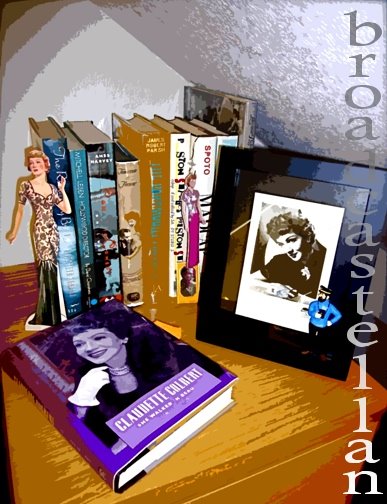
Writing a speech about Colbert in college, I concentrated on her career, of which my fellow students knew little and for which they could not have cared less. That I mentioned the mystique in which her sexuality was shrouded did not seem to have bothered either Colbert or her secretary/companion much. Weeks after sending the only copy of my speech to Colbert’s home in Barbados, I received the autographed image shown here. While I would have liked to engage in conjecture, it was mainly to come out to my own audience, an autobiographical act I ultimately rejected as self-indulgent. A biographer’s predilections and prejudices must not get in the way of the project.

This, I felt, was precisely what kept She Walked from taking flight. Never mind the fanciful title with which Dick tries to evoke the romance he never found or instilled in his subject. Approaching biography with the mind of a bureaucrat, the scholar falls short of meeting the creative challenge at which he balked in duty.

As a failed opportunity to revive interest in someone who, to my great relief, is alive and well in films like the aforementioned Midnight and The Palm Beach Story, She Walked may well put an end to future studies. Yet even if an open-minded publisher can prevent this from being the last word on Colbert, Dickโ€™s eulogy stands out as an act of unpardonable bumbling. Just how graceless a performance it is can be demonstrated by these two consecutive paragraphs, which I have mercifully abridged:

The end came on 30 July. Claudette, barely breathing, said, โ€œI want to go home,โ€ pointing upwards. Oโ€™Hagan stayed with her until the end [. . .]

Claudette was fortunate to have a friend in Helen Oโ€™Hagan, a celebrity in her own right. Widely known as the voice of Saks, she numbered the leading designers among her circle. In 2000, she hosted a retirement party for Bill Blass at the Waldorf, where she presented a slide show of his career, followed by a luncheon consisting of his favorite foods: meat loaf and oat meal cookies.

Not even if such culinary treats had been served at Colbertโ€™s wake do I want to hear about them, especially not in the wake of the deathbed scene. If โ€œThe end came on 20 Julyโ€ brought a tear to my eye, โ€œoat meal cookiesโ€ made me chokeโ€”an unpleasant sensation that even the imminent conclusion of book could not alleviate. “A film actor’s life is a palimpsest,” Dick remarks in his Preface; She Walked in Beauty qualifies as an effacement I would like to see overwritten.