"2X2L calling CQ. . .": The Night They Made Up Our Minds About Realism

Radio Guide (19 November 1938)

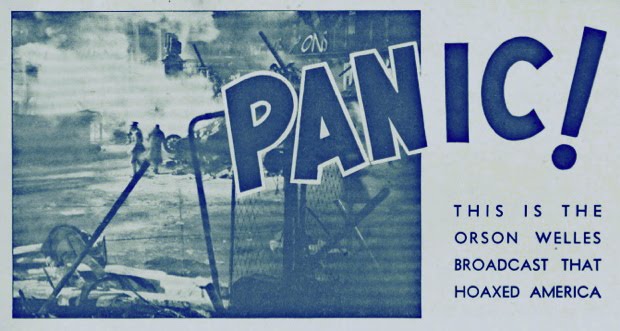
This is just the night for a returnโ€”a return to that old, beloved yet woefully neglected hobbyhorse of mine. You know, the Pegasus of hobbyhorses: the radio. After all, it is the anniversary of the Mercury Theatreโ€™s 1938 โ€œWar of the Worldsโ€ broadcast, a date that lives in infamy for giving those who say that โ€œseeing is believingโ€ an ear-opening poke in the eye. These days, the old Pegasus doesnโ€™t get much of an airing. It may have sprung from the blood of Medusaโ€”but that old Gorgon, television, still has a petrifying grip on our imagination.

What made โ€œThe War of the Worldsโ€ so convincing was that it treated fantasy to the trickery of realism, by turning an old sci-fi yarn into what, too many, sounded like a documentary. As the programโ€™s general editor, John Housemanโ€”who gave up the ghost on Halloween in 1988โ€”recalled about the Mercuryโ€™s holiday offering, not even the script girl had much faith in the material: โ€œItโ€™s all too silly! Weโ€™re going to make fools of ourselves. Absolute idiots.โ€ Instead, the broadcast made fools of thousands by exploiting their pre-war invasion anxieties.

As I put it in Etherized Victorians, broadcast fictions could

tap into what McLuhan argued to be โ€œinherent in the very natureโ€ of radioโ€”the power to turn โ€œpsyche and society into a single echo chamber.โ€

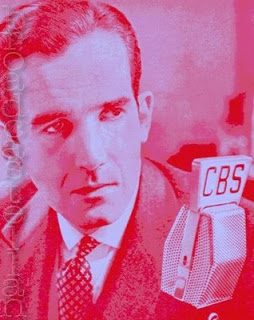
The more urgent concern for broadcasters had always been whether it was proper for radio dramatists to exploit this power at all, especially after the codes of radioโ€™s surface realism had been so forcefully violated by Howard Kochโ€™s dramatization [. . .]. In one of the most disturbing scenes of the play, a speaker identified as a CBS announcer addresses the public to document the end of civilizationโ€”โ€œThis may be the last broadcastโ€โ€”until succumbing to the noxious fumes that spread across Manhattan and extinguish all human life below. ย His body having collapsed at the microphone, a lone voiceโ€”rendered distant and faint by a filterโ€”attempts to establish communication.ย 

It is the voice of a radio operator: โ€œ2X2L calling CQ. . . . 2X2L calling CQ . . . . 2X2L calling CQ . . . New York. Isnโ€™t there anyone on the air? [Isnโ€™t there anyone on the air?] Isnโ€™t there anyone. . . .โ€ ย The Mercury Playersโ€™ โ€œholiday offeringโ€ had not only โ€œdestroyed the Columbia Broadcasting System,โ€ as Welles jested at the conclusion of his infamous Halloween prank, but had pronounced the death of its receiversโ€”the listening public. ย Considering the near panic that ensued, was it advisable to open the realm Esslin called a โ€œregion akin to the world of the dreamโ€ without clearly demarcating it as fantasy by resorting to the spells of Trilby, Chandu, or The Shadow?

After that night, the aural medium as governed by those in charge of the realties of commerce and convenience seemed destined to perpetuate what Trilling referred to as the โ€œchronic American beliefโ€ in the โ€œincompatibility of mind and reality.โ€

Related writings
โ€œโ€˜War of the Worldsโ€™: A Report from the Sensorial Battlefieldโ€
โ€œโ€˜War of the Worldsโ€™: The Election Editionโ€
โ€œThousands Panic When Nelson Eddy Begins to Singโ€

Clash by Day: A D-Day Reminder

It was a crisp, bright afternoon in April when we visited Trebah Garden, one of the most beautiful spots in all of Cornwall. The sun had come out from behind a curtain of threatening clouds and the air was fragrant with a promissory note of summer that even the leafless, wintry trees in the distance were powerless to gainsay. As we walked down the sloping path, past the Rhododendron and Magnolias, beyond the dell of young Gunnera plants that, in time, would grow into a subtropical jungle, we reached a gate that led to a secluded beach. The sea was calm, peaceful the prospect; and even though the name of Trebah had been recorded in the Domesday Book, I felt far removed from the affairs of the world, present and past, as if sheltered in a reserve beyond the reach of history.

When I turned back toward the gate, that sense of detachment was shattered in an instant. I was reminded just how connected I was, even here, with the history of the world. I was yanked out of this perceived Eden by no uncertain notice of our fall: a sign telling me that, from it this secluded spot, thousands went into battle to secure the peace that I had enjoyed.

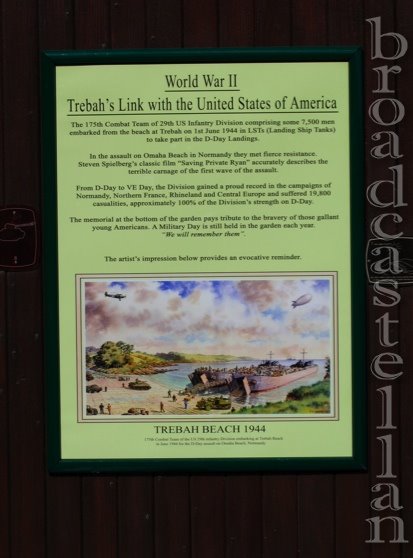
The memorial at Trebah tells of the 175th Combat Team of the 29th US Infantry Division, some 7,500 strong. On the 1st of June in 1944, those men embarked from that very beach to take part in the D-Day landings and, by carrying out their duty, face all but certain death.

โ€œThis is the hour,โ€ Edna St. Vincent Millay wrote in her โ€œPoem and Prayer for an Invading Army,โ€ recited by Ronald Colman during a special radio broadcast on D-Day,

this is the appointed time.
The sound of the clock falls awful on our ears,
And the sound of the bells, their metal clang and chime,
Tolling, tolling,
For those about to die.
For we know well they will not all come home, to lie
In summer on the beaches.

And yet weep not, you mothers of young men, their wives,
Their sweethearts, all who love them wellโ€”
Fear not the tolling of the solemn bell:
It does not prophesy,
And it cannot foretell;
It only can record;
And it records today the passing of a most uncivil age,
Which had its elegance but lived too well,
And far, o, far too long;
And which, on Historyโ€™s page,
Will be found guilty of injustice and grave wrong.

At Trebah Garden, where a Military Day is still being held each year, I was found guilty of the โ€œgrave wrongโ€ it is to be walking in the splendor of oblivion. I shall not soon forget that sudden admonishment, that unsought clash by day.

Related recording
โ€œPoem and Prayer for an Invading Armyโ€ (6 June 1944)

โ€œ. . . and it was built to lastโ€: A Message from Buchenwald

I rarely hear from my sister; sometimes, months go by without a word between us. I have not seen her in almost a decade. Like all of my relatives, my sister lives in Germany. I was born there. I am a German citizen; yet I have not been โ€œhomeโ€ for nearly twenty years. It was back in 1989, a momentous year for what I cannot bring myself to call โ€œmy country,โ€ that I decided, without any intention of making a political statement about the promises of a united Deutschland, I would leave and not return in anything other than a coffin. I donโ€™t care where my ashes are scattered; it might as well be on German soilโ€”a posthumous mingling of little matter. This afternoon, my sister sent me one of her infrequent e-missives. I was sitting in the living room and had just been catching up with the conclusion of an old thriller I had fallen asleep over the night before. The message concerned US President Obamaโ€™s visit to Buchenwald, the news of which had escaped me.
Just in time, I turned on the television to listen to the Presidentโ€™s speech, and to the words of Buchenwald survivor Elie Wiesel. I was relieved to hear the President talk of the Nazis as โ€œhuman.โ€ His predecessor would no doubt have resorted to โ€œevil.โ€ How much more meaningful is the word โ€œhumanโ€โ€”an acknowledgment of shared responsibility that forces us to relate rather than stand apart from any presumably unmitigated horror, thereby encouraging us to look at ourselves as potentially capable of the acts we are so eager to denounce as โ€œinhuman.โ€

I was stirred, too, by the seemingly incongruous message of Elie Wiesel, who expressed himself at once doubtful and full of hope, who spoke of the futility of war at the very site of triumph over tyranny. Yet how can one avoid resorting to the violence of the paradox, whether used in the despair of reason or for the purpose of achieving the kind of harmony the metaphysical poets knew as โ€œdiscordia concorsโ€? How else, if at all, can one account for the life and deaths at Buchenwald, for the monstrously rational, the efficiently profligate, the methodically mad?

One of the first Americans to have witnessed and documented Buchenwald shortly after its liberation was CBS news commentator Edward R. Murrow. On 15 April 1945, three days after first setting eyes on the concentration camp, Murrow confronted his listeners with a report prefaced by the following disclaimer:

Permit me to tell you what you would have seen and heard had you been with me on Thursday. It will not be pleasant listening. If youโ€™re at lunch, or if you have no appetite to hear what Germans have done, now is a good time to switch off the radio. For I propose to tell you of Buchenwald.

Bringing his eyewitness account to the ears of his fellow Americans, Murrow yokes together the incongruous to evoke the incalculable. Putting his finger on the imbalance of recorded figures and observable facts, he weigh in on the scale of humanityโ€™s failure and thereby succeeds in making the measureless ponderable. Broad statistics are presented alongside minute details. Observations of suffering are contrasted with references to Buchenwald as the โ€œbest concentration camp in Germany,โ€ a camp โ€œthat was built to lastโ€ yet built for annihilation.

Murrow speaks of an orderly pile of bodies, a prominent political figure starved beyond recognition, a warning against pickpockets in a scene of horrendous crime, and a new beginning of Buchenwaldโ€™s internees that coincided with the death of Franklin D. Roosevelt.

At one point, Murrowโ€™s report takes us into a โ€œcleanโ€ kitchen that supplies next to no food:

[The German prisoner, a communist, in charge of the kitchen] showed me the daily ration: one piece of brown bread about as thick as your thumb. On top of it a piece of margarine as big as three sticks of chewing gum. That, and a little stew, was what they received every twenty-four hours. He had a chart on the wall. Very complicated it was. There were little red tabs scattered through it. He said that was to indicate each ten men who died. He had to account for the rations, and, he added, “We’re very efficient here.โ€

โ€œIf I have offended you by this rather mild account of Buchenwald,โ€ Murrow adds, โ€œI am not in the least sorry.โ€ After all, had he not begun his report with the incongruous invitation to โ€œswitch off the radioโ€?

I knew switching off only too well. As a child and adolescent growing up in West Germany, I felt the incongruousness of being a good German keenly. I was raised in a small village in which a synagogue rotted away unnoticed, history and hope debased as a pigsty. At school, classmates echoed their parents by defending Hitler as the builder of the Autobahn; at home, my paternal grandmother openly spoke of her awareness of what was happening to her Jewish neighborsโ€”and then severed her connections by reducing me to the pink triangle I had pinned on myself by coming out.

I have been weighed down by collective guilt. I have lived under the terror of the extreme left and experienced the lure of the ultra-right as a stance of ultimate defiance. I failed to reconcile my responsibilities of facing history with any chance of personal happiness. So I left.

Perhaps I have been on the run ever since; trying to distance myself from the past I made my present an evasion. My life abroad has been, by and large, an existence in the neither here nor there, its escapism more shameful than my inescapable origins. Yet how else can we expect to make a clean start of it if our feet remain stuck in the soil we are anxious to shake?

It was with some unease that I realized just what I had been watching before my sister returned me to the reality of now: a neat puzzle in which every murder is accounted for and executed according to plan; a โ€œvery efficientโ€ murder mystery that reduces horror to a formula borrowed from an old and politically incorrect nursery rhyme; film released, no less, in the year of the death camp liberations. You see, before I listened to the speeches at Buchenwald I had been counting down bodies in And Then They Were None.


Related recording
Edward R. Murrowโ€™s report from Buchenwald (15 April 1945)

Related writings
โ€œThe Wannsee Konferenz Maps Out the Final Solutionโ€
โ€œArthur Miller Asks Americans to “Listen for the Sound of Wings”
โ€œFrom the House of Terrorโ€

The Dionne Quintuplets: The Catโ€™s Pajamas . . . or Katzenjammer?

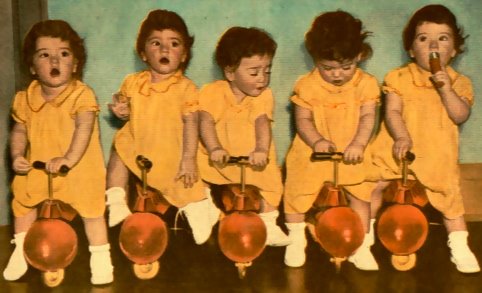
โ€œName your favorite radio star of 1950!โ€ an article in Radio Guide for the week ending 18 April 1936 appealed to its readership (reputedly some 400,000 strong). It wasnโ€™t a challenge to the clairvoyant or a call for votes in one of the magazineโ€™s popularity polls, as the implied answer stared you right in the face, a promise with five sets of peepers. โ€œThe chances are you wonโ€™t be far wrong if your list includes Cecile Dionne, or Yvonne or Annette or Emile or Marie.โ€ย  The famous Dionne Quintuplets, born on this day, 28 May, in 1934, were not yet two years old. No quintuplets before them had ever lived even that long; but their future in show business was already well mapped out for them, in contracts amounting to over half a million dollars.ย  Opposite screen veteran Jean Hersholtโ€”the quintessence of Hippocratic fidelityโ€”those essential quints had already starred in The Country Doctor, released in March 1936, to be followed up by Reunion later that year.

Quite a life for carpetful of rug rats once described as โ€œbluish-black in color, with bulging foreheads, small faces, wrinkled skin, soft and enlarged tummies, flaccid muscles and spider-like limbs!โ€ However fortunate to escape life as a sideshow attraction, the medical history makers could โ€œhardly avoid” being turned into celebrities and groomed for stardom.

“Whether they like it or not,” as the Radio Guide put it, “whether their guardians decree it, whether their parents give their permission, those five famous tots in Callander, Ontario, are the little princesses of the entire world. As such, they are already in and must remain in the public eye as long as the world demands them.”

Sure, the โ€œpublic eyeโ€ tears up at the sight of babies, bouncing or otherwiseโ€”but the public ear? Would audiences tune in to hear a quintet of babbling, bawling infants? And what of all those other noises, the blue notes producers did not dare to mention, let alone set free into the FCC-conditioned air? Publications like Radio Guide paid fifty bucks for a single photograph of the famous handful (even though various if not always authentic pieces of memorabilia could be had considerably more cheaply), and that at a time when you could get your hands on the Presidentโ€™s likeness for a mere five; but would a sponsor risk investing thousands in an act that could not hold a tune or stick to a script? As yet, there was no evidence that the media darlings could blossom into a veritable Baby Rose Marie garden.

Defending Radio Guideโ€™s continued attention to the Dionnes, editor Curtis Mitchell declared that, while the phenomenon โ€œhad little to do with radio,โ€ โ€œall the great personalities of every walk of life and every continentโ€ eventually stepped up to the microphone: “As entertainers they may not have the expertness of Eddie Cantor or Jack Benny but their gurgling and cooing will surely remind us of what a magnificent instrument for participating in the life about us young Guglielmo Marconi provided when he invented radio.”

Sure enough, radio kept the multitudes abreast of the Dionnes while gag writers worked their name into many an old routine. Baby Snooks could stay snug, though. The infantas of Quintland would not baby talk themselves into the hearts of American radio listeners. According to legend (as perpetuated by Simon Callow), it was Orson Welles whom producers called upon to supply the โ€œgurgling and cooingโ€ when the babies were featured on a March of Time broadcast.

Accompanied by their physician, guardian and manager, Dr. Dafoe, the Dionne girls would be paraded before the listening public on several occasions in the early 1940s, and were even heard singing on the air; but they never became the ultimate sister act that readers of Radio Guide, anno 1936, had been encouraged to anticipate. Seen rather than heard, they nonetheless remained a prominent feature on the advertising pages of the Guide and other radio-related publications. All those endorsement deals and money-making schemes make you wonder what the Million Dollar Babies might have said if only they had been permitted to get a word in . . .

The Ironed-Out Curtain; or, From Russia With Love Songs

“I’m in love with a fairy tale / Even though it hurts.” It was with these lyrics, a fiddle, and a disarming smile that Norwegian delegate Alexander Rybak came to be voted winner of the 54th Eurovision Song Contestโ€”an annual spectacle-cum-diplomatic mission reputed to be the worldโ€™s most-watched non-sporting event on television. However intended, the lines aptly capture the attitude of many Europeans toward the contest, just as the entries in the ever expanding competition are a reflection of all that is exasperating, perverse, and wonderful about European Unityโ€”a leveling of cultures for the sake of political stability, national security, and economic opportunity.
This year, forty-two countries qualified for the semi-finales, among them Albania, Andorra, and Azerbaijan, while former, traditional contestants Austria and Italy have opted out of participating in the competition. The friction between East and West has become more pronounced in recent years, leaving a frustrated West to contribute awkwardly self-conscious throwaway songs that further diminished the chance of a winning song from, say, Ireland (a seven-time winner), the United Kingdom, or Germany. It was as if the West chose to cloak itself in a mantle of irony to set itself garishly and haughtily apart from the closely-knit, sheer impenetrable post-Iron curtain it perceived to be obstructing Eurovision.

The collapse of the Soviet Union brought about a shift in the voting, with viewers of Eastern European nations favoring the songs representing neighboring countries, since voting for the representative of oneโ€™s own country is not permitted. For the West, the contest has become both an embarrassment and a liability (the United Kingdom, Germany, France, and Spain being the chief sponsors of the event and guaranteed a place in the finale). The chance of winning the contest based on merit or popularity became tantamount to wishing for a happily-ever-after. Until last night.

This yearโ€™s live event was hosted by Russia, the previous winning nation. Although Russiaโ€™s 2008 victory was not necessarily undeserved, the bloc voting had become so flagrant as to call any success of an Eastern European act into question. The thought that the triumph of the East was by now all but certain became so irksome to organizers and broadcasters in the United Kingdom that long-time commentator Terry Wogan withdrew from the contest and musical composer Andrew Lloyd Webber stepped in to prevent Britain from suffering another abject yet just defeat.

To increase the chances, voting procedures were changed once again, this time combining popular vote (via phone and instant messaging) with the vote of a presumably less partial jury of musical experts. In a reversal of the dreaded trend, the British entry finished fifth, and that despite Lloyd Webberโ€™s low-voltage power ballad and a somewhat flawed performance by the heretofore unknown Jade Ewen. Still, the United Kingdom may have regained the respect of the jurors by deciding to put an end to defeatist silliness and to reconsider the meaning of โ€œSongโ€ in โ€œEurovision Song Contest.โ€

Inspired perhaps by the participation of Baron Lloyd-Webber, the overall quality of the songs and the performers was superior to the dross and folly to which the pop-cultural event had been reduced in the 21st century. Sure, Alexander Rybak was born in the former Soviet Unionโ€”but there is no doubt that Norway won because of the exuberance, charm, and catchiness of its entry, just as neighboring Finland rightly came in last.

โ€œI donโ€™t care if I lose my mind / Iโ€™m already cursed,โ€ the lyrics continue. Thanks to last nightโ€™s event, those words no longer reflect the attitude of Western contestants.

Cranky Doodle Dandy: George M. Cohan Feels So Free

Jumping Jehosophat! It sure feels good to rant about our elected governmentโ€”some force that, at times, appears to us (or is conveniently conceived of) as an entity we don’t have much to do with, after the fact or fiction of election, besides the imposition of carrying the burden of enduring it, albeit not without whingeing. Back on this day, 4 May, in 1941, the Columbia Broadcasting System allotted time to remind listeners of the Free Company just what it means to have such a rightโ€”the liberty to voice oneโ€™s views, the โ€œfreedom from police persecution.โ€ The play was โ€œAbove Suspicion.โ€ The dramatist was to be the renowned author Sherwood Anderson, who had died a few weeks before completing the script. In lieu of the finished work, The Free Company, for its tenth and final broadcast, presented its version of โ€œAbove Suspicionโ€ as a tribute to the author.

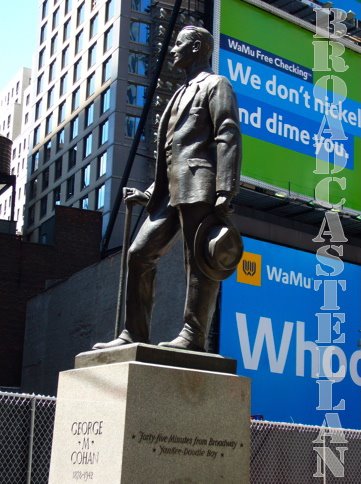
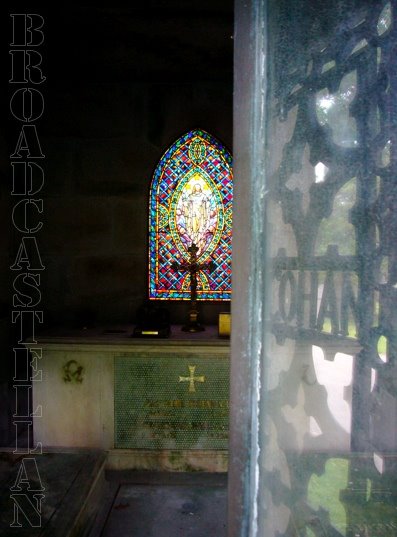
Starred on the program, in one of his rare radio broadcastsโ€”and perhaps his only dramatic role on the airโ€”was the legendary George M. Cohan (whose statue in Times Square, New York City, and tomb in Woodlawn Cemetery, The Bronx, are pictured here). Cohan, who had portrayed Franklin D. Roosevelt in Iโ€™d Rather Be Right was playing a character who fondly recalls Grover Clevelandโ€™s second term, but is more to the right when it comes to big government.

The Free Companyโ€™s didactic play, set in New York City in the mid-1930s, deals with a complicated family reunion as the German-American wife of one Joe Smith (Cohan) welcomes her teenage nephew, Fritz (natch!), from the old country. Fritz’s American cousin, for one, is excited about the visit. Trudy tells as much to Mary, the young woman her mother hired to prepare for the big day:

Trudy.  Mary, I have a cousin.

MARY.  Yeah, I know, this Fritz.

TRUDY.  Have you a cousin?

MARY.  Sure, ten of โ€˜em.

TRUDY.  What are they like?

MARY.  All kinds.  Oneโ€™s a bank cashier and oneโ€™s in jail.

TRUDY.  In jail! What did he do?

MARY.  He was a bank cashier, too [. . .].

Make that โ€œexecutiveโ€ and it almost sounds contemporary. In โ€œAbove Suspicion,โ€ the American characters are not exactly what the title suggests. That is, they arenโ€™t perfect; yet they are not about to conceal either their past or their positions.

Trudyโ€™s father is critical of the government, much to the perturbation of Fritz, who has been conditioned to obey the State unconditionally:

SMITH.  Jumping Jehosophat [chuckles].  Listen, the Stateโ€™s got nothing to do with folksโ€™s private affairs.  Nothing.

FRITZ. Please, Uncle Joe, with all respect.  If the State doesnโ€™t control private affairs, how can the State become strong?

SMITH.  Oh, it will become strong, all right.  You know, sorry, it might become too darn strong, Iโ€™ll say.  And I also say, let the government mind its own dod-blasted business and Iโ€™ll mind mine.

To Fritz, such โ€œradicalโ€ talk is โ€œdangerousโ€; after all, his education is limited to โ€œEnglish, running in gas masks, and the history of [his] country.โ€ He assumes that Mary is a spy and that anyone around him is at risk of persecution. To that, his uncle replies: โ€œDangerous? Well, I wish it was. The trouble is, nobody pays any attention. By gad, all I hope is that the people wake up before the country is stolen right out from under us, thatโ€™s what I hope.โ€

โ€œAbove Suspicionโ€ is a fairly naรฏve celebration of civil liberties threatened by the ascent of a foreign, hostile nation (rather than by forces from within). Still, it is a worthwhile reminder of what is at stake today. Now that the technology is in place to eavesdrop on private conversations (the British government, most aggressive among the so-called free nations when it comes to spying on the electorate, is set to monitor all online exchanges), we can least afford to be complaisant about any change of government that would exploit the uses of such data to suppress the individual.

โ€œDictaphones,โ€ Smith laughs off Fritzโ€™s persecution anxieties.

I wish they would some of those dictaphones here.  Iโ€™d pay all the expenses to have the records sent right straight to the White House.  Thatโ€™s what Iโ€™d do.  Then theyโ€™d know what was going on then.  [laughs]  Theyโ€™d get some results then, hey, momma?

These days, no one is โ€œAbove Suspicion.โ€ Just donโ€™t blame it on Fritz.

Floyd and the Flood

Wherever fighting men are in actionโ€”wherever disaster shakes the earthโ€”wherever history is in the makingโ€”there youโ€™ll find Headline Hunter Gibbons, the machine-gun stylist of words.

His record is 217 words a minute, steady flow for sustained speech. But what a price he has paid for the background that makes his record possible!โ€”His body is crosspatched with bullet wounds and sword cuts. The spot where his left eye should be is covered by a white patch. Heโ€™s bivouacked on the feverish sands of Mexico, India and Egypt. His toe joints have been frozen on the arctic waste of Manchuria.

But heโ€™s happy. It is his life and he loves it.

That is how a 1934 article in Radio Guide (for the week ending 17 November) introduced Floyd Gibbons (1887-1939), a news commentator whose life was as thrilling and fast-paced as the one he breathed into the scripts he readโ€”or, rather, performedโ€”on the air.

Delivering his lines, and with such rat-a-tat rapidity, was not easy for the battle-scarred Headline Hunter. According to Robert Eichbergโ€™s Radio Stars of Today (1937), Gibbons was with the American army at Belleau Wood, France, when, on 6 June 1918, the major leading his troop was struck down by German machine gun fire:

Suddenly a bullet struck Floyd in the left shoulder, and another tore through his left arm. Still he crept toward the stricken officer, only to have a third shot pierce his steel helmet, fracturing his skull, and blind him in his left eye.

As one of his colleagues, John B. Kennedy, recalls (in Robert Westโ€™s 1941 broadcasting history The Rape of Radio), Floyd โ€œused to have his scripts typed in jumbo type so that he could read easily. โ€˜With that big type he would come to the studio with forty or fifty pages of stuff, almost four times as many as the rest of us used!’โ€

Little now survives of Gibbonsโ€™s celebrated broadcasts, aside from a couple of reports aired on the Magic Key program. In March 1936, Gibbons returned to the airwaves after nearly seven months, โ€œgladโ€ to be getting away from the crisis in Ethiopia to focus instead on a natural catastrophe much closer to home: the Connecticut River Valley flood. A few years earlier, he had abandoned his coverage of the Sino-Japanese conflict to rush to Hopewell, New Jersey, to get in on the sensational story of the Lindbergh baby kidnapping.

In his Magic Key notes from 22 March 1936, which Jim Widner shares in his tribute to the man, Gibbons referred to the overflowing of the Connecticut River as โ€œthe worst flood in the history of the last half century.โ€ Seen, as he had it, from aboveโ€”a view not generally afforded his listenersโ€”the valley looked like a โ€œvast inland seaโ€ on which Gibbons spotted โ€œdismal, un-milked cowsโ€ and โ€œbedraggled wet chickensโ€ that were โ€œperched bewilderedโ€ upon โ€œisolated elevations like animated weather cocks.โ€

Gibbons talked of the โ€œwithered mushroomsโ€ that were the gas and oil tanks of the refining companies, each containing โ€œhundreds of thousands of explosive fuel which in turn represent fire and disaster should these enormous receptacles be torn loose from their foundationsโ€ and โ€œlose their fiery contents.โ€ Those at work to prevent further disaster looked like โ€œLilliputiansโ€ as they tried to โ€œtie down these deadly metallic giants.โ€

Meanwhile, in the riverbed,

in which ambitious men had hoped to incarcerate old man river with dikes and dams of stone and steel, the prisoner [ was] lashing, foaming, writhing like a serpent striking back with frightful force and power, an unexpected fury.

Some nine months before his death, Gibbons gave a brief account of his exploitsโ€”riding with Pancho Villa in Mexico, sailing on the Laconia when it was torpedoed and sankโ€”to listeners of the Lux Radio Theater (16 January 1939). In it, he remarked that

the best and most truthful report of any happening is that of the personal eye-witness who can honestly say “I saw it. I was there when it happened.” He has to keep in mind the importance of the main event, but must not overlook the apparently unimportant little facts that prove the truth of the story.

In the rush of his reportage, โ€œlittle factsโ€ at times made way for great effects. According to West, Gibbonsโ€™s report of the Ohio River Flood of 1937 referred to โ€œsensational happeningsโ€ that had not actually taken place as described. Gibbons was sued for two hundred and fifty thousand dollars in damages by a scriptwriter who argued that โ€œhis reputation had been marred.โ€

What Gibbonsโ€™s rapid-fire imagery does convey, though, is the fury of the scenes we imagine he beheld. In a rhetorical style long fallen out of favor but so vital to depiction in the absence of visuals, Gibbons personified the threatening force of the raging Connecticut River to capture the truth of the moment in a torrent of pathetic fallacies:

Like a slave, freed from the chains of his presumptuous would-be masters, the river is striking back in wild retaliation. It seems to say: for years, for years I have turned your wheels and lighted your cities and watered your fields and cattle, and heated your homes and transported your commerce; and now, now comes my day of revolt, to show you my strength.

At the conclusion of his report from the Connecticut River Valley, Gibbons paid his respect to those who kept their ears to the flooded ground and saved โ€œthousands of livesโ€ simply through word of mouth: a โ€œnewly developed class of men and women,โ€ the โ€œshort and long wave amateur operatorsโ€ who, โ€œ[w]hen landlines and other means of high-power communications became disruptedโ€ by the flood, โ€œstuck to their dangerous postsโ€ and โ€œkept going a running fire of information.โ€

Few understood better than the Headline Hunter how to keep that fire from dying out; and to men like him we must turn to rekindle our imagination in a world awash with images.

Fa(r)ther?

Historically speaking, it is difficult for me to get the larger picture. When I express anything amounting to a weltanschauung, I go all philosophical. Perhaps, I live too much in the confines of my own peculiar everyday to engage with the political events and developments that shape my existence. Life in the United States has taughtโ€”or, at any rate, encouragedโ€”me to live in and for the now, a modus of going about oneโ€™s affairs that is more personally rewarding even though it might not always be quite so socially or globally responsible. Seizing the day for the sake of that day and its glories alone is not something to which Germans, in particular, are prone; they are more likely to seize opportunities for the future, or another country, for that matter.

In the old world, people tend to plan for what might happen in generations to come; they are anxious to map out what they presume to lie ahead, sometimes for as much as a thousand years. I suppose that, once those old world futurists went west to seek their fortune, they needed to learn to reconcile themselves to the vagaries of the wilderness, to fight everyday battles, to carve a niche for themselves right out of those woods.

In societies that have a medieval past in which the individual matters less than the tribe, fascism and communism are more likely to flourish than in the United States. Creating order out of the chaos that is time not yet present so as to provide for the future of oneโ€™s kind makes even genocide justifiable.

I wonder whether, had I been born American and grown up the in United States during the 1930s, I had possessed the foresight to anticipate just what this kind of mindset is capable of undoing and getting done. Would I have been an isolationist or urged for an involvement in the European conflict? Would I have been all peacetime business as usual or seen war as a way of insuring the future of an ideal?

I trust that, for all my shortsightedness, I would have seen right through a man like Father Charles Coughlin, who, back in 1939, continued to rail against the warmongers in the US. Using the microphone and Social Justice magazine as means of reaching the American multitudes, he went so far as to recruit school children for his cause. On 19 March 1939, the notoriously anti-semitic priest offered prizes to any youngsterโ€”Christian, Jew, or gentileโ€”who could best express reasons to stay out of a foreign โ€œentanglementโ€ involving military action. One answer suggested by the announcer of Coughlinโ€™s radio addresses, who was also a spokesperson for Social Justice, hailed economic sanctions as a modern mode of warfare.

In 1936, Father Coughlin could still count on a popular magazine like Radio Guide as a forum to pose a challenge to โ€œFranklin Doublecross Roosevelt,โ€ the President he had staunchly supported some six years earlier. By 1940, Coughlinโ€™s influence was vastly diminished, his motives questioned, his hypocrisy exposed. In an issue of Radio-Movie Guide for the week of 16 to 22 March 1940, news editor and radio historian Francis Chase, Jr. shared the outcome of his investigation into Coughlinโ€™s mysterious absence from the airwaves on 4 February of that year when a “series of cryptic and intriguing announcementsโ€ informed the listening public that Coughlin โ€œwould not appear to speak and intimated that dire and sinister forces were at work to prevent his addressing the radio audience.โ€ Chaseโ€™s subsequent

investigations showed that neither [station] WJR nor the Coughlin radio network had censored Coughlinโ€™s address. ย Neither had the Catholic Church nor the Federal Communications Commission. ย The inescapable conclusion to be drawn, therefore, is that Father Coughlin, and Father Coughlin aloneโ€”was responsible for the weird performance after exhorting, through his announcer, all listeners-in to telephone their friends and get them to their loudspeakers.

Apparently, Coughlin was determined to present himself as a martyr threatened to have his tongue cut off by those who did not like what he had to say. Among those who very much liked what Coughlin saidโ€”and who liked what his staged disappearance from the airways might implyโ€”where the editors of Hitlerโ€™s Vรถlkischer Beobachter, who sneered that, in a so-called free America, Coughlin was facing censorship for the โ€œtruthsโ€ he dared to speak.

Was Coughlin, who envisioned a fascist โ€œCorporate Stateโ€ to do away with what he argued to be a corrupt United States, consumed with the larger picture in a foreign frame? Or was he, Canadian-born and barred from the Presidency, picturing mainly himself in whatever frame suited him best or was most likely to accommodate him?

However far-reaching or far-fetched his scheming, much of what the far-righteous Father espoused Chase demonstrated to be personally motivated. When Coughlin denounced the worshipping of the โ€œGod of Gold,โ€ for instance, and argued it a “Christian concern” to restore silver to โ€œits proper value,โ€ the US government disclosed that the Thunderer of Royal Oak owned “more silver than any other person in Michigan.โ€ While loudly condemning “Wall Street gambling,โ€ Coughlin was known to have played the stock market.

Sure, even the larger pictureโ€”a vision, however ghastly or inhumaneโ€”is only a reflection of the minds that conceive it; but in how far are the likes of me, whose frame of mind is too narrow or too feeble to get hold of that larger picture, content to be framed by the masterminds who seize the opportunity of creating, mounting and authenticating it?


Related recordings
Coughlin broadcast 19 March 1939
Coughlin broadcast 4 February 1940

Related Writings
โ€œ’I hold no animosity toward the Jews’: The Father Coughlin Factor”

Fat Lies Tuesday; or, Time to Love and Time to Hate

This is a day for disguises, and a night of unmasking. A time to let yourself go, and a time to let go of something. A night to make an ass of yourself, and a morning to mark yourself with ash. Shrove Tuesday, Mardi Gras, Fastnacht. Back where I come fromโ€”Germanyโ€™s Rhinelandโ€”carnival is a major holiday, an interlude set aside for delusions, for letting powerless misrule themselves: laborers parading in the streets without demanding higher wages, farmers nominating mock kings and drag queens to preside over their revels; women storming the houses of local government to perform the ritual of emasculation by cutting off the ties that hang from the necks of the ruling sex. It is a riotous spectacle designed to preserve what is; a staged and sanctioned ersatz rebellion that exhausts itself in hangovers.

Sometimes, the disillusionment creeps up on you only gradually. Upon reflection, that wondrous โ€œwhat ifโ€ begins to sound more like sobering โ€œas if!โ€ You may have had a good timeโ€”but, when it comes right down to it, youโ€™ve been had.

As a political instrument, the radio is not unlike Mardi Gras. Tuning in after a dayโ€™s work is a carnivalesque experienceโ€”the partaking of a communal pancake made from the eggs with which you didnโ€™t dare to pelt those who own most of the chicken. It is the allotted substitute for the half-forgotten voice that those content to listen tend to deny themselves. Broadcasting was, after all, an industry in the service of keeping things as they are or as they ought to beโ€”according to those who operate (within) it.

Radioโ€™s most prominent voices belonged to the fools and the trickstersโ€”Ed Wynn, Baron Munchausen, and the irreverent, imaginary Charlie McCarthy; but during the lean years of depression and war, a period when the medium was at its most influential, radio also coaxed listeners into making sacrifices by driving home their frugality or fortitude could make a difference.

One such Atwater-Lent offering was โ€œThe Women Stayed at Home,โ€ first heard on this day, 24 February, in 1940. It was written by Arch Oboler, the mediumโ€™s foremost melodramatist. If one contemporary source is to be believed, Oboler penned more than four hundred plays between 1935 and 1940 alone. The bulk of his output may be classified either as schlock or as propaganda; except that much of his work is not either, it is both.

There is jolly little cheer in โ€œThe Women Stayed at Home,โ€ starring Norma Shearer, whose 1939 screen success The Women may well have suggested the title. Not that, aside from the performer and the spurious message of female empowerment, there are any similarities between those two vehicles. The opening scene of the latter is the “wind-wept” coast of an unspecified country:

It is night. For once the sea is calm. It waits ominously upon the edge offshore where sits a woman and an old man. For a long time they have sat quietly, but now woman speaks to the old man, and her words lift out to the sea on the rush of the wind. . . .

The woman is Celia. The old man is one of usโ€”a listener. Shortly after her wedding, Celiaโ€™s fisherman husband perishes at sea. When war breaks out, she feels that she has nothing for which to live or fight. Being refused a chance to be of use to the community, she decides to drown herself. In the attempt, she happens upon a body in the water, the body of a man yet livingโ€”a โ€œman from an enemy boat.โ€

Torn between her civic duty and her moral responsibility, Celia decides to be a nurse to Carl, the German stranger whose needs and gratitude imbue her with a sense of purpose that gradually turns into love. Aware of having placed Celia in a precarious position, Carl disappears; but Celia, no longer lonely, is convinced that he will return to her one day.

There was a market for such sentiment prior to the attack on Pearl Harbor, when the isolationist lobby was still strong and outspoken responses to fascism were rarely heard on the air. In 1942, when the play was published, Oboler tried to justify its inclusion in This Freedom by arguing that โ€œafter a while, you find yourself hating too muchโ€โ€”a justification clearly tagged on since, back in 1940, even a prominent writer like Oboler could not get away with overtly opposing the policy of neutrality by inciting anger and directing it toward a foreign national target.

When the play was revived almost exactly four years later, in February 1944, the situation had long changed and the playwright was quick to adjust the message to suit the occasion that was Everything for the Boys, a variety program for American servicemen. Oboler had turned into a staunch advocate of hatred. That is, he argued it to be more effective to make Americans hate the enemy than love their own country. It was hate that got things done.

The pseudo-pacifist โ€œWomen,โ€ now headed by Mercedes McCambridge, became a patriotic morale booster set in Norway under German occupation. The stranger washed ashore is now a British flyer (played by Ronald Colman). Celiaโ€™s dilemma: whether to hide the man or nurse him back to fighting form. After he is gone, a newly invigorated Celia declares: “I like to think that he knows Iโ€™m fighting now, too. For the good people. Some day the fighting will be over. It must end. Heโ€™ll come back to me. Iโ€™ll never be lonely any more.”

โ€œThe Women Stayed at Homeโ€ is clearly of the ready-mix, on demand variety; but it takes a comparative taste test to expose both versions as sham. Real conflict is reduced to melodramatic opportunity; genuine emotion whipped up to achieve whatever was expedient. Sure, there was a time to love and a time to hateโ€”and Arch Oboler had just the words to paint the sign of the times in whatever color suited the mood.

When anti-war laments were popular, Oboler taught them be mindful of how Johnny Got His Gun and what good it did him. He introduced Americans to a โ€œSteel” worker ashamed of being in the service of making war. โ€œThe Women Stayed at Homeโ€ betrays the opportunist who knew how to keep the pot boiling, a trader in sentiment who did not hesitate to discard supposedly outmoded principles like so many rotten eggs.

Whatever you give up for Lent, keep your integrity.


Related recordings
โ€The Women Stayed at Home,โ€ Everymanโ€™s Theater (24 Feb. 1940)
โ€œThe Women Stayed at Home,โ€ Everything for the Boys (22 February 1944)

Related Writings
โ€œSenseless: One Soldier’s Fight to Speak Against Warโ€ (on Obolerโ€™s adaptation of Johnny Got His Gun)
โ€œBette Davis Gives Birth to Arch Oboler’s โ€˜Americanโ€™โ€
โ€œโ€˜. . . originally written for Bette Davisโ€™: Arch Obolerโ€™s โ€˜Alter Egoโ€™โ€
โ€œHollywood Star Kay Francis Makes Paralysis Sound Like Paradiseโ€
โ€œMercedes McCambridge, Airwaves Advocateโ€

Inherit the . . . Air: Dialing for Darwin on His 200th Birthday

Before settling down for a small-screening of Inherit the Wind, I twisted the dial in search of the man from whose contemporaries we inherited the debate it depicts: Charles Darwin, born, like Abraham Lincoln, on this day, 12 February 1809. Like Lincoln, Darwin was a liberator among folks who resisted free thinking, a man whose ideas not only broadened minds but roused the ire of the close-minded–stick in the muds who resented being traced to the mud primordial, dreaded having what they conceived of as being set in stone washed away in the flux of evolution, and resolved instead to keep humanity from evolving. On BBC radio, at least, Darwin is the man of the hour. His youthful Beagle Diary is currently being read to us in daily installments; his โ€œVoyages of Descentโ€ with Captain FitzRoy have been newly dramatized; and his theories are the subject of numerous talks and documentaries.

The bicentenary celebrations got underway early at the Natural History Museum in London, where last December I visited an exhibition of artifacts and documents from Darwinโ€™s journeys of discovery, quests that had their origin here in the west of Britain: โ€œIn August quietly wandering about Wales, in February in a different hemisphere; nothing ever in this life ought to surprise me,โ€ young Darwin noted.

Nor should resistance to change. Back in 1935 (as Erik Barnouw reminds us in A Tower in Babel), when the hostile response to Darwin’s theories resulted in a media event known as the Scopes Monkey Trial, station WGN, Chicago, took the microphone straight into the courtroom so that listeners might hear defense attorney Clarence Darrow ask prosecutor William Jennings Bryan, โ€œMr. Bryan, do you believe that the first woman was Eve?โ€

Bryan professed to believe just that; and unable to sway the jurors from thinking otherwise, Darrow lost the caseโ€”a case that, if some politicians had had their way, would not have been made public. It was not just the espousal but the very mention of Darwin’s ideas that was considered a threat. An amendment to ban all broadcasts of โ€œdiscoursesโ€ about Darwin was proposed in the 69th United States Congress. If that amendment had passed, the evolution could not be televised today.

It comes as no surprise either that the two men who penned Inherit the Wind were former broadcast writers; in fictionalizing the trial, they disowned the medium that had imposed so many restrictions upon them, that kept potentially incendiary ideas from being disseminated; that, in the interest of public calmโ€”as opposed to the public interestโ€”was apt to cast aside what it did not dare to cast broadly.

It was not until long after his death that Darrow, once known as the โ€œboy who would argue against everything,โ€ became the subject of a CBS radio documentary; in it, many outspoken thinkersโ€”including Edith Sampson, the first black US delegate appointed to the United Nationsโ€”were heard arguing in his defense.

Perhaps, I am overstating my case when say that Darwin was too hot for radio; yet even when his ideas were presented on the air, they needed to be cooled down so as not to inflame anew. In 1946, a dramatization of his career was attempted for The Human Adventure, an educational program produced by CBS in co-operation with the University of Chicago. As Max Wylie put it in his foreword to a published script from the series, The Human Adventure presented

dramatic interpretations of the progress being made in university research throughout the world, progress in any of the thirty thousand research projects that are now being worked on by scholars and scientists in this country and in the centers of learning throughout the civilized world.

The description does not quite fit the episode in question, which transports listeners to a less civilized, less enlightened past. It opens on a โ€œleisurely day in Londonโ€ anno 1859. On 24 November, to be precise, the very day on which Darwinโ€™s Origin of the Species went on sale. The scene is a bookstore, the dialogue between a young scholar and his formidable aunt who disapproves of Darwinian notions:

When I was a girl, we knew exactly how old the world was. Bishop Ussher proved it in the scriptures. The world, he proved, was created in the year 4004 BC, on a Friday in October at 9 oโ€™clock in the morning.

Not that the lad is particularly up-to-date; โ€œeveryone knows that animals donโ€™t changeโ€ and that โ€œspecies remain exactly as created,โ€ he argues. โ€œEvery kind fixed and separate.โ€ Darwinโ€™s new book was flung at that rickety bandwagon, as the play drives home. โ€œInstantly, overnight, the lines of conflict are drawn. The complaisant, orthodox world, which is Victorian England, erupts into a storm of controversy.โ€

The narrative soon shifts from social agitation to the thrill of exploration and pioneering. It emphasizes the spirit of โ€œAdventureโ€ over the dispiritingly โ€œHumanโ€ by introducing us to the younger Darwin aboard the Beagle, the eager scientist in his laboratory, and the ailing researcher supported by a loving spouse. Without diverging from facts, the drama suggests that Darwinโ€™s theory were not quite so earth-shattering after all, a similar treatise having preceded it that threatened to render Darwinโ€™s own publication redundant. Without omitting a reference to monkeys, the broadcast refuses to acknowledge that its subject matter continued to make zealots go ape.

Defusing Darwinโ€™s prehistoric time bomb, The Human Adventure argued the โ€œstorm of abuse,โ€ the โ€œbitter intemperate, all too human controversyโ€ to be โ€œbehind us now.โ€ The voices of protest give way to a demonstration of how Darwin’s words echo the theories of scientists from around the world, an enlightened world united through science. Science fiction, in short.