Cranky Doodle Dandy: George M. Cohan Feels So Free

Jumping Jehosophat! It sure feels good to rant about our elected governmentโ€”some force that, at times, appears to us (or is conveniently conceived of) as an entity we don’t have much to do with, after the fact or fiction of election, besides the imposition of carrying the burden of enduring it, albeit not without whingeing. Back on this day, 4 May, in 1941, the Columbia Broadcasting System allotted time to remind listeners of the Free Company just what it means to have such a rightโ€”the liberty to voice oneโ€™s views, the โ€œfreedom from police persecution.โ€ The play was โ€œAbove Suspicion.โ€ The dramatist was to be the renowned author Sherwood Anderson, who had died a few weeks before completing the script. In lieu of the finished work, The Free Company, for its tenth and final broadcast, presented its version of โ€œAbove Suspicionโ€ as a tribute to the author.

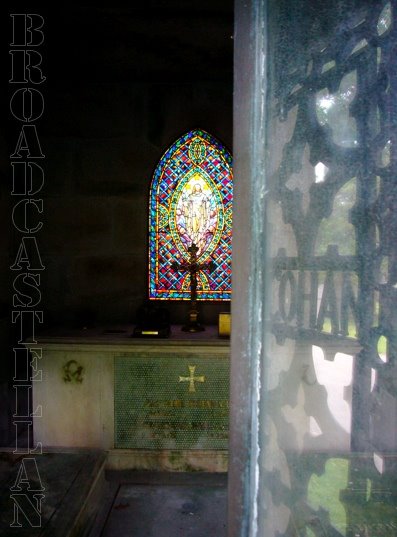
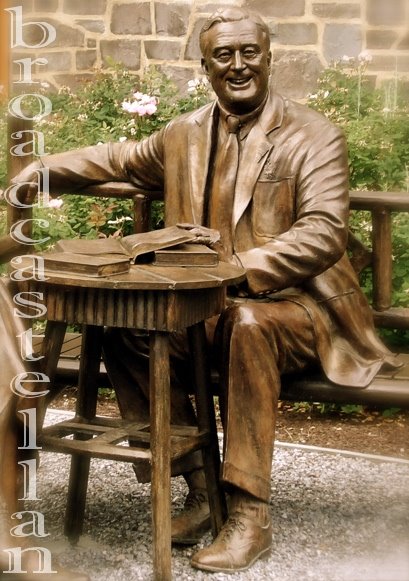
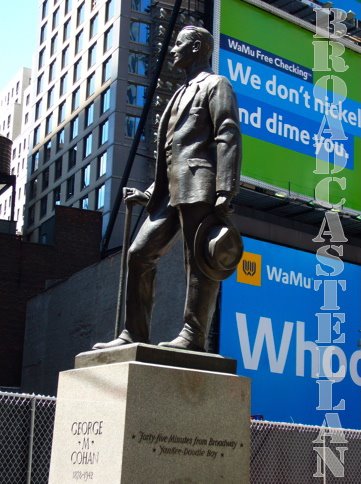
Starred on the program, in one of his rare radio broadcastsโ€”and perhaps his only dramatic role on the airโ€”was the legendary George M. Cohan (whose statue in Times Square, New York City, and tomb in Woodlawn Cemetery, The Bronx, are pictured here). Cohan, who had portrayed Franklin D. Roosevelt in Iโ€™d Rather Be Right was playing a character who fondly recalls Grover Clevelandโ€™s second term, but is more to the right when it comes to big government.

The Free Companyโ€™s didactic play, set in New York City in the mid-1930s, deals with a complicated family reunion as the German-American wife of one Joe Smith (Cohan) welcomes her teenage nephew, Fritz (natch!), from the old country. Fritz’s American cousin, for one, is excited about the visit. Trudy tells as much to Mary, the young woman her mother hired to prepare for the big day:

Trudy.  Mary, I have a cousin.

MARY.  Yeah, I know, this Fritz.

TRUDY.  Have you a cousin?

MARY.  Sure, ten of โ€˜em.

TRUDY.  What are they like?

MARY.  All kinds.  Oneโ€™s a bank cashier and oneโ€™s in jail.

TRUDY.  In jail! What did he do?

MARY.  He was a bank cashier, too [. . .].

Make that โ€œexecutiveโ€ and it almost sounds contemporary. In โ€œAbove Suspicion,โ€ the American characters are not exactly what the title suggests. That is, they arenโ€™t perfect; yet they are not about to conceal either their past or their positions.

Trudyโ€™s father is critical of the government, much to the perturbation of Fritz, who has been conditioned to obey the State unconditionally:

SMITH.  Jumping Jehosophat [chuckles].  Listen, the Stateโ€™s got nothing to do with folksโ€™s private affairs.  Nothing.

FRITZ. Please, Uncle Joe, with all respect.  If the State doesnโ€™t control private affairs, how can the State become strong?

SMITH.  Oh, it will become strong, all right.  You know, sorry, it might become too darn strong, Iโ€™ll say.  And I also say, let the government mind its own dod-blasted business and Iโ€™ll mind mine.

To Fritz, such โ€œradicalโ€ talk is โ€œdangerousโ€; after all, his education is limited to โ€œEnglish, running in gas masks, and the history of [his] country.โ€ He assumes that Mary is a spy and that anyone around him is at risk of persecution. To that, his uncle replies: โ€œDangerous? Well, I wish it was. The trouble is, nobody pays any attention. By gad, all I hope is that the people wake up before the country is stolen right out from under us, thatโ€™s what I hope.โ€

โ€œAbove Suspicionโ€ is a fairly naรฏve celebration of civil liberties threatened by the ascent of a foreign, hostile nation (rather than by forces from within). Still, it is a worthwhile reminder of what is at stake today. Now that the technology is in place to eavesdrop on private conversations (the British government, most aggressive among the so-called free nations when it comes to spying on the electorate, is set to monitor all online exchanges), we can least afford to be complaisant about any change of government that would exploit the uses of such data to suppress the individual.

โ€œDictaphones,โ€ Smith laughs off Fritzโ€™s persecution anxieties.

I wish they would some of those dictaphones here.  Iโ€™d pay all the expenses to have the records sent right straight to the White House.  Thatโ€™s what Iโ€™d do.  Then theyโ€™d know what was going on then.  [laughs]  Theyโ€™d get some results then, hey, momma?

These days, no one is โ€œAbove Suspicion.โ€ Just donโ€™t blame it on Fritz.

Floyd and the Flood

Wherever fighting men are in actionโ€”wherever disaster shakes the earthโ€”wherever history is in the makingโ€”there youโ€™ll find Headline Hunter Gibbons, the machine-gun stylist of words.

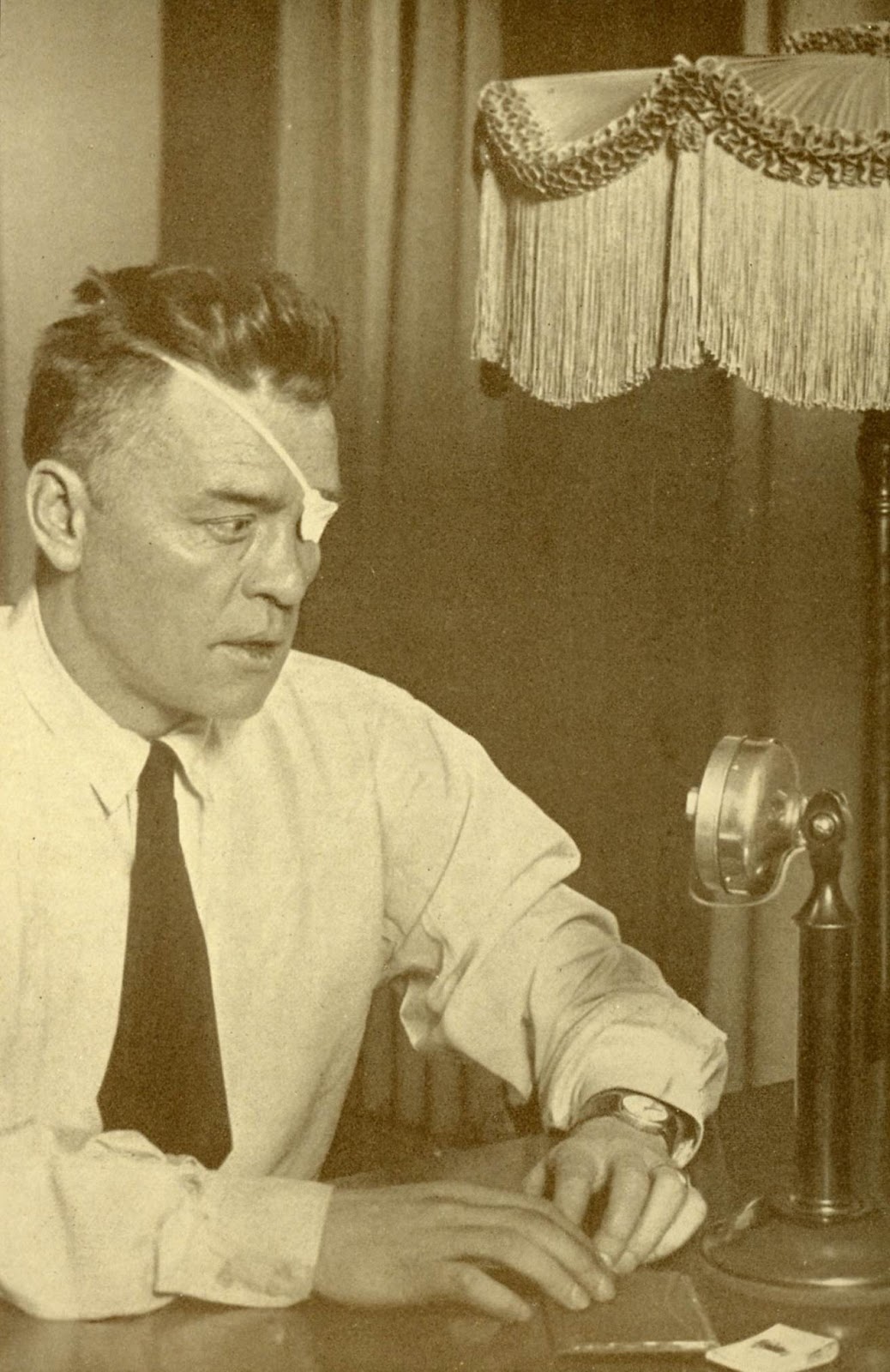
His record is 217 words a minute, steady flow for sustained speech. But what a price he has paid for the background that makes his record possible!โ€”His body is crosspatched with bullet wounds and sword cuts. The spot where his left eye should be is covered by a white patch. Heโ€™s bivouacked on the feverish sands of Mexico, India and Egypt. His toe joints have been frozen on the arctic waste of Manchuria.

But heโ€™s happy. It is his life and he loves it.

That is how a 1934 article in Radio Guide (for the week ending 17 November) introduced Floyd Gibbons (1887-1939), a news commentator whose life was as thrilling and fast-paced as the one he breathed into the scripts he readโ€”or, rather, performedโ€”on the air.

Delivering his lines, and with such rat-a-tat rapidity, was not easy for the battle-scarred Headline Hunter. According to Robert Eichbergโ€™s Radio Stars of Today (1937), Gibbons was with the American army at Belleau Wood, France, when, on 6 June 1918, the major leading his troop was struck down by German machine gun fire:

Suddenly a bullet struck Floyd in the left shoulder, and another tore through his left arm. Still he crept toward the stricken officer, only to have a third shot pierce his steel helmet, fracturing his skull, and blind him in his left eye.

As one of his colleagues, John B. Kennedy, recalls (in Robert Westโ€™s 1941 broadcasting history The Rape of Radio), Floyd โ€œused to have his scripts typed in jumbo type so that he could read easily. โ€˜With that big type he would come to the studio with forty or fifty pages of stuff, almost four times as many as the rest of us used!’โ€

Little now survives of Gibbonsโ€™s celebrated broadcasts, aside from a couple of reports aired on the Magic Key program. In March 1936, Gibbons returned to the airwaves after nearly seven months, โ€œgladโ€ to be getting away from the crisis in Ethiopia to focus instead on a natural catastrophe much closer to home: the Connecticut River Valley flood. A few years earlier, he had abandoned his coverage of the Sino-Japanese conflict to rush to Hopewell, New Jersey, to get in on the sensational story of the Lindbergh baby kidnapping.

In his Magic Key notes from 22 March 1936, which Jim Widner shares in his tribute to the man, Gibbons referred to the overflowing of the Connecticut River as โ€œthe worst flood in the history of the last half century.โ€ Seen, as he had it, from aboveโ€”a view not generally afforded his listenersโ€”the valley looked like a โ€œvast inland seaโ€ on which Gibbons spotted โ€œdismal, un-milked cowsโ€ and โ€œbedraggled wet chickensโ€ that were โ€œperched bewilderedโ€ upon โ€œisolated elevations like animated weather cocks.โ€

Gibbons talked of the โ€œwithered mushroomsโ€ that were the gas and oil tanks of the refining companies, each containing โ€œhundreds of thousands of explosive fuel which in turn represent fire and disaster should these enormous receptacles be torn loose from their foundationsโ€ and โ€œlose their fiery contents.โ€ Those at work to prevent further disaster looked like โ€œLilliputiansโ€ as they tried to โ€œtie down these deadly metallic giants.โ€

Meanwhile, in the riverbed,

in which ambitious men had hoped to incarcerate old man river with dikes and dams of stone and steel, the prisoner [ was] lashing, foaming, writhing like a serpent striking back with frightful force and power, an unexpected fury.

Some nine months before his death, Gibbons gave a brief account of his exploitsโ€”riding with Pancho Villa in Mexico, sailing on the Laconia when it was torpedoed and sankโ€”to listeners of the Lux Radio Theater (16 January 1939). In it, he remarked that

the best and most truthful report of any happening is that of the personal eye-witness who can honestly say “I saw it. I was there when it happened.” He has to keep in mind the importance of the main event, but must not overlook the apparently unimportant little facts that prove the truth of the story.

In the rush of his reportage, โ€œlittle factsโ€ at times made way for great effects. According to West, Gibbonsโ€™s report of the Ohio River Flood of 1937 referred to โ€œsensational happeningsโ€ that had not actually taken place as described. Gibbons was sued for two hundred and fifty thousand dollars in damages by a scriptwriter who argued that โ€œhis reputation had been marred.โ€

What Gibbonsโ€™s rapid-fire imagery does convey, though, is the fury of the scenes we imagine he beheld. In a rhetorical style long fallen out of favor but so vital to depiction in the absence of visuals, Gibbons personified the threatening force of the raging Connecticut River to capture the truth of the moment in a torrent of pathetic fallacies:

Like a slave, freed from the chains of his presumptuous would-be masters, the river is striking back in wild retaliation. It seems to say: for years, for years I have turned your wheels and lighted your cities and watered your fields and cattle, and heated your homes and transported your commerce; and now, now comes my day of revolt, to show you my strength.

At the conclusion of his report from the Connecticut River Valley, Gibbons paid his respect to those who kept their ears to the flooded ground and saved โ€œthousands of livesโ€ simply through word of mouth: a โ€œnewly developed class of men and women,โ€ the โ€œshort and long wave amateur operatorsโ€ who, โ€œ[w]hen landlines and other means of high-power communications became disruptedโ€ by the flood, โ€œstuck to their dangerous postsโ€ and โ€œkept going a running fire of information.โ€

Few understood better than the Headline Hunter how to keep that fire from dying out; and to men like him we must turn to rekindle our imagination in a world awash with images.

Fa(r)ther?

Historically speaking, it is difficult for me to get the larger picture. When I express anything amounting to a weltanschauung, I go all philosophical. Perhaps, I live too much in the confines of my own peculiar everyday to engage with the political events and developments that shape my existence. Life in the United States has taughtโ€”or, at any rate, encouragedโ€”me to live in and for the now, a modus of going about oneโ€™s affairs that is more personally rewarding even though it might not always be quite so socially or globally responsible. Seizing the day for the sake of that day and its glories alone is not something to which Germans, in particular, are prone; they are more likely to seize opportunities for the future, or another country, for that matter.
In the old world, people tend to plan for what might happen in generations to come; they are anxious to map out what they presume to lie ahead, sometimes for as much as a thousand years. I suppose that, once those old world futurists went west to seek their fortune, they needed to learn to reconcile themselves to the vagaries of the wilderness, to fight everyday battles, to carve a niche for themselves right out of those woods.

In societies that have a medieval past in which the individual matters less than the tribe, fascism and communism are more likely to flourish than in the United States. Creating order out of the chaos that is time not yet present so as to provide for the future of oneโ€™s kind makes even genocide justifiable.

I wonder whether, had I been born American and grown up the in United States during the 1930s, I had possessed the foresight to anticipate just what this kind of mindset is capable of undoing and getting done. Would I have been an isolationist or urged for an involvement in the European conflict? Would I have been all peacetime business as usual or seen war as a way of insuring the future of an ideal?

I trust that, for all my shortsightedness, I would have seen right through a man like Father Charles Coughlin, who, back in 1939, continued to rail against the warmongers in the US. Using the microphone and Social Justice magazine as means of reaching the American multitudes, he went so far as to recruit school children for his cause. On 19 March 1939, the notoriously anti-semitic priest offered prizes to any youngsterโ€”Christian, Jew, or gentileโ€”who could best express reasons to stay out of a foreign โ€œentanglementโ€ involving military action. One answer suggested by the announcer of Coughlinโ€™s radio addresses, who was also a spokesperson for Social Justice, hailed economic sanctions as a modern mode of warfare.

In 1936, Father Coughlin could still count on a popular magazine like Radio Guide as a forum to pose a challenge to โ€œFranklin Doublecross Roosevelt,โ€ the President he had staunchly supported some six years earlier. By 1940, Coughlinโ€™s influence was vastly diminished, his motives questioned, his hypocrisy exposed. In an issue of Radio-Movie Guide for the week of 16 to 22 March 1940, news editor and radio historian Francis Chase, Jr. shared the outcome of his investigation into Coughlinโ€™s mysterious absence from the airwaves on 4 February of that year when a “series of cryptic and intriguing announcementsโ€ informed the listening public that Coughlin โ€œwould not appear to speak and intimated that dire and sinister forces were at work to prevent his addressing the radio audience.โ€ Chaseโ€™s subsequent

investigations showed that neither [station] WJR nor the Coughlin radio network had censored Coughlinโ€™s address. ย Neither had the Catholic Church nor the Federal Communications Commission. ย The inescapable conclusion to be drawn, therefore, is that Father Coughlin, and Father Coughlin aloneโ€”was responsible for the weird performance after exhorting, through his announcer, all listeners-in to telephone their friends and get them to their loudspeakers.

Apparently, Coughlin was determined to present himself as a martyr threatened to have his tongue cut off by those who did not like what he had to say. Among those who very much liked what Coughlin saidโ€”and who liked what his staged disappearance from the airways might implyโ€”where the editors of Hitlerโ€™s Vรถlkischer Beobachter, who sneered that, in a so-called free America, Coughlin was facing censorship for the โ€œtruthsโ€ he dared to speak.

Was Coughlin, who envisioned a fascist โ€œCorporate Stateโ€ to do away with what he argued to be a corrupt United States, consumed with the larger picture in a foreign frame? Or was he, Canadian-born and barred from the Presidency, picturing mainly himself in whatever frame suited him best or was most likely to accommodate him?

However far-reaching or far-fetched his scheming, much of what the far-righteous Father espoused Chase demonstrated to be personally motivated. When Coughlin denounced the worshipping of the โ€œGod of Gold,โ€ for instance, and argued it a “Christian concern” to restore silver to โ€œits proper value,โ€ the US government disclosed that the Thunderer of Royal Oak owned “more silver than any other person in Michigan.โ€ While loudly condemning “Wall Street gambling,โ€ Coughlin was known to have played the stock market.

Sure, even the larger pictureโ€”a vision, however ghastly or inhumaneโ€”is only a reflection of the minds that conceive it; but in how far are the likes of me, whose frame of mind is too narrow or too feeble to get hold of that larger picture, content to be framed by the masterminds who seize the opportunity of creating, mounting and authenticating it?


Related recordings
Coughlin broadcast 19 March 1939
Coughlin broadcast 4 February 1940

Related Writings
โ€œ’I hold no animosity toward the Jews’: The Father Coughlin Factor”

Fat Lies Tuesday; or, Time to Love and Time to Hate

This is a day for disguises, and a night of unmasking. A time to let yourself go, and a time to let go of something. A night to make an ass of yourself, and a morning to mark yourself with ash. Shrove Tuesday, Mardi Gras, Fastnacht. Back where I come fromโ€”Germanyโ€™s Rhinelandโ€”carnival is a major holiday, an interlude set aside for delusions, for letting powerless misrule themselves: laborers parading in the streets without demanding higher wages, farmers nominating mock kings and drag queens to preside over their revels; women storming the houses of local government to perform the ritual of emasculation by cutting off the ties that hang from the necks of the ruling sex. It is a riotous spectacle designed to preserve what is; a staged and sanctioned ersatz rebellion that exhausts itself in hangovers.
Sometimes, the disillusionment creeps up on you only gradually. Upon reflection, that wondrous โ€œwhat ifโ€ begins to sound more like sobering โ€œas if!โ€ You may have had a good timeโ€”but, when it comes right down to it, youโ€™ve been had.

As a political instrument, the radio is not unlike Mardi Gras. Tuning in after a dayโ€™s work is a carnivalesque experienceโ€”the partaking of a communal pancake made from the eggs with which you didnโ€™t dare to pelt those who own most of the chicken. It is the allotted substitute for the half-forgotten voice that those content to listen tend to deny themselves. Broadcasting was, after all, an industry in the service of keeping things as they are or as they ought to beโ€”according to those who operate (within) it.

Radioโ€™s most prominent voices belonged to the fools and the trickstersโ€”Ed Wynn, Baron Munchausen, and the irreverent, imaginary Charlie McCarthy; but during the lean years of depression and war, a period when the medium was at its most influential, radio also coaxed listeners into making sacrifices by driving home their frugality or fortitude could make a difference.

One such Atwater-Lent offering was โ€œThe Women Stayed at Home,โ€ first heard on this day, 24 February, in 1940. It was written by Arch Oboler, the mediumโ€™s foremost melodramatist. If one contemporary source is to be believed, Oboler penned more than four hundred plays between 1935 and 1940 alone. The bulk of his output may be classified either as schlock or as propaganda; except that much of his work is not either, it is both.

There is jolly little cheer in โ€œThe Women Stayed at Home,โ€ starring Norma Shearer, whose 1939 screen success The Women may well have suggested the title. Not that, aside from the performer and the spurious message of female empowerment, there are any similarities between those two vehicles. The opening scene of the latter is the “wind-wept” coast of an unspecified country:

It is night. For once the sea is calm. It waits ominously upon the edge offshore where sits a woman and an old man. For a long time they have sat quietly, but now woman speaks to the old man, and her words lift out to the sea on the rush of the wind. . . .

The woman is Celia. The old man is one of usโ€”a listener. Shortly after her wedding, Celiaโ€™s fisherman husband perishes at sea. When war breaks out, she feels that she has nothing for which to live or fight. Being refused a chance to be of use to the community, she decides to drown herself. In the attempt, she happens upon a body in the water, the body of a man yet livingโ€”a โ€œman from an enemy boat.โ€

Torn between her civic duty and her moral responsibility, Celia decides to be a nurse to Carl, the German stranger whose needs and gratitude imbue her with a sense of purpose that gradually turns into love. Aware of having placed Celia in a precarious position, Carl disappears; but Celia, no longer lonely, is convinced that he will return to her one day.

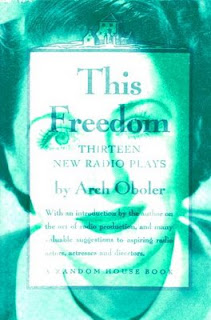
There was a market for such sentiment prior to the attack on Pearl Harbor, when the isolationist lobby was still strong and outspoken responses to fascism were rarely heard on the air. In 1942, when the play was published, Oboler tried to justify its inclusion in This Freedom by arguing that โ€œafter a while, you find yourself hating too muchโ€โ€”a justification clearly tagged on since, back in 1940, even a prominent writer like Oboler could not get away with overtly opposing the policy of neutrality by inciting anger and directing it toward a foreign national target.

When the play was revived almost exactly four years later, in February 1944, the situation had long changed and the playwright was quick to adjust the message to suit the occasion that was Everything for the Boys, a variety program for American servicemen. Oboler had turned into a staunch advocate of hatred. That is, he argued it to be more effective to make Americans hate the enemy than love their own country. It was hate that got things done.

The pseudo-pacifist โ€œWomen,โ€ now headed by Mercedes McCambridge, became a patriotic morale booster set in Norway under German occupation. The stranger washed ashore is now a British flyer (played by Ronald Colman). Celiaโ€™s dilemma: whether to hide the man or nurse him back to fighting form. After he is gone, a newly invigorated Celia declares: “I like to think that he knows Iโ€™m fighting now, too. For the good people. Some day the fighting will be over. It must end. Heโ€™ll come back to me. Iโ€™ll never be lonely any more.”

โ€œThe Women Stayed at Homeโ€ is clearly of the ready-mix, on demand variety; but it takes a comparative taste test to expose both versions as sham. Real conflict is reduced to melodramatic opportunity; genuine emotion whipped up to achieve whatever was expedient. Sure, there was a time to love and a time to hateโ€”and Arch Oboler had just the words to paint the sign of the times in whatever color suited the mood.

When anti-war laments were popular, Oboler taught them be mindful of how Johnny Got His Gun and what good it did him. He introduced Americans to a โ€œSteel” worker ashamed of being in the service of making war. โ€œThe Women Stayed at Homeโ€ betrays the opportunist who knew how to keep the pot boiling, a trader in sentiment who did not hesitate to discard supposedly outmoded principles like so many rotten eggs.

Whatever you give up for Lent, keep your integrity.


Related recordings
โ€The Women Stayed at Home,โ€ Everymanโ€™s Theater (24 Feb. 1940)
โ€œThe Women Stayed at Home,โ€ Everything for the Boys (22 February 1944)

Related Writings
โ€œSenseless: One Soldier’s Fight to Speak Against Warโ€ (on Obolerโ€™s adaptation of Johnny Got His Gun)
โ€œBette Davis Gives Birth to Arch Oboler’s โ€˜Americanโ€™โ€
โ€œโ€˜. . . originally written for Bette Davisโ€™: Arch Obolerโ€™s โ€˜Alter Egoโ€™โ€
โ€œHollywood Star Kay Francis Makes Paralysis Sound Like Paradiseโ€
โ€œMercedes McCambridge, Airwaves Advocateโ€

Inherit the . . . Air: Dialing for Darwin on His 200th Birthday

Before settling down for a small-screening of Inherit the Wind, I twisted the dial in search of the man from whose contemporaries we inherited the debate it depicts: Charles Darwin, born, like Abraham Lincoln, on this day, 12 February 1809. Like Lincoln, Darwin was a liberator among folks who resisted free thinking, a man whose ideas not only broadened minds but roused the ire of the close-minded–stick in the muds who resented being traced to the mud primordial, dreaded having what they conceived of as being set in stone washed away in the flux of evolution, and resolved instead to keep humanity from evolving. On BBC radio, at least, Darwin is the man of the hour. His youthful Beagle Diary is currently being read to us in daily installments; his โ€œVoyages of Descentโ€ with Captain FitzRoy have been newly dramatized; and his theories are the subject of numerous talks and documentaries.
The bicentenary celebrations got underway early at the Natural History Museum in London, where last December I visited an exhibition of artifacts and documents from Darwinโ€™s journeys of discovery, quests that had their origin here in the west of Britain: โ€œIn August quietly wandering about Wales, in February in a different hemisphere; nothing ever in this life ought to surprise me,โ€ young Darwin noted.

Nor should resistance to change. Back in 1935 (as Erik Barnouw reminds us in A Tower in Babel), when the hostile response to Darwin’s theories resulted in a media event known as the Scopes Monkey Trial, station WGN, Chicago, took the microphone straight into the courtroom so that listeners might hear defense attorney Clarence Darrow ask prosecutor William Jennings Bryan, โ€œMr. Bryan, do you believe that the first woman was Eve?โ€

Bryan professed to believe just that; and unable to sway the jurors from thinking otherwise, Darrow lost the caseโ€”a case that, if some politicians had had their way, would not have been made public. It was not just the espousal but the very mention of Darwin’s ideas that was considered a threat. An amendment to ban all broadcasts of โ€œdiscoursesโ€ about Darwin was proposed in the 69th United States Congress. If that amendment had passed, the evolution could not be televised today.

It comes as no surprise either that the two men who penned Inherit the Wind were former broadcast writers; in fictionalizing the trial, they disowned the medium that had imposed so many restrictions upon them, that kept potentially incendiary ideas from being disseminated; that, in the interest of public calmโ€”as opposed to the public interestโ€”was apt to cast aside what it did not dare to cast broadly.

It was not until long after his death that Darrow, once known as the โ€œboy who would argue against everything,โ€ became the subject of a CBS radio documentary; in it, many outspoken thinkersโ€”including Edith Sampson, the first black US delegate appointed to the United Nationsโ€”were heard arguing in his defense.

Perhaps, I am overstating my case when say that Darwin was too hot for radio; yet even when his ideas were presented on the air, they needed to be cooled down so as not to inflame anew. In 1946, a dramatization of his career was attempted for The Human Adventure, an educational program produced by CBS in co-operation with the University of Chicago. As Max Wylie put it in his foreword to a published script from the series, The Human Adventure presented

dramatic interpretations of the progress being made in university research throughout the world, progress in any of the thirty thousand research projects that are now being worked on by scholars and scientists in this country and in the centers of learning throughout the civilized world.

The description does not quite fit the episode in question, which transports listeners to a less civilized, less enlightened past. It opens on a โ€œleisurely day in Londonโ€ anno 1859. On 24 November, to be precise, the very day on which Darwinโ€™s Origin of the Species went on sale. The scene is a bookstore, the dialogue between a young scholar and his formidable aunt who disapproves of Darwinian notions:

When I was a girl, we knew exactly how old the world was. Bishop Ussher proved it in the scriptures. The world, he proved, was created in the year 4004 BC, on a Friday in October at 9 oโ€™clock in the morning.

Not that the lad is particularly up-to-date; โ€œeveryone knows that animals donโ€™t changeโ€ and that โ€œspecies remain exactly as created,โ€ he argues. โ€œEvery kind fixed and separate.โ€ Darwinโ€™s new book was flung at that rickety bandwagon, as the play drives home. โ€œInstantly, overnight, the lines of conflict are drawn. The complaisant, orthodox world, which is Victorian England, erupts into a storm of controversy.โ€

The narrative soon shifts from social agitation to the thrill of exploration and pioneering. It emphasizes the spirit of โ€œAdventureโ€ over the dispiritingly โ€œHumanโ€ by introducing us to the younger Darwin aboard the Beagle, the eager scientist in his laboratory, and the ailing researcher supported by a loving spouse. Without diverging from facts, the drama suggests that Darwinโ€™s theory were not quite so earth-shattering after all, a similar treatise having preceded it that threatened to render Darwinโ€™s own publication redundant. Without omitting a reference to monkeys, the broadcast refuses to acknowledge that its subject matter continued to make zealots go ape.

Defusing Darwinโ€™s prehistoric time bomb, The Human Adventure argued the โ€œstorm of abuse,โ€ the โ€œbitter intemperate, all too human controversyโ€ to be โ€œbehind us now.โ€ The voices of protest give way to a demonstration of how Darwin’s words echo the theories of scientists from around the world, an enlightened world united through science. Science fiction, in short.

NBC, CBS, and Abe

On the eve of the 200th anniversary of Abraham Lincolnโ€™s birth, I am once again lending an ear to the Great Emancipator. Franklin Delano Roosevelt may have been Americaโ€™s โ€œradio presidentโ€; but in the theater of the mind none among the heads of the States was heard talking more often than Honest Abe. On Friday, 12 February 1937, for instance, at least six nationwide broadcasts were dedicated to Lincoln and his legacy. NBC aired the Radio Guild‘s premiere of a biographical play titled โ€œThis Was a Man,โ€ featuring four characters and a โ€œnegro chorus.โ€ Heard over the same network was โ€œLincoln Goes to College,โ€ a recreation of an 1858 debate between Lincoln and Democratic senator Stephen A. Douglas. Try pitching that piece of prime-time drama to network executives nowadays.

Following the Lincoln-Douglas debate was a speech by 1936 presidential candidate Alf Landon, live from the Annual Lincoln Day dinner of the National Republican Club in New York. Meanwhile, CBS was offering talks by Lincoln biographer Ida Tarbell and Glenn Frank, former president of the University of Wisconsin. From Lincolnโ€™s tomb in Springfield, Illinois, the Gettysburg Address was being recited by a war veteran who was privileged to have heard the original speech back in 1863. Not only live and current, the Whitmanesque wireless also kept listeners alive to the past.

Most closely associated with portrayals of Lincoln on American radio is the voice of Raymond Massey, who thrice took on the role in Cavalcade of America presentations of Carl Sandburgโ€™s Abraham Lincoln: The War Years; but more frequently cast was character actor Frank McGlynn.

According to the 14 June 1941 issue of Radio Guide, Lincoln โ€œpop[ped] upโ€ in Lux Radio Theater productions โ€œon the average of seven times each yearโ€; and, in order to โ€œkeep the martyred Presidentโ€™s voice sounding the same,โ€ producers always assigned McGlynn the part he had inhabited in numerous motion pictures ever since the silent era. In the CBS serial Honest Abe, it was Ray Middleton who addressed the audience with the words: “My name is Abraham Lincoln, usually shortened to just Abe Lincoln.” The program ran for an entire year (1940-41).

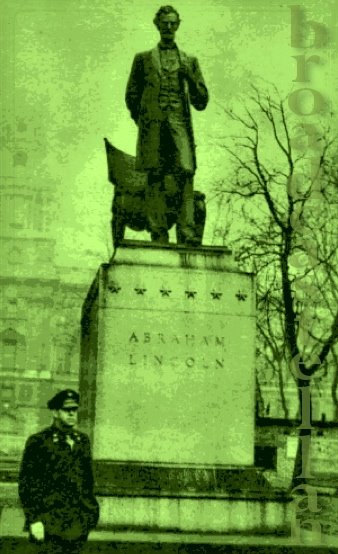
The long and short of it is that, be it in eulogies, musical variety, or drama, Lincoln was given plenty of airtime on national radio, an institution whose personalities paid homage by visiting memorials erected in his honor (like the London one, next to which singer Morton Downey poses above). Nor were the producers of weekly programs whose broadcast dates did not coincide with the anniversary amiss in acknowledging the nationโ€™s debt to the โ€œCaptain.โ€ On Sunday, 11 February 1945โ€”celebrated as โ€œRace Relations Sundayโ€โ€”Canada Lee was heard in a New World A-Coming adaptation of John Washingtonโ€™s They Knew Lincoln, โ€œTheyโ€ being the black contemporaries who made an impression on young Abe and influenced his politics. Among them, William de Fleurville.

โ€œYes,โ€ Lee related,

in Billyโ€™s barbershop, Lincoln learned all about Haiti. ย And one of the things he did when he got to the White House was to have a bill passed recognizing the independence of Haiti. ย And he did more than that, too. ย Lincoln received the first colored ambassador to the United States, the ambassador from the island home of Billy the Barber. ย And he was accorded all the honors given to any great diplomat in the Capitol of the United States. ย Yes, the people of Harmony have no doubt that Billyโ€™s friendship with ole Abe had more than a lot to do with it.

Six years later, in 1951, Tallulah Bankhead concluded the frivolities of her weekly Big Show broadcast on NBC with a moving recital of Lincolnโ€™s letter to Mrs. Bixby. That same day, The Eternal Light, which aired on NBC under the auspices of the Jewish Theological Seminary of America, presented “The Lincoln Highway.” Drawing on poet-biographer Sandburg’s “complete” works, it created in words and music the โ€œliving arterial highway moving across state lines from coast to coast to the murmur โ€˜Be good to each other, sisters. Donโ€™t fight, brothers.โ€™โ€

Once, the American networks were an extension of that โ€œHighway,โ€ however scarce the minority voices in what they carried. Four score and seven years ago broadcasting got underway in earnest when one of the oldest stations, WGY, Schenectady, went on the air; but what remains now of the venerable institution of radio is in a serious state of neglect. An expanse of billboards, a field of battles lost, the landscape through which it winds is a vast dust bowl of deregulation uniformity.

Related recording
“They Knew Lincoln,” New World A-Coming (11 Feb. 1945)
Toward the close of this Big Show broadcast, Bankhead recites Lincoln’s letter to Mrs. Bixby (11 Feb. 1951)
“Lincoln Highway,” The Eternal Light (11 February 1951)
My Tallulah salute

Related writings
โ€œSpotting ‘The Mole on Lincolnโ€™s Cheek'”
โ€Langston Hughes, Destination Freedom, . . .”
A Mind for Biography: Norman Corwin, ‘Ann Rutledge,’ and . . .”
โ€Carl Sandburg Talks (to) the Peopleโ€
โ€œThe Wannsee Konferenz Maps Out the Final Solutionโ€ (on theย Eternal Lightproduction of โ€œBattle of the Warsaw Ghetto”)

โ€œ. . . canโ€™t help being hereโ€: Edison, the Wireless, and I

No matter how small our voices, how slight our utterances, millions of us carry on making a record of ourselves and circulating it online. Long gone are the days in which autobiography was reserved for the supposed great and good; now, anyone can flaunt the first person singular, step into the forum and exclaim, โ€œHere I am!โ€ or โ€œHear me out.โ€ Sure enough, here I go again. Never mind that my record is spun a little less frequently these days, short on that groove I am so slow to get back into. A case of dyspepsia rather than abject discontent. I sometimes wonder, though, in how far the ready access to self-expression and promotion is enabling us to believe that whatever we do or say is quite worth the sharing, that we need not try harder or trouble ourselves to aspire. Now that we can all have our names in lights, provided we supply our own low-wattage bulbs, are we becoming too apt to settle for the publicly unmemorable?

Back in the earlier decades of the 20th century, when folks were more ready to listen and less likely to be heardโ€”by anyone beyond their circles of associates and relations, that isโ€”exemplars were rather more in demand than they are nowadays. No mere American Idolizing, but a veneration of excellence that inspired attempts at emulation. In the 1930s, a decade that gave rise to superheroes and uber-egosโ€”even a glossy magazine like Radio Guide encouraged its readers to aim higher than that knob with which to twist the dial.

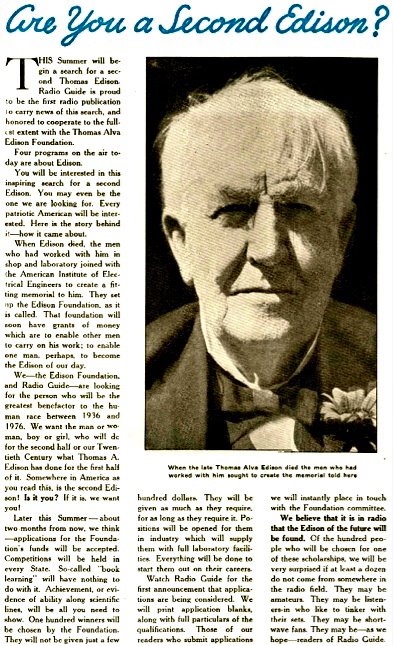
Aside from answering questions like โ€œWhatโ€™s Happening to Amos โ€˜nโ€™ Andy?โ€ or telling readers โ€œWhy Shirley Temple Canโ€™t Broadcast,โ€ the 4 July 1936 issue went so far as to look, jointly with the Edison Foundation,

for the person who will be the greatest benefactor to the human race between 1936 and 1976. We want the man or woman, boy or girl, who will do for the second half of our Twentieth Century what Thomas A. Edison has done for the first half of it. Somewhere in America as you read this, is the second Edison! Is it you? If it is, we want you.

I cannot imagine who would have the nerve to respond to such an appeal and forget all about Amos โ€˜nโ€™ Andy, then rumored to be leaving the airwaves; nor shall I speculate what Edison might have said about this search for a worthy successor, a campaign published in a less-than-scientific periodical devoted to a medium about which, as Alfred Balk reminds us in The Rise of Radio (2006), the enterprising inventor of the phonograph was less than enthusiastic.

While alive, he was rarely talked of in connection with the medium in whose development he figured; yet he often featured in radio broadcasts of the 1930s and โ€˜40s. The Radio Guide in which the above call for genius appeared states that โ€œ[f]our programs on the air today are about Edison,โ€ among them a biography heard over WCPO, Cincinnati.

On this day, 10 February, in 1947, on the eve of his 100th birthday (and some fifteen years after his death) Edison himself was propped behind the microphone, addressing the audience of the Cavalcade of America program. Titled โ€œThe Voice of the Wizard,โ€ the conjuring act was performed by one of the Cavalcadeโ€™s freelance scriptwriters, Erik Barnouw, now best remembered as the foremost chronicler of American broadcasting:

โ€œHello … hello. This is Thomas Alva Edison.โ€ It sounded as if the deaf scientist had picked up the receiver of a spirit telephone to make an urgent point-to-point call:

When I was still on earth, I invented that talk-harnessing machine to show how I felt about … well, occasions in honor of this and that. ย But now […] I feel differently. Because in a way a broadcast like this is the climax of things I worked at. ย In a way I canโ€™t help being here. ย This microphone, and the tubes in your radioโ€”I had a hand in them. ย So, when those tubes light up and bring you a voice from far off, in a way itโ€™s me talking. ย And then many radio programs are recorded, for schools, and for broadcasts overseasโ€”all ideas that I fought for. ย Because the inventions that I cared most about were those that would bring menโ€™s voices across space and time. ย Soโ€”Iโ€™d like to tell you the story behind those inventions. ย A few words for a new age.

As I put it in Etherized Victorians, my dissertation on American radio dramatics, the play bridges, in only a โ€œfew words,โ€ the invention of the telegraph, an instrument that in Edison’s youth was already โ€œbeginning to bind the world closer,โ€ to the institution of American broadcasting and its contributions to a โ€œnew ageโ€ of peace:

You who, in a later age, have sat at crystal sets to pick up Pittsburgh or Kansas City, or who, during dark days of World War II have listened by short-wave to London under air attack, you will understand how a seven-teen-year-old boy felt, sitting at his telegraph instrument in Indianapolis. ย There was already in that room a hint of the radio age […].

As Edison (equipped with the vocal cords of Dane Clark) expressed it in an exchange with his assistant and spouse-to-be, Mary Stilwell (voiced by Donna Reed),

[t]here are barriers between peopleโ€”and countriesโ€”that we almost never break down. Now these things Iโ€™m working on, Maryโ€”theyโ€™re for breaking down barriers. Talking machines, loud-speaking telephones, talking photographyโ€”weโ€™ll have them all! Machines that talk across space and time [….].

The play suggests radio to be at once โ€œtalking machineโ€ and hearing aid, a democratic communications apparatus by means of which โ€œtruthโ€ is enunciated and disseminated. The institution of broadcasting is thus construed as the product and propagator of โ€œthe American Idea,โ€ for which โ€œthe whole world is better off.โ€

We do not have to resort to thaumaturgy or otherworldly telephony to be โ€œtalking across space and timeโ€ these days; but I sometimes wish we were more receptive to the marvel of this means and expressed ourselves more grateful at the potentialities we so often squander by billboarding the trivial. While I can neither โ€œhelp” being prolix nor “being here,” I am making some amends today by refraining from relating just why Shirley Temple could not broadcast …

(In)au(gu)ral History: Presidential Addresses, Past and Present

โ€œWe observe today not a victory of party, but a celebration of freedomโ€”symbolizing an end, as well as a beginningโ€”signifying renewal, as well as change.โ€ With these words, John F. Kennedy opened his inaugural address on this day, 20 January, in 1961. Twenty years earlier, Franklin D. Roosevelt embarked upon his third term as US President by insisting that democracy was โ€œnot dying,โ€ whatever the apparent threats upon it or the wavering trust in its vigor. He urged his fellow citizens to โ€œpauseโ€ and โ€œtake stock,โ€ to โ€œrecall what [their] place in history has been, and to rediscover what [they] are and what [they] may be.โ€ Not to do so, he cautioned, would mean to โ€œrisk the real peril of inaction.โ€

Granted, as Harry S. Truman remarked in 1949, โ€œ[e]ach period of [US] history has had its special challenges.โ€ Yet somehow, as I listened to these past auguries and reappraisals, they began to echo and respond to each other as well as to the fears, doubts and hopes of our present day. I do not mean to imply that such reverberations betray a certain hollowness in their ready replication or applicability; rather, they begin to sound familiar in unexpected ways.

Outside the context of its timeโ€”though not within the vacuum of ahistoricity in which no political speech can ring true or otherwiseโ€”passages from FDRโ€™s 1941 address, for instance, brought to mind those terrifyingโ€”and terrifyingly uncertainโ€”early days of the 21st century, particularly the repercussions the so-called war on terror has had for US politics and the way the Republic and all it stands for came to be perceived beyond its borders:

The life of a nation is the fullness of the measure of its will to live.

There are men who doubt this. There are men who believe that democracy, as a form of Government and a frame of life, is limited or measured by a kind of mystical and artificial fate that, for some unexplained reason, tyranny and slavery have become the surging wave of the futureโ€”and that freedom is an ebbing tide.

But we Americans know that this is not true.

Eight years ago, when the life of this Republic seemed frozen by a fatalistic terror, we proved that this is not true. We were in the midst of shockโ€”but we acted. We acted quickly, boldly, decisively.

These later years have been living yearsโ€”fruitful years for the people of this democracy. For they have brought to us greater security and, I hope, a better understanding that life’s ideals are to be measured in other than material things.

No doubt, Roosevelt was being somewhat self-congratulatory. Could a Republican successor to George W. Bush have made such a claim and been believed when suggesting that acting โ€œquickly, boldly, decisivelyโ€ back in 2001 has brought โ€œgreater securityโ€ or that the years have been โ€œfruitfulโ€ ones for a democracy in which freedoms are being curtailed and surrendered in the dubious act of preserving them?

That โ€œideals are to be measured in other than material thingsโ€ is an echo of the sentiments Roosevelt shared in his first inaugural address (4 March 1933), in which he told a Depression-stricken audience that the

[r]ecognition of that falsity of material wealth as the standard of success goes hand in hand with the abandonment of the false belief that public office and high political position are to be valued only by the standards of pride of place and personal profit; and [that]there must be an end to a conduct in banking and in business which too often has given to a sacred trust the likeness of callous and selfish wrongdoing.

The lesson, which each generation must learn anew, is, for the most part, not absorbed voluntarily; but this time around the โ€œidealsโ€ have been threatened along with those โ€œmaterial thingsโ€ many find themselves divested of, partially as a result of failed policy and unchecked opportunism. It is this confidence in “ideals” as โ€œtruthsโ€ that the present administration is called upon to strengthen, so that the words of FDR, anno 1941, may once again ring true, namely that

[m[ost vital to our present and our future is this experience of a democracy which successfully survived crisis at home; put away many evil things; built new structures on enduring lines; and, through it all, maintained the fact of its democracy.

" . . . from numberless and nameless agonies": The Bill of Rights Remembered

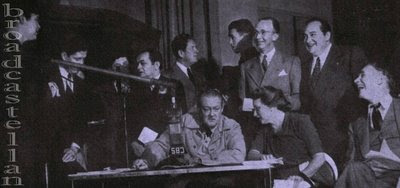
I might as well end this year’s regular programming here at broadcastellan with a bang. This one was sure made an impact, heard by as many as sixty million Americansโ€”at once. Subtitled “A Dramatic Celebration of the American Bill of Rights, Including an Address by Franklin D. Roosevelt,” We Hold These Truths made radio history on this day, 15 December, in 1942. It also made the most of history in the making.

โ€œNo other single dramatic performance [. . . ] ever enjoyed so large an audience,” author Norman Corwin remarked in his notes on the published script. The program was “[w]ritten at the invitation of the US Office of Facts and Figuresโ€ to commemorate the 150th anniversary of the United States Bill of Rights, which came into effect on 15 December 1791,; but it was already in the works when the attack on Pearl Harbor took place.

“In fact,” Corwin later recalled (in Years of the Electric Ear), “I was on a train travelling from New York to Hollywood, still working on the script when the attack on Pearl Harbor took place.” Now that the United States had entered the war, the broadcast became a rallying cry, a reminder of the rights it is the duty of all those who possess them to protect.

โ€œTo many listening Americans,โ€ Movie-Radio Guide summed up in its 3-9 January 1942 issue,

the big โ€œBill of Rightsโ€ program broadcast over the Nationโ€™s networks Monday, Dec. 15, was an utterly unforgettable event. To the many personalities who joined their talents to produce the program it was likewise a memorable privilege. Coming as it did at a time when it could not have meant mere to the nation, the broadcast brought America figuratively to its feet. A transcription of the superb dramatic production [. . .] will be preserved in the archives at Washington.

The cast, as shown above, included Orson Welles, Rudy Vallee, Edward G. Robinson, Bob Burns, James Stewart, Walter Brennan, Edward Arnold, as well as (seated) Lionel Barrymore, Marjorie Main, and Walter Huston.

According to the Movie-Radio Guide, “[o]ne of the highlights of the presentation was the performance of James “Jimmy” Stewart.โ€ So moved was he by the reading that, at the close of the broadcast, he โ€œpulled off his earphonesโ€ and โ€œlet down his emotions, excusing himself from the studio and reportedly breaking into tears in private.โ€ No wonder, Stewart was called upon to introduce President Roosevelt, who addressed the public from Washington, DC. Upon this experience, the humble actor remarked: โ€œImagine a corporal introducing a Commander in Chief of the armed forces!โ€

"Bleiben Sie wohl und halten Sie sich munter": A Visit at Kaltenmeyer’s

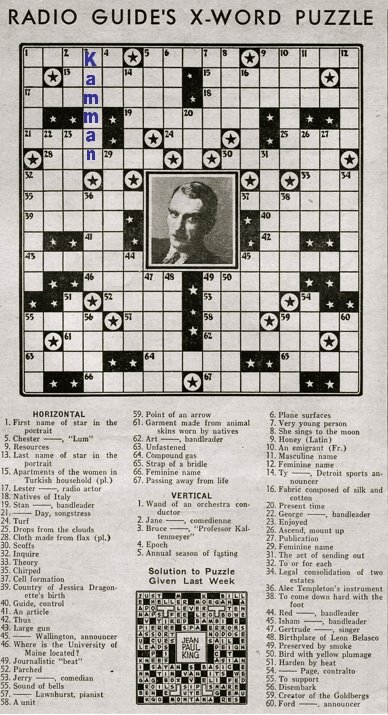
K A M M A N. I am sure a lot of readers of Radio Guide magazine would have found “Bruce ___, โ€˜Professor Kaltenmeyer” as easy a crossword puzzle clue as “Jane ___, comedienne” or “___ Wallington, announcer.”

From 1932 onwards, Bruce Kamman played the good-natured and much put upon teacher of the gang at Kaltenmeyerโ€™s Kindergarten, a weekly comedy program that originiated from WMAQ, Chicago. Kaltenmeyerโ€™s is one of those popular programs that have all but disappeared into thin air, the exception being the 12 December 1936 broadcast (which you may access on Jerry Haendigesโ€™s invaluable โ€œSame Time, Same Stationโ€ site). Reminiscent of and anticipating German schoolboy comedies like Heinrich Spoerl’s Feuerzangenbowle or Erich Kรคstner’s Das Fliegende Klassenzimmer (both 1933), Kaltenmeyer is a winsome trifle of a show. Each week, the Kindergarten opened with the catchy signature “Just for Fun”:

Kaltenmeyer’s starting,
Let’s all go to school.
In this kindergarten,
Where nonsense is the rule.

Indeed, much of it is nonsense, some of it song. Fibber McGee and Molly team Jim and Marian Jordan were featured on the program; until the fall of 1936, they were among the Professorโ€™s international crowd of poopils. The 12 December 1936 broadcast (an excerpt of which was later rebroadcast on Recollections at Thirty) includes the somewhat incongruously wistful โ€œSweetheart, Letโ€™s Grow Old Togetherโ€ and offers at least one memorable pun involving the definition of the word โ€œindisputable,โ€ which one Kaltenmeyerโ€™s rambunctious kids (adults all) manages to put into the following sentence: โ€œIndisputable weather weโ€™re having.โ€

It is Bruce Kammanโ€™s voice, though, that adds “indisputable” charm to the nonsense. It is the kind of Sig Ruman-Frank Reichert voiceโ€”warm, avuncular, and too Jean Hersholt to be altogether ridiculously, let alone threateningly Teutonic. According to Francis M. Nevinsโ€™s The Sound of Detection, the Cincinnati-born Kamman, who entered radio as early as 1920, would continue his broadcasting career off mike, namely by producing and directing episodes of the Ellery Queen mystery-cum-celebrity quiz program.

Kammanโ€™s days as Kaltenmeyer came to an end once the Germans began to wage war in Europe. In 1940, well before the United States entered the Second World War, Kaltenmeyer stopped saying “Auf Wiedersehen.” The character was removed from the Kindergarten, and what was left of the show folded soon thereafter.

I guess, when you make a career of sounding like Sig Ruman, you were expected to start shouting โ€œSieg Heil!” or hiss sinisterly and subsequently expire, rather than be permitted to send kindly greetings like “Bleiben Sie wohl und halten Sie sich munterโ€ (โ€œstay well and cheerfulโ€) to the American people, whatever their heritage or dialect. Clearly “good old days” recalled in the theme song were over.

Now, let’s all go to back to the school that was radio and solve the puzzle . . .