Feeling Strangely Animated

I had never been to a Halloween party; and the days of dressing up in more or less fancy costumes lay well behind me. It was with some reluctance and considerable misgivings that I accepted the invitation. Back where and when I grew up, there was no such blood red letter day as Halloween. Your parents might take you to the cemetery to see the candles lit for All Hallows’; but you could not expect to have a ghoulish old time. Such levity was unheard of even among those not attending church services (yet still paying their automatically deduced church tax in fear of social stigma or unemployment).

When first I saw the title character of Steven Spielberg’s E.T. being both concealed and paraded around with a sheet over his head, I had no idea how clever this disguise was; nor did I what “trick or treat” meant. And what about all those carved pumpkins! To me, dressing up was reserved for Carnival, the late winter revels preceding Ash Wednesday, while going from door to door, lantern in hand, caroling and asking for candy was a treat reserved for the feast of St. Martin’s. Who knew you could combine both festivities, have your candy and dress up to boot!

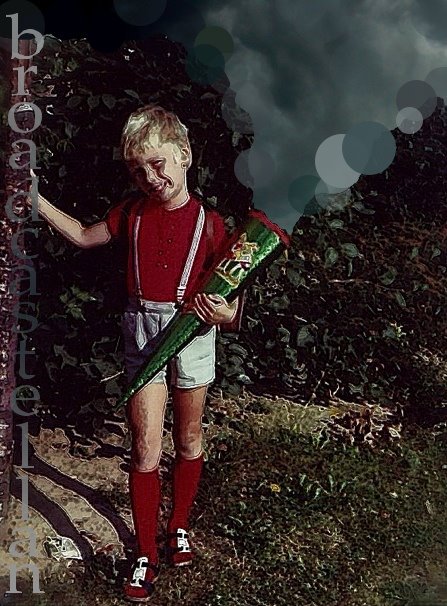
Your costume tells people what you really want to be, one of my school teachers told us. That may very well be true; but, as a pre-adolescent boy, you get uneasy when you look at yourself and others looking at you while dressed in skirt your sister , having raided the closets and not found anything resembling a costume, insisted you wear instead. It was my sister’s choice, not mine, I pointed out; but my teacher’s argument seemed more compelling to those around you (and, you secretly admit, even to yourself). It was this moment of public shaming that took the carefree joy out of fancy dress parties.

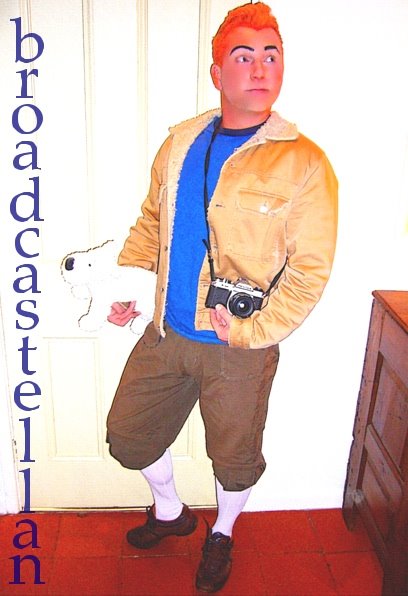
Fast forward to Halloween 2008. I am once again in costume. No wigs or dresses, if you please. There are plenty of ill-fitting garments; but little befitting the occasion. What to do? I certainly did not want to go to any great expense; being a good sport could come dear enough. To appear as my favorite comic strip character was a last minute decision, one for which my none-too-sharp pencil mustache had to be sacrificed.

And for what? Only very few people at the party guessed whom I was trying to impersonate, even though the by now nearly eighty year old boy reporter proved highly popular again when, last year, he toured Britain in a colorful stage production. It might have been the lack of preparation or my abject failure to capture this much traveled hero of my youth; and yet, I suspect that such a general shrugging of shoulders is just the kind of response that made it difficult for Spielberg to convince Paramount to green-light his latest project.

"I welcome their hatred": FDR’s Halloween Speech (1936)

“For twelve years, our nation was afflicted with ‘see nothing, hear nothing, do nothing’ government.” That is what President Franklin D. Roosevelt declared in a campaign speech at New York City’s Madison Square Garden on this day, Halloween, in 1936. Make that “eight years,” and a presidential nominee could give the speech today. Count the previous Bush administration and you got those twelve years, an era that the majority of those polled—and the majority of those looking on beyond US borders—are anxious to consider bygone next January.

“The nation looked to that government, but that government looked away,” FDR continued. It had been “nine crazy years at the ticker and three long years in the breadline. Nine mad years of mirage and three long years of despair.” Checking that Wall Street ticker lately, I have come to suspect that those years of despair and breadlines may well lie ahead. They will be a test for the candidate who succeeds next Tuesday.

FDR, who had pulled America out of that crisis, warned that “powerful influences” were “trying to restore that kind of government with its doctrine that that government is best which is most indifferent to mankind.” That, to me, sums up Republican politics, the kind of politics that count on the voters’ lowest impulse, individual greed, to sell its idea of carrying on at the expense of all else, be it nature or the future of mankind.

“For four years now,” FDR reminded his listeners,

you have had an administration, which instead of twirling its thumbs, has rolled up its sleeves.  And I assure you that we keep our sleeves rolled up.  We had to struggle with the old enemies of peace, business and financial monopoly, speculation, reckless banking, class antagonism, sectionalism, war profiteering.  They had begun to consider the government of the United States as a mere appendage to their own affairs; and we know now that government by organized money is just as dangerous as government by organized mob.

Never before in all our history have these forces been so united against one candidate as they stand today.  They are unanimous in their hate for me, and I welcome their hatred.

I am sure that many Republicans fear nothing more tonight than the impending end of politics as usual; and they have as good a reason to be afraid as do those who dread the prospect of having to endure such politics for another four, devastating years. Whatever your mask or affiliations, this is the night to be scared together. Happy Halloween!

“War of the Worlds”: The Election Edition

View from a London bus, 2005

Teaching undergraduate English in the Bronx while researching my dissertation on old-time radio, I found it difficult if necessary to relate nightly study to daytime work in the classroom.  I did not want to be one of those educators who think of their ‘job’ as an educator as being at odds with—or in the way of—an academic careers, success in which is largely dependent on self-promotional efforts rather than years of service.

Reluctant instructors tend to become resentful of their charge, a feeling that is hardly conducive to the far from mutually exclusive activities of teaching and learning.  Writing this journal has been a way of vindicating my approach, of coming to terms with my inability to squeeze the most out of the degree I earned.  broadcastellan is not a series of unheard lectures, but a record of my enthusiasms.

Now, where was I going with this? Ah, yes.  “The War of the Worlds,” the infamous “Panic Broadcast” that was first heard on this day, 30 October, in 1938. The Mercury Theater’s iconic dramatization of Wells’s futuristic parable and the resulting Hullabaloo (also the title of a 1940 musical comedy inspired by the event) provided me with a rare opportunity to forge a connection between classroom and study.  “The War” was the first recording of a radio play I shared with my students, whose listening experience was followed by the inevitable question whether such a performance could still hornswoggle us today.

Being that one of my enthusiasm is American radio drama, I have already discussed the Mercury Theater production and its rival broadcast on previous occasions. Tonight, though, “The War of the Worlds” comes to a mind that is about as uneasy as the minds of those tuning in back then.

Not surprisingly, most of my students argued that we are too sophisticated nowadays to fall for such claptrap.  There is more access to alternative media, more awareness of what is going on around the world.  However comforting it might be to think so, I have never permitted myself to share this view.  I do not conceive of the past as being inferior to the present by virtue of some supposedly natural progression.

Sure, you might snicker at preposterous styles and passing fads.  You might say, in hindsight, that certain political decisions were wrong and that those living in the past should have seen things coming. In short, there are any number of ways to demonstrate your ostensible superiority to folks back then.  Doing so, however, you should have the honesty to admit that your argument is designed to make yourself feel better about the uncertainties and anxieties of the present.

I do not hold with those who look at past generations as an older, hence inferior, model of themselves.  I reject the notion that there has ever been what is frequently referred to as “innocent” times.  Retrospection breeds contempt.  Too often, it is an act of distancing yourself from events that the present, if properly inspected, proves to be not altogether beyond the possibility of recurrence.

So, could something akin to the headlines-making broadcast be restaged tonight and elicit a similar response, a response frequently attributed to the threat of war that was about to shatter hopes of stability, peace, and prosperity? Are we not on edge enough now to have reached the point of sustainable gullibility? Or are cynicism and apathy an adequate shield against deception?

Have not many of us lived a myth constructed by those who benefit from our desire to believe in something, be it a falsehood about terror and the war on it, be it the promise of economic progress to which every aspect of our existence is made subordinate? The times, it seems, are ripe for a shake-up.

One reader of the so-called panic broadcast, Peter Lowentrout, suggests that listener belief in an attack from Mars was rooted in a “loss of spirit,” the 1920s and 1930s having been “decades in which the influence of secularization peaked in our general and elite cultures.” Are we more eager to believe in a hoax if we are incapable of or reluctant to believe in anything else? Or is a return to faith a prerequisite for a susceptibility to apocalyptic visions?

In a way, the “panic” is itself an historical construct; its extent has been exaggerated to permit us that look of superiority we tend to cast on the past.  Yet what about the present fear change and its mongers, those who look upon of the presidential candidates as a false Messiah and claim him to be alien to the economic needs of an ailing nation, if not downright hostile to those intent on clinging to a status quo that hardly seems worth maintaining?

What about those who think of ecological crises as a matter of fate or charlatanry rather than challenge and opportunity; and who, by claiming it to be either inevitable or false, go on living as if their individual conduct had no influence on the future of this planet? What about those who are disillusioned by the stock market, yet feel threatened by concepts of alternative living that involve something other than the amassing of greenbacks?

Orson Welles’s introductory remarks, at least, are readily applied to our present condition:

With infinite complacence people went to and fro over the earth about there little affairs, serene in the assurance of their dominion over this small spinning fragment of solar driftwood which by chance or design man has inherited out of the dark mystery of Time and Space.

At present, I find it difficult to think of anything other than the US election, which is what reminded me of the challenge I faced in the classroom, the challenge I am facing when keeping a journal that attempts to keep up with the out-of-date? To find relevance in the past and to relate it to the uncertainties that constitute my present, that is the challenge.  

While I have no official say in the matter, I shall have certainty next Wednesday.  On that day, I may even have renewed confidence in the democratic West; but certain and confident is not who I am tonight . . .

Go Tell Auntie: Listener Complaints Create BBC Drama

“The next programme contains some strong language which some listeners may find offensive.” That disclaimer, apparently, is not enough to keep old Auntie (the BBC) out of trouble with the strongest censors out there: the public. Several thousand listeners (or, roughly, one percent of those who tuned in) voiced their complaints about a broadcast in which British pop-culture personalities Russell Brand and Jonathan Ross made prank phone calls to Andrew Sachs, an actor mainly remembered for being a cast member of Fawlty Towers. It all happened on 18 October—but the force of those faded soundwaves is just beginning to make itself felt in a sweep of ever more dramatic repercussions. Never mind rolling waves. It’s heads now.
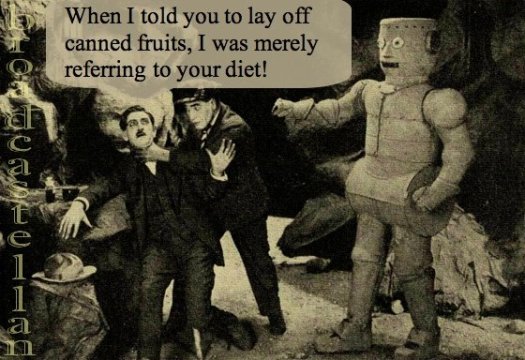
Here is what happened: Sachs was to appear on Brand’s radio program; when the guest backed out, the host and his guest, Jonathan Ross, left a number of rather obscene messages on the no-show’s answering machine. Encouraged by Ross, Brand revealed, in no uncertain terms, that he had intercourse with Sachs’s granddaughter, who is in her twenties. “If he’s like most people of a certain age,” Ross quipped about Sachs,

he probably got a picture of his grandchildren when they’re young right by the phone. So while he’s listening to the messages, he’s looking at a picture of her about nine on a swing . . .

. . . and thinking, if I may complete the sentence, what nerve those two men at the mike have to alert the masses to her change of playground.

Listener protest compelled the BBC to suspend both Ross and Brand; their respective programs on radio and television will not air until the matter has been thoroughly investigated, the director general of the trust governing the corporation announced. Apparently, even the Prime Minister has gotten involved in the matter by issuing a statement condemning such uncensored reality-meets-insult comedy on the air.

Today, 29 October, Brand resigned, offering the following apology:

I got a bit caught up in the moment and forgot that at the core of the rude comments and silly songs were the real feelings of a beloved and brilliant comic actor.

Rarely have a few dirty words and evidence of poor taste so outraged a vocal minority of a United Kingdom also known as Little Britain. That, incidentally, is the title of another BBC program, and hardly one bespeaking British wit and cultural refinement. Aside from reassuring me that folks still listen to the old wireless, that radio it is more than a source of ambient noise by which to work and play, the whole case (detailed in this BBC timeline) brings home how much power those private individuals among us wield who make their opinions as public as the chatter to which they object.

The output of the media, like the outcome of elections, is determined both by the silent many who let things happen and the outspoken few who do not; but, if it is change you are for or after, remember this: it requires far fewer naysayers to kick Auntie than it takes to shift Uncle Sam.

The Transplanted Mind: A Caligari for Radio?

“Poor print.” That was all I had to say after attending a screening of Das Kabinett des Dr. Caligari (1920) at the Museum of Modern Art in New York City. I was dreadfully disappointed. It felt like walking through an exhibition of Expressionist art in which all the paintings were covered in plastic, the lights dimmed, and the space brightened only by an occasional flash of a camera. I pretty much had the same impression when, preparing for a trip to Prague, I tried to take in Der Golem by exposing myself to the horrors of a cheap copy I had dug out of a bargain bin at a third-rate department store. You might as well experience these films on the radio, where the visuals are as clear and bold as you can make them, provided your mental camera is both creative and focused enough to take pictures that are worth keeping.

Tonight, BBC Radio 3 attempted no less with “Caligari,” a radio adaptation of Robert Wiene’s seminal horror film, one of the few classics of the cinema to rank among the top 250 films on the Internet Movie Database. In the exposition, poet/playwright Amanda Dalton slyly comments on the challenges of such a project. “Caligari” opens with the sound of a board (an advertisement for the fair, a title card for the film, a piece of scenery) being painted and hammered into position. The question this gesture begs is whether the brush and the hammer are being passed on to us. Are we the artist, the audience, or the subject? Can we choose? Must we?

A “strangely arresting” film that succeeds in giving “pictorial interpretation to a madman’s vision,” one early commentator (Carlyle Ellis) said of Caligari. Such a statement drives home that Caligari is itself an exercise in translation: a bringing to light and darkness the workings of a crooked, crazy mind in crooked, crazy images. Rather than a translation, then, Dalton’s “Caligari” (available online until 2 November 2008) should be performing nothing more—and nothing less—than a transplant, a projection of a madman’s vision onto the screen of our own mental theater, sound or otherwise.

By installing a narrator at the changing scene, “Caligari” insists on translating and interpreting, at times so facetiously as to undermine any sense of terror. Irritation, perhaps, but not anxiety. More clamorous and voluble than radio needs to be, Dalton’s frantic, play, whose light-heartedness is weighed down by anachronistic cliches like “over my dead body,” is, for all its irreverence, an unsatisfactorily literal transliteration. Too many voices shouting down our imagination, “Caligari” reviews familiar images it does not permit our mind’s eye to see, let alone re-envision or remake. A running commentary on the original on a familiarity with which it depends, “Caligari” plays itself out as a series of aural footnotes.

Last Friday, during an ostensible lecture on German film prior to a screening of Germany’s latest cinematic export, Die Welle (2008), I once again caught glimpses of Wiene’s seminal work; but its images were taken out of a context that the dull, rambling talk could not create. I had a similar attitude toward Dalton’s adaptations.

A few bars of the German national anthem, as it was once sung (that is, including the first stanza, “Deutschland, Deutschland über alles”), can hardly suffice in assisting us to adopt a Weimar Republican mindset; nor can mentions of an “intricate design” recreate an expressionistic set. And while a babble of tongues may make a failed democratic system audible, “Caligari” is little more than a poor substitute for the experience of either art or history.

Meanwhile, I am sure that the jack-o’-lantern I carved today (and display above) would look better on the air or in anyone’s mind, especially now that Montague, our terrier, has already begun to disfigure it. Is he adopting traits you may have decided to attribute to me?

“Madagascar Madness”; or, It Takes a Houdini to Get Out of That One

Tickled by Canary Feather’s account of being an accompanist for silent movies, I was in the mood for another non-talkie. The term may be unhappy in its connotation of lack, yet seems preferable to “silent movie,” considering that, prior to the late 1920, the sound for motion pictures was supplied by those playing the piano or the organ; even sound effects artists and entire orchestras were not unheard.

Having had my fill of non-talkie comedy of late, I chose a melodrama likely to wear out the most resourceful and nimble-fingered of pianists: The Master Mystery a 1919 thriller underscored by Stuart Oderman, whom I have often heard and seen playing the piano to movies screened at the Museum of Modern Art in New York. Intolerance, Grandma’s Boy, and Caligari—Lillian Gish biographer Oderman has articulated them all.

In the case of The Master Mystery, the pianist must have been relieved that his accompaniment was being recorded, rather than performed live. However fragmentary, the film still runs an epic 238 minutes. With an attention span shortened by broadband and a clock ticking down the last minutes of the day, I was resolved to take in this thriller as it was conceived; that is, as a weekly chapter play.

From the first instalment, I expected little more than an exposition, an introduction of the main characters, and the obligatory cliffhanger. After all, The Master Mystery stars the famed escape artist Harry Houdini (previously encountered on a boat about to go over Niagara Falls).

Now, I pride myself in not readily throwing in the remote control; but The Master Mystery, with its secret identities, its corridors and hidden caves stalked by an pre-RUR automaton, and its cases of Madagascar Madness—proved too complex to master at that late hour. The opening title card should have been ample warning. The “Foreword” reads:

International Patents, Inc., is a firm whose vast fortune has been made by inducing inventors to trust the marketing of inventions to their care and after obtaining sole rights—they suppress the manufacture of these inventions—much to the financial gain of the owners of already existing patents.

However intriguing, this is hardly the most effective way of opening a chapter play. We have not yet been introduced to any of the characters, but are confronted instead with a corporation and with legalities not quite the stuff of melodramatic action. Equally frustrating is the introduction of characters by indirection, that is, as a name on a title card not referring to the character shown. The secretary of businessman Peter Brent, for instance, is identified as being “secretly in the service of Balcom,” before we are shown the latter.

My own shortcomings aside, was it writerly ineptitude that caused me to get lost in the muddle? Was it owing to the fragmentary state of the surviving print, segments of which have been “rearranged” to create the “illusion of completeness”? Or was it, perhaps, all part of a shrewd design? I was determined to fill in the blanks with whatever notes I could find. Notes? How about an entire book!

In May 1919, Masters of Mystery was published as a novelization co-written by Arthur B. Reeve, one of the scenarists credited as the “authors” of the serial. Yes, viewers lost in the maze from which only Houdini could extricate himself were promised a key to it all in the form of a tie-in book, replete with stills from the film. I wonder just how many moviegoers resorted to a purchase in hopes of mastering this Mystery?

Here is how the opening title card is translated into some semblance of a narrative:

“I will see Mr. Brent,” insisted the new-comer, as he pushed past the butler. “Mr. Brent!” he cried, advancing with a wild light in his eyes. “I’m tired of excuses. I want justice regarding that water-motor of mine.” He paused, then added, shaking his finger threateningly, “Put it on the market—or I will call in the Department of Justice!”

Brent scowled again. For years he had been amassing a fortune by a process that was scarcely within the law. For, when inventions threaten to render useless already existing patents, necessitating the scrapping of millions of dollars’ worth of machinery, vested interests must be protected.

Thus, Brent and his partner, Herbert Balcom, had evolved a simple method of protecting corporations against troublesome inventors and inventions. They had formed their own corporation, International Patents, Incorporated.

Their method was effective—though desperate. It was to suppress the inventor and his labor. They bought the sole rights from the inventor, promising him glittering royalties. The joker was that the invention was suppressed. None were ever manufactured. Hence there were no royalties and the corporations went on undisturbed while Brent and Balcom collected huge retainers for the protection they afforded them.

Thus Brent Rock had come to be hated by scores of inventors defrauded in this unequal conflict with big business.

While the perfunctory prose suggests that the book is not always better than the movie, I was at least caught up with the story and prepared to follow Houdini as he gets in and out of scrapes to a score by Stuart Oderman . . . next week.

A Mind for Biography: Norman Corwin, “Ann Rutledge,” and Joan Fontaine

Yesterday, Joan Fontaine celebrated her 91st birthday. Now, I have no idea how the Academy Award winner marked the occasion; but I’ve got a suspicion that, on the twenty-seventh return of the day, Ms. Fontaine was perusing a script. Not such a startling surmise, I suppose, given that the star was particularly busy back in 1944, what with the release of Frenchman’s Creek (directed by the aforementioned Mitchell Leisen and last remarked upon in connection to my trip to Cornwall) and the work on her upcoming picture The Affairs of Susan (1945).

The script that would have been foremost on her mind, though, was not a scenario. It was what used to be called a radario: a dramatic script for radio. Not just any old script, mind you, but one written by the best in the business—the indefatigable Norman Corwin (now 98).

On this day, 23 October, in 1944, Joan Fontaine was heard on the Cavalcade of America program in Corwin’s “Ann Rutledge,” a gentle love story that historians tend to dismiss in a footnote. There is some doubt whether Ann Rutledge was indeed “The Girl Lincoln Loved,” which is the alternative title of Corwin’s biographical play. In his notes on the published script, the playwright remarked that, when commissioned to dramatize the romance between Rutledge and the man who would be President, he

decided to make it as simple as the story of the girl herself.  [His] decision was influenced by the fact that not enough is known about Ann to get a writer into complications anyway.

What is known is that she was the daughter of a tavern-keeper in New Salem, that she had several brothers and sisters, and that she was in love with one John McNeil before she took notice of Abe Lincoln.

Unable to rely on Carl Sandburg, who does not furnish his readers with further insights, Corwin needed to approach history with the open mind of the poet. He rejected the adaptation of Abe Lincoln in Illinois, since it insisted that Rutledge never loved anyone but McNeil.

Acknowledging this lack of ocular proof and inspired by the gaps it leaves for us to fill with meaning, Corwin’s biography of Ann Rutledge does not so much reconstruct the young woman’s story as it conjures continuations and alternate endings in the listener’s mind. The scripted and the spoken are merely the skeleton key that gives us access to a maze of passageways.

According to Corwin, the cast of the original production, which gathered exactly four years earlier, on 23 October 1940, was very much moved during the reading of the script, so much so that the great radio wit wondered whether we “was a tragedian and didn’t know it.”

Death is not tragic, of course, unless one ponders the opportunities that are lost along with the life. What might have become of Rutledge with Lincoln at her side? What might have become of Lincoln with Rutledge at his? And how might Lincoln’s character have been influenced by this loving companionship? It is a play that invites speculations about First Ladies, lasting impressions . . . and Joan Fontaine.

“Ann is no easy role,” Corwin commented, giving much credit to Jeanette Nolan for reviving her during the first production. Joan Fontaine certainly achieves nothing less. Hers is a spirited performance, rather than the once-over lightly attitude with which many a star deigned to lower herself to the microphone.

So, if I were a biographer with nothing else but “Ann Rutledge” to go on, I would guess that Joan Fontaine spent her twenty-seventh birthday with a woman in mind who did not live to see twenty-three.

Radio at the Movies: Golden Earrings (1947)

Placing Mitchell Leisen alongside Hollywood’s top flight directors is likely to raise eyebrows among those whose brows are already well elevated. Most others will simply shrug their cold shoulders in“Who he? indifference, a stance with which I, whose shoulders are wont to brush against the dusty shelves and musty vaults of popular culture, am thoroughly familiar by now. Respected for his knack of striking box-office gold but dismissed by his peers, the former art director was not among the auteurs whose works are read as art chiefly because it is easier to conceive of artistic expression as a non-collective achievement: something that bears the clearly distinguishable signature of a single individual. Their careful design aside, little seems to bespeak the Leisen touch, which is as light as it is assured. Stylish and slick in the best Paramount tradition, a Leisen picture stunningly sets the stage under the pretense of drama; otherwise, it has few pretensions.

The epitome and pinnacle of Leisen’s dream factory output is Golden Earrings (1947), a sumptuously lensed romance that makes Nazi Germany look like fairyland, replete with quaint villages, enchanted forests, and lusty gypsies. It is a false image conjured up by the words of a paramour with pierced ears. For the darker side of the tale, nearly hidden from view, we are referred to McLuhan’s “tribal drum”—the radio.

One of those gypsies is played by German expatriate Marlene Dietrich, who approaches the brown-face role of Lydia tongue-in-famously-hollow-cheek. To Leisen, Dietrich “was the most fascinating woman who ever lived,” as he later told David Chierichetti, the chronicler of his career. Cast as reluctant lover, Col. Ralph Denistoun, is Ray Milland, whose lack of regard for his older co-star only enhances the screwball dynamics of this improbable coupling. Sheltered by and disguised as one of her kind, Milland’s Romani wry officer is on a perilous mission to evade his Nazi pursuers and get hold of a formula for poison gas, the kind of weapon that would exterminate thousands of gypsies.

Having previously been captured by the Nazis, Denistoun owes his escape to the master race’s slavish devotion to their master’s voice. He takes full advantage of a radio address by the Führer, guaranteed to distract his captors. The scene in which the Nazi officers rise to hear Hitler’s speech and fall at the hand of their prisoner is an apt metaphor for blind faith and mass-mediated control. Unlike those gypsy earrings, the silence of a people whose ears ring with the brass of Teutonic rhetoric is not golden. A mind closed to independent thought and voices at variance, Golden Earrings suggests, is readily silenced. To be sure, this is retrospective romance; and, its ersatz gypsies roaming quite freely, Leisen’s film shows nothing of the silencing perpetrated by the fascists.

Leisen was not about to denounce the medium he had romanced in two of his earlier revues, The Big Broadcast of 1937 and its 1938 follow-up. Instead, Golden Earrings confronts nationalistic, state-run radio with a distinctly American voice of commercial broadcasting. In the narrative frame, the English officer is seen relating his story to Quentin Reynolds (pictured here with Milland), a news commentator known for his on-air missives to Doktor Goebbels and Herr Schickelgruber.

Rather than spouting anti-Axis propaganda or post-war wisdom, Reynolds is shown as a receiver, a listener tuning in to the wondrous adventure of the strangely un-British Englishman who has come under the influence of a nomadic culture foreign to his people. It is a tall tale a commentator like Reynolds, who would later be libeled in the Hearst press for his alleged lack of patriotism, is not obliged to debunk.

The frame permits Leisen to construct Golden Earrings as a romance, told as it is from the perspective of an unconventional officer summoned by his gypsy love. It is all so fabulously escapist that the enormous gamble of glamorizing Germany so soon after the war paid off without causing much offense. That, in short, is the Leisen touch.

A Nose for Business; or, This Woman Has Issues

You know you’ve got money to spare when you can afford to hire someone to do the sneezing for you. Save your nostrils, keep the tissue! Just call Hildegarde Halliday. That is what NBC did back in the 1930s and ‘40s, when Halliday was the Durante of sound effect artists. Radio actors were fortunate to have their proboscis blown by proxy whenever the script demanded the feigning of a common cold or an attack of hay fever. On this day, 20 October, in 1940, stage actress Halliday demonstrated her skill on Behind the Mike, a weekly half-hour that promised to take listeners inside the studio to reveal some of the tricks of the radio dramatic trade. Billed as “radio’s own show,” the aforementioned Behind the Mike dramatized and promoted the business by telling audiences what was involved in putting together a national broadcast, in selling it to a sponsor, or in prepping a studio audience.

“We’ve had many people on this program who make their living from radio in strange ways” announcer Graham McNamee opened the 20 October 1940 broadcast, referring to assorted animal imitators and baby criers (like my fictional Aunt Ilse). “But our next guest makes her living in radio in a way that tops all of them.” Halliday claimed to have “done all kinds of sneezes,” making herself heard on the variety programs headed by Rudy Vallee and Robert Benchley, as well as on daytime serials like Aunt Jenny.

“Oh, I can sneeze like all get-out if I just imagine very hard that I have a cold and chill,” the jovial Halliday tells the host (pictured above). To illustrate the afflatus the afflicted are to her, Halliday enacts in monologue a scene at a cocktail party she attended. Listeners are treated to a severe allergy attack, the sounds of which I know only too well. The sufferer lets out a few terrifying atchoos (a rather feeble onomatopoeic substitute, as it turns out), along with some choice words of political wisdom.

“I hope he doesn’t get besmirched,” the none-too-ladylike sneezer tells her friend, the wife of a congressman. “I always say politics are so common, what with letting everybody vote. No, I don’t know a thing about politics, but I do know what I like.”

Such sentiments are uttered more frequently than “Gesundheit,” no doubt, which is why elected governments are rarely as healthy and sound as they ought to be. And however poorly we are represented due to our lack of care at the sickbed of our democracies, we cannot rely on someone like Hildegarde Halliday to perform the suffering on our behalf . . .

“Whoops,” There They Went

No, I am not referring to the millions of dollars and pounds that have vanished into thin air during the current stock market upheaval. I am just concerning myself with thin air. You know, the kinds of programs and personalities that kept folks from falling into a great depression of their own in the months following the collapse of the stock market back in 1929. Movies and magazines aside, radio was the chief source of entertainment during those bleak days; yet whereas periodicals are generally well archived and films of the period are receiving attention from scholars and pre-code aficionados alike, few of the shows then on the air can still be appreciated today. As a lover of the old cat’s whiskers, I often resort to rivalling media to get an earful of network radio’s earliest offerings.

In September 1930, Theatre Magazine started to acknowledge radio as a source of dramatic entertainment; in his column “Listening Room Only,” novelist Howard Rockey set out to explore the still new medium in its relation to the stage. According to Rockey’s opening remarks for the October edition, the “début” of “Listening Room Only” had repercussions in the “broadcasting studios. “Apparently,” Rockey remarked, “it has been discovered that at least a percentage of the radio audience is possessed of more than moron intelligence.” Although “radio-drama is still at a low ebb, its accomplishments and its potentialities are claiming the serious attention of those who rule the destinies of the microphone.”

So, what were tuners-in destined to receive back in the fall of 1930? Aside from The Rise of the Goldbergs, few names will sound familiar even to those intimately acquainted with radio dramatics. Producers of radio entertainment still had a lot to learn, particularly since getting shows on the air frequently meant transporting them there from other media. The transfer was often unsuccessful and the results at times unintelligible, as was the case with The Whoops Sisters (pictured above), a comedy sketch “based on a cartoon by Peter Arno—whom Rockey calls the “author of the first radio flop dictated by an audience that could not understand him.”

Rather more successful was Forty Fathom Trawlers. Rockey commends it as

a breathless continuation of sea-tales by James Whipple, a writer commandeered by radio from Hollywood’s script factories. Some of these incidents are original, while others are adaptations of famous nautical stories. Stirring adventures are related about the captain’s table by Brad Sutton, a veteran actor whose stage career goes back to the days when he appeared with Lillian Russell. In the interests of greater realism, one of these instalments was actually broadcast from the cabin of a schooner at sea. The dialogue was sent ashore by short wave, picked up by Columbia and rebroadcast from coast to coast. But so cleverly is the essential background obtained with artificial sound effects that it has been found more effective to play these dramas on a studio stage.

Little remains of Forty-Fathom Trawlers, aside from a couple of scripts (available here) and Whipple’s own comments on the program. Not that any of Whipple’s many other radio efforts ring a bell these days. For NBC, he wrote Dutch Masters Minstrels, The Fortune Teller, The Melodrama Hour, Romance Isle, and Neapolitan Nights; for CBS, he wrote and produced, in addition to Trawlers, series titled Close-ups, Mrs. Murphy’s Boarding House, Around the Samovar, and The La Palina Club Smoker. As news commentator Lowell Thomas remarked in his Foreword to Whipple’s How to Write for Radio (1938), its author wrote and produced “more than two hundred radio programs.”

Forty-Fathom Trawlers must have been an exciting bit of ear-play. While the broadcasting schedules of the networks were awash with such experimental programs, few bothered to preserve them for later generations who find it increasingly difficult to fathom that drama could come flooding into your mind unseen, without having to pass inspection. Ever since television ran the good ship radio aground, those with a passion for the airwaves have had to grab at any bit of flotsam and jetsam coming their way. Reading columns like Rockey’s, I realize that I am barely knee-deep in those waves . . .