“. . . a dam’ good shake-up”: Death at Broadcasting House

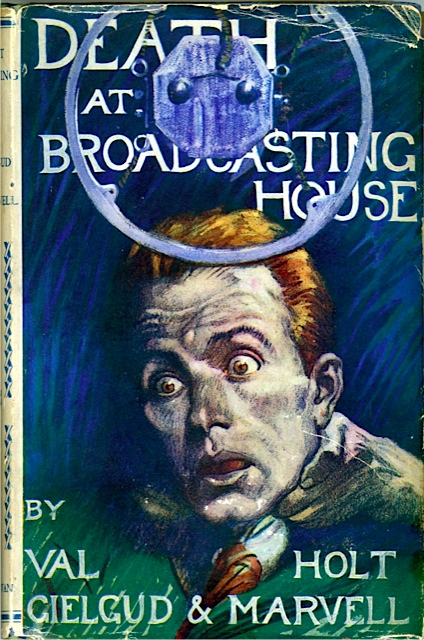
“Snobbish nonsense!” says one shabbily dressed young Londoner to another as they observe a man in a starched shirt and dinner jacket enter Broadcasting House.  The man, they reckon, is an announcer about to go on the air, unseen yet meticulously groomed and attired.  At the sight of which pointless and paradoxical propriety they sneer: “That whole place wants a dam’ good shake-up.”  A “dam’ good shake-up.”  That, in a coconut shell (to employ the most sound-effective nut in the business of radio dramatics), is what Val Gielgud and his collaborator Holt Marvell (the fanciful penname of fellow broadcaster Eric Maschwitz) set out to perform in Death at Broadcasting House (1934), a murder mystery set in and temporarily upsetting the reliable, predictable and frightfully proper BBC.  Although I had know about it for quite some time, I just finished reading it;  turns out, it’s a “dam’ good” page-turner, and a compelling commentary on the marginality, the relative obscurity of radio dramatics besides.
 
“There’s not a drop of good red blood about the whole place.  Robots engaged in the retailing of tripe! That’s broadcasting!” one of the above sidewalk critics of the tried and generally trusted institution declares.  It is clear, though, that Gielgud and Maschwitz did not side with the two self-styled “communists.”  The authors were BBC employees and not about to stage a revolution.  The “shake-up” was strictly a matter of maracas, a means of making some noise for their own undervalued accomplishments rather than spilling the beans without which those maracas would become utterly useless as instruments of ballyhoo.
 
Sure, broadcasting plays—minutely timed, meticulously rehearsed and intensely scrutinized—were far more mechanic than any other form of dramatic performance.  Yet, as Gielgud insisted in one of his many articles on radio drama, “[i]n spite of [its] machine-like qualities” and “in spite of the lack of colour and applause, the work has a fascination of its own.” That the multitude for whom these performances were intended showed so little gratitude was frustrating to an actor-director like Gielgud, who sarcastically remarked a few years earlier that dismissive reviews in the press suggested, at least, that the broadcast play had “passed the first and most depressing stage of development—the stage of being entirely ignored.”  By 1934, it had clearly not advanced to a stage that could be deemed legitimate.
 
What better way to gainsay those naysayers than to spill some of that “good red blood” or to stir it properly and to make it run hot and cold by turns.  “A killing! In Broadcasting House, of all places! Good God!” is the response of General Sir Herbert Farquharson, the corporation’s fictional Controller.  He has just been informed that an actor was done away with during the production of a live broadcast.  “My god, sir,” the director of that play exclaims, “do you realize that everyone who heard that play must have heard him die? That makes it pretty unique in the annals of crime.”
 
That most folks tuning in thought little of it—that they believed it to be part of the drama—is owing to the fact that the murder was committed right at the moment when, according to the script, the character played by the victim was scheduled to breathe his last.  A crime at once prominent and inconspicuous—like most radio dramas, performed as they were without a studio audience.  After all, even the Controller, at the time of the murder, was attending a variety program staged in the specially designed Vaudeville Studio instead.
 
Death at Broadcasting House is the self-conscious performance of two radiomen, Gielgud and Maschwitz, fighting for the recognition that, for the most part, eludes those working behind the scenes—especially the folks behind the scenes of a largely invisible business.  Their book, as they so slyly state, was “dedicated impertinently … to those critics who persistently deny that the radio pay exists, has existed, or ever can exist.”  Radio plays existed, all right, but, for the most part, they died as soon as they were heard, if they were heard at all.
 
Unless, of course, they were blattnerphoned. “Blattnerphone?” the puzzled inspector exclaims.  “Yes,” the BBC’s dramatic director, Julian Caird, explains:
 
“It’s a way of recording a programme on a steel tape so that it can be re-transmitted.  We have to do a good deal of it for Empire work.” […]
 
“You mean we can hear that actual scene over again?”
 
“We can hear that scene,” said Caird, “not only over again, but over and over again.  As often as you like.  I wonder if the murderer thought of that?”
 
Probably not.  Unless he numbers among the initiated few, folks like Caird—and Gielgud—who have their fingers at the controls, conjurers who don’t mind revealing some of their tricks to demonstrate just how powerful they are.
 
“The curious thing about the case what that it was both extremely simply and extremely complicated,” the inspector wraps up the business of detection.  “It was extremely complicated only because it took place under very remarkable conditions—conditions which you wouldn’t find repeated anywhere else, and for which, of course, there was absolutely no precedent.”  The same applies to Gielgud and Maschwitz’s fiction. However witty and engaging, the whodunit is entirely conventional. It is the setting, the broadcasting studio, that makes it unusual.  The setting, thus, becomes the star of the production—a star without whose presence the show simply could not go on.
 
Indeed, the crime depends on the complexity of British radio production to be in need of detection.  In American broadcasting, by comparison, all actors gathered in the same studio, a congregation that would render the unobserved strangling of one of them not only improbably but impossible.  At the BBC, however, plays were produced using a multiple studios, a complex approach Gielgud’s stand-in explains thus:
 
[T]he chief reasons why we use several studios and not one, are two.  The first is that by the use of separate studios, the producer can get different acoustic effects for his scenes….  Secondly, the modern radio play depends for its “continuity” … upon the ability to ‘fade’ one scene at its conclusion into the next.  You can see at once that there must be at least two studios in use for these “fades” to be possible.  In an elaborate play, therefore, the actors require as many studios as the varying acoustics of the different scenes require, while … sound effects have a studio of their own, gramophone effects one more, and the orchestra providing the incidental music yet another separate one.
 
Anyone who has ever listened to an American radio play of the 1930s, such as the ones produced by the Columbia Workshop, knows that no such complex arrangements are needed for the effective use of multiple fades and changes in acoustics.  Death at Broadcasting House is a defense of the British system.  It turns the multi-studio approach into something to be marveled at—an arcane system fit for a mystery, a puzzle whose solution requires the expertise of the initiated and thus vindicates the existence of the men masterminding the business with their hands firmly on that most complex of all pieces of broadcasting equipment: the dramatic control panel, which, Gielgud enthused elsewhere, enabled the director “to move at will, both in time and space, as simply as if he were travelling on the fabled magic carpet, and to take his audience with him.”

Once Upon a Time in Radioland: A Kind of Ruritanian Romance

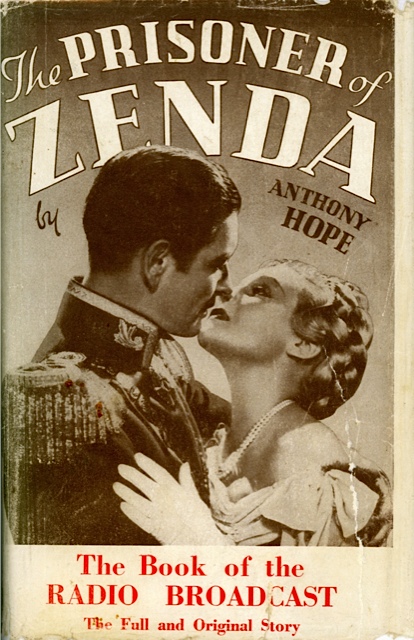
The other day, at my favorite bookstore here in Aberystwyth, I was caught in the eye by what struck me as a highly unusual cover for a 1938 edition of Anthony Hope’s fanciful pageturner The Prisoner of Zenda. Mind you, I’m not likely to turns those pages any time soon. I’m not one for Graustarkian excursions. That I found the old chestnut so arresting is due to the way in which it was sold anew to an audience of Britons to whom such a mode of escape from the crisis-ridden everyday must have been sufficiently attractive already. This was the 92nd impression of Zenda; and, with Europe at the brink of war, Ruritania must have sounded to those who prefer to face the future with their head in the hourglass contents of yesteryear like a travel deal too hard to resist.

My copy of the book

Now, the publishers, Arrowsmith, weren’t taking any chances.  Judging by the cover telling as much, they were looking for novel ways of repackaging a familiar volume that few British public and private libraries could have been wanting at the time.

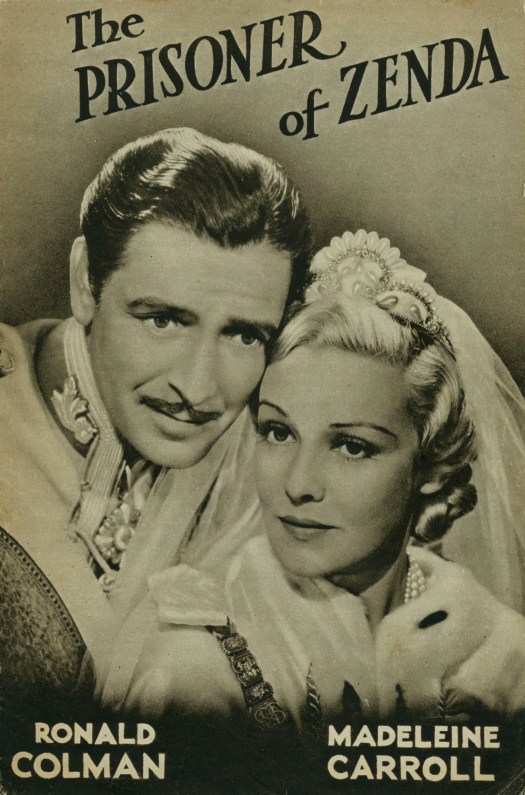
British moviegoers had just seen Ruritania appear before their very eyes in the 1937 screen version of the romance, which make dashing Ronald Colman an obvious salesperson and accounts for his presence on the dust jacket.  It is the line underneath, though, that made me look: “The Book of the Radio Broadcast,” the advertising slogan reads.  Desperate, anachronistic, and now altogether unthinkable, these words reminded me just how far removed we are from those olden days when radio ruled the waves.

The Prisoner of Zenda was recently the subject of a highly successful film,” the copy on the inside states somewhat pointlessly in the face of the faces on the cover.  What’s more, it continues, a “further mark of its popularity” was the story’s “selection by the BBC as a radio serial broadcast on the National Programme.”  To this day, the BBC produces and airs a great number of serial adaptations of classic, popular or just plain old literature; but, however reassuring this continuation of a once prominent storytelling tradition may be, a reminder of the fact that books are still turned into sound-only dramas would hardly sell copies these days.  Radio still sells merchandise—but a line along the lines of “as heard on radio” is pretty much unheard of in advertising these days.

From my collection of Cinegrams.

“This book is the original story on which the broadcast was based,” the dust jacket blurb concludes.  I, for one, would have been more thrilled to get my hands or ears on the adaptation, considering that all we have left of much of the BBC’s output of aural drama is such ocular proof of radio’s diminished status and pop-cultural clout.

Perhaps, my enthusiasm at this find was too much tempered with the frustration and regret such a nostalgic tease provokes.  At any rate, I very nearly left Ystwyth Books without the volume in my hands. That I walked off with it after all is owing to our friend, novelist Lynda Waterhouse, who saw me giving it the eye and made me a handsome present of it.  And there it sits now on my bookshelf, a tattered metaphor of my existence: I am stuck in a past that was never mine to outlive, grasping at second-hand-me-downs and gasping for recycled air . . . a prisoner of a Zenda of my own unmaking.

Smoke Gets in Your Ears; or, What Price “Butch" and "George”?

A keepsake that hasn’t been looked after

The other day, Bob and I drove down to Leominster, England.  The objective was to pick up a painting at a local auction house; but we made a day of it, during which we discovered Leominster to be a great town for antiquing.  Now, when it comes to treasure hunts, my definition of “priceless” is “unvalued,” a label (or stigma) attached to objects that somehow don’t matter much and therefore sell for next to nothing.  It is to those less prized items that I tend to be drawn—provided they have something to do with the undervalued performance art of radio. 

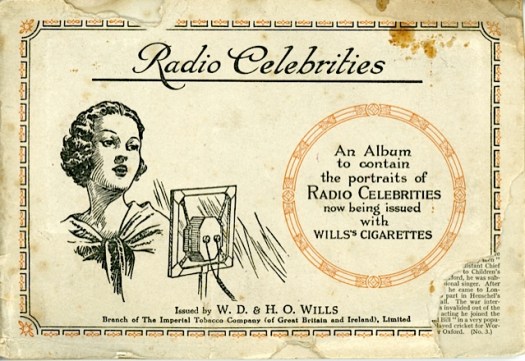
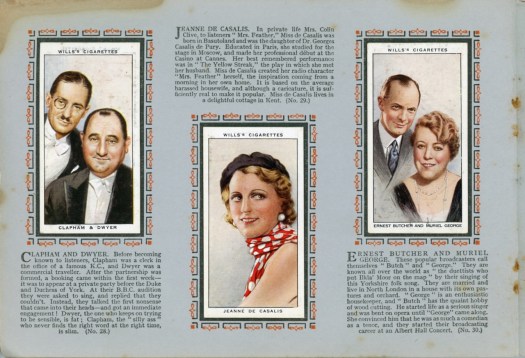
So, for about one hundredth of the cost of our latest oil, I took home a complete if somewhat tatty album of cigarette cards dating from 1934.  Since it was issued in Britain (by W. D. & H. O. Wills), the “celebrities” displayed in it are all folks heard on the BBC at the time—and rarely heard of thereafter.

Unlike their American counterparts, whose voices or musical talents are preserved on recordings anyone can readily retrieve online, most of these BBC personalities would be truly forgotten today if they had not made a name for themselves in other media.  Yet even if we remember the performer we are likely to be ignorant of the performance that brought them fame on the air.

A few years ago, Telegraph columnist Christopher Howse happened upon the same album now in my hands and remarked that the “world seen in [it] is as unfamiliar as the clipped tones of the celebrities it contains.”  Flicking through these pages means facing indifference and neglect.  How can we presume to know the 1930s if we can’t recall the names that then were household words, let alone put a voice to them?

Radio Celebrities—an oxymoron, perhaps?

Back then, the reverse was to be accomplished by those cigarette card collectibles: to put a face to the unseen visitors that millions welcomed into their homes.  No doubt, the chief purpose was to sell tobacco products—but aside from fueling an addiction these albums satisfied the need to turn word to flesh and hold on to fleeting sound by way of printed image.

“For many years,” the “Radio Celebrities” album reminded the purchaser, anno 1934, “broadcasting artistes, announcers and speakers remained rather mysteriously aloof—in the air, as it were!” No more.  The “Wireless” and their personalities were becoming “increasingly popular”; and the portraits to be collected and appreciated in this way were meant to “add a personal touch to names” that were already so “familiar to listeners.”

From time to time, I shall return to this album to report on the radio careers of Clapham & Dwyer, “Butch” (Ernest Butcher) and (Muriel) “George,” Jeanne De Casalis, and the forty-seven other “Radio Celebrities” that hit it big on the Beeb.

Sweetness and The Eternal Light

My bookshelf, like my corporeal shell, has gotten heavier over the years.  The display, like my waist, betrays a diet of nutritionally questionable comfort food—of sugar and spice and everything nice.   Now, I won’t take this as an opportunity to ponder just what it is that I am made of; but those books sure speak volumes about the quality of my food for thought.  There is All About Amos ‘n’ Andy (1929), The Story of Cheerio (1937), and Tony Wons’s Scrap Book (1930).   There is Tune in Tomorrow (1968), the reminiscences of a daytime serial actress.  There’s Laughter in the Air (1945) and Death at Broadcasting House (1934).  There are a dozen or so anthologies of scripts for radio programs ranging from The Lone Ranger to Ma Perkins, from Duffy’s Tavern to The Shadow.

My excuse for my preoccupation with such post-popular culture, if justification were needed, has always been that there is nothing so light not to warrant reflection or reverie, that dismissing flavors and decrying a lack of taste is the routine operation of the insipid mind.  That said, I am glad to have added—thanks to my better half, who also looks after my dietary needs—a book that makes my shelf figuratively weightier rather than merely literally so.

The book in question is The Eternal Light (1947), an anthology of twenty-six plays aired on that long-running program.  It is a significant addition, indeed—historically, culturally, and radio dramatically speaking.

In the words of Louis Finkelstein, President of the Jewish Theological Seminary of America, under whose auspices the series was produced, The Eternal Light was a synthesis of scholarship and artistry, designed to “translate ancient, abstract ideas into effective modern dramatics.”

In his introductory essay “Radio as a Medium of Drama,” Morton Wishengrad, the playwright of the series, defended broadcasting as a valuable if often misused “tool.” He did so at a time when, in the disconcerting newness of postwar opportunity and responsibility, radio was increasingly—and indiscriminately—dismissed as the playground of Hucksters, to name a bestselling novel of 1946 whose subject, like Herman Wouk’s Aurora Dawn (1947), was the prosperity and self-importance of the broadcasting industry in light of the perceived vacuity of its product. 

“An automobile does not manufacture bank-robbers,” Wishengrad reasoned, “it transports them.  It also transports clergymen.  It is neither blameworthy because it does the first nor is it an instrument of piety because it does the latter.  It is merely an automobile, a tool.

 What the medium needed—and what the times required—were writers who had “something to say about the culture.”

According to Wishengrad, there was “nothing wrong” with the techniques of radio writing.  He noted that serial drama, derided and reviled by “demonstrably incompetent” reviewers, had great storytelling potential: “Here are quarter-hour segments in the lives of people which could transfigure a part of each day with dramatic truth and an intimation of humanity instead of presenting as they now do a lolly-pop on the instalment plan.”

A  “lolly-pop on the instalment plan”! To paraphrase Huckster author Frederic Wakeman’s parody of radio commercials: love that phrase. Wishengrad is one of a small number of American radio dramatists whose scripts remain memorable and compelling even in the absence of the actors and sound effects artist who interpreted them.  Of the latter’s métier Wishengrad wrote: “Sound is like salt.  A very little suffices.”  He cautioned writers, in their “infatuation with its possibilities,” not to “drown” their scripts in aural effects.

Wishengrad’s advice to radio dramatists is as sound as his prose.  “Good radio dialogue,” he held, should come across “like a pair of boxers trading blows, short, swift, muscular, monosyllabic.”  Speeches, he cautioned, ought not to “be long because the ear does not remember.  There is quick forgetfulness of everything except the last phrase or the last word spoken.”

While Wishengrad made no use of serialization in The Eternal Light—as much as the title suggests the continuation and open-endedness of the form—his scripts bear out what he imparts about style and live up to his insistence on substance. 

Take “The Day of the Shadow,” for instance.  Produced and broadcast over NBC stations on 18 November 1945, the play opens: “Listen.  Listen to the silence.  I have come from the land of the day of the shadow.  I have seen the naked cities and the dead lips.  Someone must speak of this.  Someone must speak of the memory of things destroyed.”

The abstract gives way to the concrete, as the speaker introduces himself as the “Chaplain who stood before the crematorium of Belsen.”

I have buried 23,000 Jews.  I have a right to speak.   I stood the last month in Cracow when “Liberated” Jews were murdered.  I have no pretty things to tell you.  But I must tell you.

The “plain, and written down, and true” figures—appropriated from the “adding machines of the statisticians”—tell of the silenced.  But, the Chaplain protests, “[l]et the adding machines be still,” and let the survivors—the yet dying—speak; not of the past but of the continuum of their plight, of the aftermath that comes after math has accounted for the eighty percent of Europe’s Jewish population who were denied outright the chance to make their lives count.

At the time The Eternal Light was published, radio drama, too, was dying; at least the drama with a purpose and a faith in the medium.  To this date, it is a body unresuscitated; and what is remembered of it most is what is comforting rather than demanding, common rather than extraordinary.  Shelving the candy, resisting the impulse to reach for the sweet and the obvious—the lolly-popular—I realize anew just what has been lost to us, what we have given up, what we have forgotten to demand or even to long for . . .

Come On Up, Eileen; or, Wonderful Yorkville

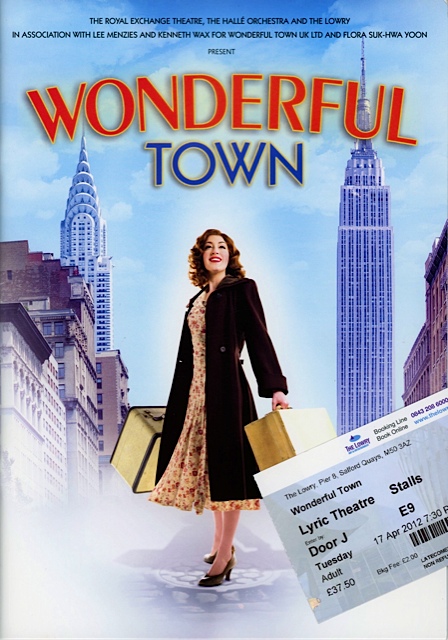
A few weeks ago, my better half and I were up in Manchester, England, to do research for an upcoming exhibition.  While there, we had the good fortune of catching a production of Leonard Bernstein’s Wonderful Town starring Welsh girl gone West End Connie Fisher as Ruth.  Though not quite the real thing, this revival of a Broadway musical version of a play (turned movie, turned sitcom) based on a series of magazine stories inspired by the personal recollections of an Ohioan in Gotham did manage to evoke some of the magic and the madness of life in the titular burg.  And now that I’m back, the residential misadventures of Eileen and her sister come to mind each time I walk down Second Avenue in my old Upper East Side neighborhood.  Like the McKenney siblings, whose Greenwich Village basement flat was shaken by blasts heralding a subway line then under construction, folks up here in Yorkville have been dealing for years with the pre-math of just such a subterranean project: the noise, the dirt, the traffic jams, the shut down stores, the narrowed sidewalks, the fenced in pedestrian passageways that make you feel like a laboratory rat . . . and the rats themselves.


Yes, Second Avenue (pictured) is looking rather worse—and far less flashy—than it did when the street was lined not with gold, but with gals who may or may not have a ticker made of that precious metal; you know, ladies whose line, like the subway’s, is well below.  Wonderful Town is not without hints of darkness, but, as in many musicals of the 1940 and ’50s, the shadier urbanites are colorful caricatures rather than delicately shaded characters.  And if Wonderful is now not as well liked as it was when it premiered, this may be owing to the fact that, even though the characters are based on real people, the assembled Christopher Street portraits are cleaned up so thoroughly as to make them look like stock figures in a formulaic pastiche.  That said, the musical still offers a glimpse at life during the Great Depression and remains translatable—and relatable—to anyone who can read between all those half erased lines of none-of-your-business.

Not that I need to step out of my old apartment to get that sinking Ruth and Eileen feeling.  The two women struggled to find work and put up with a lot while waiting for a break, a wait that, in Eileen’s case, ended at the age of 26 in a fatal car crash.  Journalist Ruth McKenney immortalized her sister and saw—or made us see—the bright side of their hardship and the squalor down in their dingy, downstairs domicile.  Indeed, when I first caught up with My Sister Eileen, sitting in an Upper East Side park listening to a 1948 radio production starring Shirley Booth, I assumed it to be a comment in the post-Second World War housing crisis.  And it is this crisis that hits home today.

If ever I write another autobiography—the one I penned somewhat prematurely at age 14 was discarded once it had served its purpose of communicating my pubescent angst to the girls in my class, whom I knew it was pointless for me to pursue—I might take a lesson from Ruth and look on the proverbial if sometimes elusive silver lining when I reflect on this morning’s knock on the door.  An eviction notice was posted on it and my old apartment is once again contested territory.  I am writing this—while culture beckons unheeded—sitting at the shaky dinner table that, for many years, was stacked with books, student essays, and the drafts of my MA thesis and PhD dissertation.  No, this town would not feel half as wonderful to me if it weren’t for that table, this apartment, and for the friendship that made it possible—and indeed desirable—to come back for a visit, year after year . . .

Of Myrt and Marge-inal “interest”; or, Getting It in the “hinterland”

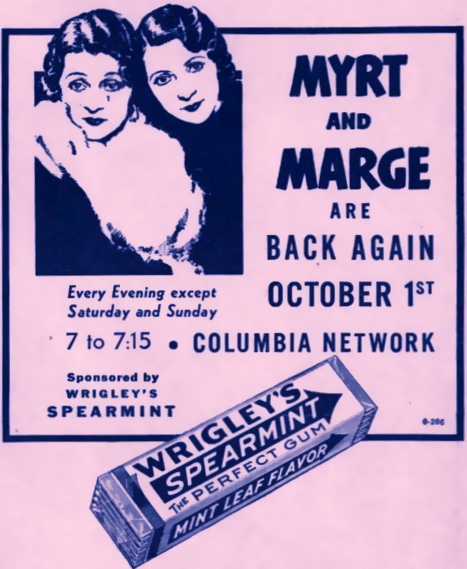
Amos ‘n’ Andy is old-fashioned,” radio critic Darwin L. Teilhet complained as early as 1932. “Its dramatic machinery creaks.”  He much preferred Myrt and Marge, a 42nd Street-smart if way-off-Broadway Melody then in its inaugural season.  To Teilhet, Myrt and Marge was not only “very good serialized melodrama,” it was the “most advanced program of its type now on the air.” 

For all its popularity—and its groundbreaking granddaddy-of-them-all status—Amos ‘n’ Andy sure was “old-fashioned.”  Indeed, its success depended on that comforting, reassuring recognizability—comforting and reassuring, that is, to folks who thought a black face routine less troubling than the effectuation of racial equality.  The early 1930s were highly competitive times of economic hardship, and to hear potential competitors bumbling and make fools of themselves must have been comic relief to the paler faces in the crowd, the faces that mattered most to sponsors.

So, how fresh-faced were Myrt and Marge by comparison? And why was it that, by January 1933, their serialized adventures came pretty close to rivaling Amos ‘n’ Andy in the ratings? Never having been enthusiastic about the latter, I was eager to find out.

As next to nothing is left of the program’s initial run, I had to take the critics’ ear and word for the “it” of listening.  Teilhet, for one, was wowed by the “swift lines,” which he found to be “very different from Amos’ and Andy’s ponderous exchanges.”

Indeed, those “swift lines” translated into swell curves in the critic’s mind.  “Miss [Donna] Damerel [as Marge] provides a sweet and pure sex interest,” Teilhet opined, “which can be safely gulped down by the hinterland without making the children go to bed before their proper hour.”  It took an adult’s imagination of adulterated purity to figure that not all that occurred in the lives of chorines Myrt and Marge was altogether “sweet and pure,” least of all by the puritan standards commercial radio was obliged to uphold.

According to Teilhet, the “tempo” set by the two leads was “hard and glittering.”  Myrt and Marge was quick to respond to the public’s fascination with Al Capone and Little Caesar by turning the backstage drama into an “exciting gangster story.”  It brought a touch of Dillinger to the dilly-dalliance of romantic serials, then still a genre in search of a formula.  By doing so, and by implicating its leads, Myrt and Marge came as close to pre-code Hollywood as network radio could get.

What’s more, Teilhet remarked, that “tempo” was “directly traceable to the vaudeville antecedents” of Myrtle Vail, who created the serial, wrote and starred in it.  “The things she has seen—and experienced,” winked Radio Guide’s Arthur Kent in 1934.  Kent attributed the program’s success to the fact that the title characters were played by actresses who were mother and daughter in real life and that Myrtle Vail had “lived in three great epochs of show business: epochs dominated, respectively, by stage, movies and radio.”  Having “been though it all,” Vail now wrote “the life of the theater as well as her own life into her script.”   Like a true trouper, she carried on even after the death of her co-starring daughter in 1941.

At least on one occasion, the realism was inspired by actual events.  “That tearful episode of Myrt and Marge last week was not the result of an emotionally successful script, m’dears,” readers of Radio Guide’s issue for the week ending 1 February 1936 were told.  “No, it was because the cast almost was overcome by tear gas fumes released when the bank adjoining the CBS studios tested out its automatic vault system.” 

I am surprised that listeners, if not overcome by the vapors, weren’t positively fuming at some of the backstage goings-on.  Perhaps they were overcome, which may account for the lack of documented complaints, radio’s chief tool of self-censoring.  Could they have been oblivious of the program’s other or third “sex interest”—that flaming figure in the dressing room?

What Myrt and Marge brought into American homes, if they didn’t already have one in the closet—and what contributed to renewed interest in the serial, albeit as a mere pop-cultural footnote—was Clarence Tiffingtuffer, the queer sidekick responsible for the gowns worn by the show-busy leads, and for considerable gossip besides.

If listeners were clueless, the hoofers sure weren’t.  When teenager Marge, the newest member of Hayfield Pleasures celebrated precision chorus, feels uncomfortable about being fitted by a man, one of her fellow chorines hisses “Don’t worry, he’ll never harm a hair o’ your head, dearie.”  Rather than being the brunt of it, Clarence dishes out some “swift lines” of his own. “Those gams of yours are practically parenthetical,” he remarks upon the alleged assets in his sartorial care.

Now, belated followers of Myrt and Marge have to make do with a mid-to-late 1940s revival of the serial (although a 1933 film version featuring the radio cast is extant).  Gone are the true-to-life leads; gone, too, is much of what had seemed “different” or “advanced” about the serial back in 1932.  Yet even though we now have to settle for Myrt and Marge-arine, the substitute still retains a flavor of the first outing, as the actor originating the part of Clarence, Ray Hedge, reprises the role he made his own.

I can imagine that, had I been growing up in the early 1930s, Myrt and Marge would have made me feel a little less marginal by moving someone recognizably like me—yet way out there, enjoying a career and a life of make-believe—into the center of the action.  How thrilling it would have been to hear Myrt and Marge take to the soundstage set by their better-known seniors, Gosden and Correll, and listen to them tear down that old minstrel show-on-taxi cab wheels.  With Clarence in their midst, and on my mind, it sure would have sounded like the “most advanced program of its type.”

To be continued, as they say in soap opera land.

Blind Man’s Stuff: Alec Templeton in Time and Space

Last night, I had the good fortune to hear the music of Alec Templeton. Live and by proxy—and right here in town. Templeton’s compositions, among them barrier-obliterating and class-unconscious numbers like “Bach Goes to Town” and “Debussy in Dubuque,” were performed at the National Library of Wales, Aberystwyth. Pianist Simon Crawford-Phillips was ably assisted by Templeton himself, whose voice and ways on the keyboard were heard in a variety of radio recordings from the 1930s, ‘40s, and ‘50s.

Why here? Why now? Well, Templeton was a Welshman by birth, a fact that seems to have eluded most of the Welsh who pride themselves to be a nation of song. So, last night was as good and as high a time as any for his countrymen and women to acknowledge Templeton’s remarkable against-almost-all-odds career, even if the will to embark upon it took the composer-pianist as far West from the West of Britain as Hollywood. The countrywoman who did the acknowledging was Rhian Davies, teller of Templeton’s life in words and images. Davies, who generously acknowledged as well all the support and assistance her project received from broadcasting buffs and music lovers around the inter-networked world, has known about Templeton practically all her life. Eager to share her readily transmitted enthusiasm, she brought home to us, the assembled audience, that it is always Alec Templeton Time.

Templeton’s life is the stuff of legend. Born blind, he developed an ear so keen and a wit so sharp that he was destined to play tunes made for the cutting of rugs. That he was an expert at middlebrow musical culture has a lot to do with the fact that the eyes beneath his brows saw nothing and that his ears saw nothing but potential. Others, left in the dark yet accustomed to light, might have seen an insurmountable impediment.

The mind’s eye of Alec Templeton saw no such manifestations of doubt. He saw, say, Lower Basin Street … and took it. It may be that sightless people, who sense space by feeling their way around and listening intently, are not so much impressed by the walls facing them as their seeing contemporaries, not so much concerned with apparent boundaries, be they cultural or national.

“I understand,” a writer for Radio Guide remarked in 1936, “why his friends, when you start glooming about his sightless eyes, smile superciliously and say: ‘Save your sympathy for someone who needs it.’”

The stuff sighted folks concern themselves with is so much nonsense to a man like Templeton. Sensing a universe where others might imagine chaos, he crossed the waves and made a home for himself on the airwaves, authoring an etherized existence.

“Radio,” Templeton reportedly said, “is to me the greatest miracle of man’s ingenuity. My ears are my eyes, and I tune in at every opportunity, listening to everything from Vic and Sade to Toscanini.”

Hearing Templeton’s music performed live and seeing his career celebrated was a thrill. Yet as pleased as I was that all this happened in the little Welsh town where I now live, I wonder what claim Wales has to her native son. After all, the place of his birth, like his blindness, was not of his choosing. Indeed, he chose to unfurl his pinions, take to the air, and come to live for all willing to be all ears, in a medium whose art is not limited by space but that is instead the stuff—the no-matter—of time.   Make that Alec Templeton Time.

Of “historical value”: Hitler’s “Best” Straight Talk and Other Continuity Types

As soon as I decided to make radio plays written in the United States in the 1930s, ‘40s and early ‘50s the subject of my doctoral study, I set out to scour New York City University libraries for scripts published during that period. My degree is in English, and I was keen not to approach broadcasting as a purely historical subject. The play texts and my readings of them were to be central to my engagement with the narrative-drama hybridity that is peculiar to radio storytelling. Whenever possible, I tried to match script with recording—but, to justify my study as a literary subject, I was determined to examine as many print sources as possible. One text that promised to provide a valuable sample of 1930s broadcast writing was Radio Continuity Types, a 1938 anthology compiled and edited by Sherman Paxton Lawton.

Back in the late 1990s, when I started my research, I was too focused, too narrow-minded to consider anything that seemed to lie outside the scope of my study as I had defined it for myself, somewhat prematurely. Instead, I copied what I deemed useful and dutifully returned the books I had borrowed, many of which were on interlibrary loan and therefore not in my hands for long. It was only recently that I added Radio Continuity Types to my personal library of radio related volumes—and I was curious to find out what I had overlooked during my initial review of this book . . .

Radio Continuity Types is divided into five main sections: Dramatic Continuities, Talk Continuities, Hybrid Continuities, Novelties and Specialties, and Variety Shows. Clearly, the first section was then most interesting to me. It mainly contains scripts for daytime serials, many of which I had never heard of, let alone listened to: Roses and Drums, Dangerous Paradise, Today’s Children. There are chapters from Ultra-Violet, a thriller serial by Fran Striker, samples of children’s adventures like Jack Armstrong and Bobby Benson, as well as an early script from Gosden and Correll’s Amos ‘n’ Andy taken from the period when the program’s format was what Lawton labels “revolving plot drama.”

Aside from a melodrama written for The Wonder Show and starring Orson Welles, I got little use out of Lawton’s book, mainly because I concentrated on complete 30-minute or hour-long plays rather than on serials I could only consider as fragments. Besides, I was not eager to perpetuate the notion of radio entertainment as being juvenile or strictly commercial.

Anyway. Looking at the book now, I am struck by Lawton’s choices. Never mind the weather report on page 346 or Madam Sylvia’s salad recipe. How about the editor’s selection of “Occasional speeches”? Historically significant among them are Franklin D. Roosevelt’s first inaugural, a “Welcoming” of Roosevelt by Getulio Vargas, President of Brazil, as well as Prince Edward VIII’s announcement of his abdication.

No less significant but rather more curious are Lawton’s “Straight Talk” selections of fascist propaganda by Benito Mussolini, Joseph Goebbels and Adolf Hitler: “Long live the National Socialist German Reich!” and “Now and forever—Germany! Sieg Heil!” Surely, such lines draw attention to themselves in a volume promising readers “some of the most successful work that has been done in broadcasting.” What, besides calling Goebbels’s “Proclamation on Entry into Austria” and Hitler’s “I Return” speech (both dated 12 March 1938) “straight” and “occasional,” had the editor to say about his selections? And what might these selections tell us about the editor who made them?

In a book on broadcasting published in the US in 1938, neutrality may not be altogether unexpected, as US network radio itself was “neutral”; but Lawton—who headed the department of “Radio and Visual Education” at Stephens College in Columbia, Missouri—seems to have gone beyond mere representations of “types.” Introducing a translation of Hitler’s speech, which comments on the reluctance of “international truth-seekers” to regard the new “Pan-Germany” as a choice of its people, Lawton argued it to represent “some of the best work of a man who has proved the power of radio in the formation of public opinion.” There are no further comments either on technique or intention. No explanation of what is “best” and how it was “proved” to be so. No examination of “power,” “public,” and “opinion.” It is this refusal to contextualize that renders the editor’s stamp of approval suspect.

The “continuity” Lawton was concerned with was of the “type” written for broadcasting—not the “continuity” of democracy or the free world. When he spoke of “historical value,” the editor did so as a “justification for a classification” of the kind of “continuity types” he compiled (among them “straight argumentative talks” by Senator Huey Long and Father Coughlin). And when, in his introduction, he speculated about radio in 1951 (“when broadcasting [would] be twice as old” as it was then), he did not consider what consequences the “best” and “most efficient” of “straight talk” might have on the “types” that were still “in common use” back in 1938.

Given its definition of “historical value,” it hardly surprises that Lawton’s anthology was not in “common use” for long. There was no second edition.

Ascent to the Gods: The Odyssey of Norman Corwin (1910-2011)

Obituaries often begin like this: The world (the art world, the theater world, the world of miniature golf, or what have you) has lost one of its leading, brightest, most prominent so-and-so’s. But that won’t do. Not if the so-and-so is Norman Corwin. The formula would not be worthy of him, for one. Stylistically alone, it would be un-Corwinian; it would be Hummertsian. Nor would it fit the occasion of commemorating his life’s work since the formula cannot contain it. The application would lead instead to inaccurate, misleading statements such as this one: The world of radio drama lost one of its greatest writers.

True, Norman Corwin, who died on 18 October 2011 at the age of 101, was a leading light in that dark theater of the mind. But he was also a journalist, a teacher, a screenwriter, a director, a producer, and, what has yet to get into the heads of those who assemble the anthologies of American Literature, a poet. He inhabited and enriched many worlds—and yet, for the past sixty years or so, Corwin has not been known the world over. You might say that we, most or millions of us, lost Norman Corwin decades ago because we, or some somebodies we permitted to act in our stead—though not on our behalf—decided that the world Corwin helped create and never forgot should be written off, abandoned, and depopulated of its talent like the ghost of a mine whose ore is no longer deemed worth our digging . . .

In the United States, the world of radio drama is such a lost world—and those, like cretaceous me, who keep on living in this world even if we can no longer live by it, might as well be dwelling on some dark star in a parallel universe. Unlike today’s listeners, radio writers did not have that choice back in the late 1940s, unless they were content, as Corwin put it in retrospect, to be “apolitical except for strong support of home and motherhood,” “inoffensive to the world in all its parts (although in radio practice, exceptions are often made in the case of minority-opinion groups which cannot possibly reply)” and prepared to “keep within the pale of clichés of character and situation so traditional there is a mellow patina on them.”

“I believe that artistic radio, whether commercial or otherwise, will not develop without a willing and interested leadership on the part of those who control programming, budget and time,” Corwin exclaimed in 1947. “That is all.”

That was all. One year later, Corwin felt compelled to remind those in control that he was still there, waiting and willing to take on another creative assignment—another Twenty-Six by Corwin, perhaps, another One World Flight. “I Can Be Had,” he announced; but those in “control” would not have him back.

“The artists are around, and there is nothing occult about the process of dialing their telephone numbers and talking it over.” Apparently, no one bothered to touch that dial. After years of restraint, commercial radio was eager to get richer even it that meant becoming culturally less enriching. It was a short-lived strategy of cashing in before television would take over and pretty much close the theater of the mind for good. Never again would a single play written for the ear reach and move an audience of sixty million in no more than two performances—as Corwin’s “On a Note of Triumph” did in 1945.

Forced to exit network radio because executives no longer commissioned verse plays, dramatic documentaries or travelogues in sound—three genres that are quintessentially Corwinian—Norman Corwin began travelling between worlds, the worlds of film, journalism, and the academia. Television, at least initially, was too small, too restrictive a realm to attract, let alone accommodate an imagination as vast as his. To Corwin, the audiovisual upstart was but a “poor bastard among the arts, having the benefit of neither the full scope and mobility of cinema, the immediacy of the legitimate theatre, nor the powerful suggestibility of radio’s unillustrated spoken word.”

The American theater of the mind may have been shut up, but Corwin’s mind stayed open. For over sixty years, he kept on journeying, searching and yearning. That’s the spirit that sustains you until you’re 101. Lucky are those who encountered him along the way. I prize the words of encouragement he wrote to me when, a few years ago, I dusted off my obscure dissertation on the American play to share my chapter on Corwin with the very man. I think of those words whenever I feel that, not being quite as eager as he to venture elsewhere, I lost my way; that I am lost to most of the image-minded world, untravelled, unraveling, yet all the while revelling in the “unillustrated spoken word.” I got the words, all right; Corwin had the wisdom as well.

I shall leave this entry in my otherwise image-filled journal “unillustrated.” I imagine Mr. Corwin appreciates the gesture . . .

(For those ready to catch up or on, the entire run of Twenty-Six by Corwin is currently being rebroadcast by John and Larry Gassman of Same Time, Same Station.)

Better the DeMille You Know

“Take Back UR Power Now,” the letters on the marquee read. I am standing in front of the Music Box Theater on Hollywood Boulevard. Whose power? I wonder. Who took it? Who lost it? And just who is telling me—or anyone else reading—to seize it? Take it from me, perhaps? Do I have it? Did I ever have it? Am I supposed to have it? If so, to do what with? Storm the box office? Take to the stage? Tear down the building and plant a tree? A windmill? Hold it. Is this one of those tiresomely postmodern Barbara Krugerisms? As my friend Clifton once put it, “I could look [it] up . . . but it’s more fun to speculate.”

The imperative “Now” intrigues me. It strikes me as incongruous, anachronistic. And, yes, antagonistic. It does not seem to denote the “Now” of 2011, my “Now” on this bright, sunny afternoon spent in one of the most frivolous locales in the western hemisphere. The look of the venue, the somewhat run-down surroundings, the slogan and its lettering transport me back to the early, bleak, violent, recession-shaken 1990s. Why am I thinking race relations? Could this not just as well be some hackneyed Tea Party catchphrase? Or else, a sign of things to come . . .

The time is ripe for warping. I’ve just been to Grauman’s Chinese, placing my palms into the imprints left by stars long gone out. I’ve been taking in all those names on the Walk of Fame, and it felt like treading on gravestones. And I arrived here, at the Music Box, transported by a longing, by the kind of nostalgia I am so wary of.

I did not expect to be reminded of the 1990s, to be taken aback instead of simply being taken back, if that were ever achieved ‘simply.’ Sure, I was prepared to be late. Seventy-five years late, to be exact. If it were in my power, I would be standing here, back in line with hundreds of other enthusiasts, to take a gander at Marlene Dietrich, Myrna Loy, Ruby Keeler, or Claudette Colbert. Not on the screen, mind, but live and in person. The Music Box, after all, was once the venue for the Lux Radio Theater, a Monday afternoon extravaganza hosted by showman-director Cecil B. DeMille. Merle Oberon, Marion Davies, Joan Crawford. Back in the summer of 1936, they were all here. I am in awe.

That is why I have come to this spot—on a Monday afternoon, no less, as I would later realize. I was dreaming. Now I feel tired out, and a little bit stupid, having caught myself chasing after ghosts. It is as if I had been hoping to get hold of the breeze stirred up by some wispy number long since mothballed. The spirit of the place does not “send me,” as swooning teenagers used to call it (the state of swooning, I mean). If anything, it sends me back to where I started this reverie. It takes me back into the ether, the mythical non-space I can fill, at will, with the voices of Marlene Dietrich, Myrna Loy, Ruby Keeler . . . as they were performing for millions of listeners, broadcasting live from the Music Box stage. It takes me back.

Wait. When was it again that I discovered these recordings for myself? The early 1990s. Well, what do you know! I guess, looking at that marquee, I have been forced to catch up with myself, and I find that self wanting, historically lost to the world. Years spent circling in representations of a past not alive to my being. Is it time to take back whatever I squandered? Is there still time? Do I have the energy to matter, the power to mean? I wonder . . .