Eyrebrushing: The BBC’s Dull New Copy of Charlotte Brontë’s Bold Portrait

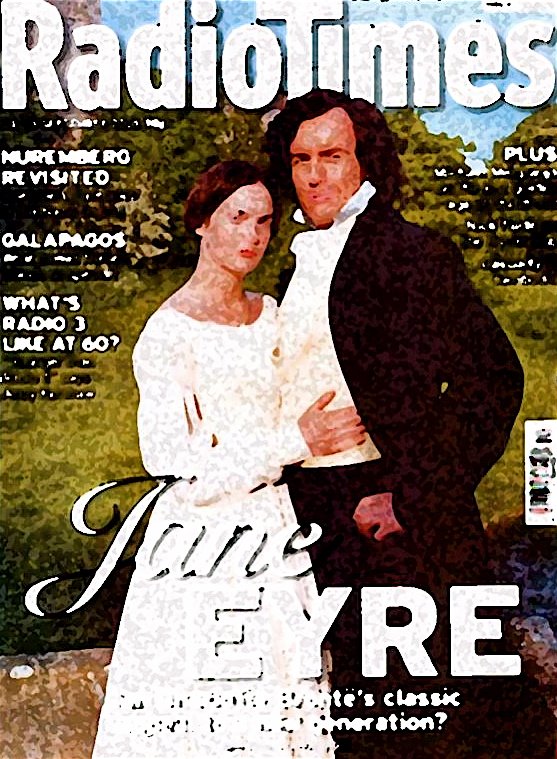
Well, I could blame it on the medication. Or it might be this holiday souvenir of a cold that is dulling my senses. I sure haven’t been able to savor my meals lately. So why should I thrill to yet another warmed over helping of Jane Eyre, a story I have read, written about, and taught, that I have heard and seen more often than any other work of English fiction? Why should anyone get excited about such a much chewed on and oft-reconstituted chestnut? Save college students, perhaps, who may take the BBC’s new television production as an occasion to keep their assigned editions unopened and to watch the plot unravel in four readily digested hour-long installments. If I sound cantankerous, it is neither bronchitis nor Ms. Brontë, I assure you: it is Sandy Welch’s bland rehash of one of the most daring and delicious growing-up stories ever concocted.

So, what’s wrong with this version, apart from production values and camera work reminiscent of 1970s television, apart from plain Jane’s sculptured eyebrows (brought to the job by Rossetti-lipped Ruth Wilson) and swarthy Rochester’s Darcyish looks (courtesy of Toby Stephens), apart from its skimming of some ten chapters (or eight years) and the half-hearted rendering of the novel’s relished if easily overcooked gothic mystery? Perhaps I had expected something rather more dynamic and radical after last year’s sensational adaptation of Bleak House.

Jane Eyre, to be sure, is not a Dickensian novel. It does not depend on bathos and caricature to elicit our responses; it relies instead—and succeeds in relying—on the intimacy of its portrait, the self-portrait of an inexperienced, self-conscious young woman who is given a voice to tell her tale.

That was radical in 1847—and it is still remarkable today, despite millions of blogs reveling in or bogged down by the mundane. Indeed, readers of Brontë’s pseudonymously published tale wondered whether this was fiction at all, or whether it was, perhaps, a thinly veiled if highly romanticized version of a real governess (in the employ of Mr. Thackeray, perhaps?). They wondered, too, whether this story was penned by a woman, considering its frank account of a socially unequal and as such questionable relationship.

Adaptations of Jane Eyre—any reworking worth our while—should make an effort to recreate this sense of realism, which is not found in the novel’s gothic situations, in the screaming but otherwise voiceless character of the presumably mad, Sargasso Sea-swept Bertha, in the fire that consumes Thornfield Hall and temporarily blinds its owner, or in the telepathic connection that reunites a mature Jane with her now helpless and emasculated master. The realism lies in the first-person narration, in the observations of a woman who has the nerve to tell her story, a story of teenage angst filled with humiliation, unease, and doubt. In short, a real story.

Voice-over narration, so closely associated with film noir, assists viewers to reach where the novel invites us to go: under the surface of conventions, beyond appearances, and as straight as Victorians could possibly permit themselves to pry into the heart and mind of a woman whose story is taken from her once she is not permitted to tell it herself.

Even radio, the medium best suited for the exploration of Jane’s mind, often resorted to an omniscient narrator such as this one by Walter Hackett, as performed in the US by the Yankee Players and broadcast in the early 1950s over the Yankee-Mutual Network:

The courtyard of the King George at Millcote is deserted with but the exception of the young girl standing at the entrance. She shivers as the rawness of the late November afternoon strikes through her thin cloak. Suddenly the door of the inn opens and a large-boned, powerfully-built, sullen-featured woman walks across the cobblestones toward the young girl.

It is time to return the story to that “young girl”—or leave it with Charlotte Brontë, who tells it so well. So, would-be dramatists of radio, film and television, take heed: let Jane Eyre speak up, or shut up!

Istanbul (Not Constantinople); or, There’s No Boat "Sailing to Byzantium"

Well, I have returned from a weeklong trip to Istanbul, Turkey. I did not bother to go in search of the aforementioned Rocky Jordan or look for his Café Tambourine in the Grand Bazaar, a shopping maze I, being slightly claustrophobic and averse to haggling, was glad to escape. A man like Jordan bey would probably be lost as well in present-day Istanbul, a sprawling metropolis whose population continues to grow at an environment and infrastructure challenging rate and may well have surpassed twelve million. And yet, you are not likely to encounter the populace in Sultanahmet, the old part of town, which, despite its ancient buildings and monuments, comes across as spurious—and thoroughly commercial—as an American pulp serial like A Man Named Jordan—a western reconception of Istanbul as a Disney theme park.

Walking from the Blue Mosque to the Haghia Sophia, the erstwhile site of the Byzantine Hippodrome, you will find yourself amid hordes of British, American, Australian, and German tourists. I rarely got an opportunity to pull out the Turkish phrase book I had purchased for the occasion. Nor did the dishes served at restaurants just off the Hippodrome strike me as authentic; then again, many of the menus were written in English or German, however ill spelled. You will have to cross the Golden Horn to Beyoğlu better to appreciate that foreign influences other than commercial tourism have been shaping the city for centuries.

Tourism might have been somewhat more discreet and less detrimental when the Orient Express first stopped in Istanbul, but the tracks for the seasonal invaders, many of whom flock to the cinematically commodified Topkapi (it having been on worldwide display since the 1964 movie of the same name), were already being laid during the late-19th century.

One of the oldest hotels catering to western visitors is the Pera Palas, where, among other well-known personages including Mata Hari and her Hollywood impersonatrix Greta Garbo, the previously discussed whodunit writer Agatha Christie stayed during the journey that inspired her Murder on the Orient Express. On the anniversary of her birth (15 September 1890), an enterprising concierge took us up into her room, now itself shrouded in a mystery contrived, no doubt, by the operators of said establishment; but more about that another time.

I grew up among Turks who were lured to Germany by the thousands during the post-World War II economic boom known as the Wirtschaftswunder and stayed there despite much hostility and humiliation. I lived among Turks, but rarely got to interact with them. I cannot say from experience how the situation is nowadays; but until I left Germany in 1990, Turks were still regarded as little more than servants who cleaned our streets and tidied our houses, a cleanliness ascribed to German efficiency but actually owning to foreign guest workers desperate enough get their empty hands dirty for a people known for its ethnic cleansing, a supposedly reformed nation enjoying the US support that ought to have gone to Blitzkrieg-devastated ally Britain.

Apparently, Germans have not reformed altogether. After strolling around remnants of glorious Constantinople and Byzantine ruins such as the Medusa head that, lying upside down, adorns the cavernous 6th century Basilica Cistern (pictured above) or taking a ferryboat across the Bosphorus to the Asian side of Istanbul, where we enjoyed lunch talking culture and politics with a descendant of the Ottoman rulers, CNN kept us up-to-date about the return of the Nazis in Germany’s local elections and gave us the jitters when the German Pope, who is supposed to visit Turkey in November, made some inflammable remarks about Islamic faith.

To avoid having to explain that I spent most of my adult life in the United States and just where my present home, Wales, is on the map and in relation to England, I often found myself replying “Germany” to the often voiced query “Where are you from?”—but I could not say it either with pride or a sense of veracity.

To be sure, as today’s news reminded me, Turkey faces its own struggle to match the ideals of Western democracy, ideals rarely met anywhere but most conveniently found wanting elsewhere. Apparently, it is still deemed a criminal offence for any Turkish citizen openly to criticize the state, past or present, so that even a fictional character’s voicing of controversial remarks may get its author-creator into serious legal trouble.

Turkey might be a more dangerous place than Agatha Christie or the creators of A Man Named Jordan could have dared to imagine, lest they were prepared to divest this gateway to the Orient of its fabled and profitable enchantments.

As I have always insisted writing this journal, I am not one to be carried away by bouts of nostalgia. When poet William Butler Yeats imagined “Sailing to Byzantium,” one year before Constantinople’s name was officially changed to Istanbul, he talked of visiting antiquity by reading about an illustrious golden age so that he might dwell in the “artifice of eternity.” Arriving by plane and walking in present-day Istanbul, such reveries seem out of place.

What kind of place is Istanbul now? What is its place in the West as Turkey strives to join the European Union but rejects or refuses to embrace much of what strikes us as Western (money and consumerism aside)? Having caught a couple of fragmentary chapters of the country’s history, I, for one, will stay tuned . . .

On-the-Air Travel: Meeting A Man Named Jordan at the Café Tambourine

Well, I am off to Istanbul tomorrow; and instead of studying my travel guide or practicing my language skills for the inevitable bartering, I am once again delving into popular culture for some dubious impressions of my destination. Earlier this year, I picked up Daphne Du Maurier’s Jamaica Inn to learn about Cornwall. I shall probably comment on that reading experience later this fall, considering that I recently found a contemporary article on the release of the film version starring Maureen O’Hara. Last summer, I watched Charlie Chan in Eran Trece to prepare for my trip to Madrid. Once again, I learned little and ended up eating tapas for a week.

Tuning in for some make-believe Turkish delights as offered to American radio listeners in the 1940s and early 1950s, I had my share of unreliable travel companions. I would have enjoyed going astray with Marlene Dietrich in her radio adventures at the Café Istanbul. Yet unlike its follow-up, the globetrotting romance Time for Love, the Café is no longer open for inspection; nor was it located in the city from which it took its name. A Man Called X (played by wooden-legged Herbert Marshall) ventured to Istanbul on at least one occasion and there is an episode of The Chase called “Flight to Istanbul.” The most obvious choice for some Istanbul escapes, however, is A Man Named Jordan, the serialized precursor of the episodic Rocky Jordan adventures.

Starring Jack Moyles and airing from January 1945 to April 1947, A Man Named Jordan took listeners to the Café Tambourine, which was initially located in Istanbul before being relocated to Cairo. That alone should suffice in answering any questions about the authenticity of such adventures set in a world gradually becoming open once more to tourists, rather than the military. That it was still an uncertain world seems to have been exploited by the spy thrillers of the day, cloak and dagger adventures that not so much romanced the world as relied on and fostered the audience’s suspicion of foreign places.

“In those places in the world where intrigue and danger still go hand in hand, where death and disaster are the rewards of weakness—in such places will be found, A Man Named Jordan,” the announcer-narrator introduced each installment. The location was as easily set as it was later changed. In those early days, Jordan’s establishment, the Café Tambourine, was to be found in “a narrow street of Istanbul’s Grand Bazaar not far from the Mosque Valide Sultan.” The Bazaar, more Byzantine than the plot of the serial, was established some five hundred years before Jordan opened his fictional Café there, a hazardous locale “clouded with the smoke of oriental tobaccos, crowded with humanity, alive with the battle of many languages.”

No doubt, I am going to have my share of linguistic challenges and will fail as miserably as on my trip to Morocco many years ago to negotiate the streets or haggle with the peddlers with dignity and success. Once back at the hotel Tash Konak, I shall pick up my iPod to compare notes with Rocky and that Man Called X before filing my report at the end of next week.

"Panic" Shopping at the Argosy

Sure I love books; but even more than reading, I enjoy hunting them down. It must be an instinct stronger than intellect that makes me want to sniff out volume after volume, many of which remain unread. Last Friday, for instance, en route to Birmingham International Airport to pick up two old friends from Germany who came to visit me for the first time here in Wales, we spent some two hours at Sunnycroft, a late-Victorian suburban villa once owned by a well-to-do, upper middle-class family.

As is often the case on such National Trust properties, there was a second-hand bookstore on the premises, however small and dingy. The piles of paperback romances did not bode well; and still I could not resist and stepped inside what, if I read the map right, was formerly the Sunnycroft boiler room. For something amounting to less than a dollar, to be left in a basket standing in for a salesperson, I snatched up a bound volume of The Snow Image, a British edition of some of Nathaniel Hawthorne’s Twice-told Tales, probably as old as Sunnycroft itself. Here it lies, next to me, waiting for some wintry evening by the fire or such time I deem fit for its perusal.

Nineteenth-century treasures like this one aside, I am thoroughly modern in my choice of books, my library consisting chiefly of texts on that mid-20th century phenomenon known as radio drama. And while I do much of my shopping online nowadays, I still prefer walking around town—be it New York City or Hay-on-Wye—in search of well-worn volumes on my favorite subject.

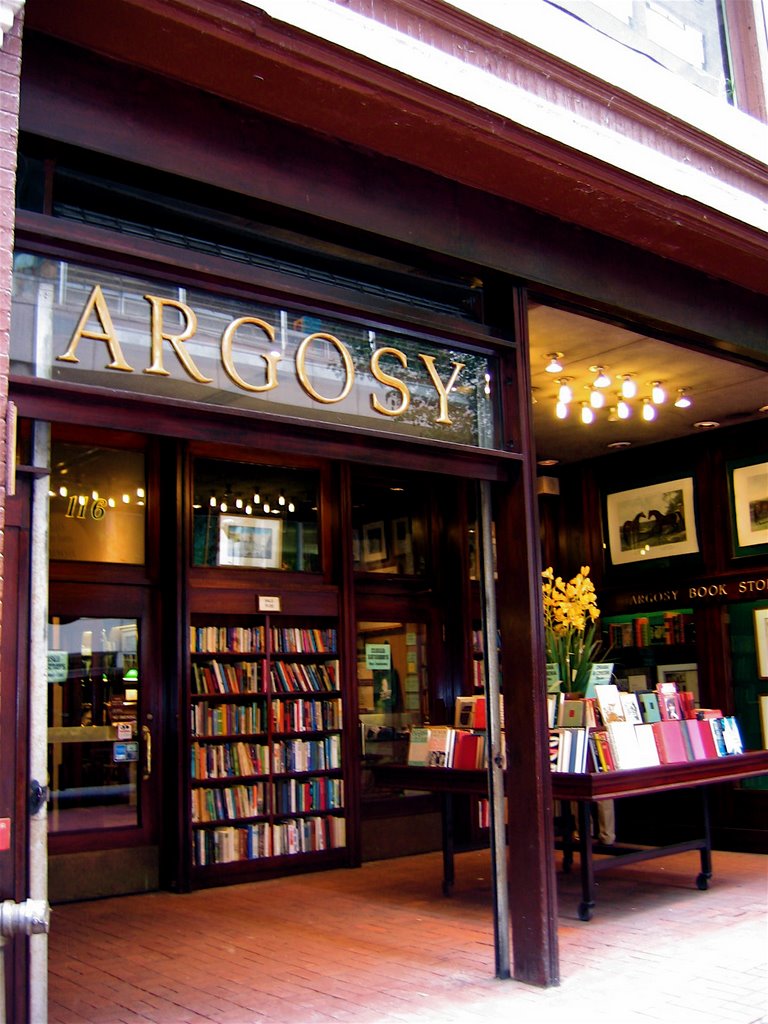
On the Upper East Side in Manhattan, just around the corner from Bloomingdales, one such supplier of old books on film, theater, and radio is the aptly named Argosy. As I mentioned in the comments section of a previous journal entry, the store is run by the wife of Stuart Hample, whose all the sincerity in Hollywood is a fine introduction to the wit of radio comedian Fred Allen.

On my tour of the Manhattan’s fast disappearing used and antiquarian bookstores a few weeks ago, I was pleased to discover that the Argosy had one of its themed sales, the theme being drama and television. Among the $3 items displayed in front of the store, I found a 1944 copy of Behind the Microphone by one John J. Floherty, a prolific writer of supposed non-fictions like Inside the FBI, Your Daily Paper, and Board the Airline. I expected neither insights nor entertainment; this, I thought, was merely one for the collection. As it turns out, Mr. Floherty was quite the storyteller. Listen to this Daphne du Maurier rivalling introduction to the miracle of Marconi, whose Poldhu station I failed to visit during my Cornwall trip earlier this year:

The State Troopers’ lodge at Montauk Point on the easternmost tip of Long Island stands on one of the loneliest spots along this seaboard. Rolling sand dunes and high bluffs, at which the Atlantic has gnawed for centuries, stretch drearily westward to Montauk village nine miles away. 

It was here that Captain Flynn of the New York State Troopers had me enthralled one stormy Sabbath night with tales of the early days in the lumber towns on the Canadian border, when troopers and lumberjacks fought it out with the accepted weapons of the period and place—bare knuckles. 

Outside the night was storm mad. A sixty-five mile gale machine-gunned rain pellets with battering force against the windowpanes. The pounding surf on the beach a few steps from the door vied with the thunder that came in frequent peals. The crackling fire of driftwood gave the room a coziness for which I was thankful on such a night. 

The captain was in the middle of a story when the door was flung open violently and a woman, tall and blonde, hurled herself into the room in an onslaught of rain and wind. At that hour, on such a night and in such a place, it was as if she had been flung from another planet. She was drenched and dishevelled. Terror was in her eyes. She tried to speak, but gasped instead. She was followed presently by a bedraggled wisp of a man and a thoroughly frightened boy. 

“What’s all the excitement?” the captain said, as calmly as if he had been asking the time. The intruders stared at him for a moment with popping eyes. The woman spoke. “Haven’t you heard, Captain!? Haven’t you heard!!? Thousands of people are being killed in New York and New Jersey. Twenty of your troopers have been murdered. People are jumping into the Hudson River and drowning like rats. It’s a gas or something? Our children are in Brooklyn—do you think they are safe? Do you think the soldiers, or whatever they are, will attack over there?”

I have never read a more melodramatic—yet supposedly authentic—account of the “War of the Worlds” panic. I am glad the industrious Mr. Floherty had enough zest to spin such a yarn, which surely deserves a mention in Etherized, my study on old-time radio. And I am glad I returned to the Argosy, which, after some eighty years, is still afloat in a sea of corporate sameness.

Where Silent Partners Join for Noisy Crime

White trousers may be out of fashion; but there are still a lot of ways to tell that summer is officially over. And I am not even talking about the mist rolling in from the Irish Sea this afternoon. After all, I am reporting from New York City, even though my reports are filed a few weeks late and some three thousand three hundred miles away.

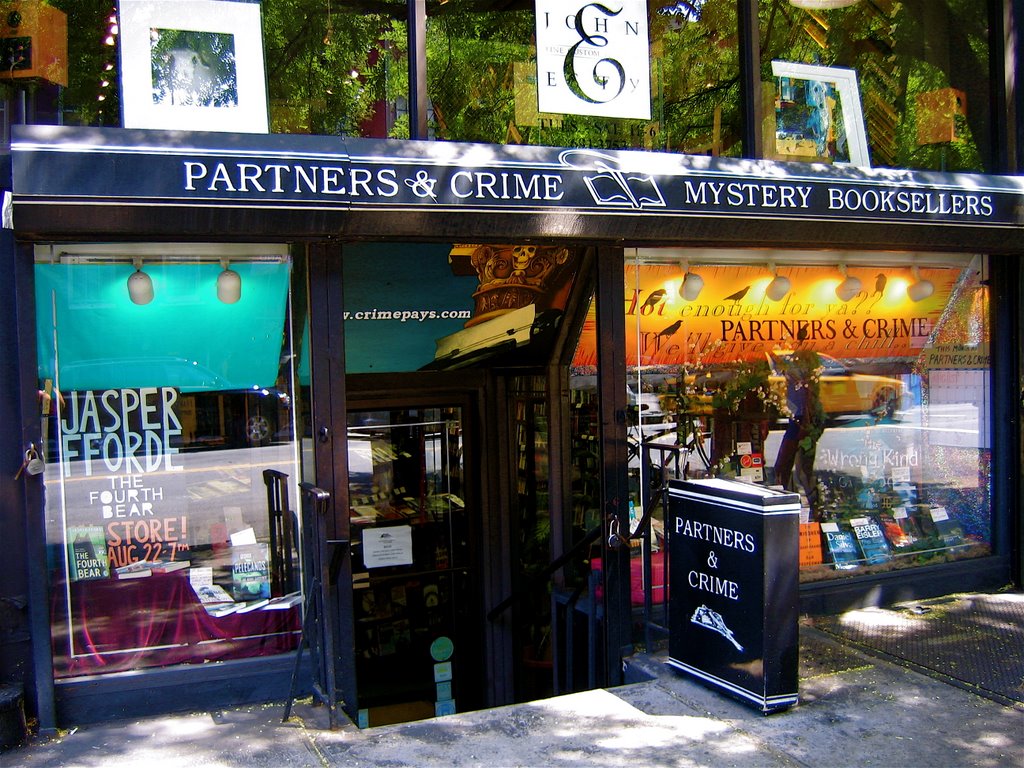
In the United States, the summer season traditionally ends on the first weekend in September, a time when millions of college students abandon beaches for bookstores and a certain band of players reclaims its space behind the shelves. Unlike those students I used to teach during my ten years of adjunct lecturing in the metropolis, the W-WOW! troupe only frequents one exclusive—if academically less than sound—venue: the Partners & Crime bookstore in the West Village.

Ever since the mid-1990s, when the city that presumably never sleeps still bore a slight resemblance to the bawdy and raucous town it had been before naps (and a lot else) became mandatory or derigueur, the W-WOW! players have been gathering on the first Saturday of each month (summer excepting) to re-enact the cases of Sherlock Holmes, Harry Lime, Philip Marlowe, and The Shadow as they were heard on US radio during the 1940s and early 1950s. You know, those days when the city had so much character to spare that a shadier one of it could be knocked off and tossed into the East River without causing more than a RIP-ple. Those days when the city was divided into distinct and clashing neighborhoods rather than being homogenized for the purpose of corporate milking. Those pre-television days during which keeping ones eyes shut to the world to share an imagined one was a national pastime rather than a geo-political hazard.

Anyway. Partners & Crime is a terrific store, one of the few sites that somehow managed to withstand the pressures imposed by chains like Borders or Barnes and Noble. One day, when the millennium was still very young and terrorism something that, from an American perspective, happened mainly to people in Europe and the distant Middle East, I discovered that Partners & Crime had become somewhat of an old-time radio institution—without ever going on the air. In short, it was an intriguing anachronism in a town about to trade in its past for clean facades and the promise of crime-free streets. I’d rather look at the scar above my left eye, dating back to a nightly stroll anno 1989, than walk what now goes for 42nd Street. But, back to fictitious felonies . . .

I was probably browsing for an old copy of Seven Keys to Baldpate or some such chestnut brought to light in my dissertation, when, much to my astonishment and joy, I spotted a microphone at the back of the store. As it turned out, there was an entire studio in the tiny, windowless backroom, a space modelled after station WXYZ in Detroit, as the playbill informed me.

I don’t suppose the goings-on behind the shelves do much for the sales at Partners & Crime. I, for one, immediately forgot all about the volumes around me and inquired about the microphone and its purpose. I was thrilled to learn that it was not set up for a reading of a contemporary crime novel, but for some old-fashioned radio mystery, to be performed for the benefit of a small group of theater-of-the-mind goers who eagerly squeezed into this nook beyond the books. I joined them, of course.

The W-WOW! players recreate old-time radio thrillers—commercials ‘n all—by placing their audience inside the make-believe Studio B of the equally imaginary W-WOW Broadcast Building. It may not further or elevate the art of radio drama and be done largely for camp (a way of misreading I can do without); but watching the performers as audiences once watched live broadcasts over at Radio City is nonetheless an enjoyable experience, particularly if you happen to eye the sound effects artist eager to elicit a few laughs while playing to the onlookers.

It is unfortunate that the W-WOW! troupe, unlike the Gotham Radio Players, do not go on the air to put their skills to the ultimate test of prominent invisibility. Theatrical training insures that some of the voices are fit for radio; and the actors are passionate even when the scripts are ho-hum. One among them, a certain Darin Dunston, not only appeared in a production of Under Milk Wood, but was the lead in Radioman, an award-winning student film about drama.

For a mere five bucks (less than one tenth of the cost of a half-price theater ticket), you may still take in a double feature of thrillers, transcribed from original recordings. Never mind that most of those in attendance at Partners & Crime seem more interested in the corny sales talk than in the plot of the mysteries or in the history of radio dramatics. I, for one, often listen to audio plays to get lost in sound instead of bothering to find much sense in them; and the noise made in the back of that West Village bookstore is quite in keeping with the shots, thuds, and wisecracks heard on US radio during the 1940s.

“Dark World”: Arch Oboler Makes Paralysis Sound Like Paradise

Nothing ends a joyful gathering more abruptly than an emergency phone call. We were taking in the sun on this mild afternoon here in Ceredigion when one in our party was being told that her mother had a wasp in her tea and was rushed to the hospital. I refrained from relating the story I had been told a few months ago during our trip to Cornwall, where I heard that the same dietary supplement had meant the end of a beloved pet. Best wishes and hopes for a speedy recovery was all I could impart at parting. True, I prefer looking on the bright side and make light of dark matters—an approach to life it has taken me decades to adopt. Still, sometimes the bright side is downright garish and irritating, a neon artifice that cons or comforts none. Take the story melodramatist Arch Oboler shared with US radio listeners on this day, 3 August, in 1942.

The play was “Dark World” and was soundstaged for the anthology program This Is Our America. Heard in the leading role was screen actress Kay Francis, who is enjoying considerable critical attention these days and is being celebrated in one of my favorite webjournals, Trouble in Paradise. On that August day back in 1942, Ms. Francis had several million Americans in her spell—but what a dizzying one it was.

As might be expected, particularly given the title of the series in which it was featured, “Dark World” is a comment on the horrors of warfare. It certainly was a change from the jingoism of the day, delivered by the creator of the fiercely pacifist and similarly themed “Johnny Got His Gun,” adapted by the same playwright. And yet, Mr. Oboler was one of the chief advocates of hate as a motivator in wartime; and “Dark World,” which was first produced nearly two-and-a-half years prior to the attack on Pearl Harbor, is ambivalent, which is the academic term for murky and muddled.

“Dark World” opens as two nurses lean over and contemplate the body of a dead patient, the paralytic Carol. “I just don’t get it!” one nurse tells the other. “All the time you’ve been on the staff, I’ve never seen you act this way over losing a case! And especially this one—blind—paralyzed—helpless. . . .” “That’s just it!” her colleague responds. “For twenty-five years—from the hour she was born—Carol Mathews had nothing but loneliness and misery! And then to die like this—never having known anything but darkness—it isn’t fair—it isn’t fair!” Has Carol’s existence been worthless? Is her death a relief? It is the dead woman herself who has the last word on the matter:

Hello, Amy. . . .  Hello, Amy. . . .  No, you can’t hear me, can you? And yet I must speak—while I’m still here close to you.  You said I’d never known anything but darkness. . . . You’re very wrong, Amy.  There was never any darkness in my world. How cold there be? The skies that I saw never clouded.  The flowers never faded.  The trees were always green and fresh.  I saw a lovely world in my darkness, Amy—lovely. . . .

It was a world inhabited by the words of Victor Hugo and Joseph Conrad, “and all the rest,” Carol insists; “theirs weren’t just words printed on white pages as you read them to me! They were white, flaming magic that carried me so far away from here—to the sea. . . .” It was a “world of space and freedom, where each man had a dignity of self so great the he could not bear the hurt of other men who are all as himself.”

Carol’s friends were the “Brownings—oh, such charming people—and Shakespeare—I used to argue with him! And Keats”; and “Walt Whitman—yes, he was here, too. . . . He taught me not to be afraid!” and “Schubert and Brahms and Mozart and Tschaikowsky—all of them—my friends!”

Carol claims to have “made a world” in her” darkness,” a world “where everyone walk in loveliness—where things were as they might some day be.” Thanking the nurse for her pity, she reminds her that “pity is for those who have nothing—and I had a world where all was beauty.”

Is “Dark World” advocating isolationism? Is it a perverse escape fantasy in which passivity, however involuntary, is deemed preferable to resistance and strife? In the triumph of mind over matter, Oboler’s play celebrates the medium; and in its sentimentalizing of inaction, it takes the side of the radio audience, those having stories read to them, stories that take on a life in the imagination of each receptive listener. It was the very passivity and solitary play that most propaganda drama, including Oboler’s own, worked hard to combat.

Dark is the world in which a case of paralytic blindness may be presented as a prelapsarian vision.

Many Happy Reruns: Herman Melville and M. R. James

Well, August is coming across a lot like autumn. Fierce winds, cool temperatures, and short intervals of rain put an end to the July heat here in Ceredigion, Wales. Undoubtedly, I will return to hothouse climes next week, when I am back in New York City, where, on this day, 1 August, in 1819, a child was born that would eventually become one of the most celebrated authors of the 19th century: Herman Melville. Moby-Dick, his most famous work—a story everyone knows but a book hardly anyone reads—was filmed, starring Gregory Peck, not far away from here in the Welsh town of Fishguard, where, last summer, I had the misfortune to drown a cellular phone.

Losing a chance to keep in touch with humanity—that is not altogether un-Melvillian. Melville’s yarns, apart from his early Omoo and Typee, are not primarily seafaring adventures. They are stories of the forlorn, of friendlessness and frustrated ambitions. Teaching American literature in New York, I once assigned Melville’s novel Redburn, a devastatingly triste tale of a young man unable to establish meaningful and fulfilling personal relationships. It is a subject to which Melville returned frequently in his work, his Kafkaesque story “Bartleby, the Scrivener” being a prime example. It is also a fine example of literature being well served by radio; and such instances are quite rare.

Those adapting literature for the airwaves were often asked to synopsize popular pieces of 19th-century fiction, to produce hurried rehashes that rarely captured the varied aspects, let alone the experience of epic tomes like Moby-Dick. The far shorter story of “Bartleby,” however, was well translated for radio by the creative team of Jerome Lawrence and Robert E. Lee. As the host of the series, Ronald Colman, told listeners of Favorite Story back in the late 1940s (the series was transcribed and syndicated, rather than broadcast live on network radio), “The Strange Mr. Bartleby” was an obscure work of fiction. It was owing to actor Robert Montgomery, who allegedly chose it as his favorite, that the story was picked up by Favorite Story and dramatized starring William Conrad and Hans Conried (as Bartleby).

As a short story, it is far more suitable for a twenty-minute dramatization than the novels that were generally bowdlerized in the process. Despite the changed title (the word “scrivener” being deemed rather too quaint and alienating, no doubt), Favorite Story‘s rendering of “Bartleby”—a dark tale in which communication failure is having a “dead letter” day—is probably the most satisfying and faithful Melville adaptation heard on American radio.

A similar success in adaptation may be reported in the case of another author born on this day (in 1862), a spinner of a very different sort of yarn: M. R. James, who shares his first name with our terrier, Montague (pictured). Still somewhat outside the canon of western literature—a canon that now includes Frankenstein and Dracula—James is a highly regarded teller of antiquarian ghost stories.

A decade before it was adapted for the movies, his “Casting the Runes” was readied for radio by Irving Ravetch and John Dunkel. With a score composed by the recently deceased Cy Feuer (commemorated here), it was heard on the thriller anthology Escape on 19 November 1947. Unlike Tourneur’s Night of the Demon, which exists in two versions and points up the Curse of visualizing terror as horror, the sound-only adaptation is both literate and liberating, depending on the listener’s imagination rather than showy yet inadequate special effects.

was often and not unjustly accused of playing fast and loose with literary classics. It reduced novels like Moby-Dick to skeletons best left in the closets of those who were commissioned to strip the meat from the bones of such meaty fictions. Shorter works like “Bartleby” and “Casting the Runes,” concentrating on one central idea and exploring a key situation involving a few main characters, fared considerably better on the air. These two plays are worthy of the men who conceived them without a microphone in mind.

Celebrated East-West Menace Starts Out Selling US Magazines

Well, I hadn’t intended to continue quite so sporadic in my out-of-date updates, especially since a visit to my old neighborhood in New York City is likely to bring about further disruptions in the weeks to come, however welcome the cause itself might be. A series of brief power outages last Friday and my subsequent haphazard tinkering with our faltering wireless network are behind my most recent disappearance. It is owing to the know-how of this creative talent that broadcastellan is now back in circulation. So, it seems fitting that, upon returning today, I should commemorate the career of a man who was particularly adept at vanishing, of casting his voice, and of having a laugh at matters least laughable: The Shadow. After all, he first went on the air on this day, 31 July, in 1930.

As expert Anthony Tollin relates it in The Shadow Scrapbook, the invisible man with the menacing laugh was at first little more than a radio announcer—a mouthpiece for Street and Smith, a company specializing in the cheap thrills of magazine fiction. While radio had little drama to offer during those early days of network broadcasting, its promotional prowess had long been proven by sharks, shysters, and shamans alike. As is often the case, the advertisement took on a life of its own, as tuners-in were more intrigued by the voice than by the product it was called upon to peddle. So, The Shadow was rushed into the limelight and, after being promoted to the narrator of Street and Smith’s Detective Stories, stories, became a bona fide superhero in print and on the air.

As the Orient—that is, the US concept of such non-Western territory with traditions predating the old world of Europe—was then all the rage, The Shadow is somewhat of a Fu Manchurian candidate, casting himself under an imported family tree from which branches dangle the wise Charlie Chan, the magical Chandu, and the sly Mr. Moto.

All those Americanized adventurers and much-relied-upon crime solvers owe some of their mystique to an element of the sinister or suspicious, even though this quality became diluted and, in the case of Charlie Chan, was obscured over the years whereas Mr. Moto was sent on leave when the allure of the extra-occidental seemed irreconcilable with the cultural reorientation of the US after Pearl Harbor and the expediencies of wartime propaganda.

Lamont Cranston, as listeners of The Shadow were told each week, had brought back a secret from the Orient—the hypnotic power to “cloud men’s minds so that they cannot see him.” He revelled in this invisibility, the hunt, hide and seek it made possible; as his menacing laugh suggests, he was no kindly Mr. Keen, no detached Sherlock Holmes, no matter-of-fact gumshoe. He enjoyed feeding his enemies the “bitter fruit” borne by the “weed of crime” and of feasting on its juices, on employing powers which, on this day in 1938, for instance, helped him to catch a group of western diamond mine raiders with the aid of a non-western sage turned servant who passed on “The Message from the Hill,” through “mental telepathy, the oldest wireless in the world.”

It is a telling case of a Hollywood identity crisis that screen villain Bela Lugosi first played Chandu’s archenemy and then returned to impersonate the radio original himself in subsequent movie serial sequels; nor should it be surprising that someone as typecast to play outcasts as Peter Lorre was chosen to play Mr. Moto. The duality—the duplicity—of Easterners gone West or Westerners under Oriental influences suggests something adulterated, ominous, and forbidding. It is a spinning forth of yarns like Dracula and The Green Goddess, stories of an East that not so much meets West but infiltrates it or insinuates itself.

Perhaps, in today’s global market, the Shadow might have started out as a hawker of Japanese electronics, the hardware of choice with which western media produce latter-day broken blossoms of diplomacy. It strikes me as disingenuous or incongruous, at least, that melodramatic Orientalism is deemed politically incorrect while demonizations of Iran and North Korea and the anxieties triggered by Communist China, by a distant Asia or Arabia—a far or middle east—are being propagated by a West that glorifies diversity but relies for its cultural survival and economic supremacy on demonstrations of its vulnerability, on images of threatened borders and threatening barbarians.

"Chained" to the Mike: Joan Crawford Goes Live Reluctantly

Well, they come to the remotest of spots, spreading their words—or the word—undaunted by the indifference or hostility with which they are greeted. Jehovah’s Witnesses, I mean. This morning, I’ve been listening for about an hour to two of these travelling preachers, one of whom likened our lack of receptiveness and knowledge to sitting in front of a broken television set. Actually, the two reminded me of radio announcers: hawkers with a mission who come into your home (or as near as you let them) to sell you ideas and convince you to tune in tomorrow—a tomorrow so protracted it might have been conceived by a soap opera writer if it weren’t quite so blissful.

Radio announcers, of course, were being paid for delivering promotional messages they did not compose; and it sufficed for them to feign conviction and enthusiasm in their pushing of ideas, services and products. Rather than turning the dial or twisting the doorknob on those Witnesses and their ill-concealed prejudices, I kept listening to their mythological broadcastings, even though my life at present is so serene that I do not long for another or any hereafter.

We are being sold so many mass-marketed keys to happiness that, when one of them finally fits into the lock, the confounded peddlers and their less-than-satisfied customers importune us to question whether we’ve got the right door. Once achieved, happiness is reduced to a token of stupor or proof of lacking ambition, a mark missed rather than hit. After all, there is business in creating desire and none in realized contentment.

Now, the elusive happily ever after is an illusion often smashed to great effect. The creators of melodrama, the theater of the contested status quo, turned the struggle for a joyous or secure future into a chief generatrix of storylines. The characters of melodrama often seek happiness by looking for something not belonging to them and find it by discovering that what they want is close by, however obscured by conventions or removed from their everyday by the chains of society. In all this strife, melodrama often insists on destiny, on a path chosen not by us, but for us, a path to be discovered instead of forged.

On this day, 27 July, in 1936, Joan Crawford stepped behind the microphone she dreaded to struggle against such conventions—and succumb to others—by recreating her role of Diana (or Dinah) Lovering in Chained, which was adapted for a production of the Lux Radio Theater.

Diane is a secretary of a well-to-do, “middle-aged, but attractive steamship magnate.” She vows to marry him—once his wife consents to set him free. In the meantime, she falls in love with a younger man, played by Crawford’s husband, Franchot Tone, a man who poses a challenge, rather than showering her with affections. There is little excitement in the triangle, a routine love affair in which Crawford is blandly smooth, rather than edgy. Perhaps the greatest achievement of Crawford’s performance is that the actress, reputedly uneasy about speaking live before an invisible audience of millions (as previously mentioned here), displays no audible signs of mike fright.

Setting the scene with an apposite if contrived Hollywood legend, Lux Radio Theater host Cecil B. DeMille explains that Crawford and Tone, whom he had never before met professionally, were meant for each other by virtue of their ancestry. “Their romance, which began in 1933, was more than a courtship,” he suggests. “It was a coincidence which had its beginnings in 1798, when an undecided Corsican named Bonaparte was lighting the fuse that was to explode all Europe and an Irish patriot named Wolfe Tone was enlisting French aide in a revolt against England.” Sure, Ms. Crawford, who married the descendant of said Wolfe Tone, was born Lucille LeSueur; but the “little French girl” was born closer to Paris, Texas, than to the French capital.

Aided by the continuity writers of the Lux Radio Theater, DeMille was able to craft a compelling theme out of such historic strains, even if it meant to strain historic facts in the crafting. For all his vision, though, DeMille was no seer. Between the second and final acts of “Chained,” the famed director introduces Helen Burgess, one of his recent discoveries for the screen. She might have been groomed for stardom, but, as Billips and Pierce remind us in Lux Presents Hollywood, the on-air promotion was futile. The promising starlet died on 7 April 1937, shortly before her twenty-first birthday.

Crawford, meanwhile, kept returning to the microphone, relieved, no doubt, when the era of live radio drama came to an end in the late 1940s.

Dark of Day: "Danger" and the Drama Invisible

Well, it was a scorcher of a day—the first I experienced here in temperate Wales. The unexpected heat brings back memories of my many summers in New York City and will prepare me for my return to the asphalt jungle this August. Moving to rural Wales from that bustling metropolis took more of an adjustment than adding a few layers of clothing; but anyone ready to weave life according to E. M. Forster’s motto “Only connect,” which is not a bad motto to live by, there is the comfort of that web of relations that, however remote or isolated you might believe yourself to be, will place you smack in the middle of the world, like a spider resting in the assurance that flies are bound to drop in, by and by.

Here is one such moment in the web in which I find myself. You might have to stretch your antennae a bit to get caught up in it.

Picture this: New York City, on this day, 18 July, in 1936. It’s the premiere of The Columbia Workshop, the most experimental and innovative of all the radio dramatic series produced during the so-called “golden age” of old-time radio. For that first broadcast, the Workshop revived what is generally considered to be the first original play for radio: The Comedy of Danger, by British playwright-novelist Richard Hughes, better known for A High Wind in Jamaica (1929), an adventure story that has been ranked among the hundred best novels of the twentieth century.

Danger is a sort of Poseidon Adventure staged in utter darkness; a spectacular melodrama of disaster involving three people about to drown in a collapsed coal mine. It is a scenario mined for the theater of the mind, evoked by sounds and silence alone. Danger was first produced by the BBC on 15 January 1924, but was still a novelty act when the Workshop chose it for its inaugural broadcast more than twelve years later. Back in 1924, US radio had no use for such theatricals, Hughes remarked in an article about “The Birth of Radio Drama”:

A few months [after the BBC production], finding myself in New York, I tried to interest American radio authorities in the newborn child.  Their response is curious when you consider how very popular radio plays were later to become in the States.  They stood me good luncheons; they listened politely; but then they rejected the whole idea.  That sort of thing might be possible in England, they explained, where broadcasting was a monopoly and a few crackpot highbrows in the racket could impose what they liked on a suffering public.  But the American setup was different: it was competitive, so it had to be popular, and it stood to reason that plays you couldn’t see could never be popular.  Yet it was not very long before these specially written “blind” plays (my own “Comedy of Danger” among them) began to be heard in America, and on the European continent as well.

Other than creating a situation in which the characters are as much bereft of sight as the audience, Danger has no artistic merit. It purports to be philosophical about death; but the fifteen minutes allotted for this piece of melodramatic hokum are hardly time enough to probe deeply, and much of the dialogue is ho-hum or altogether laughable.

What makes this seemingly generic if radiogenic play more personally meaningful to me is that it was written by a Brit of Welsh parentage, by a man who chose to live in a Welsh castle, and who chose, for this, his first dramatic piece for radio, a story set not far from the very hills where I found myself after these long years of writing in New York City about American radio drama. Is it a coincidence that I came home to the birthplace of radio drama?

“Goodness knows!” exclaims one of the trapped visitors,

I’d expect anything of a country likes Wales! They’ve got a climate like the flood and a language like the Tower of Babel, and then they go and lure us into the bowels of the earth and turn the lights off! Wretched, incompetent—their houses are full of cockroaches—Ugh!

In the background, Welsh miners face their fears by singing “Aberystwyth”—the name of the town near which I now reside. The Welsh, of course, are known for their oral tradition, for their singing and poetry recitals; their most famous poet is Dylan Thomas, author of the best know of all radio plays, “Under Milkwood.” It is here that American radio drama is still being thought of and written about: Rundfunk und Hörspiel in den USA 1930-1950 (1992), for instance, by fellow German Eckhard Breitinger, was written here, as was Terror on the Air, by Richard J. Hand, published in 2006. It is here, in Wales, that I started communicating with radio dramatist Norman Corwin; and it is here that, after a short break from my journal, I will continue my visits to the theater of the mind.

Yes, it is a web all right, even though I am not sure whether it was woven by or for me. I am merely discovering connections that, upon reflection, are plain to see and comforting to behold.