Politics and Plumbing

Doesn’t Republican rhetoric sound tired these days? The material isn’t fit for Vaudeville. The same old folksy (make that fauxsy) references to the mythical Joe Sixpack or average Joe, plumbing and otherwise. Shouldn’t that at least be the average José by now? It all strikes me as so 1950s in its white picket-fenced-in parochialism. Tuners-in are treated to the same bromidic anecdotes that are meant to stand for what supposedly matters or to distract from what truly does.

To candidates like McCain and Palin, what matters surely isn’t the presumably average Joe or Jane, at least not as anything other than statistical figures adding up to a sufficient number of votes. What matters to Republicans is the maintaining of a status quo serving those at the top who, if they deem it fit, let a few crumbs fall from the table at which few sit and most serve. Republicans tend to appeal to our meanest instincts, greed and selfishness, for which reason they rely on the lowest common denominators in their campaign speeches and their less-than-reassuring assurances.

No new taxes? “Read my lips,” perchance? The line is familiar, even if the letdown seems to have been forgotten by most. Less government? Tell that to the average Janes whom you deny control of their own bodies and destinies. I, who might have been a US citizen by now had it not been for conservative politics, would rather have big government than a world controlled by large corporations whose profit-marginalization of humanity is not only harming national economies but, what should be more important to us than mammon, our shared, global ecology.

Joe the Plumber? Sure, he exists. That does not make the figure any less of a fiction, a campaign speech commodity. Listening to the final Presidential debate, I was reminded of a certain “expert plumber” who stood up against a ruthless politician clawing himself into office; a cat, no less. Back in 1940, when socialism was not quite the dirty word that it is today, playwright Arthur Miller (a revival of whose All My Sons opens on Broadway tonight) created such fierce opponents in his radio fantasy “The Pussycat and the Expert Plumber Who Was a Man” (previously discussed here).

Tom, the Pussycat in question, is a questionable campaigner who shrouds his feline identity in threats and promises; he gets elected mayor in a nasty contest relying on the exposure of past wrongs in the lives and careers of elected officials, however irrelevant such revelations might be to the act of governing.

Tom aspires to the Presidency . . . until he is confronted by a fearless plumber, a citizen who exposes him for the sly customer he really is. Beaten, Tom returns to his home. The “difference between a man and a cat,” he concludes,

is that a cat will do anything, the worst things, to fill his stomach, but a man . . . a man will actually prefer to stay poor because of an ideal. That’s why I could never be president; because some men are not like cats. Because some men, some useful men, like expert plumbers, are so proud of their usefulness that they don’t need the respect of their neighbors and so they aren’t afraid to speak the truth.

As long as there is cream there will be cats that keep their paws on it while they purr about prosperity for all. Send in some stout-hearted plumbers who refuse to be campaign fodder and, rather than having pulled the fur over their eyes, set out to realize the ideal of draining the arteries in which the cream is clotting. And don’t let cream-licking felines make you believe that an ideal such as this is nothing but the stuff of pipe dreams . . .

Banks (for the Memories)

“How do you want it?” the stern-looking woman inquired. “In tens,” I said, because I needed it that way. She was a bank clerk behind a counter; and I was referring to the denomination in which a portion of my savings was to be returned to me. I sounded like a masochist saying it; but, stepping into the money market in tense times such as ours, you must really be a glutton for punishment. As someone who still counts his savings in tens, I am not among the afflicted. Still, what with that whiff of October 1929 in the air and Iceland at the center of an international incident, you’ve got to be in hysterics to be laughing all the way to the vault.

Could an economic bust be a boon for the sit-at-home, dim-the-lights medium of radio? Of all commercial enterprises catering to our need for news and entertainment, it was the wireless that experienced a boom during the Great Depression. Radio profited from the closing of Broadway shows and the demise of Vaudeville. And while programs on the air advertised plenty of products, they came to your home free of charge; unlike today’s cable and satellite receiver, the old cat’s whiskers did not require a subscription. Even the equipment could be assembled cheaply.

Be it Wall Street laying an egg or enemy planes dropping bombs, the poor cousin of television truly comes into its own when the world is in turmoil. To be topical, for once, I am listening to a few classic programs featuring assorted banking woes.

Jack Benny pinching a penny, safecrackers at work in an episode of Gang Busters, or hapless yokels like Lum and Abner offering financial services, radio gave the public an earful of what, for the most part, it didn’t have: money, and the trouble that comes it with, especially when it goes.

Given the prudery of radio entertainment, it is probably safe to assert that misdeeds for dough outnumbered crimes of passion on the air, unless that passion exhausted itself in a peck on the cheek, however embellished it might get in your mind. Mr. Keen may not have been a Tracer of Lost Profits, but radio thrillers were nonetheless teeming with have-nots trying to get some without resorting to the legalized gambling known as the stock market.

“Please, would you come to the bank with me. Please,” a woman urges, with distress in her voice.

I, I’ve asked so many people, but they won’t listen to me. You, will you come to the bank with me? No, don’t turn your head. Please don’t go away. Listen, if I tell you very carefully why I want you to come to the bank with me, you will come, won’t you?

Another terrified investor? A demented clerk trying to get you to open an account? Well, wait and hear. It is the opening of a Lights Out! thriller cheekily titled “Come to the Bank” (17 November 1942). As playwright Arch Oboler explains, it is “the story of a woman who, for strange reasons soon apparent, is determined to get us to the bank.” These days, as empty bank vaults are about as spine-chilling a setting as a crowded morgue, the above plea makes for an intriguing premise indeed, especially if the concept of a presumably solid depository and a final resting place are being equated.

“Come to the Bank” is the account of a woman robbed of her savings as well as her sanity, insisting as she is that the missing man she cared for is “entombed” in the wall of the titular institution. “This is your last warning,” a psychiatrist tells her, “You are to stay away from the bank. You are to behave yourself as the good, intelligent citizen you normally are.” If he were alive today, shrewd Mr. O would milk his scenario for all it is worth.

Pitch-Hitting; or, When Dietrich’s Not Herself

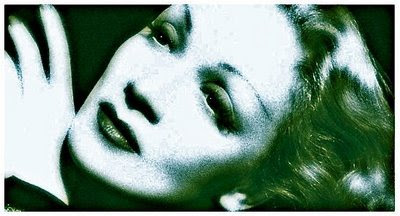
My grandmother refused to listen. She would walk out of the room whenever Marlene Dietrich appeared on the small screen. “She betrayed our country,” Oma would say, referring to Dietrich’s departure for Hollywood about the time the fascists came into power. Actually, Dietrich left a few years earlier; but the Nazis sure failed to lure her back. What a loss it is to turn a deaf ear to what aforementioned radio actor Joe Julian called “an exotic accent” and a “strong voice-presence.” Working with her in Dietrich’s lost radio series Café Istanbul (1952), Julian got a “glimpse behind the public image” and discovered
a woman of strength, warmth, and intelligence, yet so spontaneous that when, during a rehearsal, she overheard one of the actors express doubt that the rest of her body [she was in her early fifties by then] was as youthful as her famous legs, she ripped open her blouse to prove him wrong.

On this day, 8 October, in 1939, Dietrich could provide no such proof of her health and vitality. Scheduled to appear on the Screen Guild program that night, she was forced to call in sick due to a severe cold that, according to Roger Prior, host of the show, had halted the shooting of Dietrich’s comeback feature Destry Rides Again. The star had tried to honor her commitment, but had lost her voice entirely during rehearsals. In what must be one of the most inept voice-overs in Hollywood history, the Screen Guild producers replaced her with . . . Zasu Pitts.

It was all for laughs, of course. After all, Pitts’s voice had about as much sex appeal as fingernails being painstakingly filed . . . with a blackboard. And by casting Pitts opposite the less-than-expressive Gary Cooper, the Guild made the most of this emergency situation. “Is that Marlene Dietrich?” Cooper inquired. The affirmative only produced a terse “Well, so long.” Trying to explain the situation, Prior informed Cooper that “Zasu has Marlene Dietrich’s lines.” “Not from where I’m standing,” Cooper retorted. Together with Bob Hope and the actress billed as “Marlene Zasu Dietrich Pitts”, he nonetheless condescended to co-star in the sketch “The Girl of the Woolly West; or, She Was Wearing Slacks, So She Died Like a Man.” It sure made audience’s anxious for Dietrich’s return.

Nine years later to the day, on 8 October 1948, Dietrich was once again sick—and scheduled to appear on the air. This time, though, she was able to perform her role, cast as she was as the ailing Madame Bovary in the Ford Theater presentation of the novel as adapted by NBC staff writers Emerson Crocker and Brainerd Duffield . Sure, you’ve got to take Madame Bovary with “a pinch of power”; but you won’t be sorry to hear Dietrich breathe her last on the occasion. Besides, who could expect fidelity in the case of Emma Bovary?

“If some of Flaubert’s delicate delineation of character was missing from ‘Bovary’-on-the-air,” critic Saul Carson remarked, “Marlene Dietrich more than made up for this loss in literary flavor by her superb acting in the lead role.” Hardly carrying the chief burden, Dietrich was supported that night by Van Heflin and Claude Rains. “Too often, film stars rely on their screen reputations to cover slipshod work in radio,” Carson conceded; “but these people performed as artists who respected the medium as well as the vehicle.”

If Dietrich’s in it, just about any vehicle will do for me. Unfortunately, the extant recording does about as much justice to her timbre as Zasu Pitts. As for you, grandma, who saw trains depart for the concentration camps without making a noise, I’m just sorry that fascist propaganda robbed you of your senses . . .

He Calls Them As He Hears Them: Joseph Julian Remembers

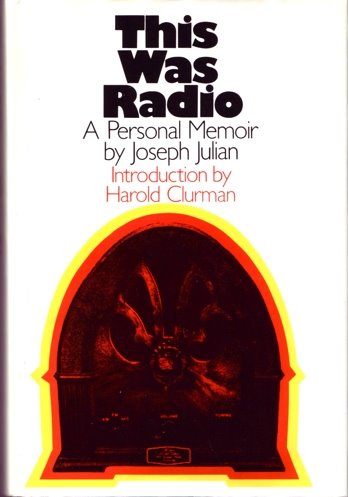
“The small but rich body of radio literature, which [Norman Corwin] brought so lovingly to life, lies languishing in a few libraries and second-hand book shops, under the titles Thirteen by Corwin and More by Corwin—a great shame and deprivation for the present generation!” My sentiments, entirely. Not my words, though, which is why I had to slap quotation marks on them. The man who said so was Joseph Julian, a once highly acclaimed and sought-after radio actor who starred in a number of plays written and directed by Corwin during the early-to-mid 1940s. Today, Julian’s memoir, a copy of which I recently added to my own library of out-of-print books on broadcasting, is one among those “languishing” volumes, a forgotten voice from a medium whose dramatic potentialities have remained largely unsounded since the late 1950s.

This Was Radio came out in the mid-1970s, a time widely deemed ripe for a reassessment of the aural medium and its derelict theater of the mind. Rather than waxing nostalgic—thereby squeezing the last few bucks out of a defunct business which, back then, most American adults still recalled experiencing first-ear, and fondly at that—Julian takes readers on a trip down memory lane that leads into neighbourhoods they would not get to hear about on an official tour.

His Corwinian class acts aside, Julian appeared on thriller programs like The Falcon, The Shadow, Inner Sanctum, Mr. Keen, Broadway Is My Beat, and The Mysterious Traveler. He was first heard on The March of Time, but as an also-ran-off-the-mouth, in re-enactments that called for crowd scenes. Briefly, he served as a sound man, during which stint he learned what noise a human body produces when it is turned inside out.

I can imagine just what kind of sounds emanated from Julian when he learned that the same thing was happening to his career. An established actor by the early 1940s, Julian remained highly successful throughout the decade, until, in 1950, his name appeared in Red Channels. His career as a radio actor declined rapidly; by 1953, his annual income had dwindled to a mere $1630.

Barred from work at CBS, Julian fired back by filing a lawsuit for libel. Character witnesses during Julian’s 1954 trial were Edward R. Morrow (last talked of here) and the aforementioned Morton Wishengrad. It was “an ugly period in American life and in mine,” Julian comments. His “urge” was “to skip over it”; but he felt a

responsibility as a victim to record some of what [he] went through. A whole new generation hardly knows that such a thing ever happened. But the fact is it could easily happen again if we relax our vigilance in defending our freedoms. Control of broadcasting is one of the first major objectives of those who would take them away.

His lawsuit was dismissed; thereafter, Julian virtually unemployed until William Fitelson, a theatrical lawyer and executive producer of the Theater Guild’s US Steel Hour television series staged one of the actor’s own plays in December 1954. Julian’s fortunes changed as quickly as they had declined; and he once again “getting calls for radio acting jobs.”

Without bitterness, Julian tells it as it is. About Myrna Loy, for instance, he remarks that, “if she had to win [her radio] role in a competitive audition with radio actresses, she wouldn’t have been there. Her voice, isolated from her other attributes, was dull and flat. She was selling her name, not her art.” More problematic still was it to perform a dramatic scene with Veronica Lake, who had such a weak, wispy voice” that the sound engineer could not get her and Julian “in proper balance.”

Lake was handed a “separate microphone across the stage” so that the engineer could “could mechanically raise her voice level to mine.” However effective for listeners at home, her faraway whispers had Julian straining to hear his cues. “Especially since they had her facing front so the audience could see her famous peek-a-boo hairdo. Hardly the way to play an intimate love scene with a lady!”

Of the notorious Hummerts, who “grimly dominated their empire” of soap operas, Julian remarks:

There was something darkly foreboding about [them].  Their stiff presence always evoked a sense of insecurity.  And with good reason.  They had a reputation for firing actors who incurred their slightest displeasure.  And authors.  When Mrs. Hummert once told a writer that she wanted “God” on every page of a script, and his answer was “Who will we get to play Him?” he was fired on the spot.  And whey you were fired from one of their shows it was a catastrophe.  It meant being banned from all their nine or ten others that might be on the air at any given time.

Call him fortunate or not, Julian continued to act on the air well into the medium’s decline. On this day, 4 October, in 1959, he was heard on Suspense, one of radio’s last remaining drama anthologies, in the routine thriller “Room 203.” It is a far cry from Julian’s greatest work; but these days, almost any cry uttered on radio seems distant.

An Ear Against the Blue Wall

I tire easily of Henry James and can countenance only so much blue. If I got a kick out of being cryptic, I’d say that about explains why this journal contains only a single reference to Dragnet, the influential crime drama that, between 1949 and 1957, caught the ear of millions tuning in to NBC radio. As much as I enjoy detective stories, I don’t warm readily to cop shows. Or cops, for that matter, the sight of whom is rarely a comfort to me. Let me give you a “for instance.” One sunny afternoon in September, I was sitting on a bench in Carl Schurz Park on the Upper East Side of Manhattan. It being the beginning of a new semester, and the beginning of my career as a doctoral student, I had a backpack full of books to pore over so as not to fall behind right from the start. I was—and am—a slow reader; and, when it comes to American and British fiction, a non-native one at that.

So, I took out the library copy of James’s Princess Casamassima, a tome so long and somnolent that I struggled to keep my eyes open. The next thing I know is that an officer addresses me from a police car several yards behind me, insists that I had broken a law, and hands me a ticket. I was very nearly speechless; but, after cautioning a few old ladies on the verge of dozing off over their cross-stitching that they would do so at their own peril, I betook myself, past the crowds gathered in the area for the annual German-American Steuben Parade, to the nearest precinct, where I protested against the treatment I had received. At that point I ran into what is commonly known as the blue wall. There was no alternative but to appear in court, a prospect likely to make the non-immigrant even more uneasy than the citizen.

However trifling, this experience made me think of those who had been abused in the name of the law, in the name of all the laws the breaking of which does not mean the least bit of harm or inconvenience to anyone, but whose enforcement provides those in uniform with the opportunity to intimidate, demonstrate their might, and put a few coins into government coffers. My case was ultimately dismissed; but the whole affair caused me no slight irritation. Is it any wonder that I prefer my Friday on a desert island?

Still, the chance of placing an ear on that blue wall and listening in on the workings of the force has an undeniable appeal. The one radio program to cater to spies like me was Night Watch (1954-55), billed as “the actual on-the-scene report of your police force in action.”

“You’re gonna ride with us tonight,” the narrator promised those tuning in to CBS on this day, 25 September, in 1954. “And remember, the people you meet are not actors. What happens to us, happens to you; because this is it. This is real. This is Night Watch.

This early reality show was presented with the cooperation of the police department of Culver City, California, and took listeners straight to the scene of conflict. In the 25 September 1954 installment, the cases involve stolen motel towels and a disagreement between a mother and her fourteen-year-old daughter whose unrehearsed, unscripted words and untrained voices leave no doubt as to the authenticity of the recorded incident, careful editing notwithstanding.

While Night Watch did not feature the sensational crimes that listeners came to expect from fictional programs, the reporter accompanying the officers was attacked, shot and stabbed, on at least two occasions while serving as proxy witness to scenes of juvenile delinquency, prostitution, domestic abuse and suicide.

No matter how diligent, courteous, and compassionate the officers, the star attractions of the series are the average, anonymous folks of whose lives the audience gets an earful as if being handed a glass to press against the walls behind which dwelled the neighbors to whom our doors are closed. Having been kicked off that bench, I can meet them with something else besides idle curiosity.

The Lilt of the Lilliputian

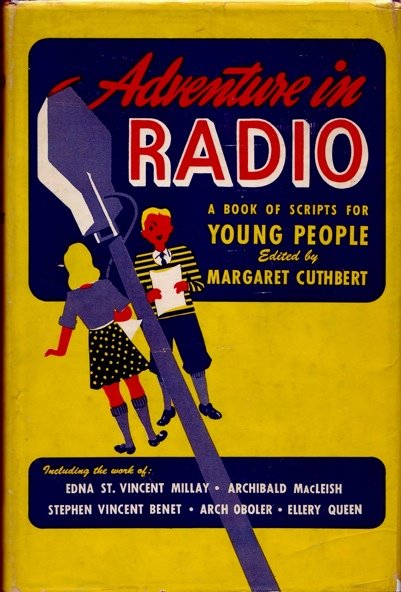
The cover of Adventure in Radio, from my collection

A few years ago, walking home from graduate school one afternoon, I stopped by at a second-hand bookstore in my old neighborhood of Yorkville, Manhattan. Judging from the window display, the shop seemed to specialize in children’s books and memorabilia. While this did not deter me, I hardly expected to make any significant acquisition of a volume on the subject to which this journal is chiefly devoted. I mean, I was not looking for a decoder ring or some such souvenir from the bygone age of radio dramatics. I was, after all, researching my dissertation. There was on the shelves a beautiful copy of Adventure in Radio (1945). Subtitled “A Book of Scripts for Young People,” it may be expected to include juvenile playlets written for the medium, although not necessarily produced on network radio. On such compilations, of which there are many, I was not inclined to waste money or time.

Spiting my assumptions, Adventure in Radio not only contains a number of broadcast scripts from programs like Jack Armstrong and Let’s Pretend but also propaganda plays and wartime commentaries geared toward an adult audience. In addition, it offers insights on the production of radio plays, on sound effects, announcing, and “radio language.” It took a little salestalk from the owner of the by now long closed store, but I was soon convinced. Where (I did not know much about eBay back then) would I ever find such a book again? And how could I claim to be serious about old-time radio if I did not snatch up this copy? So, I handed over my $40 (it was the price tag that made me hesitate) and walked off, eager to continue my studies . . . and determined to find the recordings to match the published scripts now at my fingertips.

That often proved quite difficult; but I had made up my mind that I was not going to write about words divorced from performance. I wanted to hear what was being done with those scripts, how they were edited and interpreted. Take the NBC University Theater’s production of “Gulliver’s Travels,” for instance. It was broadcast on this day, 24 September, in 1948. My appreciation of the challenges of soundstaging the play grew after reading the comments with which Frank Papp, a director of radio drama for NBC, prefaces the script, originally written for the series World’s Great Novels. Papp points out the “unusual problems” Frank Wells’s adaptation posed in production:

In the matter of casting, the Lilliputian was the most difficult.  Here was needed a voice which gave the illusion of a tiny man.  A trick voice in itself would be only a caricature.  What was required was a voice that created a picture of a real human being of Lilliputian size.  After extensive auditioning, an actor was found whose talent and vocal capabilities fulfilled these requirements.

The actor portraying Gulliver was placed in an isolation booth, Papp explains, “so that the Lilliputian’s voice would not spill over into his microphone” and the two voices could be miked separately, with a volume reflecting the size of each character. The voice of the King of Brobdingnag, meanwhile, was “fed” both through an electronic filter to amplify its base quality and through NBC’s largest echo chamber to create the illusion of a giant.

The 24 September 1948 presentation of “Gulliver’s Travels,” starring Henry Hull in the title role, does not quite live up to the expectations raised by Papp’s introduction. Under the direction of Max Hutto, child actor (Anthony Boris) is cast in the role of the Lilliputian, a choice that infantilizes the character and renders pointless the effects achieved by the sound engineer.

While Wells’s script downsizes Swift’s story and diminishes its bitterness and bite, it is the production that contributes to a sense that Gulliver’s Travels is, at heart, a juvenile fantasy, despite its airing on the ambitious if misguided NBC University Theater, a program that linked listening to such bowdlerizations with courses in distant learning. I may have been able to match the script with a production, but it was not the one described in Adventure in Radio.

Squeezed as I am into the isolation booth of my preoccupations, it is my mind’s voice that supplies the lilt of the Lilliputian . . .

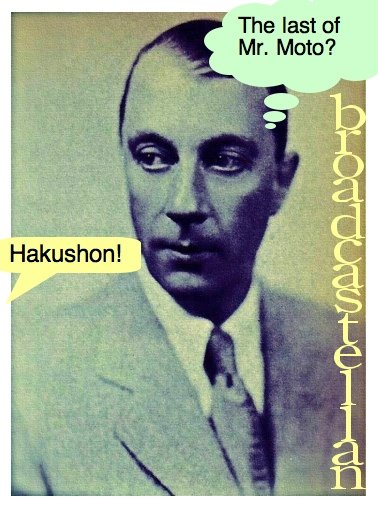
Taking a Name for Yourself: The Strange Case of Peter Lorre Vs. Peter Lorre

If only my father had been a serial killer. That’s what I thought, one afternoon, when I called the government office in charge of name changes. Regulations were so strict in Germany, the reason of doing away with your old moniker had to be something close to murder in the family. “We can only hope” is what I said to the bureaucrat on the other end of the line and, hanging up, gave up on the idea. I was just about to move to the United States and thought that it might be easier for me not to be “Harry Heuser” and face the prospect of being called “User,” as “Heuser” is so often mispronounced.

Now, I had no fancy alternative in mind; “Hauser” (as in Kaspar Hauser) would have done just nicely. I certainly did not try to free ride on someone else’s fame, faded or otherwise. That is what happened in the strange case of “Peter Lorre Vs. Peter Lorre,” a radio play by Michael Butts based on The Lost One by Stephen D. Youngkin; it premiered on BBC Radio Four this afternoon (1 September 2008) and was available here for listening until 7 September 2008. Having long had a fascination for the aforementioned Lorre, as well as onomastics, I was all ears.

“Peter Lorre Vs. Peter Lorre” is concerned with the final stage of the actor’s career, which coincided with those dark years in which aging Hollywood players found themselves crushed under the rubble of the old studio system that had cast them into stars. The 60s were cruel indeed; and many of the once highly paid players were reduced to accepting parts in low-budget horror films, about the only genre open to them. Sure, they could stop acting; but, for those who had made a living of it, this meant a kind of death; which is why many settled for gradual decay. In the case of Peter Lorre, who had been in the thriller business since his breakout role in Fritz Lang’s M, the decline had been more gradual still; he had been typecast so early in his career that he was soon reduced to caricatures. Just when Lorre was trying to push for a remake of M to restore the name he had made for himself, someone else was trying to claim it.

“Some fruitcake has filed a deposition,” his agent, Lester Salkow, informs Lorre, “He wants to use your name.” Determined to have this threat to his identity “stopped,” Lorre was puzzled nonetheless. “Why would anyone want to be me?” The “anyone” in question was Eugene Weingand, a Hollywood-based real estate salesman born in Germany in 1934.

“How would you feel,” the judge asks Weingand, “if your name was Peter Lorre and someone came in and wanted to use that same name after you developed it for a period of over thirty years?” To this Weingand made no reply; but, as Butts’s play has it, it got Lorre thinking and caused him to re-examine the worth of his name, not merely as a handle for salables but as a synecdoche of the self.

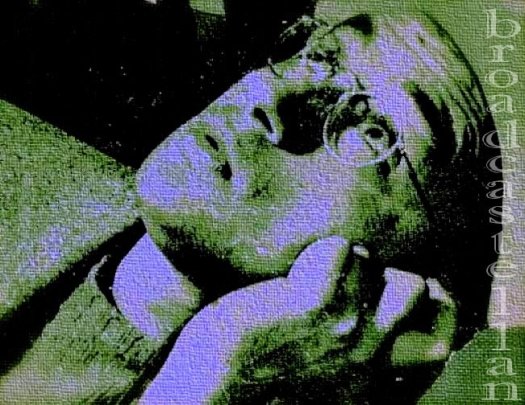
Weingand’s petition was rejected; yet, after Lorre’s death in 1964, he took the actor’s name for appearances in film and on television (in Get Smart, for instance), eventually settling for colourful parodies of Lorre’s ghoulish screen persona in cereal commercials. Weingand even claimed to be Lorre’s son, adding “Jr.” to his assumed name. Having just fast-forwarded through Hitchcock’s Torn Curtain (1966) and spotted him in the scene shown above, I cannot deny the resemblance.

Nor can I deny the resemblance of Lorre’s voice to that of British character actor Stephen Greif, who is remarkable in one of the two title roles. So torn and identity crisis tormented is the aging Hollywood star he portrays that you might as well say that Greif is heard in both of the title roles. “Strange,” Lorre comments on Weingand’s story, whose statements he reads, slipping into the role of the deluded man to whose ambitions his life in the public eye gave birth.

 “I feel I know him,” Lorre tells his agent. Having so long played roles he would rather disown, Lorre could not bring himself to calling his namesake an impostor.

Officers’ Disagreement: Gregory Peck Prepares for Future Fights

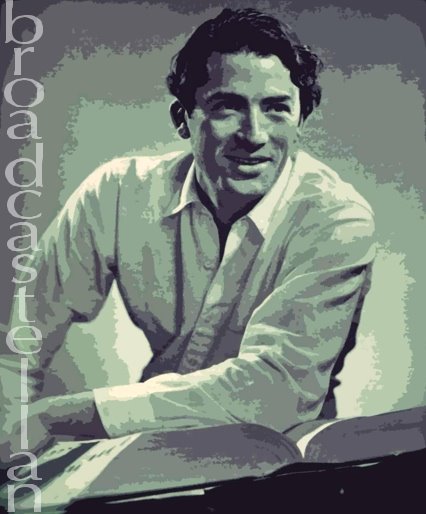
“The eternal providence has appointed me to watch over the life and death of all thy creatures. May I always see in the patient a fellow creature in pain. Grant me strength and opportunity always to extend the domain of my craft.” That is what was left of the Oath of Maimonides when it was uttered, on this day, 28 August, in 1945, on The Doctor Fights, a radio series dramatizing the challenges of physicians operating in the theater of war. Gregory Peck read those lines with a dignity becoming the profession; at the same time, he lifted The Doctor Fights above the dubious status of an infomercial for the pharmaceutical concern sponsoring the series.

The program was fast losing its edge, now that World War II had officially come to an end. The Doctor was fighting his last ratings battles; but the fight for dominance of the world market was just getting under way. “With the rest of America,” the sponsor, Schenley Laboratories, was looking “with great expectation toward the limitless afforded by peace. Opportunities for bettering the lot of all mankind.”

As anyone knows who has watched The Third Man, war-devastated Europe was a crippled, corrupted, and cadaverous body aching for medical treatment; and announcer Jimmy Wallington spelled out where the opportunities lay for improvement and profit: “One of the greatest among these gifts of medicine is Penicillin. Born of war, this promising drug will contribute much toward making a peacetime world in which disease and suffering reach a new and all-time low.” No mention is made of the all-time lows in the field of advertising, which hit the airwaves for the first time on this day, 28 August, back in 1922.

The Oath of Maimonides, which may be of German origin, is uttered in many variations; but most of them argue the physician to have been appointed to “watch over the life and health” of the human race, not over its “life and death.” This is a peculiar phrasing, given the program’s sponsor. Should doctors merely stand by and “watch over” people’s death, or do their utmost to see to its prevention? Perhaps, the war had been turning the Oath into a curse, as doctors were called upon to heal those who were prepared and ruthless enough to cause them harm.

Such a story is the “Medicine for the Enemy,” the episode scheduled for 28 August 1945. Purportedly, it is the “true story of Lieutenant Commander Harry Joseph,” whom Peck portrays and who is interviewed at the close of the program. As a medical officer aboard the destroyer USS Osmond Ingram, Joseph is low on penicillin, but faced with the duty of having to care for the thirteen Germans who survived the sinking of their submarine.

“What if one of our own men’s injured before we get back to port,” the doctor confides in the captain, “and the only medicine that can save him has been used up on enemy prisoners?” He is reminded that it is “up to [him]” to make such decisions. Clearly, the Oath has been revised for such occasions of watching “over the life and death” of “creatures” foreign and hostile.

Foreign and hostile they are, those Nazi prisoners, men who would rather die than be treated by a non-Aryan. “The first time since I’ve been a doctor,” Joseph tells the German commander, a man twice blinded, by hatred and acid, “I’m not sure I care.”

The medical officer realizes that, in order to heal the body, he has to fight as well the ignorance and arrogance of the proud Nazis, applying “doses of truth, backed up by facts. That was the treatment used in combating the disease.” In dispensing this “anti-toxin for fascism” along with the Penicillin administered on behalf of the sponsor, Peck that was doing so, the actor who portrayed Joseph was preparing for the roles for which he became famous.

Little Noisemakers: Hedy Lamarr, Winifred Wolfe, and Lili Darvas

“Are you willing to undertake a dangerous mission behind the enemy lines, knowing you may never return alive.” Thus opens Cloak and Dagger, an early-1950s radio series dramatizing the experiences of OSS (Office of Strategic Services) agents during World War II, “ordinary citizens who to this question answered ‘Yes.’” On this day, 27 August, in 1950, Cloak and Dagger presented “The Black Radio,” a story “suggested by actual incidents” concerning an “OSS agent who broadcast allied propaganda from behind enemy lines.” A radio thriller about radio? I had to tune in, of course, but got distracted by a little incident very early in the story.

Narrated by Larry Haines as Major Mark Lange, “The Black Radio” opens in the “big gadget room” at the OSS headquarters in Washington. It is a quiet day when, all of a sudden, one of Lange’s colleagues grabs his arm and, warning him about an air raid, detonates a small device in his waste basket. Just a prank among co-workers. The latest OSS gadget, Lange learns, is “a little noisemaker” about the size of a lemon, “great if you are in a tight spot and want to start a riot,” his colleague laughs. “We call it the Hedy Lamarr.”

The real Hedy Lamarr, of course, was more than a “little noisemaker.” Not only was she an accomplished Hollywood actress, but an inventor as well. Together with theaforementioned composer George Antheil,, Lamarr (seen above with Ish Kabibble and Kay Kyser at a Command Performance broadcast) developed a patented radio control for torpedoes, based on the principle of “frequency hopping”; but the navy would not have anything to do with the invention . . . at least not until the patent had expired.

And yet, “The Black Radio,” along with a few other episode of Cloak and Dagger, is not the kind of he-man adventure you might expect from a series so titled. It was penned by short story writer Winifred Wolfe, who, aside from being for a time the head writer for the television soap opera As the World Turns, became known for her stories about career women. “Ask Any Girl”—she knew their stories. Perhaps, Wolfe was merely commenting on the sexism in the work field when she exploded that little crack about Lamarr. “The Black Radio” does have a formidable woman at its center.

Major Lange is sent to Germany to weaken resistance with black propaganda by cutting in on the local Nazi stations to tell the people of Freiburg the kind of stuff the OSS wants them to hear. This was to prepare for the US invasion of Germany. The “Black Radio” in that strategic region was already manned, Lange learns. Or, rather, it was womanned—and the agent, Lucille, has not been heard from in over three months.

Our narrator begins to fantasize about Lucille, imagining her to be young and beautiful. It is here that Wolfe plays a trick on the Haines and the audience—for Lucille has “neither been slim nor young for longer than [she] can remember.” She once “taught history in grade school; now she was “helping to make it.” For this, she is prepared to die.

A well-crafted episode in the Cloak and Dagger series, “The Black Radio” recalls Charles J. Rolo’s reports on the “pirate stations” broadcasting in “defiance of the Nazis.” In Radio Goes to War (1942), a signed copy of which is in my library, Rolo “recount[s] episodes in the melodrama” of what he calls “one of the most thrilling chapters in the history of underground movement.”

Ever since the outbreak of war, mysterious voices supposedly broadcasting from within Nazi-controlled territory have periodically been picked up by vigilant listeners. [. . .] If any of these stations was really operated inside of occupied Europe, it was a suicide venture. Modern technical equipment makes it an easy matter for engineers of the German radio to detect the whereabouts of a bootleg transmitter.

“The Black Radio” and its operators do not escape detection. Featuring the voices of Barry Kroeger (as a Gestapo clerk), German-born Stefan Schnabel, and Adolf Hitler (in newsreel footage), the play is rendered particularly poignant by the casting of Lucille. Heard in the role is Hungarian-born stage actress Lili Darvas, the Tony-Award nominated wife of playwright Ferenc Molnar, with whom she was forced to emigrate to the United States in the 1930s. Wolfe’s play gave Darvas an opportunity to impersonate a freedom broadcaster making some noise from within.

As it turns out, Wolfe reserved a strong supporting role as well for “Hedy Lamarr. The “little noisemaker” ends up creating a riot in the place where most people would expect Lamarr to work her magic: in a crowded movie theater.

Radio at the Movies: To Please a Lady

She played tougher than anyone else in pictures, and she was better at it. She could get a guy to fall for her and a fall guy to do anything for her, be it to lie, cheat, or kill. To please her was a dangerous game; but to displease her was a deadly one. She could make puppets of men; Charlie McCarthy was just target practice. I’m talking Barbara “Baby Face” Stanwyck, of course, the kind of social climber who shoved the ladder right into the face of those far from selfless fellas who lined up to give a gal a helping hand. In To Please a Lady (1950), Stanwyck proved that her very lips could kill. Well, as newspaper columnist Regina Forbes, Stanwyck had the means to finish the job properly: a microphone, a broadcasting studio, and a weekly radio program.

To Please a Lady makes you wonder what Stanwyck could have done with a regular radio broadcast; she certainly could have out-Hoppered—and, out-Hoopered—Hedda, who simply didn’t have the voice to match her name. That said, Regina Forbes is not quite as eager as Hopper to pick up any name dropped in her lap.

“But you can’t go to Newark tonight,” her secretary exclaims as Forbes rushes out to get a story that piqued her interest. Never mind that she already had an appointment with “Margaret.” “What about Margaret?” Forbes asks. “You know,” she is reminded, “the one who sings.”

That, if you require a footnote, is a reference to the aforementioned Margaret Truman, the President’s daughter. And Forbes had no qualms about standing her up to get the dirt on a disgraced speed racer (smug-as-ever Clark Gable), who, like Forbes, stops at nothing to be first at the finish line.

To Please a Lady is a contrived story, and one that is told none too well. So, as the camera follows Gable for another spin around the track, you get to fantasize about Stanwyck’s voice and the radio and . . . hang on, there’s Ted Husing. Best known for his sportscast, the CBS announcer was also heard on an early Eddie Cantor program and its successor Rhythm at Eight, starring Ethel Merman; an excerpt of a routine for the latter is reprinted in Husing’s book Ten Years Before the Mike (1935).

Of the “grand trouper” Merman, Husing says:

While admitting that television will double her value as a radio performer, I still think she is radiates personality over the air. Her speaking voice is vibrant with health and youth, and is highly individual, while her singing tones are thrilling. What more can you ask of a radio personality?

Television doubling the value of a radio performer? Obviously, this was written before radio took the corner around which it was assumed to be lurking all those years. And when it got there, round that bend, it crushed the competition. While radio was still not yet quite defeated as a dramatic medium back in 1950, there are signs of an impending crash in To Please a Lady.

Forbes may still have her radio program, and Gable as an avid listener, but she gets her news from television, which introduces her to Gable’s mug and convinces her to rush out to interview him. She may still be in a position to knock them dead with the lashings of her tongue—inducing one of her victims to commit suicide—but it is television that is giving her ideas.

Voices like Husing’s were fast becoming a mere adjunct to the flickering images on the small screen, filled as it was with the dust in which it left the art of giving you a mind’s eye view of it all through speech alone. You know, the thousand-and-one words it presumably takes to approximate a single picture.

My Eyes Are in My Heart, Husing told his former listeners in his second autobiography, published in 1959. And so they were. The book was written after he had gone blind. Stanwyck, around that time, was embarking on a career as a television actress and personality, which, aside from guest appearances, ranged from hosting an anthology series bearing her name to playing matriarch Victoria Barkley on The Big Valley. By then, plays for listening had all but vanished from US radio.