“Thank you for being …”: From Silver to Golden with Betty White

Betty White, Bea Arthur and Rue McClanahan as I met them at a DVD signing at Barnes & Noble in downtown Manhattan in November 2005

What a fitting end this was to a mostly “stinky” 2021. Just as I was plonking myself down to subject my unsuspecting husband to a viewing of Ernst Lubitsch’s Design for Living (1933), news reached me of Betty White’s death. The year could hardly have expired on a more cheerless note, with the last of the Golden Girls not living to see her hundredth birthday in January 2022. Like so many other celebrations these days, that centenary now has to be called off as well. As the clock ticked relentlessly toward midnight, I shed a tear, remembered the laughter and called to mind the many years I spent in the company of … Rose Nylund.

I know that White, who started out on radio, played many roles on screens small and big. I also know better than to confuse an actor interpreting a script with a person inhabiting a character. Nevertheless, it was as Rose on The Golden Girls that White had the most profound influence on my life, especially in the late 1980s and early 1990s, when I was trying to adopt a more colloquial American English, to make the vernacular mine and make it work for me to boot.

Now, I’m not one to “blow my own gertögenflögen” – or however you might spell Rose’s pseudo-Scandinavian additions to my vocabulary – but, with the aid of White’s Rose, I managed to find the joy in speaking in at least two tongues, resigned to the likelihood that none quite conveys what I am aiming to say, particularly in the face of that “precise moment when dog do turns white.”

Peroxide blonde like me, White’s Rose was reassuringly naïve, curious and enthusiastic. She was generally good-natured and, trusting in fellow human beings she remained even after the end of her relationship with the man she had assumed to be Miles, was especially kind to animals, among them Mr. Peepers, the cat she reluctantly gave up on the day she met her future housemate Blanche Devereaux; Count Bessie, the piano-playing chicken she dreaded consuming; and Baby, the aged pig she agreed to adopt – or indeed to all the injured animals back on the farm on which she grew up. Rose’s character and the situations in which she found herself reflected White’s commitment to animal activism.

Rose was an outsider, too, an adopted child (with a monk for a father, no less). After the death of her husband, Charlie – of whom the bull on her family farm “would have been jealous” – she moved from Minnesota to Florida, struggling to acclimatize. She felt even more out of place visiting the “Big Potato.” Never having “seen so much of everything” in her “whole life,” she did not know “how people live here.”

Rose was also highly competitive, filled as she was with the “bitter butter memories” of having lost Butter Queen – a disappointment she revisited on the night she was arrested for prostitution – and occasionally exhibited a sarcastic streak, all qualities that I possessed anno 1990 without quite having the language to give them adequate expression in my temporary home of NYC.

Rose, as brought to life by White, never left me; indeed, the Girls helped me when I relocated from Manhattan to Wales, ill equipped as I was in my knowledge of that nation. Only yesterday, in the shower, I was making up another St. Olaf story that Rose might have tried to spring on Blanche, Dorothy and Sophia – a story sure to sound incomprehensible beyond that shower door.
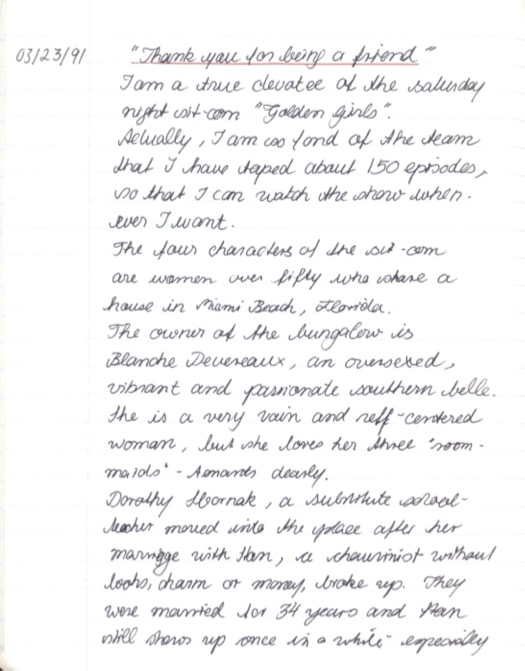
A page from my ENG 101 journal

I am used to talking to myself, unable to make myself understood about my distant past, which is another country not on anyone else’s map. Like Rose, though, I never quite stopped trying.

On 23 March in 1991, during my first semester of college at BMCC in downtown Manhattan, and toward the end of what would be the final season of The Golden Girls, I devoted an entry to the girls in my journal – an assignment for my English 101 class with Ms. Padol – insisting that those “four women [we]re not just knitting sweaters.” After all, there were “episodes on artificial insemination, gay marriage, racial problems, Alzheimers, homeless[ness] and death.” As I pointed out to my audience of one, “the show is liberal but does not come along too preaching or moralising.”

When you keep watching the show you come to know the characters[,] learn a lot about their relationship.  And even though the four leading ladies are slightly off-beat you can get a lot out of the show; you can often relate to some of their various problems.

There is life and sex after 50.  Some youngsters seem to forget that and some old people find it hard to compete or fight for their rights in the fast-paced world of today

As a queer young man growing up at the height of the AIDS crisis in the West, I certainly could relate to Rose and her agony of waiting for the result of an HIV test. I found comfort in the fiction that they had made it past the age of forty and envied the close and safe commune of the Girls.  When I taught an English literature class on friendship back in the late 1990s, I played the theme song that had inspired the theme of my class.  

Now that I am over fifty (Rose was 55 in the first season of the show, even though White was already in her sixties then), I think of The Golden Girls as a cultural product that made it easier for me to transition from silver to gold. And while I did not pick up many medals along the way, I did it all without access to the professional services of Mr. Ingrid of St. Olaf and his moose. Rose never divulged which part of the moose he used. “But,” she declared, “it’ll keep your hair in place in winds up to 130 miles an hour.”

I could always count on Betty White to see me through a storm.
Down Memory Street; or, Thanks for the Sesame

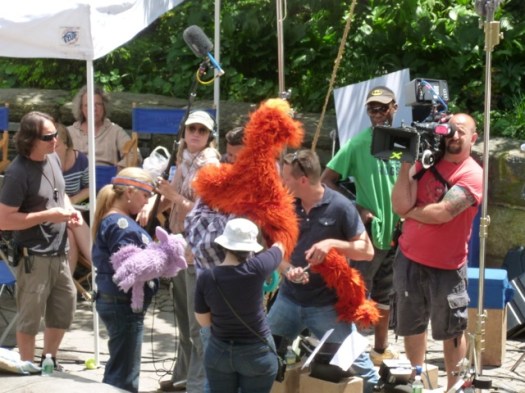
Filming of Sesame Street in Carl-Schurz Park, Manhattan

The sight was monstrous. There was shouting. They were shooting. Someone stood guard to keep strollers from trespassing while the action went on undisturbed. Few folks seemed to care, though, so familiar had such sights become in New York City. One could always catch up with it later, on television. Besides, this wasn’t a crime scene. It sure wasn’t Needle Park or Fort Apache, The Bronx. This was the peaceful, upmarket Upper East Side, for crying out not too loudly, and the wildly gesticulating savage in furs was of the Cookie Monster sort.  Sesame Street was being filmed on location—and the location, on that May day, was Carl-Schurz Park in my old neighborhood of Yorkville.

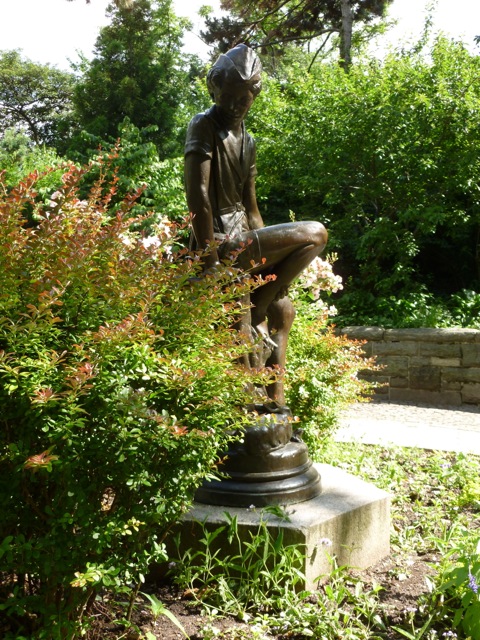
Peter Pan sculpture, Carl-Schurz Park

It seemed fitting that the beloved children’s television series should be shot here, right in front of Peter Pan, the bronze statue that, some fifteen years earlier—when the park had gone to seed other than Sesame—was violently uprooted and tossed into the nearby East River like an innocent bystander who, some thugs decided, had seen too much. It seemed fitting because Carl-Schurz Park is a tribute to German-American relations—and, in a long and roundabout way, I came to New York City from Germany by way of Sesame Street.  

As a prepubescent, I spent a great deal of time in front of the television, a shortage of viewing choices notwithstanding. My parents were both working and I turned to the tube for company, comfort and the kind of guidance that didn’t come in the form of a command or a slap. West German television had only three channels until well into the 1980s, and the third one, back in the early 1970s, was still experimental, reserved mainly for educational programs aired at odd hours. Odd hours would have been anything before mid-afternoon, when regular programming commenced on weekdays.  

So, there was literally nothing else on when I pushed the knob of our black-and-white set (a stylishly futuristic Wega) to come across Ernie, Bert, Oscar and the Cookie Monster—and they all spoke, growled or squeaked English. That is how I heard them first and how, several years before I was taught English at school, I got my first lessons in a foreign language.

I had just gotten through the alphabet and the numbers from one to ten when, without “Warnung,” Sesame Street turned into Sesamstrasse and the felty, fluffy foreigners became German, even though they changed neither looks nor scenery. Being beyond pre-schooling, I now tuned in chiefly for the puppetry and the antics of the Krümelmonster. That is the way the Cookie Monster crumbled. “Krümel” literally means “crumb,” suggestive of the state to which something solid could be reduced in the process of translation.

Educationally, the early dubbed version of Sesame Street was dubious, to say the least. Spoken and written words and images did not always match.  Sure, “A” is for “apple” as well as “Apfel,” and “B” for “banana” and, well, “Banana.”  But there was little use for “C,” since few words in the German language begin with that letter; at least they didn’t during those days before Computers.  I remember watching a lesson on “A” that ended in “Alles am Arsch,” an expression only a tad short of the exclamation summed up in the last three letters of “snafu.” For once, even my parents took note. 

Never mind, I remained loyal to Ernie and Bert, whose odd coupling I envied; and once the magazine accompanying the series was launched, with images of the puppets as centerfolds, the pair became my first pinups.  If only Sesame Street (a pun that, too, is lost in German translation) had remained on the air in its original language. By the time high school started, and with it lessons in English—British, if you please—I had all but lost the enthusiasm; for the next nine years, I learned reluctantly and none too well, being that we were forced to go through joyless Grammar drills to arrive at the point of meaningful self-expression. 

As a child, I never associated Sesame Street with any real place, let alone New York City, the seedy ways of which, back then, conjured scenes of violence and decay: the turf of gangs, the marketplace for drugs, and the inspiration for nothing except TV cop shows. It was just as difficult to get that image out of my head as it had been to get English into it. 

Indeed, my first exposure to the Big Apfel demonstrated that image to be truer than the pictures of it in glossy travel brochures; no doubt, I had spent too much time eyeing the Carringtons of Denver, Colorado. That I fell in love with old, crime-ridden Gotham all the same had more to do with hormones than with anything we traditionally understand to be “tourist attractions.”

Since the mid-1990s, Manhattan has cleaned up its act, even though it wiped out much of the city’s character along with the crime—so successfully, in fact, that I once was slapped with a fine for dozing off on a bench opposite Peter Pan because I felt safe enough to rest my eyes.  

Sesamstrasse, Carl-Schurz Park, and the old Wega set (images of which I had to google to remind myself): the neighborhood of memory sure gets crowded as you travel ever further down the road . . .

So Long, Onslow

One of my too few regrets in life is that I did not manage to inspire any of my fellow students to make up a nickname for me when I was in high school. Not counting “Battle of the Sexes,” that is. That was more of a cut than a nick, and all because I didn’t seem quite ready to shave—or perhaps even to be beyond shaving—at least not where man folk is supposed to. It was much later in life that I earned a moniker, one that didn’t make me feel I should be called Monica, and without having to do much or make an effort to look like much to deserve it, if deserve it I do.

Onslow’s the name—a name that, to millions of television viewers, conjures up an image of a lazy slob in what is dead commonly referred to as a wife beater, a bad name given the kind of shirt I tend to don when the point of dressing up beats me, when reaching for a respectably casual shirt seems a waste of time, especially of daylight savings. Is it that shirt, or perhaps the silvery whiskers to the swift removal of which I do not always see soon enough now that I got them, at last? Else, it might just be those extra few pounds around my waist that just scream handle, luv! Handle, nickname, dishonorific, or what have you. It’s a name only an uppity so-and-so like Hyacinth Bucket would call a sobriquet.

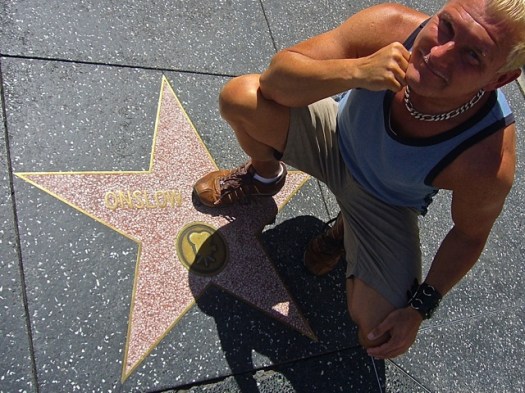
That I learned to live with—since that is so much easier than having to live up to anything else—can be readily demonstrated by the above shot taken on the Hollywood Walk of Fame. The star thus honored is, in truth, character actor Onslow Stevens; but I put my foot down to give the underachieving Onslows of this world their due, especially since I had already shed my shirt in the midday sun and was undressed for it.

Onslow, of course, was, like Ms. Bucket, a character in the Britcom Keeping Up Appearances, and Geoffrey Hughes was the actor who played the part, filling that undershirt better than I could ever hope or fear to do. Hughes died at the age of 68. And while I only knew him as Onslow—or Twiggy on The Royle Family—the fact that his passing topped news about the Olympics on the BBC website well before fatigue about that event set in even among High Jump (or Canoe Slalom or Trampoline or Water Polo) fanatics shows just how big a name he made for himself.

Eur[e]vision

I don’t often indulge in morning afterthoughts. I might—and frequently do—revise what I said (or, rather, how I said it); but I generally just take time, and one time only, to say my piece instead of doling it out piecemeal. Unlike the producers of much of the (un)popular culture I go on about here, I don’t make a virtue of saying “As I was saying” or make my fortune, say, by milking the cash cow of regurgitation. To my thinking, which is, I realize, incompatible with web journalism, each entry into this journal, however piffling, should be complete—a composition, traditionally called essay, that has a beginning, middle and end, a framework that gives whatever I write a raison d’être for ending up here to begin with.

Although I resist following up for the sake of building a following, it does not follow that my last word in any one post is the last word on any one subject—especially if the subject is as inexhaustible as the Eurovision Song Contest, which festival of song, spectacle and politics compelled me previously to go on as follows: “It [a Eurovision song] is, at best, ambassadorial—and the outlandish accent of the German envoy makes for a curious diplomatic statement indeed.”

Diplomatic blunder, my foot. My native Germany did win, after all, coming in first for the first time since 1982, when Germany was still divided by a wall so eloquent that, growing up, I did not consider whatever lay to the east of it German at all. Apparently, this year’s German singer-delegate Lena Meyer-Landrut, born some time after that wall came down, did not step on anyone’s toes with her idiosyncratic rendition of “Satellite,” a catchy little number whose inane English lyrics she nearly reduced to gibberish.

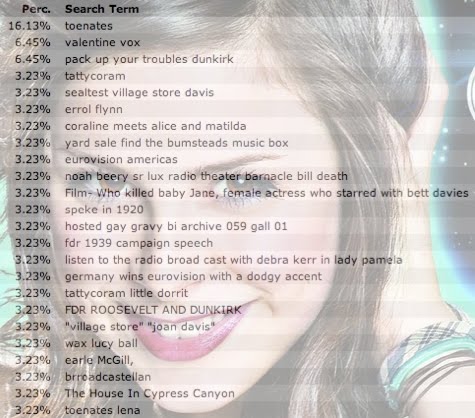
Her aforementioned insistence on turning toenails into “toenates” intrigued a number of bemused or irritated viewers to go online in search of answers, only to be directed straight to broadcastellan. Perhaps, the United Kingdom should have fought tooth and nates instead of articulating each tiresome syllable of their entry into the competition, a song so cheesy that it did not come altogether undeservedly last, even if European politics surely factored into the voting.

Britain never embraced European unity wholeheartedly—and those in the thick of the economic crisis now challenging the ideal of Europe may well resent it. Is it a coincidence that the votes were cast in favor of the entrant representing the biggest economy in Europe, a country in the heart of the European continent?

While not content, perhaps, to orbit round that center of gravity, other nations may yet feel that it behoves them to acknowledge the star quality of Germany, which, according to contest rules, is called upon to stage the spectacle in 2011. After all, why shouldn’t the wealthiest neighbor be host of a competition some countries, including Hungary and the Czech Republic, declared themselves too cash-strapped even to enter this year.

I may not have been back on native soil since those early days of German reunification, but there was yet some national pride aroused in me as “Satellite” was declared the winner of the contest by the judges and juries of thirty-eight nations competing in Oslo this year along with Deutschland.

That said, seeing a German citizen draped in a German flag as she approaches the stage to take home a coveted prize, however deserved, still makes me somewhat uneasy. Given our place in world history, the expression of national pride strikes me as unbecoming of us, to say the least. I was keenly aware, too, that there were no points awarded to Germany by the people of Israel.

Will I ever stop being or seeing myself as a satellite and, instead of circling around Germany, get round to dealing with my troubled relationship with the country I cannot bring myself to call home? That, after the ball was over, formed itself as a sobering afterthought. And that, for the time being, is the beginning, middle, and end of it. Truth is, I take comfort putting a neat frame around pictures that are hazy, disturbing or none too pretty.

“The Hut-Sut is their dream”; or, Accent on Eurovision

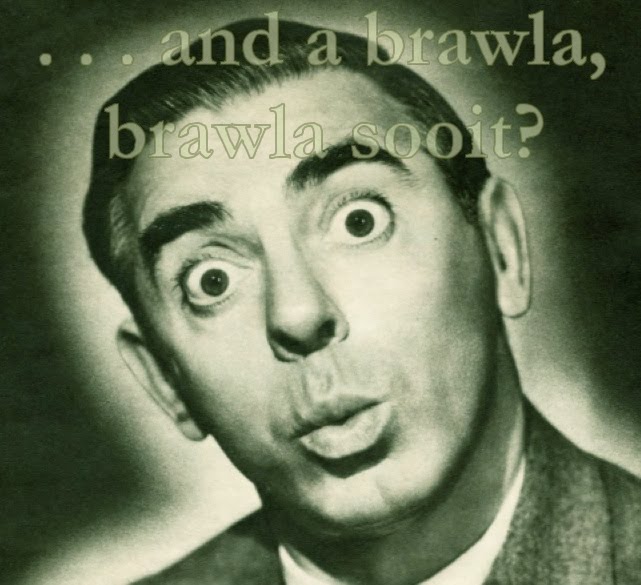
Eddie Cantor

Folks flicking through the May 25-30 issue of Radio-Movie Guide back in 1941 were told about a “New Song Sensation,” a novelty number written by Ted McMichael (of the Merry Macs), Jack Owens and Leo V. Killion. The identification of the tunesmiths aside, this was probably no news at all to America’s avid dial twisters. Published only a few weeks earlier, the “Sensation” in question had already “featured on the air by Kate Smith, Bob Hope and Alec Templeton.” In fact, as early as 23 April, listeners to Eddie Cantor’s It’s Time to Smile program would have been exposed to what was tongue-in-cheekily billed as a “Swedish Serenade” overheard by an illiterate boy who “should have been in school”:

Hut-Sut Rawlson on the rillerah and a brawla, brawla sooit,
Hut-Sut Rawlson on the rillerah and a brawla sooit.
Hut-Sut Rawlson on the rillerah and a brawla, brawla sooit,
Hut-Sut Rawlson on the rillerah and a brawla sooit.

According to Radio-Movie Guide, Benny Goodman was so keen on the ditty that he wanted to “buy an interest in its profit for five thousand dollars.” It is easy to see the attraction of such novelty nonsense at a time when news from Europe were similarly bewildering yet decidedly less diverting. And before we tut-tut a nation at war for going gaga over a trifle such as “The Hut Sut Song” while being gleefully indifferent to—or woefully ignorant of—the world, we might consider the musical offerings conceived for the current Eurovision Song Contest, an annual agit-pop extravaganza that, in this, its fifty-fifth year, is playing itself out against the somber backdrop of the European fiscal crisis.

Much of Europe may be cash-strapped and debt-ridden, but the thirty-nine nations competing in Oslo this year have it yet in their means to bestow points and favors upon one another—or to withhold them. Even the least affluent countries of greater Europe may take comfort as well in the potentiality of turning freshly minted tunes into pop-cultural currency. Europe is less concerned, it seems, with the phrases it must coin to achieve such a feat.

The emphasis on rhyme over reason is apparent in traditional Eurovision song contest titles—and winners—like “Boom Bang-a-Bang” (United Kingdom, 1969), “Ding-A-Dong” (Netherlands, 1975), and “Diggi-loo, Diggi-ley” (Norway, 1984). It is an orchestrated retreat to the banks of a mythical “rillerah,” a clean plunge into a stream of pure nonsense beyond the realities of the Babel that is Europe. Might an agreement to be agreeably meaningless be a key to intercultural understanding?

“The Hut Sut Song” came with its own dictionary:

Now the Rawlson is a Swedish town, the rillerah is a stream.
The brawla is the boy and girl,
The Hut-Sut is their dream.

By comparison, most Eurovision entries, which, in the past, included “Volare,” “Waterloo,” and some inconsequentiality or other performed by Celine Dion, do not make much of an effort to render themselves intelligible. While by and large performed in some approximation of English, today’s Eurovision songs are, for the most part, incomprehensible rather than nonsensical, as if members of the vastly, perhaps inordinately or at any rate prematurely expanded union were determined to avail themselves of the English language as a means of keeping apart instead of coming together, inarticulate English being the universal diversifier.

Eurovision songs have always suffered—or, you might well argue, benefited—from less-than-sophisticated lyrics. Take these lines from this year’s Armenian entry, performed by one Eva Rivas: “I began to cry a lot / And she gave me apricots.” Which begs the question, I told a friend the other day: if she had only laughed a little, might she have gotten . . . peanut brittle? Well, perhaps not. Apricots are a symbol of Armenian nationality.

In its well-nigh incomprehensible delivery, “Satellite” takes the cake, though. According to British bookies and the internet downloads on which they rely to establish the odds, the quirky, bouncy little song representing my native Germany—where it became an instant success—is second in popularity only to the entry from Azerbaijan (which, as the contest rules have it, lies within the boundaries of Europe).

A Danish-German-American collaboration, “Satellite” scores high in both the “bad lyrics” and “strange accent” categories, proving, as only a Eurovision song can, that those categories are not mutually exclusive:

I went everywhere for you
I even did my hair for you
I bought new underwear that’s blue
And I wore it just the other day.

The singer, Lena Meyer-Landrut hails from Hanover. Not that this should lead us to expect any pronounced British connections in her house. Still, being a graduating high school student, she ought to have a firmer grasp on the English language. At least, her origins and education cannot account for—or explain away—references to painted “toenates” and underwear “thay blue.” Since, after weeks of tryouts and rehearsals, she still can’t, er, “nate” those undemanding lyrics, her accent is clearly an affectation. Could it be anything else?

Just what kind of “Hut-Sut” are European “brawla” dreaming of these days as they insist on diving, seemingly pell-mell, into the turbid “rillerah” they make of English? Not of a unity achieved through universality, I reckon. Perhaps, they are simply getting back at the native speakers by twisting their tongue in ways that are as likely to alienate as to amuse, and are having the last laugh by turning this recklessly appropriated language into Europop gold with which to pay back the British for steadfastly refusing to adopt the sinking Euro. The apricot stones-filled cheek!

Whether “Satellite”—or Germany—wins this Saturday has perhaps more to do with the recent bailout of Greece than with the merits of the song or the quality of the performance. Then again, a Eurovision song, however frivolous, is generally looked upon as something larger than its number of bum notes and odd intonations. It is, at best, ambassadorial—and the outlandish accent of the German envoy makes for a curious diplomatic statement indeed.

A Room With a View-Master; or, Four-Eyes in the Third Dimension

What the Bwana Devil! I’ve been trying on various kinds of glasses to take in Channel 4’s 3D fest—but none transport me into the third dimension. Turns out, viewing the weeklong series of films and specials, culminating in a “3-D Magic Spectacular” and a clipfest of “The Greatest Ever 3-D Moments”—requires special goggles that can only be obtained from a certain chain of supermarkets whose reach does not extend to Mid Wales. By the time we got around to driving some 100 miles down south, the glasses had already been snatched up. The thought of having a digital recording of “The Queen in 3-D”—contemporary film footage of the 1953 coronation—without being able to take it in makes me want to jump out and hurl flaming arrows at whoever devised this regionally biased marketing scheme.
Had the coronation taken place only a year or two later, this experimental and previously unseen documentary might never have been shot right at you. After all, 1953 was a big year in three-dimensional filmmaking; but it proved little more than a fad. By the time Hitchcock’s Dial M for Murder was released in the spring of 1954, the novelty had already worn off and, to this day, few viewers get to experience the climactic scene in the way it was re-conceived for the film.

I caught up with the stereoscopic movies of the 1950s—among them It Came from Outer Space, House of Wax, and Miss Sadie Thompson—when they aired on German television back during the early 1980s 3D craze, which was similarly brief yet decidedly less distinguished: Parasite, Metalstorm, Spacehunter, and the inept Indiana Jones knockoff El Tesoro de las cuatro coronas.

Ever since I got my first stereoscope, known as a View-Master, I have been enthralled by three-dimensional images, or at least by the idea thereof. Rather peculiar, this, considering that those of us fortunate enough to have a set of matching peepers get to experience the same effect without having to sport ill-fitting, nausea-inducing eyewear.

So far this year I have put up with putting on special spectacles to see five 21st-century 3D movies, among them Coraline, The Final Destination, and Up (not counting the partially 3D IMAX presentation of Harry Potter and the Half-Blood Prince).  It seems that 2009 is even a bigger year for 3D than 1953. Yet while I rejoice in the prospect of further excursions into space, it strikes me that, as 3D goes mainstream at last, the technology has lost some of its rogue appeal.

Movies like Ice Age: Dawn of the Dinosaurs do not exploit the potentialities of the medium with the abandon the added dimension invites. I mean, why throw money at 3D films if they don’t throw anything back at you? Maybe I’m wearing rose-colored glasses, but I am still hoping for a throwback to those 1950s throwaways. In the meantime, I’ll gladly return to radio drama, the invisible, immaterial theater whose action unfolds in the fourth dimension.

Television and the Individual Talent

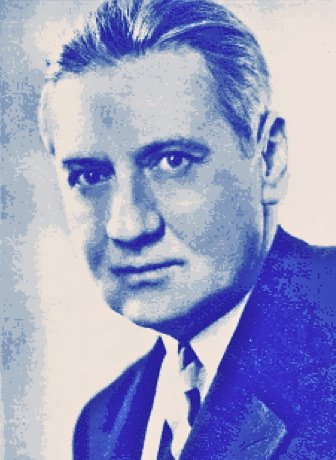
Edwin C. Hill

“What happens to these ambitious people after their first appearance? Do they go on, succeed, become famous and lead the lives they’d dreamed of living? Or, after a brief glimpse of glory, do they return, disappointed and broken, into the humdrum lives they’d led before?” Those are question many viewers feel compelled to ponder after watching common folk like Susan Boyle perform on amateur competition programs like Britain’s Got Talent. Now, Boyle did not win last night’s finale, and a chance to sing for the Queen; still, her audition turned the unassuming, middle-aged belter-weight into what we are wont to call an overnight sensation. She so captivated an international audience of television viewers and YouTubers that a movie deal and a musical seem pretty much in the bag, even though a career as a recording artist strikes me as somewhat less likely for La Boyle.

The world—or a considerable part of its too readily distracted population—fell in love with a moment, not with a voice. It was an instant in which our media-forged preconceptions about appearances in relation to ability was being checked in a way that was eye-opening without being cause for contrition. Boyle was duly rewarded for dealing with our initial cynicism, with the schadenfreude with which we approached her and to whose temporary check she so greatly contributed. Watching that performance was not so much a guilty pleasure as it was pleasurable guilt.

For anyone who has seen the audition performance (I only caught up with it online, days after the original broadcast), that sudden realization that she was proving us wrong by proving we had wronged her can never be recaptured. From now on, we simply expect a boffo performance worthy of all the ballyhoo. We are accustomed to the face and, having gladly suffered the momentary loss of ours, we keep our jaundiced eyes open for another chance to snicker and sneer. After all, as T. S. Eliot famously remarked in “Tradition and the Individual Talent” (1919), “criticism is as inevitable as breathing.”

The thing is, though, that the above questions were not raised by a contemporary reviewer; rather, they were voiced on this day, 31 May, back in 1937, by American news commentator Edwin C. Hill. Hill was referring to the rise of the amateur hour, a programming format he called “[o]ne of the most interesting radio developments in recent years” and commended as a “very human, very appealing movement”—“and a worthy one.”

The comment was made on Your News Parade, ostensibly with one Helen Gleason in mind:

Well, Saturday night on the radio, Helen Gleason answered this question—at least insofar as her particular case was concerned. Winning an Amateur Night Contest was the beginning of a brilliant career for Miss Gleason . . . a career which has carried her around the vaudeville circuits, through the concert halls of Europe, to the stage of the Metropolitan Opera Company . . . and more recently to stardom in operetta.

I say “ostensibly” because that blurb about the “appealing” talent show format was only another occasion to advertise cigarettes, Lucky Strike being the sponsor of Your News Parade. The media may create “overnight” sensations; but in their exploitation of such phenomena, in the milking of the cash cows of human kindness, they foster the very attitude of doubt that they make us question.

Somehow it has only gotten worse with the advent of video. On radio, Boyle might have had a chance to show off the talent she came to display and to be judged by that ability alone. It is television that makes us look like asses by encouraging us not to believe our ears . . .

[This post came to you a day late, on account of the exceptionally fine weather we’ve been enjoying.]

“Alone Together”: A Portrait of the Artist as an Artist’s Spouse

“So, here he is. My father. In a churchyard in the furthest tip of Llŷn. Eighty years old. Wild hair blowing in the wind. Overcoat that could belong to a tramp. Face like something hewn out of stone, staring into the distance.” The man observing is Gwydion, the middle-aged son of R. S. Thomas (1913-2000)—“Poet. Priest. Birdwatcher. Scourge of the English. The Ogre of Wales.” With this terse description opens Neil McKay’s “Alone Together,” a radio play first aired last Sunday on BBC Radio 3 (and available online until 28 March).
The voice of the Nobel Prize nominated poet (as portrayed by Jonathan Pryce) is heard reading lines from his works, the words that are, to us, a stand-in for the man. None of them escape the commentary of his estranged son: “Yes, you could tell yourself this is him, the real R. S. Thomas,” the observer, filial yet unloving, remarks. “But you’d be entirely wrong.” As his father’s old voice keeps on reciting, he adds: “Oh, he’d be happy enough for you to fall for it . . . and to fall for the version he tells of his own life.”

What compels the son to revise this “version” of a life is the life of another, a figure that, to his mind, is concealed or mispresented in the autobiography of the father. The figure is Elsi, the Welsh poet’s English wife (1909-1991), whose fifty-year-relationship with R. S. was compressed by him in these lines:

She was young;
I kissed with my eyes
closed and opened
them on her wrinkles.

Speaking of their first encounter, R. S. introduces Elsi as “a girl who was lodging fairly close by,” the kind of icy understatement with which Thomas, writing about himself in the third person, kept his distance from his readers, just as the people he knew and wrote about were turned into abstracts on a page. “He doesn’t even give her a name,” the son comments, “and that’s where it starts to unravel.”

The churchyard in which we are introduced to the father is Elsi’s burial place; it is Gwydion’s ambition and quest to bring her to life for us, to let us see her in something other than the austere words of an introverted, discontented, and tormented man—an Anglican rector who sought isolation in the remote west of “the real Wales,” who, advocating Welsh independence and separation from England, was consumed by what the Welsh call “Hiraeth”: a longing for home. In how far did this longing, this radical yet futile attempt at forging an identity alien to him, prevent R. S. from making a home for the two, the three, of them?

Searing, severe, yet profoundly moving, “Alone Together” is a compelling play at biography; listening to it, I was reminded of the above self-portrait of Elsi, who, as an artist, was known as Mildred Eldridge, respected and sought-after long before R. S. published a line of poetry. Until now, whenever I looked at it, hanging there on a wall of our home, I have never considered it as an autobiographical act.

Both their approaches to rendering the self seem indirect, his being the third person singular, hers a reflection. Eldridge does not assume the center of the frame; nor does she give us a close-up of the face in the looking-glass; and yet, her self-portrait, tentative as it may be, allows us a glimpse at her perception. The distant self in her husband’s performance, by comparison, seems a construct, the artifice of an entire controlled performance. Unlike her husband, Eldridge appears before us the first person singular, letting us see her as only she sees herself: a mirror image.

In how far are written or spoken words a path to—or a vessel for—the essence of the one writing or speaking? Is anyone knowable through the vocables that are a locum for self and experience? Cautioned not to take a father’s word for whatever “it” amounts to verity, can we now trust the estranged son in his voice-over, his over-writing of the words he claims to be false or misleading?

“Alone Together” suggests that, for all his accomplishments as a writer, R. S. Thomas—who yearned to be Welsh but could not speak it, who, as Elsi puts it, “adopted the vowels of an Oxford Don” to hide the shame of being, as he puts it, an “ignorant Taff from Cardiff”—envied the ease with which his accomplished artist wife communicated in a language beyond words, expressed herself freely on a blank canvas . . . and felt at home there.

Hattie Tatty Coram Girl: A Casting Note on the BBC’s Little Dorrit

They are still after him, those producers of television drama. And they know that many of us are eager to follow. In a way, we cannot help being After Dickens, to borrow the title of a study on “Reading, Adaptation and Performance” by John Glavin. It is a sly title, that. After all, we are belated in our pursuit; we do more than simply try to catch up. We are bringing something to the game that is the act of reading. We are making sense, and we remake it, too.

Andrew Davies, the writer responsible for the award-winning dramatization of Bleak House, subsequently tackled Little Dorrit (1855-57), one of the lesser-known works in the Dickens canon. Having greatly enjoyed Bleak House when it first aired back in 2005, I was again drawn away from the wireless, to which most of the posts in this blog are dedicated, to go after what is being shared out—in installments, not unlike in Dickens’ day—by radio’s distant and rich relation.

Now, it has been some time since I read Little Dorrit. During my graduate studies, the novel tantalized me with its perplexing nomenclature, an uncrackable code of names and monikers that inspired me to dabble in the dark art of onomastic speculation. The result of my academic labors, “Nominal Control: Dickens’s Little Dorrit and the Challenges of Onomancy,” is available online.

While many of the names heard in the adaptation of Little Dorrit still ring the proverbial bell for me, some of the faces, as made up for us by the adaptor, seem less familiar. Never mind Arthur Clennam, who is rather younger than the middle-aged man Dickens was so bold to place at the center of his novelistic commentary on the manners, mores, and money matters of Victorian Britain. The character of Tattycoram is the one to watch out for and puzzle over: a foundling turned changeling.

In the original story, Tattycoram (alias Harriet Beadle, alias Hattey—the act of naming is that complicated in Little Dorrit) is introduced as a “handsome girl with lustrous dark hair and eyes, and very neatly dressed.” As portrayed by Freema Agyeman, the televisualized Tatty certainly fits the bill: a young woman with dark hair and eyes, and, my metaphorical hat off to the costume department, handsomely outfitted.

Hang on, though. The color of her skin, to which no reference is made in the novel, appears to have been adjusted; and, in a crowd of pale faces, it is a change that really makes a difference. Has Tattycoram just “growed” that way?

It surely is not simply a case of equal opportunity for television actors like Agyeman, if such cases are ever simple. A black Tattycoram transforms the very fabric of Little Dorrit. It imposes an historical subtext on our reading of the story and the young woman’s part in it.

Adaptors, like translators, frequently engage in such updates, if that is the word for what can amount not only to anachronisms but to presentism, the latter being the imposition of a viewpoint contemporary with the audience of the new version. I was not bothered by the lesbian characters the BBC insisted on sneaking into the staid and psychologically none too complex mysteries of Agatha Christie, even though such reorientations seem gratuitous. The determination adaptors made regarding Tattycoram’s ethnicity is altogether more problematic.

While slavery was abolished in Britain prior to its publication, Little Dorrit is set some thirty years in the past, the possible implications of which present-day television audiences are not given sufficient context to ponder and may not even notice. I had certainly forgotten about the dating of the action prior to the coronation of Queen Victoria. Little Dorrit, unlike Dickens’ A Tale of Two Cities and Barnaby Rudge, is not an historical novel, however; nor is it a commentary on the slave trade.

Concerned with prison reform, and the injustices of the debtor’s prison in particular, the novel refers to slavery only metaphorically to signify systems of oppression and forms of thraldom, perceived or actual. At one point, the orphan Harriet is taken in as a companion by the fiercely independent Miss Wade who, in readings of the novel, has been outed as a lesbian. In a first-person narrative, Miss Wade reflects on her earlier experience as a governess: “I was not bought, body and soul. She [Miss Wade’s employer] seemed to think that her distinguished nephew had gone into a slave-market and purchased a wife.” Clearly, in this questionable equation of servitude and slavery, no comment on the reality of the slave trade was intended by Dickens in this expression of a character’s anger regarding her station and the transgression of which she believes herself to have been accused.

In the Victorian novel, the black or “mulatto” figure remained largely invisible, or else was the brunt of derision. One such laughing-stock character is Thackeray’s Miss Swartz, the “rich woolly-haired mulatto from St. Kitt’s” who parades through Vanity Fair being “about as elegantly decorated as a she chimney-sweep on May-day.” In Dickens’ Bleak House, concerns about black lives in the colonies are dismissed as the folly of “educating the natives of Borrioboola-Gha, on the left bank of the Niger.”

Of the nearly one hundred, mostly flat characters that flit in and out of Little Dorrit—which, according to the Radio Times, were reduced to around seventy-five in the process of compression—it is Tattycoram, an orphan named after the notorious Coram hospital in London, who now stands out as an individual struggling to emerge from a socially imposed conspicuous invisibility that, the adaptation insists, is owing to her ethnicity. Thus, a marginal character takes center stage by an imposed discourse on the nature of her marginalization. In other words, the attention paid to her, belatedly, is justified mainly by the postcolonial narrative grafted on the novel in which the Harriet in question is treated as if she were the brainchild of Beecher Stowe.

Showing a little skin, and revealing it to be black, Davies’ retailoring may strike some audiences who are acquainted with the genuine article as a bold new cut. And yet, in the process of giving the old Empire new clothes, the Dickensian fabric is suggested to be more than a little Tatty. Perhaps, instead of such alterations, the assumption that, with strategic trimming, Dickens can still meet our aspirations needs adjusting.

They are still after Dickens, all right. The question is: are they even trying to get him or, riding on his coat-tails, are they out get at something he just hasn’t got?

Secondary Childhood; or, Pandas to Ponder

Wili and Wali at Penrhyn Castle

It is not dotage but a momentary state of doting. Not the reliving of one’s own youth, however romanticized, but an imagining—or experiencing—of what it means to be very young while looking at objects or confronted with performances not created with me in mind. Not reverie, in short, but empathy. That is what I call “secondary childhood”—the state of being elsewhere in time and space, being young there while being here and quite otherwise. Listening to so-called old time radio programs produced in the US, for instance, I am keenly aware that I am entering worlds once inhabited by millions of children born in a country other than my German birthplace, past generations whose reflections are lost to us and, all too frequently, even to them—worlds the passage to which might have been blocked and obscured over time, but that might nonetheless be recoverable.

This recovery effort is quite distinct from the nostalgia of which I am so wary, the attempt of forcing oneself back through that passage and, failing to do so, creating one through which one may yet squeeze wistfully into a niche of one’s own making. It is quite another thing, to me, to set out to gain access to the worlds of other people’s childhoods, to tune in with one’s child’s mind open. I try not to make assumptions about audiences and their responses; instead, I try to become that audience by permitting myself to be played with so as to figure out how a game or play works.

Penrhyn Castle

As I have had previously occasion to share after a trip to Prague, I enjoy looking at old toys. Visiting the grand and rather austere neo-Norman castle of Penrhyn last weekend, on an excursion to the north of Wales, I was surprised to find, housed in that forbidding fantasy fortress, a corner devoted to a collection of dolls. Now, it seems perverse to be so drawn to the two stuffed animals pictured above, stuffed as Penrhyn is with exquisite furniture and impressive works of art (a Rembrandt, no less). I gather it was the bathos of it, the relief after having had greatness thrust upon me to be surprised by these unassuming and, by comparison, prematurely timeworn objects.

Turns out, the twin pandas in the straw hats are Wili and Wali, marionettes who co-starred in a long-running Welsh children’s program titled Lili Lon (1959-75). Upon returning to mid-Wales, where I now live, I immediately went online in search of the two; but, aside from a history of their creators, little can be found about them. I have become so accustomed to YouTubing the past that I was surprised to find no trace of Wili and Wali. No doubt, they still dwell in the memories of thousands who shared their adventures. I was not among them; yet, as is often the case when I come across titles of lost radio programs or fragments thereof, I imagine myself enjoying what is beyond my reach . . .