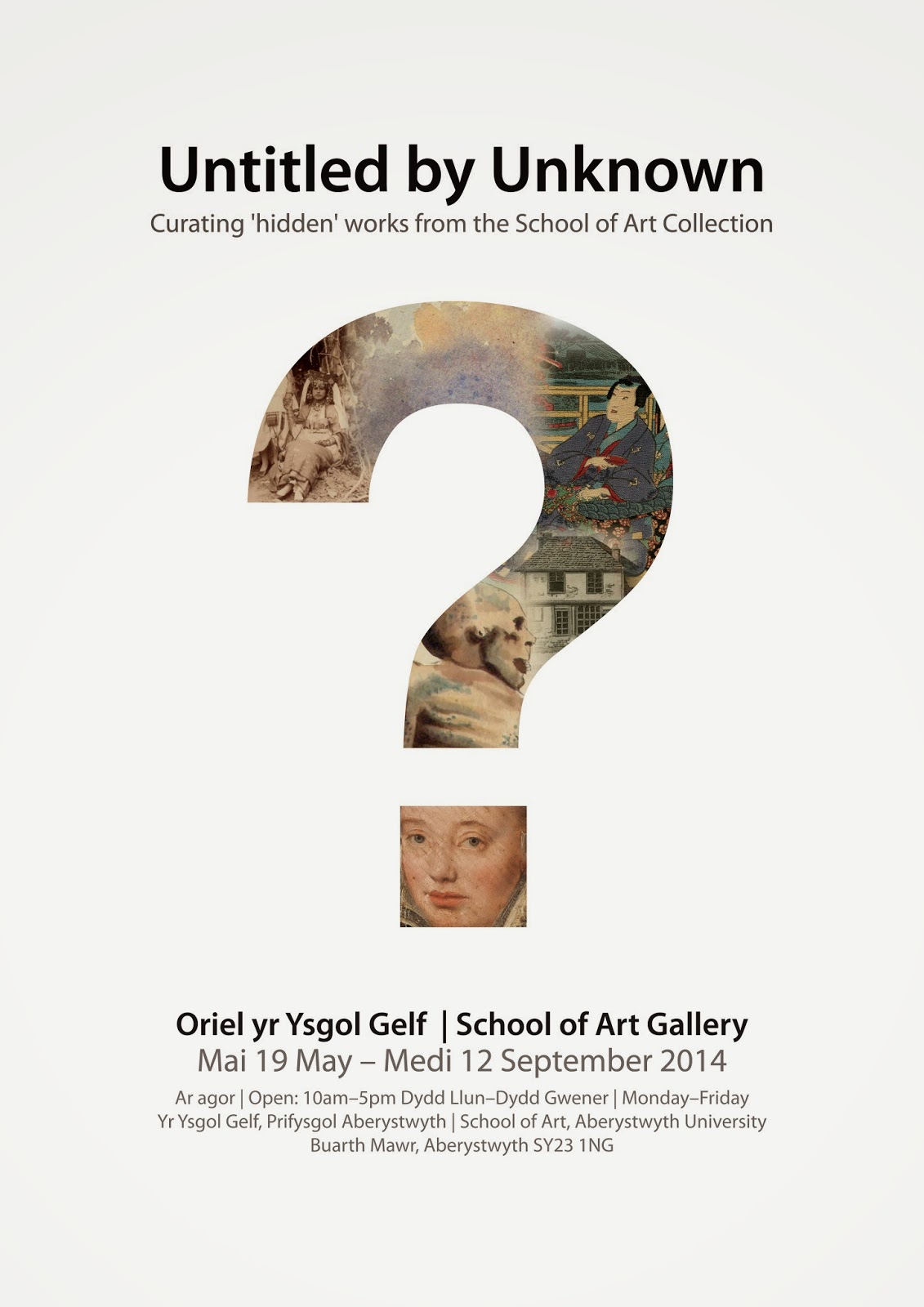
Every spring, the students of my “Staging an Exhibition” class are doing just what the title suggests: they curate a show at Aberystwyth University’s School of Art galleries. And every summer, I have to come up with another idea for another spring. This year’s exhibition, on show now until 12 September, poses a particular challenge. As stated on introductory panel, most of the works on displayed “have no official title. The identity of their creators remains unconfirmed.” This opens the debate as to their value and relevance: “Do their uncertain origins mean that these objects are unworthy of our time and attention?”
Untitled by Unknown: Curating ‘Hidden’ works from the School of Art Collection investigates the effects of doubt and mystery on our estimation of visual culture. The thirteen curators not only researched the objects but also needed to think of ways to interpret in the absence of verifiable facts.
Viewers are “encouraged to reflect on the ‘hidden’ lives” of the objects chosen by students: they include photographs, watercolours, prints and miniature paintings. Each work is identified only by the number by which it is filed and can be accessed in the School of Art collection’s online database.
The idea was to let visitors of our exhibition in on the curatorial task, to suggest that while a “lack of facts can be an obstacle,” it “can also be an opportunity for personal engagement.” Visitors may well question our interpretations and uncover alternative stories. Perhaps, they know more than we do about some of the mystery objects in our collection.
Untitled art works by unknown or anonymous artists often have no chance of being displayed—at least not until their mysteries are solved. Still, public museum and galleries have a responsibility of sharing the works in their collection.
Untitled by Unknown is not intended to show astounding works from exceptional artists. It is here to open a debate about what should be on display and how it may be shared.
My thanks to the students involved in making the show – and my class – possible: Jessie Davis, Karolina Hyży, Justyna Jurzyk, Kate Largan, Charlotte Raftery, Laura Roll, Elizabeth Salmon, Melissa Sarson, Belinda Smith, Julia Steiner, Stephanie Troye, Veera Vienola, and Eleri Wood.
Our thanks also to curator Neil Holland for all his help and expertise.
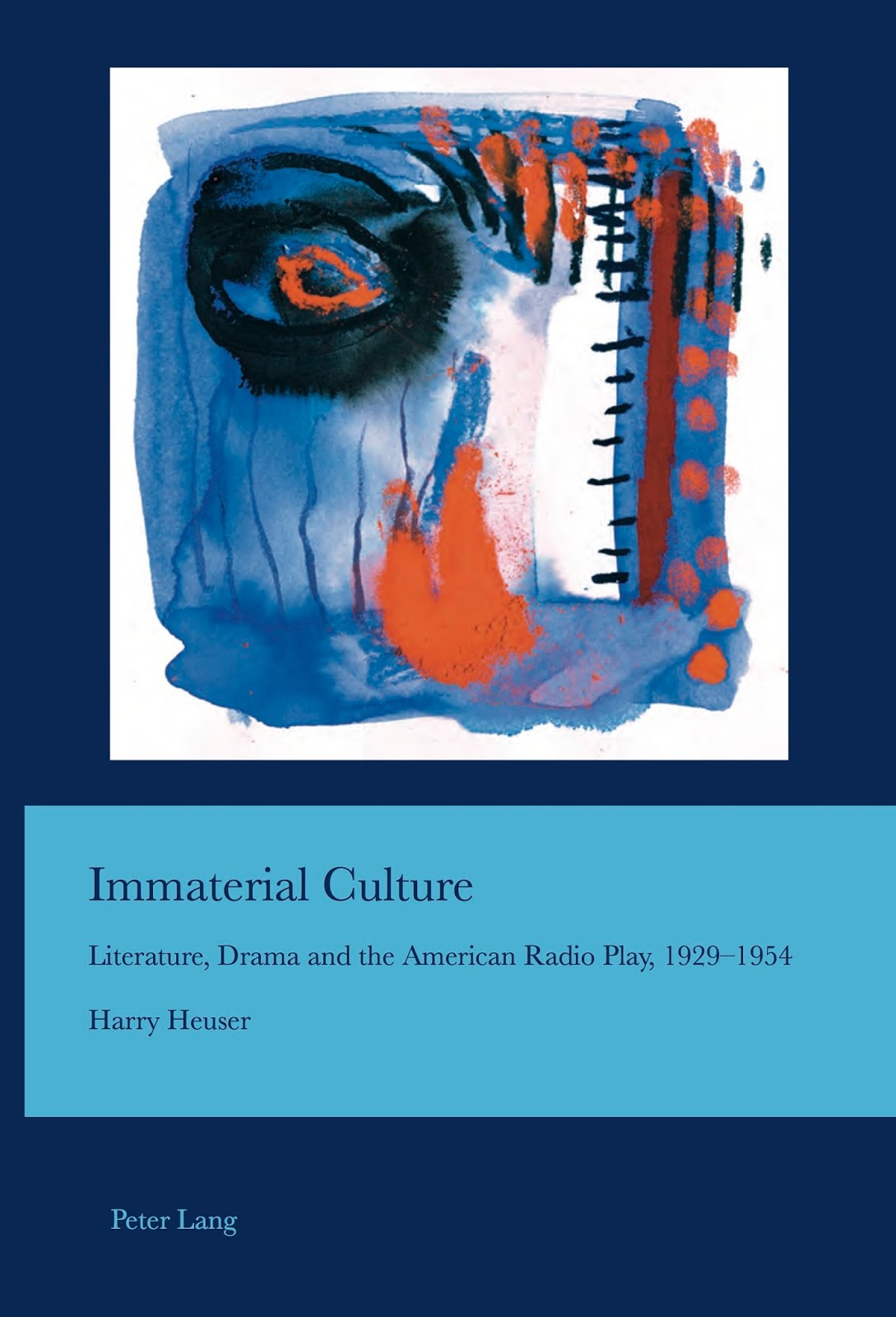
My study Immaterial Culture: Literature, Drama and the American Radio Play, 1929-1954 has just been published. So, as well as explaining the subject matter of the book and the objectives of its writer, I decided to devote a few journal entries to the story behind its production, to its birth and life in relation to my own journey. There is also the small matter of its afterlife, a matter to which no parent, proud or otherwise, can be entirely indifferent.
Along with my other recent publications and current projects, of which I have said nothing in this journal, Immaterial Culture has long kept me from materializing here. No doubt, I could have made more effective use of broadcastellan as a promotional vehicle. And yet, writing, like listening to radio plays, is a solitary experience; at least it is so for me.
Like the performers behind the microphone, writers are generally removed from the audience for whom their performance is presumably intended, an audience that often seems so abstract as to be no more than a construct. The writer, script reader and listener may be sitting in a crowded room, and that crowd may well matter; but what matters more is the immateriality of the words once they are read or spoken. Words that create images or match stored ones. Words that evoke and awake feelings, stimulate thought. Words that, uttered though they are to the multitude, begin to matter personally and take on a multitude of new lives.
That Immaterial Culture is a profoundly personal book will not be readily apparent to anyone reading it. After all, I have refrained from using the first person singular to refer to myself as the reader or interpreter of the plays I discuss. I thought I’d leave the privilege to say “I” to that “obedient servant” of the Mercury Theatre, the orotund Orson Welles. Instead, I decided to disappear and let the play scripts and productions I audition take center stage, a prominent position they are often denied.
Talking about old radio plays as if they have no presence, as if they are chiefly of interest to the (broadcast) historian, only makes matters worse. Immaterial Culture, then, is an invitation to listen along, an invitation to talk about American radio plays of the past as one still discusses the material culture of books, motion pictures, theater, and television programs …
When Radio Times magazine announced a few weeks ago that its 10-16 November issue would celebrate the ninetieth anniversary of the Corporation largely in charge of the medium to which the pages of said venerable British weekly are nominally dedicated, I was very nearly all ears. That I wasn’t ears entirely is owing to the skepticism I have developed when it comes to the wireless and its status in today’s mass-mediated society. Sure enough, the Radio Times celebration fell as flat as my introductory sentence. The promised “Anniversary Special” amounted to little more than a few pages of pictures designed to demonstrate that radio—or, strictly speaking, BBC radio—is very much alive.
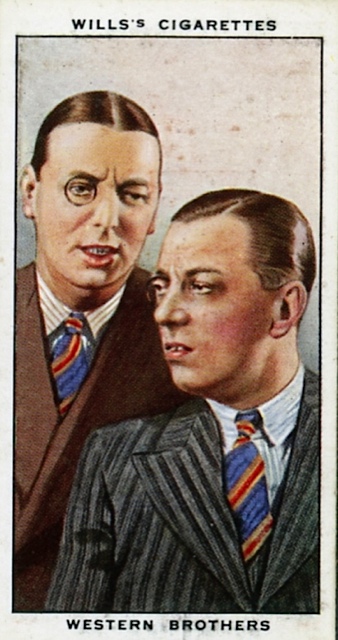
Clearly, I haven’t kept my ear to the ground, as most of the personalities depicted on the pages of the Radio Times anniversary issue are no more familiar to me in appearance or voice than the radio stars of yesterday whose images I put on display here to suggest that commemoration and oblivion are not mutually exclusive, and that what is being marked by the “Anniversary Special” is not so much the birth, infancy or longevity of radio as is its presence and relevance today.
“Print, they say, is dying,” news presenter Eddie Mair opens his commemorative Radio Times article, and television programs nowadays are “watched by a fraction of the numbers who used to tune in.” The wireless, on the other hand on the proverbial dial, he argues to be in “rude health,” ninety years after the BBCs mics first went live” on 14 November in 1922.
“Remember what I said yesterday?”
No doubt, those words are meant to be eulogistically reassuring, albeit less so to the publishers of an ailing print magazine, in deference to whom Mair distances himself from his opening statement by injecting “they say.” I might add—and shall—that if “they say” radio is thriving, then why isn’t there a radio on the cover of that ‘anniversary’ issue?
It isn’t radio’s age, surely, that made editors decide against a shot of an historic wireless set, a glistening microphone, or any number of radio personalities, living or dead. After all, the editors chose Sir David Attenborough as their cover boy—and he, at 86, is nearly as old as the BBC.
Why Attenborough? Well, he, too, has a broadcasting anniversary worth celebrating; and, apparently, his sixty years of television are worth more to the BBC than its own ninety years of radio broadcasting, marked in the pages of Radio Times with a slim timeline of scant microphone highlights so miniscule that it, like the fine print in advertising, makes you feel what is really wanting is a microscope.
Could it be that the Corporation toned down its self-glorification in light of the scandal surrounding desanctified saint Jimmy Savile and the efforts to cover up or deal with his posthumously emerging history of pedophilia? While this may not be the time for airs and graces, it does not follow that any self-reflexive, critical history the BBC airs disgraces.
“Just who do they think we aren’t?”
Sure if your face is red, you are not inclined to parade it in public; but that does not quite explain, let alone justify, the way in which the wireless anniversary is scheduled to unfold sonically this afternoon. At 5:33 PM precisely—the exact time of the first BBC radio broadcast back in 1922—all BBC stations jointly air a newly commissioned composition of music and sound bites, the latter to be contributed by listeners. However thrilling and noteworthy, the whole rather self-defacing event lasts about three minutes, less time by far than commercial television sets aside for a single block of advertising.
Not quite believing my eyes at the sound of that announcement, I flicked through the pages of Radio Times in search of further commemorative programming. Alas, it is, for the most part, business as usual. And even though the “usual” is usually quite satisfactory, the extraordinary sure has a deflated air about it.
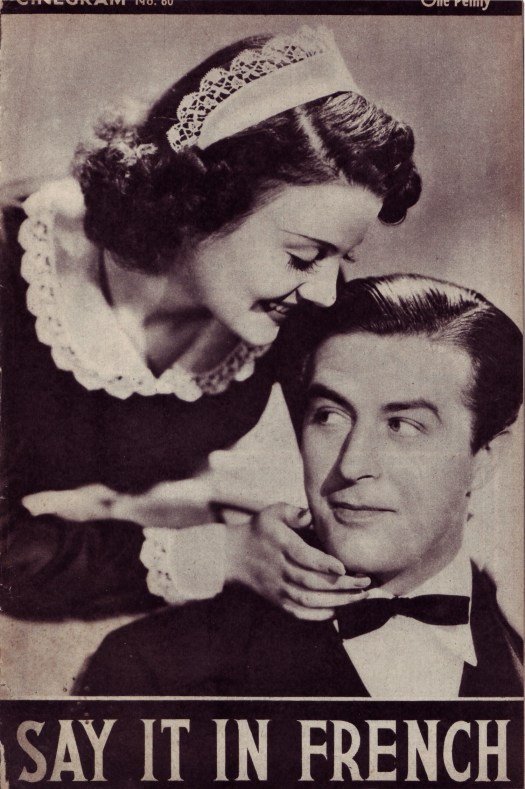
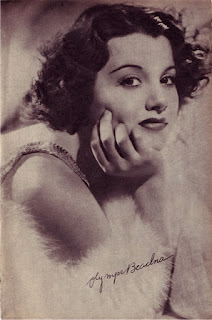
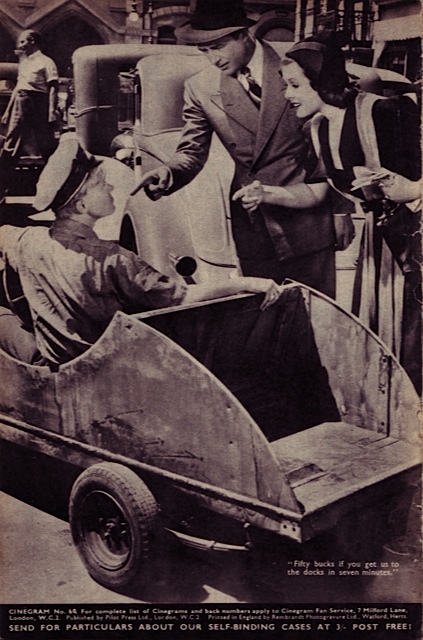
Olympe Bradna is a diplomat of the first rank!” So declared the editors of Cinegramin an issue devoted to Say It in French. In that now largely forgotten romantic comedy, Bradna co-starred as a French student who impersonates a maid to be close to an American lover (played by Welshman Ray Milland) expected to marry a millionaire’s daughter (Irene Hervey) to save his father’s business.
The cover of Cinegram No. 60, from my collection
Maybe that sounded better in French, in which the comedy was first staged under the title Soubrette. Never mind. The “petite morsel of feminine allure,” so the Bradna legend goes, had “only been kissed by two men during her whole lifetime”—that lifetime amounting to eighteen years back in 1938.
One year into her brief Hollywood career, Bradna had overcome her “anxiety and embarrassment” and forgotten about her vow that she “would never kiss” at all, “either on the screen or off, until she had a ‘steady’ beau.” Having been teamed with both Milland and Gene Raymond (in Stolen Heaven), the actress was “all in favour” of on-screen romance; but, when asked whose lips she preferred, the teenager refused to kiss and tell. “If I did that, it would be, how do you say? ‘propaganda.’”
In the context of European pre-war clamour and the business of Hollywood glamour, the word choice is peculiar, especially since Cinegram was a promotional effort aimed at British audiences. It is a telling statement, too, as it suggests Bradna’s questioning of the role she was expected to play in the propagation and exploitation of her own image.
Far from naive, the French-born performer knew all about the real world of make-believe, which is why, in her future pursuit of “real romance,” she was determined to “go outside the show business.” In the early 1920s, her parents, Jeanne and Joseph Bradna, had a successful bareback riding act at the Olympia Theater in Paris, after which venue Olympe was named and where she made her stage debut when she was not quite two years old. Hence, I suppose, her expressed need for security: “[A]ctors are fellows with uncertain jobs. They’re generally honest, gay, intelligent and interesting, but they lack that quality of stability that is so important to a girl who wants to establish a home.”
Presumably, she said all this in English, rather than in her native tongue. When she first set her dancing feet on the United States as a member of the Folies Bergère and subsequently performed at New York’s French Casino, she was so dismayed at her “lack of English that she determined to learn to speak the language properly. She succeeded so well,” Cinegram readers were told, “that when it came to making this new picture she had to put in several weeks of hard work under a French tutor to get her French back to standard.” A Hollywood standard, that is. After all, in romantic comedy, a French accent was as desirable as a maid’s uniform.
Bradna in Cinegram No. 60
Bradna’s language skills were put to the ultimate test when, on 14 November 1938, she went behind the microphone for the Lux Radio Theater production of “The Buccaneer,” co-starring Clark Gable as French pirate Jean Lafitte; but her part was suitably Old-World, and all over the map besides, to account for any foreignness in her speech. Bradna assumed the role of Gretchen, which had been played on screen by the Hungarian-born cabaret artist Franciska Gaal. “Oh, I don’t know how I sound, Mr. DeMille,” Bradna said to in the nominal producer of the program during her scripted curtain call, “a Dutch girl with a French accent in an American play.” Supported as she was by Gertrude Michael and Akim Tamiroff, both of whom enriched American English with peculiar accents and inflections, she hardly stood out like a sore tongue.
Not that Bradna, who appeared on the cover of the 27 July 1938 issue of Movie-Radio Guide, was a stranger to the microphone. According to the March 1938 issue of Radio Mirror, Paramount Pictures “put her into five consecutive radio guest-spots for a big build up—but without giving her a nickel.” Perhaps, DeMille would not have given her a nickel, either, for the privilege of making it into a Lux-lathered version of The Buccaneer, one of his own productions, nor given her an opportunity to promote her latest picture, Say It in French, had he known what British Cinegram readers gathered by flicking through their souvenir program for Say It. Bradna, they were told, had “startled experts by announcing that the secret of her facial complexion [was] a daily buttermilk massage.”
The makers of Lux Toilet Soap could not have been pleased at Bradna’s insistence, fictive or otherwise, that buttermilk was “all” she needed: “My skin may be ever so parched and dry before the routine, but afterwards it is as fresh and smooth as I could want!
Say It: A rickety vehicle
Wally Westmore, Paramount’s make-up chief, reputedly explained that the “secret”—an age-old French recipe for a youthful complexion perhaps not quite so difficult to achieve at the age of eighteen—lay in the rich oil content of buttermilk, which had the same “softening and freshening effect upon the skin as the most elaborate and expensive preparations used by the stars.” That, of course, was just the claim Lever Brothers were making each week on the Lux Radio Theater, which might explain why Ms. Bradna was never again heard on the program, whose stars were handsomely remunerated for their implied or stated endorsement of the titular product. Perhaps, Bradna was not “a diplomat of the first rank” after all . . .
Olympe Bradna died on 5 November 2012 in Lodi, California.
Look! There are objects, people, and situations that compel me to do just that. It takes some effort, though, to make me look longer than a moment, that blink of an eye Germans call “Augenblick.” It is an effort and commitment that I have to bring myself to make, and whatever or whoever it is that commands me to look must warrant my sustained attention, must conquer my resistance, must provoke, charm, or seduce me to engage me in an exchange
“Look!” is a command that rarely fails; but, apart from performances that define the intended or desired duration of that look, few sites dictate, implore or recommend just how long I am to keep looking. Do I circle once around this sculpture? Do I give that landscape the once-over, the twice-over or the over-and-over? How long do I need to look until I see something that rewards me for not looking away sooner?
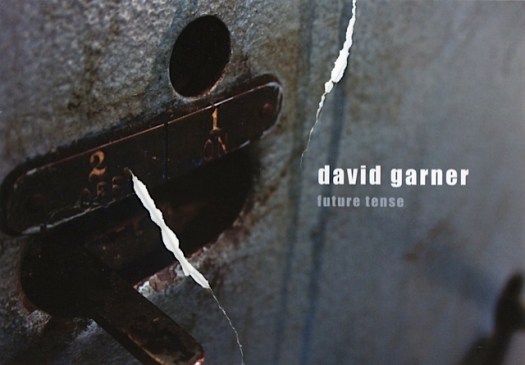
Garner uses found objects to make more or less—and mostly less—compelling statements about a grab bag of social and political issues: production and consumption, education, unemployment, and postcolonialism. His work hinges on a pairing of visual and verbal puns (such as “Wooly Learning/Dysgu Gwlanog,” a school blackboard with felted wool surface and wool text) or clichés (like “Beware when the gloves are off,” a row of ten Porcelain glove moulds mounted on an oak panel and suggesting a fascist salute); most of these pairings are too obvious in their single-minded double-meaning to startle, let alone enliven a discourse.
Often, as in “Sheep in Sheep’s Clothing”—a taxidermied sheep wearing a coat knitted from its own fleece—the found object is stripped of its mysteries, its woolliness—its indeterminacies and ambiguities—spun instead into a readily solvable and as such instantly dissolvable puzzle.
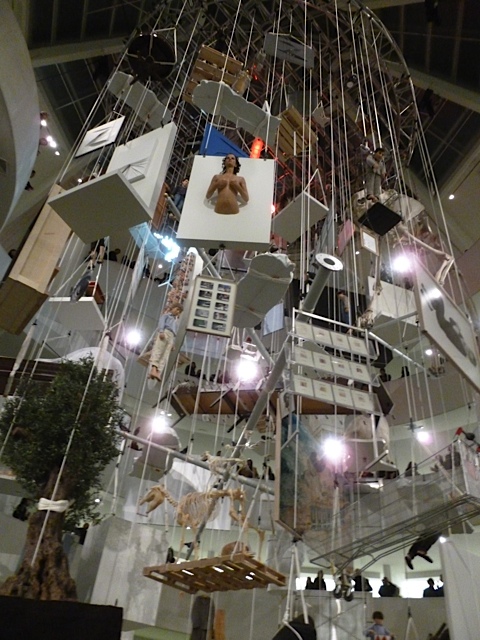
Unlike Duchamp’s perennially stimulating Fountain, Garner’s found objects are given a final resting place in a self-contained junkyard of a performance that rewards only those who are content to discover an artist’s meaning and who, unlike me, accept that meaning as final; such hermetic hermeneutics leave no room to respond other than “Got it. Next!” There is none of the wonder, the awe—the sheer thrill of looking—that I experienced staring at Maurizio Cattelan’s All at the Guggenheim Museum earlier this year.
The only truly gripping sight in Garner’s Future Tense is not a sight at all but a sound: the sound of a large clock loudly ticking away. I resisted looking at the caption and let that sound transport, envelop, and alarm me; listening, I was, for once, unaware of the time I had wasted looking here but reminded instead of the potentialities of art to move us to the point that we cannot but invest it with our life experience, our anxieties and desires—a potential that is largely unfulfilled by Future Tense, a configuration of readymades whose presence is so much circumscribed by the artist’s foregone conclusions that they have little chance of a future in our imaginings . . .
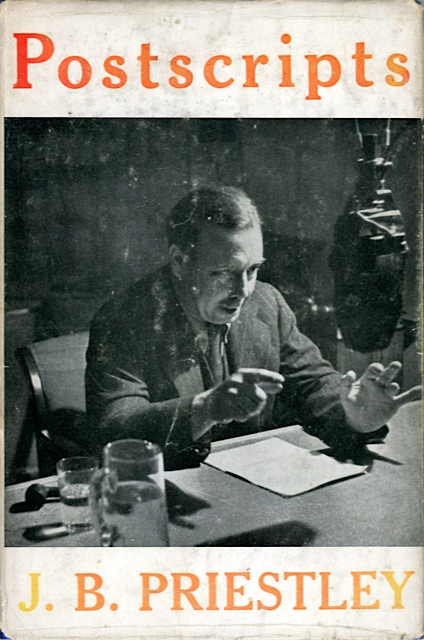
I have never heard J. B. Priestley deliver his famous Postscripts, a series of morale-boosting talks broadcast to the British public during those early, uncertain and hence no doubt most terrifying days of the Second World War. Many decades later, actor Patrick Stewart returned Priestley’s lines to the airwaves that had once carried them into the homes of millions; but somehow I could not get excited about those recreations. For, no matter how delayed an originally live broadcast, its recording yet retains the immediacy of a first-hand experience that no re-enactment can approach.
Recently, I came across the published Postscripts (1940). Unlike Stewart’s voiceovers, the printed speeches are unabridged and, their author insists, “exactly as they were, without a speck of retouching.” These are “wireless talks and not essays,” Priestley cautions the reader:
If I had my way they would never have re-appeared in this form, to be examined at leisure instead of being caught on the wing every Sunday at nine-fifteen, but the requests for a volume of them have come in so thick and fast during these last three months, that I felt it would be churlish to refuse. So here they are, and please don’t blame them now, for they have already done the work they were intended to do.
Indeed, reading those scripts aloud now, I can, even in my own indifferent, untrained voice, hear them doing their work. Priestley indulges in none of the hysterics and hyperboles that so often render alienating what is meant to be persuasive speech. They are sentimental, these talks, and they are sane.
As Priestley puts it in the Preface, the
tricks of the writing trade and some fortunate accidents of voice and manner are all very well, but what really holds the attention of most decent folk is a genuine sharing of feelings and views on the part of the broadcaster. He must talk as if he were among serious friends….
Priestley’s Postscripts are simply words of encouragement, gentle reminders that much of our seemingly inconsequential everyday is worth holding on to as it defines who we are, that the loss of even the slightest thing may be keenly felt as a threat to our identity. Take a piece of pie, for instance—and make it a fake one.
That is just what Priestley did, on this day, 29 September, in 1940, when he talked about returning home to Bradford, the “solid real place” of his childhood. The seemingly random devastation caused by a recent air raid, though far less grand in scale than the attacks on London, “made a far deeper impression” on Priestley “because it somehow brought together two entirely different worlds; the safe and shining world of my childhood, and this insecure and lunatic world of to-day.”
The local bakery, too, had suffered during the raid; but there, in the broken, half boarded up window, could still be glimpsed at the giant pie that had fascinated Priestley when, as a child, he saw emanating from it a steady flow of “fine rich appetising steam.” A wondrous, awe-inspiring sight it was to Priestley, the boy—and a wonder it was now to Priestley, the man, that, after all those years and after all those hours of bombing, the pie was still in its place, still in one piece, and still steaming away.
Mindful of the prosaic souls who needed to have their lessons spelled out for them, and who may well have resented as this “yapping about . . . pies and nonsense” at a time of acute crisis, Priestley added the reminder to “keep burnished the bright little thread of our common humanity,” a world in which that particular pie had “its own proper place.”
If only we had heard a voice like that during the dark days after 9/11, an opportunity seized by warmongers and profiteers. If only there had been that sane and gentle voice, the raising of which in a time of terror is as difficult as pie.
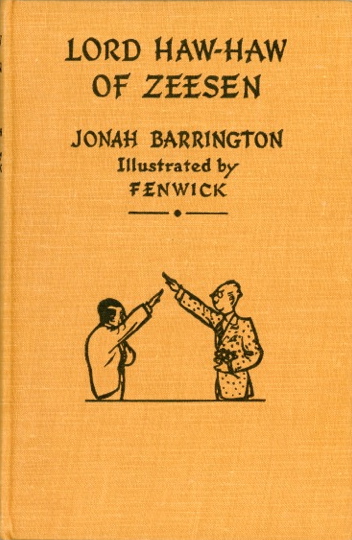
When I picked up this slim and curious volume, Lord Haw-Haw of Zeesen (1939), at an antiquarian bookstore in the Welsh border town of Hay-on-Wye, I was puzzled, to say the least. I mean, I had heard about—and had listened to recordings of—the notorious Lord Haw-Haw, the fascist broadcaster whose role it was to demoralize the British, to make them turn against their own government by convincing them that to side with the so-called Third Reich was the safest, surest way to march forward. Yet here was a book—written pseudonymously by a journalist calling himself Jonah Barrington and cartoonishly illustrated by an artist who went by the name of Fenwick—that turned propaganda into satire by lending form and features to a voice of terror that was infiltrating the home front.
Yes, it is a curious performance—a biographical act of deflating a windbag, of knocking the stuffing out of a nameless, disembodied operative whose dangerous air of mystery was just plain hot by the time Barrington had laughed off the threat by calling it “Haw-Haw.” Those in Britain who, like Barrington, had caught the bizarre broadcasts from station Zeesen in Germany began to speculate about the speaker. In the absence of evidence, Barrington created a character that, to him, had already “become real”; and out of the polemics that “nightly pollute[d]” the British air, the journalist set out to weave “silly fancies.”
“Let me make one point perfectly clear,” Barrington added:
Although Fenwick and I have use our imagination in building up the home life and background of Haw-Haw and his fellow propagandists, the actual speeches credited here to them are given verbatim—exactly as broadcast from the stations Hamburg, Cologne and Zeesen (D.J.A).
Lord Haw-Haw of Zeesen defused a crisis by giving a ridiculous shape to uncertain things to come, by making preposterously concrete what had been potentially persuasive or at least dangerously ambiguous hearsay. Filmmakers and journalists had parodied Nazi figures before—but the task of turning rhetoric into a figure of ridicule is a rather more complex strategy of counter-propaganda, especially since, in this case, print was rendering fictive what it had made definitive:
Haw-Haw in print needs stage directions, scene-setting and local colour. And Fenwick needn’t think he’s going to sit back and do nothing, either. You want the best of Haw-Haw, and we give it to you—drawings and all.
Best or worst, readers of Lord Haw-Haw of Zeesen were meant to get the better of him.
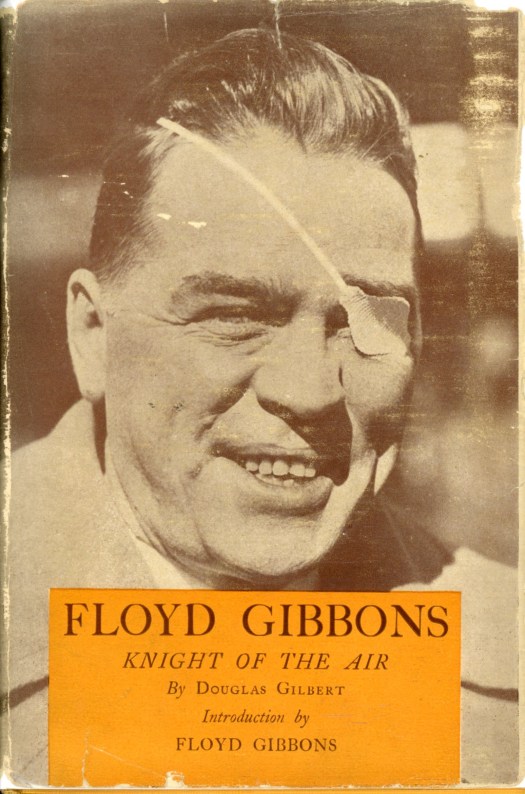
“Have voice, will travel.” That was the line my history of broadcasting professor Frank Kahn used to advertise his vocal services in the trade papers of yesteryear. And a voice for radio he did have, even though what he said and how he brought it across was appreciated by next to no one at Lehman College in the Bronx, where he ended up teaching in the cable TV age. Kahn was out of touch and, no doubt, keenly aware of it, incapable or unwilling though he was to do anything about it. “Have voice, will travel”? I mean, who among his students even got this sly reference to a time when the medium of radio was being challenged by sharp-shooting television? “Have voice, will travel.” The line came to mind when, some time ago, I read Douglas Gilbert’s biography Floyd Gibbons: Knight of the Air (1930).
You don’t have to be out of touch to appreciate it, though it sure doesn’t hurt any if you catch up with someone whose fifteen minutes of fame (and airtime) was up nearly three-quarters of a century ago.
“There is no one in the world who can talk like Floyd Gibbons,” his biographer marvelled:
He speaks at a maximum speed of 245 words a minute and at an average speed of 216 words a minute and every word is clearly pronounced, completely enunciated, readily understood. He dramatizes his speech, just as he dramatizes the news.
My copy of the book
Gilbert, in turn, “dramatizes” Gibbons’s career. Indeed, he melo-dramatizes it. The biographer seems determined to turn the journalist into a swashbuckler and to imbue with romance what, on the air, was down-to-earth and up-to-date.
“He could, and often does, wear any sort of costume,” Gilbert says about Gibbons, “and when he does, he has an air. It is a negligent and yet perfect air.” Shown with his signature patch (Gibbons lost one eye while, as a newspaper journalist, he was reporting from French battlefields during the First World War), the so-called “Headline Hunter,” then middle-aged, certainly has that “air” of romance about him.
According to Gilbert, Gibbons was through being a roving reporter at the age of forty. His latest book, The Red Napoleon, which he was in the process of completing back in 1928, was a “prophesy of the next world war and the part radio was to play in it.” To make such a prophesy, Gibbons consulted NBC president M. H. Aylesworth; and out of his luncheon with the radio executive there “developed the ‘Headline Hunter’ and the ‘Prohibition Poller’ and news gatherer that ma[de] the Literary Digest’s fifteen minutes over WJZ a radio ‘front page.’”
At 40 through with roving? Today at 42 he’s just begun—roaming for fifteen-million persons—their vicarious vagabond of the air, satisfying the gypsy lust of those of us who have never traveled.
“He’s radio’s knight errant,” Gilbert insists, “the listener’s passport to uncharted harbors; their open sesame to Cathay; their vista of a world whose only boundaries are the poles.”
For his audition, performed in front of an “unseen audience of Aylesworth and other NBC officials,” Gibbons recounted his “most exciting experience”—being aboard the Laconia when she was torpedoed. The event had taken place over a decade earlier, on 25 February 1917; but Gibbons managed to bring it to life and to lend it urgency through the power of his voice.
Back in 1917,
Gibbons had had a hunch, a newspaper man’s hunch when he took the Laconia. He had been ordered to France as war correspondent. He refused to go on the ship on which Von Bernsdorff [German ambassador to the US] was sailing because he knew no harm would come to that ship from the Germans. He chose the Laconia, having a hunch she would be sunk and that he would escape and file a story of the sinking.
In the late 1920s, there was no indication that radio, too, was a ship under fire. As Gilbert suggests, Gibbons would have gotten aboard anyway, had he known just how much danger lay ahead. Not many people beside Gibbons imagined in 1930 that radio would become the medium most called upon for up-to-date accounts of warfare. Had he been born a decade or two later—and not died in 1939—Gibbons would have gone straight into the thick of it and brought his spitfire delivery to a medium to which his voice was so adequately equipped. Living too early, living too late? All we can hope is that our voices will travel some distance once we are convinced we have something to say . . .
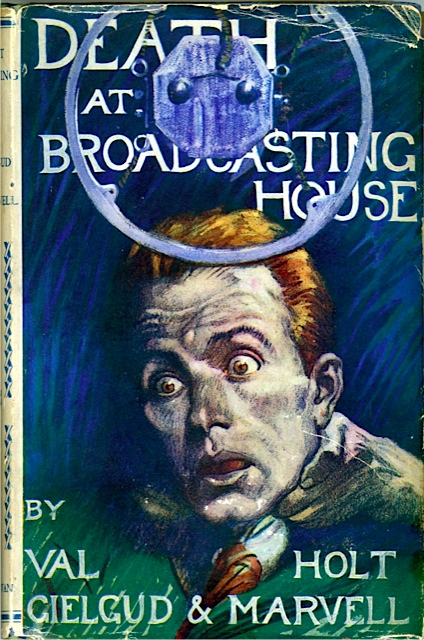
“Snobbish nonsense!” says one shabbily dressed young Londoner to another as they observe a man in a starched shirt and dinner jacket enter Broadcasting House. The man, they reckon, is an announcer about to go on the air, unseen yet meticulously groomed and attired. At the sight of which pointless and paradoxical propriety they sneer: “That whole place wants a dam’ good shake-up.” A “dam’ good shake-up.” That, in a coconut shell (to employ the most sound-effective nut in the business of radio dramatics), is what Val Gielgud and his collaborator Holt Marvell (the fanciful penname of fellow broadcaster Eric Maschwitz) set out to perform in Death at Broadcasting House (1934), a murder mystery set in and temporarily upsetting the reliable, predictable and frightfully proper BBC. Although I had know about it for quite some time, I just finished reading it; turns out, it’s a “dam’ good” page-turner, and a compelling commentary on the marginality, the relative obscurity of radio dramatics besides.
“There’s not a drop of good red blood about the whole place. Robots engaged in the retailing of tripe! That’s broadcasting!” one of the above sidewalk critics of the tried and generally trusted institution declares. It is clear, though, that Gielgud and Maschwitz did not side with the two self-styled “communists.” The authors were BBC employees and not about to stage a revolution. The “shake-up” was strictly a matter of maracas, a means of making some noise for their own undervalued accomplishments rather than spilling the beans without which those maracas would become utterly useless as instruments of ballyhoo.
Sure, broadcasting plays—minutely timed, meticulously rehearsed and intensely scrutinized—were far more mechanic than any other form of dramatic performance. Yet, as Gielgud insisted in one of his many articles on radio drama, “[i]n spite of [its] machine-like qualities” and “in spite of the lack of colour and applause, the work has a fascination of its own.” That the multitude for whom these performances were intended showed so little gratitude was frustrating to an actor-director like Gielgud, who sarcastically remarked a few years earlier that dismissive reviews in the press suggested, at least, that the broadcast play had “passed the first and most depressing stage of development—the stage of being entirely ignored.” By 1934, it had clearly not advanced to a stage that could be deemed legitimate.
What better way to gainsay those naysayers than to spill some of that “good red blood” or to stir it properly and to make it run hot and cold by turns. “A killing! In Broadcasting House, of all places! Good God!” is the response of General Sir Herbert Farquharson, the corporation’s fictional Controller. He has just been informed that an actor was done away with during the production of a live broadcast. “My god, sir,” the director of that play exclaims, “do you realize that everyone who heard that play must have heard him die? That makes it pretty unique in the annals of crime.”
That most folks tuning in thought little of it—that they believed it to be part of the drama—is owing to the fact that the murder was committed right at the moment when, according to the script, the character played by the victim was scheduled to breathe his last. A crime at once prominent and inconspicuous—like most radio dramas, performed as they were without a studio audience. After all, even the Controller, at the time of the murder, was attending a variety program staged in the specially designed Vaudeville Studio instead.
Death at Broadcasting House is the self-conscious performance of two radiomen, Gielgud and Maschwitz, fighting for the recognition that, for the most part, eludes those working behind the scenes—especially the folks behind the scenes of a largely invisible business. Their book, as they so slyly state, was “dedicated impertinently … to those critics who persistently deny that the radio pay exists, has existed, or ever can exist.” Radio plays existed, all right, but, for the most part, they died as soon as they were heard, if they were heard at all.
Unless, of course, they were blattnerphoned. “Blattnerphone?” the puzzled inspector exclaims. “Yes,” the BBC’s dramatic director, Julian Caird, explains:
“It’s a way of recording a programme on a steel tape so that it can be re-transmitted. We have to do a good deal of it for Empire work.” […]
“You mean we can hear that actual scene over again?”
“We can hear that scene,” said Caird, “not only over again, but over and over again. As often as you like. I wonder if the murderer thought of that?”
Probably not. Unless he numbers among the initiated few, folks like Caird—and Gielgud—who have their fingers at the controls, conjurers who don’t mind revealing some of their tricks to demonstrate just how powerful they are.
“The curious thing about the case what that it was both extremely simply and extremely complicated,” the inspector wraps up the business of detection. “It was extremely complicated only because it took place under very remarkable conditions—conditions which you wouldn’t find repeated anywhere else, and for which, of course, there was absolutely no precedent.” The same applies to Gielgud and Maschwitz’s fiction. However witty and engaging, the whodunit is entirely conventional. It is the setting, the broadcasting studio, that makes it unusual. The setting, thus, becomes the star of the production—a star without whose presence the show simply could not go on.
Indeed, the crime depends on the complexity of British radio production to be in need of detection. In American broadcasting, by comparison, all actors gathered in the same studio, a congregation that would render the unobserved strangling of one of them not only improbably but impossible. At the BBC, however, plays were produced using a multiple studios, a complex approach Gielgud’s stand-in explains thus:
[T]he chief reasons why we use several studios and not one, are two. The first is that by the use of separate studios, the producer can get different acoustic effects for his scenes…. Secondly, the modern radio play depends for its “continuity” … upon the ability to ‘fade’ one scene at its conclusion into the next. You can see at once that there must be at least two studios in use for these “fades” to be possible. In an elaborate play, therefore, the actors require as many studios as the varying acoustics of the different scenes require, while … sound effects have a studio of their own, gramophone effects one more, and the orchestra providing the incidental music yet another separate one.
Anyone who has ever listened to an American radio play of the 1930s, such as the ones produced by the Columbia Workshop, knows that no such complex arrangements are needed for the effective use of multiple fades and changes in acoustics. Death at Broadcasting House is a defense of the British system. It turns the multi-studio approach into something to be marveled at—an arcane system fit for a mystery, a puzzle whose solution requires the expertise of the initiated and thus vindicates the existence of the men masterminding the business with their hands firmly on that most complex of all pieces of broadcasting equipment: the dramatic control panel, which, Gielgud enthused elsewhere, enabled the director “to move at will, both in time and space, as simply as if he were travelling on the fabled magic carpet, and to take his audience with him.”
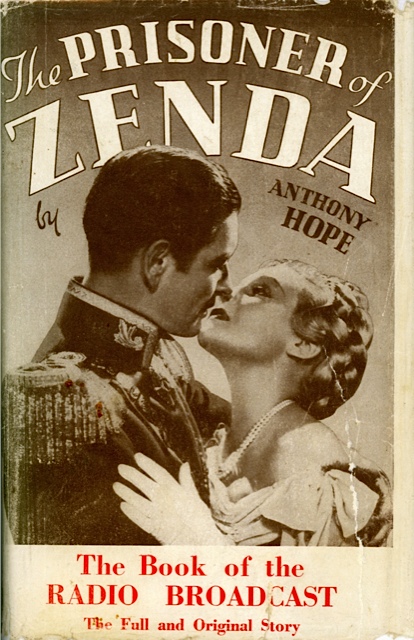
The other day, at my favorite bookstore here in Aberystwyth, I was caught in the eye by what struck me as a highly unusual cover for a 1938 edition of Anthony Hope’s fanciful pageturner The Prisoner of Zenda. Mind you, I’m not likely to turns those pages any time soon. I’m not one for Graustarkian excursions. That I found the old chestnut so arresting is due to the way in which it was sold anew to an audience of Britons to whom such a mode of escape from the crisis-ridden everyday must have been sufficiently attractive already. This was the 92nd impression of Zenda; and, with Europe at the brink of war, Ruritania must have sounded to those who prefer to face the future with their head in the hourglass contents of yesteryear like a travel deal too hard to resist.
My copy of the book
Now, the publishers, Arrowsmith, weren’t taking any chances. Judging by the cover telling as much, they were looking for novel ways of repackaging a familiar volume that few British public and private libraries could have been wanting at the time.
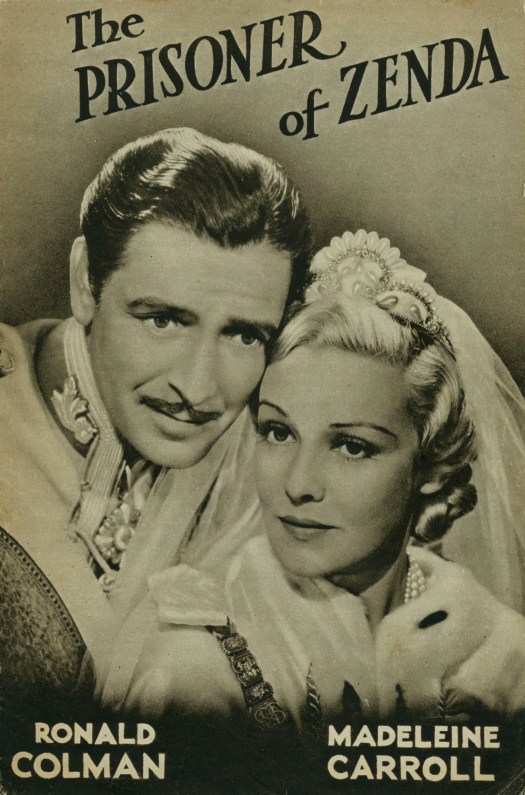
British moviegoers had just seen Ruritania appear before their very eyes in the 1937 screen version of the romance, which make dashing Ronald Colman an obvious salesperson and accounts for his presence on the dust jacket. It is the line underneath, though, that made me look: “The Book of the Radio Broadcast,” the advertising slogan reads. Desperate, anachronistic, and now altogether unthinkable, these words reminded me just how far removed we are from those olden days when radio ruled the waves.
“The Prisoner of Zenda was recently the subject of a highly successful film,” the copy on the inside states somewhat pointlessly in the face of the faces on the cover. What’s more, it continues, a “further mark of its popularity” was the story’s “selection by the BBC as a radio serial broadcast on the National Programme.” To this day, the BBC produces and airs a great number of serial adaptations of classic, popular or just plain old literature; but, however reassuring this continuation of a once prominent storytelling tradition may be, a reminder of the fact that books are still turned into sound-only dramas would hardly sell copies these days. Radio still sells merchandise—but a line along the lines of “as heard on radio” is pretty much unheard of in advertising these days.
From my collection of Cinegrams.
“This book is the original story on which the broadcast was based,” the dust jacket blurb concludes. I, for one, would have been more thrilled to get my hands or ears on the adaptation, considering that all we have left of much of the BBC’s output of aural drama is such ocular proof of radio’s diminished status and pop-cultural clout.
Perhaps, my enthusiasm at this find was too much tempered with the frustration and regret such a nostalgic tease provokes. At any rate, I very nearly left Ystwyth Books without the volume in my hands. That I walked off with it after all is owing to our friend, novelist Lynda Waterhouse, who saw me giving it the eye and made me a handsome present of it. And there it sits now on my bookshelf, a tattered metaphor of my existence: I am stuck in a past that was never mine to outlive, grasping at second-hand-me-downs and gasping for recycled air . . . a prisoner of a Zenda of my own unmaking.




 Harry Heuser