Cardboard Sentiment

I have yet to write a card this season; and considering that half of my greetings are to be flown overseas, I should really put pen to shiny paper any day now. In Germany, where I am from, it is tradition to wait until the last possible moment to post seasonal greetings, whatever the season. It is not customary there to display received mail for weeks on dusty end, certainly not prior to the event they are designed to commemorate. So, when is the right time to drop off those sentiments? The ever earlier reminders that are the shop windows can hardly be a guide in the matter.

“To save the postman a miserable Christmas, we follow the example of all unselfish people, and send out our cards early.” Thus noted the imaginary writer of The Diary of a Nobody (1892) in an entry dated . . . 22 December? The postal workers, no doubt, were less than pleased by the way in which the sentiment found implementation.

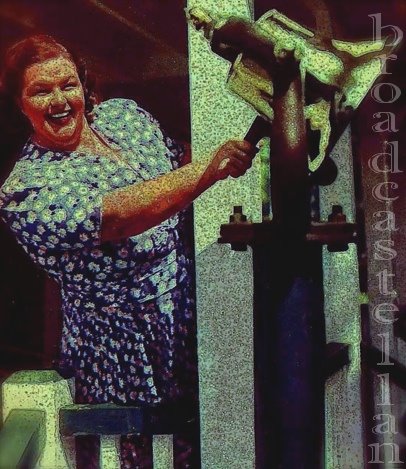
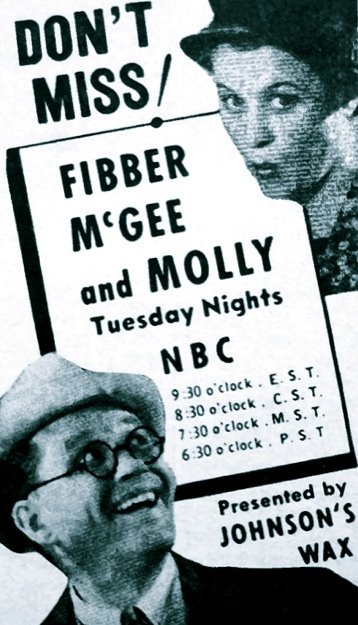
“Most of the cards had fingermarks, which I did not notice at night,” the same writer observed, a potential smudge on his reputation against which he resolved to guard henceforth by buying “all future cards in the daytime.” Another noted nobody determined not to purchase any cards at all. His name was Fibber McGee; and on this day 6 December, in 1949, he was found hard at work making his own holiday cards. To be sure, it was not his big idea to be creative or thoughtful that temporarily turned him into one-man Hallmark factory.

“Boy-o-boy,” Fibber told his wife, the doubtful Molly, “I sure wish I’d a-thought of this before. Look at the money I’d a-saved if I’d a-made my own Christmas cards every year.” Fibber did not merely paint the designs, including a beardless Santa Claus; he also dreamed up the accompanying sentiments. Among the rhymed excuses for his schlock art (words for which writer Don Quinn deserves and received some credit), are:

St. Nicholas had his beard cut off
as up on the roof his reindeers trample
because how can a guy with whiskers on
show little shavers a good example?

“I got a million ideas as good as this one,” Fibber boasted. “Well, I should hope so,” Molly replied.

For the Mayor of the town, Fibber paints the picture of a pork barrel with a hand in it; and for a friend who has been avoiding him for reasons soon to be apparent, he sketches a fish swimming through mistletoe, a symbolism explained in verse:

I hope the fish I hereby show
recalls the fin I loaned you last July.
And though he swims through mistletoe,
I ain’t gonna kiss that fin goodbye.

Ultimately, Fibber has to wash his hands of the whole Christmas card business, dirty as they are with paint and glue. Like the Nobody before him, and like millions of people everywhere, Fibber resorts to store-bought sentiments, even though the ones he has his hands on were pre-owned. The seller proved savvier than old Fibber. As Nobody’s experience with “fingermarks” suggests, even the purchase of new cards can be a challenge, especially when one has to face a shop

crowded with people, who seemed to take up the cards rather roughly, and, after a hurried glance at them, throw them down again. I remarked to one of the young persons serving, that carelessness appeared to be a disease with some purchasers. The observation was scarcely out of my mouth, when my thick coat-sleeve caught against a large pile of expensive cards in boxes one on top of the other, and threw them down. The manager came forward, looking very much annoyed, and picking up several cards from the ground, said to one of the assistants, with a palpable side-glance at me: ‘Put these amongst the sixpenny goods; they can’t be sold for a shilling now.’ The result was, I felt it my duty to buy some of these damaged cards.

I had to buy more and pay more than intended. Unfortunately I did not examine them all, and when I got home I discovered a vulgar card with a picture of a fat nurse with two babies, one black and the other white, and the words: ‘We wish Pa a Merry Christmas.’ I tore up the card and threw it away. Carrie said the great disadvantage of going out in Society and increasing the number of our friends was, that we should have to send out nearly two dozen cards this year.

May a joyous season be in your cards, fingermarks ‘n all!
Nyuk, Nyuk! Who’s Not There?

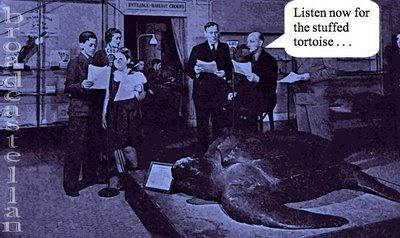
“Ladies and gentlemen. We take you now to New York City for the annual tree lighting ceremony: Click.” Imagine the thrill of being presented with such a spectacle . . . on the radio. You might as well go fondle a rainbow or listen to a bar of chocolate. Even if it could be done, you know that you have not come to your senses in a way that gets you the sensation to be had. I pretty much had the same response when I read that BBC Radio 4 was going to air a documentary on the Three Stooges.

According to the Radio Times, “The Three Stooges: Movie Maniacs” (first aired on BBC Radio 4 on 4 December in 2008) promises a “detailed overview” of the career of the comedy trio and its six (that’s right, six) members (not counting Emil Sitka). That there were six Stooges is about the only revelation of this half-hour program, other than that attempting an audio documentary on this most visual of slapstick comics is almost as dumb (but not nearly as funny) as anything the Three Stooges might be seen doing, if only they were to be seen.

There is a lot that radio can do better than television or the movies; but bringing home the appeal of physical comedy is not one of them. Matters are not helped by historian Glenn Mitchell, who delivers what Radio Times‘s David Crawford calls a “rather dry analysis” in a flat, humorless voice that makes you reach for a jug of water or, alternatively, for the proverbial off button of whatever device you use to tune in these days. Pratfalls never sounded this dull.

“Their wild knockabout and lunatic spirit continued to endear [the Three Stooges] to fans worldwide,” Mitchell tells us, “albeit less so in Britain.” Why? “It may be that British tastes run less to the direct brand of slapstick that was their stock in trade,” Mitchell suggests, only to point out that “they were enormously popular” in Britain during the 1930s and ‘40s. This “lack of familiarity” Mitchell attributes to the fact that the Stooges were rarely seen in Britain thereafter, whereas they have been television stalwarts in the US since the late 1950s. Obviously, those guys have to be seen to be appreciated. Heck, they have to be seen to be loathed.

Comparative obscurity aside, their disappearance from British screens seems to have translated into a lack of funding for a television documentary that might have contributed to a reappraisal of their work. Without visuals, you end up with explanatory—and rhetorically slipshod—notes like this one: “It must be said that the Stooges films maintain a constant stream of slapping, eye-poking, and bashes over the head that some people find relentless to the point of irresponsibility.”

While clearly out of its element on the airwaves, “The Three Stooges: Movie Maniacs” is not an out-and-out dud. Tracing the comedians’ career from their vaudeville beginnings to their work in pictures, big and small, the lecture is enlivened by numerous sound bites from films and television interviews. Among the voices you’ll hear are those of Moe Howard, Larry Fine, Joe Besser, Curly Joe DeRita, and Lucille Ball.

For all its swift editing, the program still leaves you with that “you had to be there” feeling, the shrug that might have been a chuckle; and to take you there via radio takes consummate professionals like Edward R. Murrow or Ted Husing, or a Herbert “Oh, the humanity” Morrison describing the Hindenburg go down in flames. This one simply deflates before your very ears.

"Everybody talks too much": Dylan Thomas and the Long-Lost "Art of Conversation"

“To begin at the beginning.” Thus opens what is undoubtedly the most famous of all plays written for radio: Under Milk Wood, by Welsh poet Dylan Thomas. BBC radio first produced the play in January 1954, with fellow Welshman Richard Burton in the role of the narrator. It had been previously performed in New York, shortly before Thomas’s death in November 1953 (which is the subject of a new book, Fatal Neglect by David N. Thomas, whose previous biography was the source for the motion picture The Edge of Love. Thomas’s poetry is still widely read today; but little is known generally about his other works for the wireless, about which there is generally little talk these days.

Thomas’s most popular story, “A Child’s Christmas in Wales” (published posthumously in 1955) was originally written for radio, as may be deduced from the attention Thomas’s pays to descriptions of sounds and voices, from the “most unducklike sound, a mewing moo that an ambitious cat might make who wished to be a cow” to that “small, dry voice, like the voice of someone who has not spoken for a long time,” a “small, dry, eggshell voice from the other side of the door: a small dry voice through the keyhole.”

Indeed, as I learned from Douglas Cleverdon’s introduction to the Folio edition of Under Milk Wood, Thomas had been on the air, whether as poet, critic, or actor, since 1939. Among his broadcast features is “Return Journey” (1947), a precursor to “Mad Town” (as Under Milk Wood was initially titled); it has been published in the anthology Wales on the Wireless (1988). Earlier this year, another play for voices by Dylan Thomas has been discovered and is now being given its first production on the air. Titled “The Art of Conversation,” it is available online until 9 December.

The title is somewhat misleading, since the play is really about shutting up. It is a Second World War propaganda piece, commissioned as part of a “Loose Lips Sink Ships” campaign, the sort of cautionary talk on the virtue of silence exemplified in the US by mystery writer Mignon Eberhart’s “The Enemy Is Listening” (Cavalcade of America, 7 June 1943). In it, a sinister voice (Everett Sloane’s) replies to remark that no “real American intends to give information to the enemy,” that

sometimes, sometimes someone forgets.  A word overheard and repeated. A small fact passed on to someone else may mean little to you.  It may mean nothing to the person to whom you repeat it.  But the third or the fourth person or the tenth or the twentieth may be your enemy. Your enemy.

Thomas’s “The Art of Conversation” is a rather more subtle performance. It permits us to indulge in the excesses of talk by Britain’s most celebrated conversationalists, only to remind us that there are times when—and subjects about which—the word should be “mum.” “I don’t think you’ll find Mr. Hitler with a little notebook under our table, do you?” one careless talker quips; but, just to be on the safe side, the idle talk that ensures is being censored.

Like Eberhart, Thomas weaves a web of compromising voices; yet he dispenses with melodrama and, indeed, as is typical of his compositions, with plot altogether. Instead, he opts for an informal lecture (replete with audience) punctuated by “the lantern slides of sound”: a multitude of voices, some distinct, others choric. All are preliminaries and subject to shushing:

Hundreds of odds and ends of hundreds of hearsays and rumours may, and can, be brought together into such a pattern that a whole Allied enterprise is thwarted or destroyed. A wagging tongue may sink a ship; a stray word over a mild-and-bitter may help to murder children.

However chatty and playful, “The Art of Conversation” eventually gets down to business and brings its message across; at least, it might have done, had it not disappeared for decades—apparently before it was ever broadcast. According to the current issue of the Radio Times, there is no evidence that the play was intended for radio; but you need only to listen to know that it could have hardly been written with any other medium in mind.

Alison Hindell’s belated production slightly condenses the original script (available here in its entirety), but otherwise takes few liberties with Thomas’s prose and directions; a 1920s “nigger” is turned into “negro,” a concession to our politically corrected sensibilities. Few US radio dramatists were treated with such respect.

The single exception is the rather pointless addition of an opening line that is not part of Thomas’s “Art,” but the famous introduction to Under Milk Wood, quoted above. No doubt, the presenters intended to draw the famous poet into his forgotten “Conversation,” so as to validate this lesser performance; but, instead of indulging in such self-conscious reverberations, they should have left themselves out of it, especially since there is enough of Thomas in it to make the lecture worth our while.

If only a discovery like this could get us talking again about radio . . .

Yola (Not Quite Lola); or, The Blonde Who Bombed

Germany. 1932. Another young screen actress is lured from the thriving UFA studios to the motion picture colony in California. Her name was Anna Sten. She was born one hundred years ago (3 December 1908) in what was then Russia. According to Deems Taylor’s Pictorial History of the Movies, Sten was thought of as “another Banky [aforementioned], Garbo, or Dietrich.” Highly, in short. The man who did the thinking was Samuel Goldwyn; and soon after, he must have thought, “What was I thinking!”

European beauties were all the rage in the early 1930s Hollywood. It was a peculiarly anachronistic fad, considering that the talkies called for clear diction, however exotic the looks of the actress from whose mouth the sounds poured into the still imperfect microphones. Beauty, Taylor’s 1948 update of his compendium to motion pictures conceded, Anna Sten “undeniably” possessed; but her “all-too-Russian” accent was better suited to comedy than to tragedy.” Surely, a Russian accent need not be no impediment to melodrama; rather, this non sequitur signals that, by the mid-1940s, Russians were deemed too dangerous or dubious to be romantic leads in Hollywood and were more safely marketable as so many eccentric cousins of Mischa Auer.

When Sten’s first three movies misfired, Goldwyn sensed that the eggs this Kiev chick laid were not golden. By 1935, her leading lady period was effectively over. Still, two years after her last Hollywood flop, the notoriously diction-challenged Sten was given another shot at stardom . . . by stepping behind the microphone of the most popular dramatic show on the air: the Lux Radio Theater. The show’s nominal producer, Cecil B. DeMille, was called upon to remind an audience of millions (most of whom potential moviegoers) why Sten was still a star; no Banky, but bankable:

I first saw Anna Sten in one of the most effective scenes ever filmed.  It was in a foreign production with Emil Jannings [Robert Siodmak’s Stürme der Leidenschaft (1932)].  Determined to place her under contract, I started negotiations for the service of this very young girl who had starved with her parents in the Ukraine to become one of Europe’s most glamorous stars.  Then, one day, Samuel Goldwyn invited me to his office to ask my opinion of an actress he just signed.  The actress was Anna Sten.  I was greatly disappointed to lose her, but tonight have the privilege of presenting her in a DeMille production.

The “production” was an unusual one for Lux, a program best known for its microphonic telescoping of Hollywood pictures. Sten was cast in yet another variation on George Barr McCutcheon’s Graustark, that popular, sequel-spawning romance of the early days of the last century. Sten had not appeared in the screen version; indeed, the property was never revisited after the end of the silent era, when last it served as a vehicle for comedienne Marion Davies. By 1937, Graustark was pretty much grave stench. Was Sten being condemned to suffocate in it?

Not quite. The Lux version (8 February 1937) made no attempt at fidelity to the original. Like many romances written or rewritten in the wake It Happened one Night, Graustark was given a screwball spin. Clearly, this radio production was designed to test how Sten’s comic appeal. For this, the air waves were an economically safer testing ground than the sound stage. Besides, it forced the foreigner to prove her command of the English language, albeit in a role demanding an eastern European accent. Sten is delightful (and altogether intelligible) in the role of Princess Yetive; but the broadcast did nothing for her career.

Commemorating Sten’s 100th birthday (she died in 1993), I am turning to her final pre-Hollywood effort, the musical comedy Bomben auf Monte Carlo (1931), from which all the images here are taken. As the bored Princess Yola, a not-so-distant cousin of Yetive, Sten plays opposite German screen idol Hans Albers, the sea captain whom she employs and pursues, using the manual How to Seduce Men as a guide. It is the kind of screwball material that would have served her well overseas. Also in the cast are Heinz Rühmann (last seen here) and Peter Lorre, whose voice remained an asset in Hollywood, and the lively tunes of the Comedian Harmonists (who also appear on screen). This one bombed in name only, however monstrous the title in light of German air attacks on Spain in 1937 . . . shortly after Sten’s first and final Lux broadcast.

It was not so much Sten’s diction that caused her fall as it was the rise of a stentorian dictator. The Old World that Sten had been called upon to represent was fast disappearing; and whatever was distant and foreign soon ceased to be exotic, glamorous, or desirable.

Even Reindeer Get the Flu

Four weeks and a day! As the exclamation mark suggests, being that I use it so sparingly, I am not counting down the days to New Year’s Eve here or marvel at the seemingly accelerated passing of time. It is the time my cold has been taking thus far to run its collision course and me crazy into the not so welcome bargain. It could be, though, that today’s headache has been exacerbated by Mickey Rooney.

My attempt to book tickets to his latest show, that is. I tried to get in touch with a sales representative to make sure that the tickets I ordered online won’t be sent to our home, as requested, given that, as it dawned on me only after I had finalized the booking, we are elsewhere during the latter part of December.

The apparently unstoppable octogenarian, Judy Garland’s co-star in a series of musical-comedies, is going to be in one of those pantomimes so popular in Britain during the holiday season; this time, some eighty-two years after his acting debut in motion pictures, he appears at the Hippodrome in Bristol, England, where we had planned to spend the final forty-eight hours of 2008.

The busy Mr. Rooney, slated to appear in four films in the upcoming months, stars opposite British stage and television actress Michelle Collins, whom last we saw backstage at the Shaftesbury Theatre in London (and whose autograph I displayed here). Anyway, I eventually sorted out the mailing situation and can only hope that the constitution of the man formerly known as Andy Hardy will prove sturdier than mine.

I am in the mood for a seasonal tale, tall or otherwise, but would much rather close my eyes than read Christmas Stories with its selection of fiction by Conan Doyle, Damon Runyon, Evelyn Waugh, and, a personal favorite, Anthony Trollope. So, once again, I rely on the radio, or recordings of plays once produced for the medium. On this day, 2 December, in 1945, The Philco Radio Hall of Fame presented a new story, which it predicted to “become a Christmas classic.”

Never mind that this prediction did not quite come true. After all, the woman who made it was not chiefly known as a clairvoyant, even though she had a voice that could induce millions to spend millions on war bonds and forge stars in the smithy of her own radio shows. Announcer Glenn Riggs somewhat needlessly reminded the public that, “as commentator, singer, forceful personality and discoverer of stars,” she had “no equal on the air.” Yes, it was Kate Smith who ventured that guess, no doubt boosting the sales of the volume. When Smith sings, you can count on sales as well as volume.

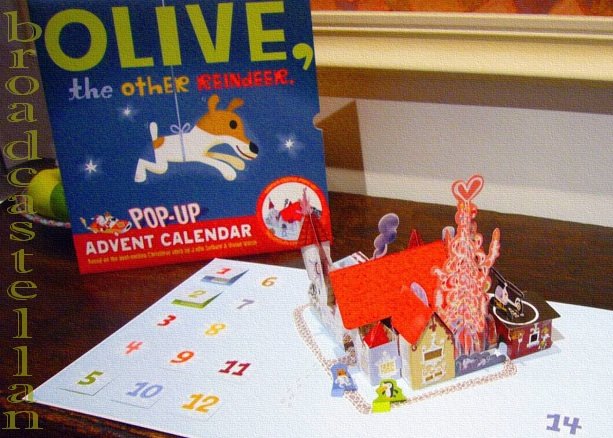
On the Hall of Fame, Smith not only belts out a number of tunes, including “If I Loved You” from the latest Rodgers and Hammerstein musical Carousel and her celebrated rendition of “God Bless America”; as story lady, Smith narrates a dramatized version of Roger Duvoisin’s “The Christmas Whale,” a whimsical paean to ingenuity involving the breakout of a flu epidemic at Santa’s toyshop and the reindeer that flew not because they all came down with it. Perhaps, such susceptibility explains why this year’s advent calendar featuring Olive, the Other Reindeer, arrived a day late in the mail.

The title of Duvoisin’s story leaves no doubt as to the creature lending a helping fin. Perhaps, the sudden substitution was a metaphor for the death of FDR just at the time when things were beginning to look up and the theaters of war were closing, not merely for the duration of the holidays. There is no mention of Harry Truman; but, when asked what Christmas gift she would make General Eisenhower, Smith remarks: “Well, I’d give him a future as great as his past.” Perhaps, she was prophetic after all . . .

Picking up The Magic Key

When I was growing up, looking forward to Christmas meant opening the Türchen (little doors) of an advent calendar (last shown here). Every morning, for twenty-four days, colorful pictures marked the countdown to Heiligabend, as Christmas Eve is known and celebrated in my native Germany. In an update of this seeming oxymoron—the surprise-filled ritual—I am trying to turn this journal into such a calendar, discovering something new to think, wonder, and write about. There won’t be twenty-four doors, mind you, since I am going to make an exit to London on the 17th, from which day forward there will be many a silent night here at broadcastellan; but, during the next few weeks, I shall open as many Türchen as time and internet access permit.

Perhaps, this isn’t so very different from what I do with this journal throughout the year; but I shall endeavor to make what’s behind the door a revelation, or a surprise, at least, to myself—stories, voices, and personalities I have not yet mentioned on these virtual pages. Rather than being a reflex, the surprise is a reaction for which I shall have to strive. What I find behind those closed doors, I should add, may not always befit the spirit of the season.

I shall open the first door by picking up The Magic Key, a popular US radio variety program of the mid to late 1930s; sponsored by RCA, it was designed to promote the wonders of radio, no expenses spared. On this day, 1 December, in 1935, the hourlong program offered “varied entertainment, from Buenos Aires, Ottawa, Canada, Chicago and New York City, presented for the families of the nation by the members of the family of RCA.”

The afternoon’s entertainers included silent screen idol Richard Barthelmess who, opposite Warner Brothers’ star Jean Muir, made “one of his rare microphone appearances” in a scene from Maxwell Anderson’s Pulitzer Prize-winning Saturday’s Children, along with Eddy Duchin and his orchestra, Eduardo Donato and his tango ensemble, members of the cast of George Gershwin’s Porgy and Bess and, if that weren’t varied entertainment enough, John B. Kennedy touring the Chicago stockyards and a report from Canada’s Minister of Agriculture. All live, of course, both from the studio and via hook-ups.

The Magic Key was a marvel in this respect, and it wasn’t bashful about being marvelous: “Within the memory of men now living, the speediest communication between New York and Buenos Aires consumed twenty-seven days. Today, we’ll make the journey in so many seconds [. . .].”

The highlight, for me, are the scenes from Saturday’s Children; but it is difficult to enjoy the performance, knowing what actress Jean Muir had to endure throughout the 1950s, when the doors to sound stages and broadcast studios were closed to her as a direct result of anti-Communist hysteria. In 1950, Muir’s name appeared in Red Channels, effectively barring her from starring in the television version of The Aldrich Family. As Rita Morley Harvey tells it in Those Wonderful, Terrible Years, Muir sought “solace” in alcohol, suffering “poor health” and “personal sorrow.”

Muir’s is a notorious case of witch-hunting; and, considering that few recordings of her radio performances are extant today, it is a thrill to hear her on this Magic Key program, well before radio, anxious to avoid scandal and diminished returns, decided to lock her out. “The proverb says,” Richard Barthelmess remarked in an overly complicated setting of the scene, “that Saturday’s children must work for a living”; but a regular job as only radio and motion pictures could offer an actor back then was a luxury denied the talented Ms. Muir.

As if to comment on things to come, the scenes from Anderson’s play involve a peculiar gift: a bolt, a hammer, and a screwdriver, given to Muir’s character, “a free agent” lately separated from her husband, by her boss, an admirer who wanted to guard against an inquisitive landlady. “Anytime you want a bolt on your door,” her still-loving husband implores her, “I wish you’d ask me.” Unlike Muir, her character got to choose whether to bolt the door or bolt.

The broadcast closes with the obligatory holiday shopping reminder, announcer Milton Cross insisting that the “members of the family of RCA [were] eager to help make your Christmas holidays happy ones. Will there be an RCA Victor in your home this Christmas?” I wish there were occasion for such a purchase these days; but, about half a century ago, the makers and sponsors of radio entertainment decided to throw away those magic keys to the kingdom of make-believe . . .

Mark Twain, Six Feet Under

“I have been trying all I could to get down to the sentimental part of it,” Mark Twain remarked on the “subject of graveyards.” Yet, he concluded, there was “no genuinely sentimental part” to the spectacle we make of the act of decomposing. “It is all grotesque, ghastly, horrible.”

Perhaps it takes a higher degree of sentimentality to find the romance in the morbid; but I am capable of just that. Whenever I travel, I enjoy visiting places of interment, particularly those large necropolises with their temples and statues erected in memory of mortals who, while above ground, played a vital role in the workings of our large metropolises.

Bankers and bigwigs seem to insist on occupying the largest dwellings in the cities of the dead. There must be some consolation in knowing that, even when six feet below, one can still get folks to look up in admiration. Writers, by comparison, often have modest graves. They, after all, leave their impressions by filling volumes that, however small by comparison to a mausoleum, are apt and ample monuments to their craft. Tombs are largely reserved for those who managed no tomes.

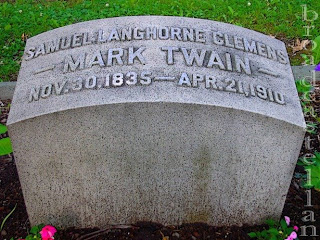
Mark Twain’s own grave is an encasement in point. Last summer, returning to New York City from a trip to Niagara Falls, we had a stopover in the town of Elmira. Since I was in charge of both the map and the guide book, I made sure it was on our way. After all, the humorist from Missouri is buried there. The first thing we did, after securing a room for the night, was to go in search of his final resting place, which we found, eventually, along with that of filmmaker Hal Roach (shown here). However impaired our sense of dimensions after beholding the Falls, the stone (pictured) is less than majestic.

Close to it, though, is a larger monument, about twice as high as the number of feet I presume him to be under, which is precisely the length denoted by the cry of “mark twain” from which Samuel Clemens took his name. The cleverness of the tribute notwithstanding, I wonder whether the writer so honored would have welcomed such a column. Resting assured that monuments are being perpetually erected in the minds of those who read, relish, and recite his words, Mark Twain may well have been better pleased with a more modest disposal, given his attitude toward burials as expressed in Life on the Mississippi:

Graveyards may have been justifiable in the bygone ages, when nobody knew that for every dead body put into the ground, to glut the earth and the plant-roots, and the air with disease-germs, five or fifty, or maybe a hundred persons must die before their proper time; but they are hardly justifiable now, when even the children know that a dead saint enters upon a century-long career of assassination the moment the earth closes over his corpse.  It is a grim sort of a thought.  The relics of St. Anne, up in Canada, have now, after nineteen hundred years, gone to curing the sick by the dozen.  But it is merest matter-of-course that these same relics, within a generation after St. Anne’s death and burial, made several thousand people sick.  Therefore these miracle-performances are simply compensation, nothing more.

Besides, he pointed out (quoting a member of Chicago Medical Society, who was an advocate of cremation), “[f]unerals cost annually more money than the value of the combined gold and silver yield of the United States in the year 1880! These figures do not include the sums invested in burial-grounds and expended in tombs and monuments, nor the loss from depreciation of property in the vicinity of cemeteries.”

Mark Twain was born on this day, 30 November, in 1835; he died nearly a century ago and, whatever his views on the matter of tombstones, has well earned his keep at Woodlawn. Here he immaterializes for us in “The Adventures of Mark Twain” (Cavalcade of America, 1 May 1944), the voice being that of Fredric March. In light of Mark Twain’s remarks, I believe he would have approved of the memorial services a cost-effective medium like radio can provide. Radio gets rid of the body but keeps the spirit alive.

Radio Was . . . “Stud’s Place”

“The importance of the ‘word’ was lost when television took over the living rooms of America. Sure, there were plenty of trivial programs on radio at the time, but there were also brilliance and creativity that have never been equaled by television.” This is how Pulitzer Prize-winning oral historian Studs Terkel (1912-2008) summed up the decline in our regard for and funding of the medium in which he, as an interviewer, excelled. “The arrival of television was a horrendous thing for the medium of radio,” Terkel told Michael C. Keith, editor of Talking Radio (2000). “It was devastating for the radio artists as well as the public. Television was a very poor replacement.”
In the late 1940s, when radio had not yet been superseded by television in all but talk and music, Terkel was frequently heard on Destination Freedom, a history program dramatizing the stories of America’s negro people, including notable Americans like Joe Louis, Richard Wright, and Jackie Robinson.

Tonight, BBC Radio 4’s Archive Hour (in a broadcast available online until 5 December 2008) brings back the life of the legendary voice of the Bronx-born and Chicago-bred journalist. “Studs Terkel: Back in the Wax Museum” delves into the late historian’s personal collection of some seven thousand hours of recordings that he donated to the sound archive of the Chicago Historical Society; these interviews represent nearly half a century of broadcasting. As documentarian Alan Dein puts it, Terkel is the “undisputed hero and the modern pioneer of what we now know as oral history, the art of exploring living memory.”

To Terkel, America was deficient in memory, as well as the respect for its inconstancy; so, whether he interviewed and recorded noted figures of his day or the “so-called ordinary people”—workers, civilians, survivors of war—who could not count on a public platform elsewhere, Terkel did much to prevent listeners from forgetting.

Among the voices heard on the program, aside form Stud’s own, are those of beat poet Allen Ginsberg, Canadian-American economist John Kenneth Galbraith, film star Joan Crawford, fan dancer Sally Rand, Algonquin Round Table wit Dorothy Parker, Vietnam veteran Ron Kovic, feminist Simone de Beauvoir, philosopher Bertrand Russell (interviewed at his home in Wales), Irish street singer Margaret Barry, the Reverend Martin Luther King, Jr., African-American journalist Vernon Jarrett, and gospel singer Mahalia Jackson venting her frustrations without song. “I haven’t the vaguest idea” how to operate a tape recorder, Terkel once confessed. “Yet, it is my right arm,” he marveled.

According to Terkel, who was discharged from military due to a perforated eardrum, the advent of television was “forcing radio to reinvent itself into something not quite as good”; but, the loss of radio dramatics notwithstanding, the audio documentary was surely the very best way in which to reinvigorate the airwaves. “Stud’s Place” was Terkel’s foray into television back in 1949 (cut short due to anti-Communist hysteria); but it was radio that remained his true domain.

Let’s Pretend . . . We’ve All Grown Up

Just how up have we grown since, say, the 1950s? You know, those innocent days of atomic terror, Cold War fears and anti-Communist witch-hunting. We who presume to have grown up tend to make small of what lies behind us, whether we ridicule or romanticize it. We not only know, we know better. We believe ourselves so much more educated, sophisticated or complicated than folks back in the day, whatever that day might be. It rarely occurs to us that we may have lost something other than simplicity, that we have forgotten much that was worth remembering. All those fables and fairy tales, for instance, those legends and myths that once were known to children and adults alike, the archetypal yarns that bound us, tied us to distant yet related cultures, to past generations, and to antiquity by reminding us that we are one with the earth and the universe. We have not so much grown up, it seems to me, as we are growing apart.

Imagine a children’s program these days dramatizing the by now little known story of “Ceres and Prosperina,” which was heard on this day, 28 November, in 1953 by anyone tuning in to the popular and long-running radio series Let’s Pretend. Obviously, this was well before those Teenage Mutant Ninja Turtles graced the plastic lunch boxes of a myth-starved generation.

Let’s Pretend rarely resorted to such faux myths and ersatz folk tales; instead, it kept many of the traditional ones alive, from “Bluebeard” to “Hiawatha,” from “Jason and the Golden Fleece” to “The Emperor’s New Clothes.” Under what Norman Corwin in his Foreword to cast member Arthur Anderson’s chronicle of the program called the “benign dictatorship” of Nila Mack, Let’s Pretend “enjoyed a run of 24 years, during which it scooped up almost half a hundred national awards, and also during which the adapter-director-producer smoked two and a half packs of cigarettes daily.”

For the “Ceres and Proserpina” episode, the producers of the series (Ms. Mack, pictured above, had died earlier that year of a heart attack) did not feel obliged to explain just who these characters were, other than pointing out that this Roman myth was a perfect story for Thanksgiving, which had been celebrated two days prior to the Saturday broadcast. As the host of the series, Uncle Bill Adams, put it:

Thanksgiving is America’s own holiday; but ever since the beginning of time people have been celebrating the harvest season one way or another. The Greeks and Romans, two thousand years ago, had a wonderful harvest story. And today we’re doing it for the first time on Let’s Pretend.

All that needed to be clarified to make “Ceres and Proserpina” (as streamlined and sanitized for radio by Johanna Johnston) come alive to the target audience of tots was the meaning of the word “pomegranate.” As Sybil Trent defined it, “it’s round and red, and a little bigger than an apple, Pretenders, but the inside is full of red seeds like big currants, full of juice and very delicious.”

I suspect that, these days, the producers of a kids’ program would have to spend more time explaining or justifying their choice of presenting a myth like “Ceres and Proserpina” than they would the shape or taste of the fruit that plays such a pivotal role in it. Thanksgiving aside, the story was readily made relevant to its listeners, who were reminded of the people who, even eight years after the end of the Second World War, were living in abject poverty overseas. As announcer Jim Campbell explained:

Yes, Pretenders, now that the Thanksgiving season is almost over and everybody is beginning to think about Christmas, here’s a reminder for you to pass on to your families. Many children, and grown-ups, too, in lands that were devastated by the war, face a very miserable Christmas indeed, unless some good Americans play Santa Claus for them.

This year, a “miserable” or, at any rate, less splendid holiday season is being forecast for many families, including “some good Americans”; but no one seems to advocate Ovid’s Metamorphoses as an alternative to the computerized fantasy games that are less likely this season to fly off the shelves of the electronic stores not yet closed down for good. Along with cost-effective radio dramatics, mythology is the kind of nutritious snack that has long disappeared from the menu of children’s entertainment. The change of seasons, fancifully explained by “Ceres and Proserpine,” is now defined by commerce, by what is and what is not on display in the shop windows. It is the modern myth of perpetual growth and prosperity that may well prove the less relevant and enduring one. By all means, have that pomegranate, but brace yourself for a prolonged visit with Pluto.

Death Draws No Line: Edgar Holloway (1914-2008) Remembered

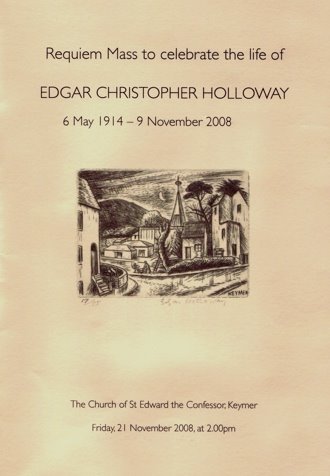
It was an honor to write the farewell that, at last, appeared in The Guardian today. It was agony, too, this assignment to capture, in the scant space allotted, the likeness of an artist who told of himself in etched lines more lasting than those far from final words of mine. Indeed, what I had intended to be the last line was clipped by that dispassionate, faceless Atropos of the publishing world, the editor. It read: “Holloway was that rarest of prodigies: he lived up to his promise.” Edgar Holloway, who passed away at the age of 94 on 9 November 2008, was just that: a promising young artist who continued to share his gifts into old age, no matter how fickle the fortunes, how mutable the market.

It is this picture of success in adversity that I wanted to paint: a teenager without means and formal education who got to etch the portrait of T. S. Eliot and other illustrious sitters; a self-conscious young man who, afflicted with a skin disease, examined and displayed a face he often felt compelled to hide; a boy wonder born too late and raised in an age that seemed past miracles; a skilled chronicler of life denied the chance to serve his country at war by recording its devastation; a distraught teacher who went into the countryside to restore his health only to find his fortunes fall in the city that could keep his career alive; an artist who found a lover in the model of another; a young father who taught himself to be practical to provide for his growing family; a printmaker who sold his tools for scrap metal when the once lively trade appeared to have died; a mature man who returned to art after machines had put an end to the demand for his craft; a painter active in old age, whose gifts were unimpaired yet whose newfound acclaim was based chiefly on a likeness he had etched in adolescence—a likeness so unlikely to represent all that he had to share.

Being a relative newcomer to the British Isles, I was ignorant of Edgar Holloway’s accomplishments, as familiar as I soon became with the face that looks out at me from that handsome self-portrait on our kitchen wall. My partner, who has written extensively on him and who was privileged to befriend him, could tell me much about Edgar; but it was not until I greeted the man in our home that I learned more fully to appreciated the stories a portrait can tell and withhold: “Here I am,” it whispers, and “find me.”

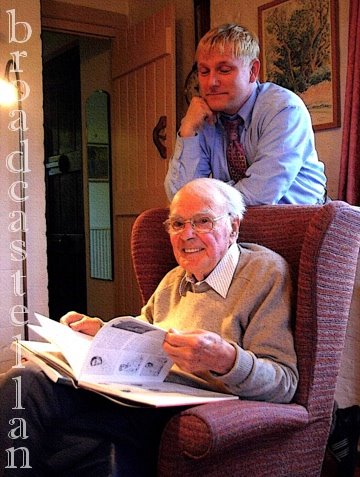
Last April, when we visited Edgar and his wife Jennifer in their home in Sussex, England, I glanced over the artist’s shoulders as he browsed the catalogue of his oeuvre and recalled scenes and events of a long, rich life. His memory was fading; but many of his impressions remained strongly etched in his mind and could be reproduced for inspection.

“My memory is not nearly as good as yours,” I told him when the task of recalling became more frustrating than rewarding; “but unlike you,” I added, “I have done so little that seems worth remembering.”