Officers’ Disagreement: Gregory Peck Prepares for Future Fights

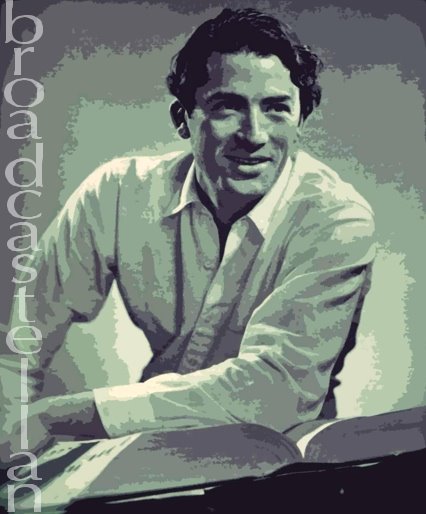
“The eternal providence has appointed me to watch over the life and death of all thy creatures. May I always see in the patient a fellow creature in pain. Grant me strength and opportunity always to extend the domain of my craft.” That is what was left of the Oath of Maimonides when it was uttered, on this day, 28 August, in 1945, on The Doctor Fights, a radio series dramatizing the challenges of physicians operating in the theater of war. Gregory Peck read those lines with a dignity becoming the profession; at the same time, he lifted The Doctor Fights above the dubious status of an infomercial for the pharmaceutical concern sponsoring the series.

The program was fast losing its edge, now that World War II had officially come to an end. The Doctor was fighting his last ratings battles; but the fight for dominance of the world market was just getting under way. “With the rest of America,” the sponsor, Schenley Laboratories, was looking “with great expectation toward the limitless afforded by peace. Opportunities for bettering the lot of all mankind.”

As anyone knows who has watched The Third Man, war-devastated Europe was a crippled, corrupted, and cadaverous body aching for medical treatment; and announcer Jimmy Wallington spelled out where the opportunities lay for improvement and profit: “One of the greatest among these gifts of medicine is Penicillin. Born of war, this promising drug will contribute much toward making a peacetime world in which disease and suffering reach a new and all-time low.” No mention is made of the all-time lows in the field of advertising, which hit the airwaves for the first time on this day, 28 August, back in 1922.

The Oath of Maimonides, which may be of German origin, is uttered in many variations; but most of them argue the physician to have been appointed to “watch over the life and health” of the human race, not over its “life and death.” This is a peculiar phrasing, given the program’s sponsor. Should doctors merely stand by and “watch over” people’s death, or do their utmost to see to its prevention? Perhaps, the war had been turning the Oath into a curse, as doctors were called upon to heal those who were prepared and ruthless enough to cause them harm.

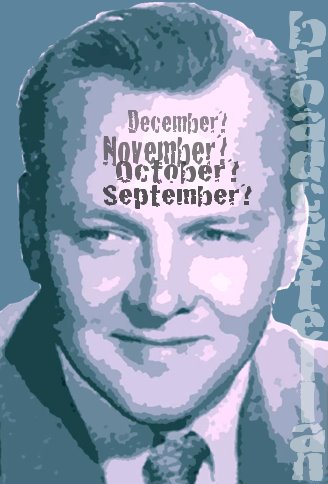
Such a story is the “Medicine for the Enemy,” the episode scheduled for 28 August 1945. Purportedly, it is the “true story of Lieutenant Commander Harry Joseph,” whom Peck portrays and who is interviewed at the close of the program. As a medical officer aboard the destroyer USS Osmond Ingram, Joseph is low on penicillin, but faced with the duty of having to care for the thirteen Germans who survived the sinking of their submarine.

“What if one of our own men’s injured before we get back to port,” the doctor confides in the captain, “and the only medicine that can save him has been used up on enemy prisoners?” He is reminded that it is “up to [him]” to make such decisions. Clearly, the Oath has been revised for such occasions of watching “over the life and death” of “creatures” foreign and hostile.

Foreign and hostile they are, those Nazi prisoners, men who would rather die than be treated by a non-Aryan. “The first time since I’ve been a doctor,” Joseph tells the German commander, a man twice blinded, by hatred and acid, “I’m not sure I care.”

The medical officer realizes that, in order to heal the body, he has to fight as well the ignorance and arrogance of the proud Nazis, applying “doses of truth, backed up by facts. That was the treatment used in combating the disease.” In dispensing this “anti-toxin for fascism” along with the Penicillin administered on behalf of the sponsor, Peck that was doing so, the actor who portrayed Joseph was preparing for the roles for which he became famous.

Little Noisemakers: Hedy Lamarr, Winifred Wolfe, and Lili Darvas

“Are you willing to undertake a dangerous mission behind the enemy lines, knowing you may never return alive.” Thus opens Cloak and Dagger, an early-1950s radio series dramatizing the experiences of OSS (Office of Strategic Services) agents during World War II, “ordinary citizens who to this question answered ‘Yes.’” On this day, 27 August, in 1950, Cloak and Dagger presented “The Black Radio,” a story “suggested by actual incidents” concerning an “OSS agent who broadcast allied propaganda from behind enemy lines.” A radio thriller about radio? I had to tune in, of course, but got distracted by a little incident very early in the story.

Narrated by Larry Haines as Major Mark Lange, “The Black Radio” opens in the “big gadget room” at the OSS headquarters in Washington. It is a quiet day when, all of a sudden, one of Lange’s colleagues grabs his arm and, warning him about an air raid, detonates a small device in his waste basket. Just a prank among co-workers. The latest OSS gadget, Lange learns, is “a little noisemaker” about the size of a lemon, “great if you are in a tight spot and want to start a riot,” his colleague laughs. “We call it the Hedy Lamarr.”

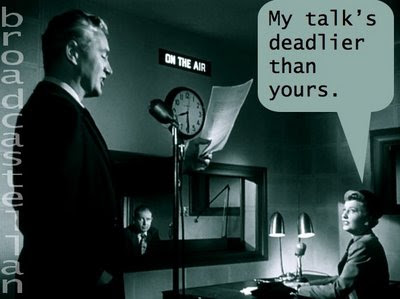
The real Hedy Lamarr, of course, was more than a “little noisemaker.” Not only was she an accomplished Hollywood actress, but an inventor as well. Together with theaforementioned composer George Antheil,, Lamarr (seen above with Ish Kabibble and Kay Kyser at a Command Performance broadcast) developed a patented radio control for torpedoes, based on the principle of “frequency hopping”; but the navy would not have anything to do with the invention . . . at least not until the patent had expired.

And yet, “The Black Radio,” along with a few other episode of Cloak and Dagger, is not the kind of he-man adventure you might expect from a series so titled. It was penned by short story writer Winifred Wolfe, who, aside from being for a time the head writer for the television soap opera As the World Turns, became known for her stories about career women. “Ask Any Girl”—she knew their stories. Perhaps, Wolfe was merely commenting on the sexism in the work field when she exploded that little crack about Lamarr. “The Black Radio” does have a formidable woman at its center.

Major Lange is sent to Germany to weaken resistance with black propaganda by cutting in on the local Nazi stations to tell the people of Freiburg the kind of stuff the OSS wants them to hear. This was to prepare for the US invasion of Germany. The “Black Radio” in that strategic region was already manned, Lange learns. Or, rather, it was womanned—and the agent, Lucille, has not been heard from in over three months.

Our narrator begins to fantasize about Lucille, imagining her to be young and beautiful. It is here that Wolfe plays a trick on the Haines and the audience—for Lucille has “neither been slim nor young for longer than [she] can remember.” She once “taught history in grade school; now she was “helping to make it.” For this, she is prepared to die.

A well-crafted episode in the Cloak and Dagger series, “The Black Radio” recalls Charles J. Rolo’s reports on the “pirate stations” broadcasting in “defiance of the Nazis.” In Radio Goes to War (1942), a signed copy of which is in my library, Rolo “recount[s] episodes in the melodrama” of what he calls “one of the most thrilling chapters in the history of underground movement.”

Ever since the outbreak of war, mysterious voices supposedly broadcasting from within Nazi-controlled territory have periodically been picked up by vigilant listeners. [. . .] If any of these stations was really operated inside of occupied Europe, it was a suicide venture. Modern technical equipment makes it an easy matter for engineers of the German radio to detect the whereabouts of a bootleg transmitter.

“The Black Radio” and its operators do not escape detection. Featuring the voices of Barry Kroeger (as a Gestapo clerk), German-born Stefan Schnabel, and Adolf Hitler (in newsreel footage), the play is rendered particularly poignant by the casting of Lucille. Heard in the role is Hungarian-born stage actress Lili Darvas, the Tony-Award nominated wife of playwright Ferenc Molnar, with whom she was forced to emigrate to the United States in the 1930s. Wolfe’s play gave Darvas an opportunity to impersonate a freedom broadcaster making some noise from within.

As it turns out, Wolfe reserved a strong supporting role as well for “Hedy Lamarr. The “little noisemaker” ends up creating a riot in the place where most people would expect Lamarr to work her magic: in a crowded movie theater.

Radio at the Movies: To Please a Lady

She played tougher than anyone else in pictures, and she was better at it. She could get a guy to fall for her and a fall guy to do anything for her, be it to lie, cheat, or kill. To please her was a dangerous game; but to displease her was a deadly one. She could make puppets of men; Charlie McCarthy was just target practice. I’m talking Barbara “Baby Face” Stanwyck, of course, the kind of social climber who shoved the ladder right into the face of those far from selfless fellas who lined up to give a gal a helping hand. In To Please a Lady (1950), Stanwyck proved that her very lips could kill. Well, as newspaper columnist Regina Forbes, Stanwyck had the means to finish the job properly: a microphone, a broadcasting studio, and a weekly radio program.

To Please a Lady makes you wonder what Stanwyck could have done with a regular radio broadcast; she certainly could have out-Hoppered—and, out-Hoopered—Hedda, who simply didn’t have the voice to match her name. That said, Regina Forbes is not quite as eager as Hopper to pick up any name dropped in her lap.

“But you can’t go to Newark tonight,” her secretary exclaims as Forbes rushes out to get a story that piqued her interest. Never mind that she already had an appointment with “Margaret.” “What about Margaret?” Forbes asks. “You know,” she is reminded, “the one who sings.”

That, if you require a footnote, is a reference to the aforementioned Margaret Truman, the President’s daughter. And Forbes had no qualms about standing her up to get the dirt on a disgraced speed racer (smug-as-ever Clark Gable), who, like Forbes, stops at nothing to be first at the finish line.

To Please a Lady is a contrived story, and one that is told none too well. So, as the camera follows Gable for another spin around the track, you get to fantasize about Stanwyck’s voice and the radio and . . . hang on, there’s Ted Husing. Best known for his sportscast, the CBS announcer was also heard on an early Eddie Cantor program and its successor Rhythm at Eight, starring Ethel Merman; an excerpt of a routine for the latter is reprinted in Husing’s book Ten Years Before the Mike (1935).

Of the “grand trouper” Merman, Husing says:

While admitting that television will double her value as a radio performer, I still think she is radiates personality over the air. Her speaking voice is vibrant with health and youth, and is highly individual, while her singing tones are thrilling. What more can you ask of a radio personality?

Television doubling the value of a radio performer? Obviously, this was written before radio took the corner around which it was assumed to be lurking all those years. And when it got there, round that bend, it crushed the competition. While radio was still not yet quite defeated as a dramatic medium back in 1950, there are signs of an impending crash in To Please a Lady.

Forbes may still have her radio program, and Gable as an avid listener, but she gets her news from television, which introduces her to Gable’s mug and convinces her to rush out to interview him. She may still be in a position to knock them dead with the lashings of her tongue—inducing one of her victims to commit suicide—but it is television that is giving her ideas.

Voices like Husing’s were fast becoming a mere adjunct to the flickering images on the small screen, filled as it was with the dust in which it left the art of giving you a mind’s eye view of it all through speech alone. You know, the thousand-and-one words it presumably takes to approximate a single picture.

My Eyes Are in My Heart, Husing told his former listeners in his second autobiography, published in 1959. And so they were. The book was written after he had gone blind. Stanwyck, around that time, was embarking on a career as a television actress and personality, which, aside from guest appearances, ranged from hosting an anthology series bearing her name to playing matriarch Victoria Barkley on The Big Valley. By then, plays for listening had all but vanished from US radio.

In Clover . . . or Out?

“Broadway. It’s a swamp that’ll drag you, breath by breath, into its shadowed pools. Or it’s a meadow shining with golden light. It’s a place and a time and a loneliness that reaches out for you, then beckons you into an airless room and locks the door. You get out or you don’t. Either way, it’s Broadway, my beat.” That was the opening of the final episode of Broadway Is My Beat, which ended its run as a summer replacement for The FBI in Peace and War on this day, 25 August 1949. Final episode? Not in hindsight, of course.

The series (which I previously discussed here) would return to CBS radio, eventually, and run for another five years; but most of the listeners tuning back on that evening in August had no clue. “You get out or you don’t.” Was detective Danny Clover going to get out of the black hole of summer, the “airless room” that was the slot allotted to programs on probation while the shows that sold were on hiatus?

A man dies in silence and in dark, and a city sets up a shrieking clamor, and you’re part of it.  You ride a scream through the crowded, heat-heavy streets.  And then you hit a dead end, and it’s a building, and a room at the top of the building.  And it’s a man lying in the center of the room while other men take notes on the history of his dying.

Executives, no doubt. Is Danny Clover to vanish into the dark of the city, to be silenced in the shrieking clamor of the network schedule, hard hit as it was by the coming of television, on which sponsors were ever more likely to lay their bet. It is hardly a coincidence that writers Morton Fine and David Friedkin concocted for their final outing that summer a story involving the death of a popular yet generally despised author—a murder perpetrated in a locked room, bolted from the outside.

To eat or not to eat. That was the question in the “Val Dane Case.” His room was “like a tomb,” Clover comments; except that it was “loaded with food, all jarred.” Canned food, waiting to be consumed. Food, food, everywhere, but the author “died of starvation.” Even his ghost has to laugh at this irony. Dane’s ghost writer, Lyle Brooks, that is, who is in “convulsions of hilarity” about the conclusion of the whole rotten business of penning The Great Fake, Dane’s latest piece of fiction, without receiving the credit promised to him. “What does it matter if his exact words are remembered?” a yogi observes with a equal lack of remorse about the dead man’s career.

The shady mystic who was Dane’s titular Fake is mum about the outcome of the case, a case of a murder whose victim was not blameless in the death of his own child. Only the ratings could tell whether the Beat should go on; and when the less-than-neat case is considered done and dusted, the narrating detective muses: “How do you fill it in reports, how do you make statistics out of it and file it in a ledger? How do your write sorrow as a number? How?”

Fine and Friedkin’s Broadway Is My Beat was known for its fanciful rhetoric; but “The Val Dane Case” was all metaphor . . .

To Hear, to Belong, to Submit: The Volksempfänger Turns 75

Nowadays, the concept of not having a voice is so alien to most of us Westerners that we fool ourselves into believing that what we are saying is of consequence, that because words are sent into the world they may also change it. We are too used by now to telecommune via phone or internet that the one-sidedness of broadcasting strikes us as downright barbaric. Why listen and be still when we can chatter and twitter, why take in a thought when we can put out a great deal of thoughtlessness with the greatest of ease? Publishing online or opining about world events on our slick mobiles, we are apt to believe that we have the world at our lips and by the ear. We are given gadgets—or, rather, we purchase them at considerable cost—that encourage us to exhaust ourselves in gossip while permitting others to check that our talk is indeed idle.

The talking disease is the talking cure of our modern society: the comforting illusion of having the power to say anything, anytime serves a system that, if our words mattered, would have to resort to more drastic acts of silencing.

Back in early 1930s Germany, Bertolt Brecht rejected radio as a distribution apparatus, a machine through which the few addressed the many, generally in the guise of speaking on their behalf. The German for broadcasting itself is misleading.  “Rundfunk” (literally, sparking around) hardly captures the one-sidedness of transmission. Brecht was looking forward to the day in which broadcasting could be a system of exchange, the kind of wireless telephony now available to us, at least technologically speaking.

Instead, German radio cut off all means of response other than compliance. It removed from the dial any voices that might utter second opinions. Effectively, it removed the dial itself by tuning the public to the official channel, and to that channel alone. Today, 18 August, the Volksempfänger turns 75. It was not simply the furniture of fascism.  It was its furnisher.

The Volksempfänger (the people’s receiver) fed Germans with whatever was in the interest of the Reich, that is, the governing body rather than anybody being thus governed. This privilege of being talked down to, of being shouted at and being shouted down, was offered at a discount—a discount that ended dissent in the bargain. Dictatorships, after all, depend on dictation.

Brecht had reason to be wary of broadcasting, a means of listening that precluded response. Does not the German language suggest that the German people are prone to being led by the ear? The German for “hearing” is “hören,” a related form of which is “horchen.” Both are the root of a great many words, and some weighty ones at that.

Take “gehören,” for instance, which means to belong, while “verhören” means to interrogate. “Hörig sein,” in turn, means “to be submissive,” and “gehorchen” means to obey. “Auf jemanden hören” means to pay heed. Remove the “jemand” (the anybody), and you have “aufhören,” which means to end, as free speech did when the Volksempfänger became cheaply available to anybody.

Today, we have the opportunity to receive as well as broadcast. We can take in hundreds of channels and put out millions of words. It calms many of us to the point of not speaking up. We can, therefore we don’t. A system that does not take the microphone away from us, that permits us to air our concerns, must be fair system. Why listen to anyone who tells us otherwise? Well, “Wer nicht hören will muss fühlen,” a German saying goes. Its meaning? Those who don’t listen shall feel the consequences.

Why Carry a Torch for Joan When She Puts Her Career to It?

I have always been fortunate in having what is now conveniently termed a gaydar. Long before I knew what I could long for, long before I even dared longing, I simply knew or sensed what what was. What was what I was, that is. I looked into Raymond Burr’s eyes or listened to disco divas like Hazell Dean and, somehow, I could relate. Not to whatever their lines or notes were, not to the label that may nor may not become attached to their names, but to the individual behind or beneath, to the one who agreed to perform what was deemed suitable for mass reproduction. Ours was, is—and, I suppose, has to be—a society of re-producers, a society that accepts those who do not reproduce only as long as they churn out plenty of product and generate heaps of dough.
For all my queer gifts, which somewhat fail me here in Britain, where every other male seems somehow gay to me (gay, I say, not desirable), I never developed a sense of camp. I resent camp. To me, it is an act of wilful misreading, and that is empowerment at too great an expense—somebody else’s. You need to read the lines first before you can sneak between them, let alone get palimpsestic. After all, it is not that there has never been anything other to read, hear or see than the conventional, the traditional that then is mercilessly turned into—or, if you will, exposed as—travesty. There is always some code that permits you to identify—and identify with—a designated misfit or underdog, a guise for what you might feel yourself to be. Perhaps I am old-fashioned that way; but I do not insist on breaking something to pieces if it does not bend toward me.

I welcome melodramatic manipulation. I let it happen. It is an openness I bring to the popular arts, however cloaked in conventions and coded accordingly. How irritated was I when, during a screening of Douglas Sirk’s Imitation of Life at New York’s Public Theater, the audience started to snicker and swoon at the sight of Lana Turner’s admittedly fabulous sunglasses. I was absorbed in the to me already familiar action. I recall my father, a Hemingway-gone stoic who would rather die an alcoholic (which he did) than admit to being vulnerable, reduced to tears at the conclusion of the movie. And I respected him for that. If you cannot get drawn in at least once, just withdraw. I see no use in intellectual exercises removed from any felt engagement with the arts.

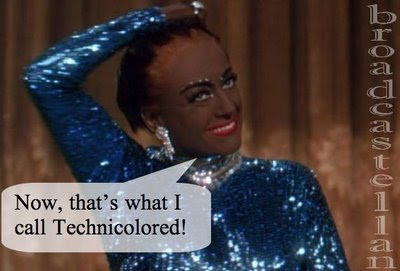
Sometimes, though, no involvement can be forced, no manipulation willed. You are being pushed or taken aback too far to venture an approach. Last night, for instance, I caught up with Torch Song (1953) and could only gape in disbelief at the misfireworks before me. I very nearly felt guilty watching the carnage as Joan Crawford goes into her blackface “Two-Faced Woman” routine as if this wreck of a vehicle were another Band Wagon. It is the self-destructive act of a perfectionist too delusional to notice the damage this would mean to what was left of her career.

However removed from any sense of reality, the story is remarkably close to the star’s own Hollywood history, reflective of her state and status then, of her demise as a leading lady which this film, in turn, accelerated. All the while, though, Crawford failed to elicit my compassion; her earnest and joyless quest for perfection turns Torch Song into a stilted, lifeless performance.

Torch Song is not quite Trog; but for all its glossy production values, it is monstrously inept. Crawford’s humorless performance is as uncomfortable to watch as the carefully choreographed moves of a dancer too focused on getting the steps right to notice the misstep of it all, too fixed on the floor to see where it is going.

Torch Song is, at best, a rehearsal—a rehearsal of a swan song recorded in the act of drowning. If only there had been room for a tongue in Crawford’s cheek, the dire melodrama leading up to the supposed triumph of “Two-Faced Woman” would not have been quite so jaw-droppingly awful. Even the film’s reflexivity does not improve matters, since the entire production is self-delusional rather than self-conscious. Torch Song is all about Crawford, not All About Eve. It may be concerned with the staging of a show and the dropping of masks; but even what is going on behind the scenes is all cardboard and paste.

It seems to me that Torch Song came about twenty years too late for Crawford. I don’t mean that she was too old for the part. Like Madonna, who turns fifty today, Crawford had an amazing figure on which rested the head of a business-hardened professional. To bowdlerize Sheridan, the trunk’s modern, ‘tho the head’s antique. No, it isn’t a question of Crawford’s fitness, but of the datedness of the material, a grab bag of hand-me-downs it would be generous to describe as contrived.

The only genuine article in the entire production is Marjorie Rambeau, who was both old and bold enough to play Crawford’s mother, imbuing her few moments on the screen with a wit and restrained sentimentality reminiscent of parts that often went to Thelma Ritter.

Today, Torch Song is considered classic camp, a status not reflected in the tepid reception from Internet Movie Database voters. Being among them, and having rated some 160-odd pictures so far, I am puzzled as to how to judge this unspectacular if spectacularly misjudged production. I am almost beginning to envy Michael Wilding’s character, a blind man to whom Crawford’s Gypsy Madonna appeared as the remembered image of her promising and glorious past; but then I keep thinking: Joan, as flattered as you might have been by the invitation to work once more at the studio that made you a star, you should not have taken those steps like a blissfully oblivious Norma Desmond. You were never away from Hollywood long enough not to know your place there. If only you had slipped and cracked a smile for all those people out there, in the dark, I would have been happy to carry the torch.

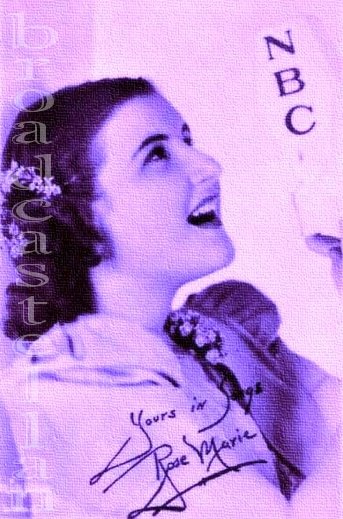
“How’dja Like to Love Me?”: Baby Rose Marie Turns . . . She Is . . . Well, Here She Is!

I couldn’t believe my eyes. I couldn’t believe my ears, either. That is how I felt when I first watched International House (1933) and saw the sensational Baby Rose Marie belting out “My Bluebird Is Singing the Blues.” Watch out, Shirley Temple, I thought, this kid has got a little more octane; she’s more Maker’s Mark than Little Miss Marker, more moonshine than Sunnybrook. Today, that kid is celebrating her ( )th birthday. Her shoes may be on display at the Smithsonian in a few weeks; but, later this year, she is also going to be back on the screen—in a movie adaptation of the musical revue Forever Plaid. To find out more about the wunderkind from her own lips, I am tuning in to the first installment of a five-part interview with Rose Marie, recorded in 1999.

The interviewer, one Karen Herman, is about as dense as a pea souper, only far less absorbing; but the quondam phenom doesn’t seem to be phased by it, brushing aside or simply ignoring what she does not care to hear or answer: “Age is only good with wine and cheese,” she responds when Herman quizzes her on her date of birth, something “Baby” had to deal with right from the start of her career.

She also had to deal with doubters like me who, listening to her, imagined a rather more mature performer. “I never sounded like a child. I never had a Shirley Temple voice. Always had a Sophie Tucker type of voice,” Rose Marie commented. Now, that is a problem for a performer who is not seen. Sure enough, the singer-actress recalls, “people started writing in letters saying ‘that’s not a child, that’s a thirty-year-old midget.'” So, the alleged midget was sent on tour around the country.

Very little of Rose Marie’s many years on NBC radio is extant or readily available today. A clip from the 14 March 1938 broadcast of the Baby Rose Marie Show may be found here. Among the number is the catchy “How’dja Like to Love Me?” from College Swing (1938). Nearly a decade later, in 1947, “the little tyke who used to be in movies and on the air” was featured on Command Performance, hosted by a cheerfully daft Ken Niles, who was looking forward to holding her in his lap once again. Ginger Rogers set him right by describing Rose Marie to listeners as a “grown-up, luscious, attractive blonde.” “Well . . . ?” Niles replies rather salaciously and invites the guest to come up to his apartment to look at his rattles.

Mercifully cutting short the patter, Rose Marie sings “My Mama Says No, No” and, later in the program, goes back to the year 1926 BS (“before Sinatra) and does a swell Jimmy Durante impression (also heard on Durante’s own show).

This anniversary strikes me as just the occasion to reopen my Gallery of Radio Stars . . .

Fight . . . Headache . . . Three . . . Ways

I’m fighting them any which way I can. Headaches! This time, though, nothing seems to work. And all the while, during a very nearly sleepless night, I’ve been torturing myself, thinking of the old Bromo-Seltzer train and its insistence that listeners to those Bromo-Seltzer sponsored programs “fight . . . headache . . . three . . . ways.” That meant taking care of stomach upset and jangled nerves into the bargain. Jangled nerves? I don’t know, but somehow that train whistle is the last thing you want to hear when you are under the weather (or whatever is firing up that blasted steam engine in my cranium these days).

The Bromo-Seltzer train was a menace, if you ask me; but it was also a marvel. It came to life through the magic of Sonovox, one of those fabulous if artistically insufficiently explored sound effects devices used in 1940s film and radio, where it was largely relegated to commercial duties. Its potential becomes no more apparent than in those insinuating drops of water dripping on A Letter to Three Wives (discussed here). As Time magazine described the invention in its 24 July 1939 issue, a recorded sound is “fed through wires to two little biscuit-shaped gadgets which are placed on each side of the throat against the larynx. These gadgets transmit the sound vibrations to the larynx, so that the sound comes out of the throat as if produced there.”

For comic effect, the novelty was used in the comedy-thriller You’ll Find Out (1940; mentioned here) and Disney’s Dumbo (1941). The Sonovox was also heard in The Falcon and the Co-eds (1943), and, rather more hauntingly, in the Joan Crawford-starring melodrama Possessed (1947; mentioned here). The swan song for the Sonovox appears to have been The Good Humor Man (1950), as a fellow web journalist shares it here, with a clip from the film.

The other day, I caught another glimpse of the Sonovox in operation while watching the The Reluctant Dragon (1941), a promotional tour of the Disney Studios filmed during the making of Dumbo, which was released early the following year. The proxy visitor taking the tour on our behalf is Algonquin Round Table wit Robert Benchley (pictured).

Tonight, though, it had better be a silent movie. Why not a stroll in Hitchcock’s Pleasure Garden, (1925)? After all, it is Alma Reville’s birthday.

. . . but Grandmother Was a Radio

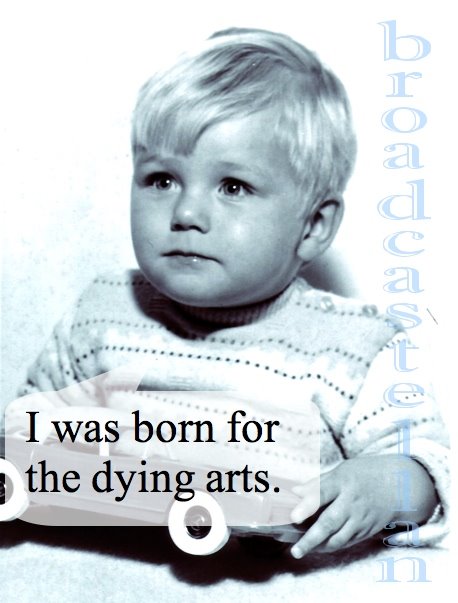
I am, in the words of a fellow webjournalist, “a child of television.” Being a latchkey kid, the TV set was a surrogate parent to me. It was around. It talked to me. And when it began to bore or annoy me, I had sufficient force in my little finger to evade its glare. True, during my early childhood, Germany had only two television channels (father and mother, you might say) and programming did not start until mid-afternoon; but it still came home earlier than my parents. At night, when I was assumed to be sleeping, I re-enacted what I had seen and played out stories with whatever I could lay my hands on. And those hands were greedy enough to grab at straws, or less.

When separated from my folks during a three-months stay at a sanatorium (I was a sickly child suffering from chronic bronchitis), I was so thirsty to satisfy my artistic impulses that I used saliva to draw images on the bed linen, for which offense I was rebuked by the nurses who, lacking both the imagination and the sense of humor to appreciate such spitting images, accused me of having wetted my quarters. I could have done that by crying; it was the only sound to penetrate the nightly silence.

Breathless as I was, I retreated into an inner world, imagining my ear to be a knob at the turning of which I could talk to the animals. Stuffed animals, that is. No sounds were made; we communicated without utterance. That way, I did not have to speak on their behalf, but could believe them to be responding without feeling quite so pathetically lonely. For the most part, my imaginings remained non-aural. I created motion pictures using rolls of adding machine paper my mother brought home from work; I invented cartoon characters and penned stories the moment I learned to make letters add up to words.

It was only after we moved into our own house, the house my father built for us, that I got intimately acquainted with that old-fashioned kind of television for which you supplied the picture. I got a radio. Not the enormous console that stood in my grandparents’ dining room, but a portable one with a built-in tape recorder. Soon I got carried away by sounds and thrilled to foreign voices.

I was not easily weaned off TV, though.  Once in a while, when I was assumed to be sleeping, I attempted to watch television through my binoculars (ours was an L-shaped house, and from my window I could peep into the living room); but gradually I learned to make the most of the wireless. Before my English was good enough to understand what was being said, I tuned in to the British Forces Broadcasting Service; I intercepted citizens’ band radio conversations and went dxing in search of faraway stations.

Yet what really awakened my love for the drama of sound was not the radio at all—it was a gadget my father insisted on installing in our house. It was an intercom. Now, our bungalow was hardly large enough to warrant such a device; but Papa was a professional electrician and avid hobbyist, aside from being somewhat of a show-off. While we were certainly not above shouting at each other, the family had to have an intercom (and, come to think of it, we had it before we got our first phone). It did not make us communicate any better; but it was certainly an interesting feature.

One night, when the wallpaper in my room (my very own room!) had not yet lost the smell of incomplete attachment, my father was ready to put the talking machine to the test it. He went into the kitchen, the control center from which we could all be summoned to the table and, I became aware later, monitored in our doings, provided we weren’t hush-hush about them or dared to switch off, suggesting we had something to conceal. Then he pressed a button and started talking to me as I was lying in bed. We chatted for a while; but, knowing my father close by and not being used to holding longer conversations with him, the novelty of the exchange soon wore off . . . until Papa hit on an exciting idea.

He went “off the air” for a while, during which time he rummaged through the kitchen drawers. I could hear as much through the closed doors; but my ear was fixed on that cream-colored box on the wall. Then it went on again; and the next sound I heard was not my father’s voice, but . . . what? The splank of a spoon in a pot, the sploshing of water in a glass, the swooshing of a tea towel being flung through space? Sounds. Mundane yet suddenly magical. And while I was invited to guess their origins, I also imagined their destination. I heard a church bell where others saw a pot, found an ocean in a cup, and saw, not a tea towel, but a dragon spreading its giant wings.

It was this little sound effects quiz that brought home a new world to me. Once I realized that there did not have to be a single right answer to those sonic puzzles, there opened up a realm of noisy possibilities. Sounds divorced from their maker, ready to be imbued with a new, almost independent life. Sounds waiting to be taken in like stray kittens, to be dispatched like carrier pigeons. Those were the sounds of latchkey child longing . . .

All Washed Up: A Lament for Those Soap Sisters

“Poor Old Helen Trent,” a fellow webjournalist exclaimed the other day. It is right and proper to join in this lament; not only was she single, middle-aged, and beset by troubles into which she was drawn each quarter hour to tease but never quite satisfy those members of the radio audience who had the morbid curiosity that is a requisite for serial listening. She now has very little to show for all those years of turmoil. While still recalled by many who used to follow her getting nowhere fast, she is very nearly silenced today, with only a few chapters of the long-running serial readily available to anyone desirous to catch up. Even worse is the fate of Stella Dallas (pictured), who does not get a single mention in Robert C. Allen’s Speaking of Soap Operas (1985), one of the books I consulted for the occasion.

When I began to research American radio drama and narrative (there is something dissatisfying to me in the term “radio drama,” considering the importance of the narrator in most of these fictions), I wondered whether I would ever get to hear the programs I had hoped to write about. In my recovery efforts, I went so far as to dig up MA theses and dissertations written during the 1930s, ‘40s, and ‘50s, if only to marvel at the material accessible to a student tuning in back then. Sure, I could have asked some of the old ladies whose Manhattan apartments I was cleaning back then; but, my memory being less than elephantine, I have come to distrust the recollections of others and much rather consult contemporary sources. One such is “The Radio Serial,” an unpublished thesis by Stanley Robert Rowe, who received his MS in 1949 from Boston University.

As Rowe puts it, his “treatise is based upon six weeks of regular listening in July and August 1948 to all the dramatic serials offered by the two radio networks which broadcast them [i.e. NBC and CBS].” Can you imagine? Six weeks with Stella Dallas, Helen Trent, and Ma Perkins! These days, one has to make due with isolated chapters; and, in some cases, with less.

In the summer of 1948, over thirty daytime serials were being broadcast each weekday over CBS and NBC alone. Beginning at 10:30 AM and concluding at 5:45 PM, NBC presented, in order of their broadcast time, the serials Road of Life, Joyce Jordan, MD, This Is Nora Drake, We Love and Learn, Lora Lawton, Claudia, Today’s Children, Light of the World, Life Can Be Beautiful, Ma Perkins, Pepper Young’s Family, Right to Happiness, Backstage Wife, Stella Dallas, Lorenzo Jones, Young Widder Brown, When a Girl Marries, Just Plain Bill, and Front Page Farrell.

CBS began airing its line-up of serials at 11:45 AM; by 3:15 PM, listeners could tune in to Rosemary, Wendy Warren, Aunt Jenny, Helen Trent, Our Gal Sunday, Big Sister, Ma Perkins, Young Doctor Malone, Guiding Light, Second Mrs. Burton, Perry Mason, This Is Nora Drake, Evelyn Winters, David Harum, and Hilltop House.

Now, why would anyone be willingly subjected to such programs? Why, to have something to say about them, of course. Stating his “reason for wanting to listen to all the serials,” Rowe explained:

First, I hoped to have as many examples as possible to substantiate and illustrate any conclusions I reached; and also, I wished to be able to write authoritatively about all the serials offered on a nation-wide network and determine the range and variety they represented. Far too much criticism is made of radio which is based on too little actual knowledge of the medium and its programs. In auditing all the radio serials, I hoped to be able to avoid sweeping generalizations which overlooked significant exceptions.

Yes, this is how writing about radio needs to start: with listening. Which, alas, is precisely why I have to remain silent about poor Stella Dallas and her sudsy sisterhood . . .