
Playing, Dead and Alive: Tennyson, the Internet, and the Radio Racket

Well, the afternoon is about as lively as a cancelled séance whose medium walked out due to death in the family. For the past few days, picking up where I left off a long time ago, I’ve been flicking through two sets of an English literature anthology. Rather than tossing out the old for the new, something I’d be happy to do with a pair of shoes, I’ve been comparing the volumes, pondering the expulsion or demotion of canonical authors whose once prominent works have been removed from subsequent editions. One such author now represented by fewer works is Victorian poet laureate Alfred, Lord Tennyson.

Now, reading Tennyson on a gloomy day does little to brighten the mood; but the following lines, from “In the Valley of Cauteretz” (1864), seem worth reviving, if only to remind me of my present state of mind.

The speaker of the poem, whom we may or may not take to be Tennyson himself, returns to a stream he once visited with a friend, now dead:

Thy living voice to me was as the voice of the dead,
And all along the valley, by rock and cave and tree,
The voice of the dead was a living voice to me.

Tennyson may have been revisited by the memories of his dead friend Arthur Hallam; but to me these lines somehow echo my own noisy yet quiet present, conjuring up my life among the voices of the past, my dwelling and revelling in recorded speech. Why do many of the radio voices I replay each day, transcribed sounds of live broadcasts featuring people now living no longer, sound so much more alive or closer to me than the voices of the present day?

Radio, back in the 1940s, when thousands of men were dying in battle far from home, was complicit in this sense of being visited by those gone or lost, a conjuring act achieved by a mere twist of the dial. Radio often presented itself as a spiritual medium, a modern device capable of annihilating space as well as time. On this day, 2 October, in 1944, for instance, Walter Huston introduced a play about the life of Thomas Paine by remarking that the words of this man called “Common Sense” still speak the

thoughts of many of us even today, in the year of 1944. And because of many other thoughts that this man put into words, we, in these troubled times, reach across the years to shake hands with him, to shake hands with Thomas Paine.

Sure, Thomas Paine sounds an awful lot like Edward G. Robinson, in whose hands lay Robert L. Richards’s script for that broadcast of “The Voice on the Stairs,” produced by the Cavalcade of America. Still, the phonic handshake was neither phoney nor merely symbolic; it was an act symptomatic of radio’s exploitation of our sense of revenance when we hear a voice from the past.

I am reminded of a friend of mine (the one with whom I went to the mystery book store a while back) who threw out her answering machine after playing back the voice of her dead father, still calling for her from the sonic loop of an old tape recording. When we look at pictures of dead people, the subject does not spring to life in the process of beholding; instead, pictures of the past or dead tend to serve as memento mori. They are a representation that does not quite render present, a reminder that is merely an aid to the act of calling to mind, whereas a recorded voice—sound being alive for the duration of its occurrence—streams through the ear canal into the now of our presence before fading into memory. Emanating from the living or the dead, it comes to life anew with each listening.

Dead, alive? The living dead? Or, speaking Tennyson, “Death in Life”? Perhaps I have dwelled among these sonic revenants for too long, becoming in turn, like Widmark’s character in the Inner Sanctum thriller “The Shadow of Death” (also cast on this day, back in 1945), dead to the world. Being engaged in this kind of séance, in the retrieval and re-presentation of past voices, I at times sense being shut out from and slipping out of touch with the living. Just like being caught in the internet, living in a world of sound is, after all, only the exposure to an echo of life—a reverberation produced by the clashing bones of a life stripped of flesh.

On This Day in 1944: Home Folks Lose Ground to Plot Developers

Well, this will sound like a familiar story. A small house (halfway up in the next block, say) is being torn down after its long-established and well-liked owners cave in to some corporate big shots who want to get their hands on a valuable piece of property that seems just ripe for redevelopment. The transformation achieved proves agreeable enough to all; but to those who remember the neighborhood and used to stop by at the old house, there is something missing in the bright new complex that has taken its place.

No, this is not the plot of Vic and Sade, the popular American radio series that ended its run on this day, 29 September, in 1944. As discussed previously, Vic and Sade had no such socially relevant plots. In fact, it didn’t have any plot at all, which is precisely what distinguished it from the soap operas and situation comedies that came to define American storytelling on radio and television.

You might say (or let me just do it for you) that Vic and Sade was being done in by plot developers—by those who were eager to streamline dramatic storytelling into a solid row of daytime serials and evening sitcoms. In the early 1930s, soaps and comedies had been far from antithetical. Weekday serials like Amos ‘n’ Andy or Lum and Abner told continuing stories whose prevailing mood was cheerful rather than somber.

Eventually, however, savvy producers in search of reliable and lasting formulas determined to strengthen such modes of storytelling by separating the slow tease of the serial from the quick repartees of situation-derived comedy, thereby turning daytime sudsers into murky melodramas that thrived on an atmosphere of present gloom and dark forebodings.

Having no future in washboard weepers, radio vaudevillians, including long-established acts like Burns and Allen, felt compelled to revamp their comic routines to meet the demand for this new kind of zinger and laughter punctuated two-acter.

Vic and Sade, which was not performed before a live audience and which depended neither on one-liners nor on storylines for its lasting appeal, was least likely to adapt successfully to the new situation in comedy. It told stories, all right, but it did not rely on plots. It created characters by letting them go on about something or nothing at all, by reminiscing and gossiping, laughing and lamenting.

Imagine the aforementioned Golden Girls never leaving their kitchen table and forever sharing stories about St. Olaf, the Old South, about Brooklyn and Sicily. That’s pretty much what Vic and Sade Gook, son Rush (later, adopted son Russell) and Uncle Fletcher were doing, day after day, year after year.

What kept listeners coming back to the “Small House” was that writer Paul Rhymer kept on delivering anecdotes about certain colorfully named individuals who were often heard of but never heard, thereby creating the illusion, for faithful listeners, at least, of becoming part of a comfortingly stable family and their large circle of odd friends and acquaintances.

It mattered little that some of those folks Uncle Fletcher delighted in talking about sounded as if they had been brought into being in the very process of animated yarnspinning. They—and good old Uncle Fletcher along with them—came to life for the audience in that manner anyway.

When, in the summer of 1946, Rhymer did adhere to the trend and refashioned Vic and Sade into a weekly, half-hour situation comedy, the charm and wit of the small house talks was lost. Gone was the intimacy of the living room chats or porch meetings as some of those odd friends and neighbors began to step inside, filling the house with needless noise and disturbing our image of them. Equipped with the cartoonish voices of sitcom stock characters, they did not become any more real, but a great deal more irritating.

Not surprisingly, the relocated Gooks disappeared after less than three months. It was a plot that the developers of radio’s new and rigid storytelling had dug for them.

Past Escape/Inescapable Present: Mr. Moto, the Orient, and the Death of Tokyo Rose

Well, I am not a Houdinist. I mean, a hedonist who escapes artistically. No matter how many supposedly escapist works I see, read, or hear, I can never entirely lose myself in them; instead, I seem to bring to or burden them with my own story and the stories of our time. By the time I am halfway through a yarn like Thank You, Mr. Moto, a 1936 thriller I am currently reading, I have spun such a web of references that I am thoroughly entangled, lost not in the world of the text but in the context of the world I invariably find between the covers, the world that draws my mind’s eye to the not so blank spaces between the lines. It is through my writings that I try to uncover a few intelligible strands in the muddles my mind makes while reading, listening, and watching. Let me give you a “for instance.”

I had considered continuing my recent discussions about the challenges of adaptation by commemorating the anniversary of “Alice in Wonderland,” the first of a two part radio version broadcast in the US on this day, 28 September, in 1937. I took a copy of Lewis Carroll’s fantasy from my bookshelf, but left it unopened. Surely my plans would be undermined somehow, I thought, when I stepped into the floating library that is our bathtub. And so it was. Alice had to wait, and is waiting still. The aforementioned Mr. Moto was not done with me yet.

Ever since I saw Peter Lorre’s impersonation of the man a few decades ago, I’ve been meaning to read a Mr. Moto mystery; so, browsing with a friend at the aforementioned Black Orchid Mystery Bookstore in Manhattan last month, I gladly accepted the gift of a 1980s paperback copy of Thank You, Mr. Moto, the film adaptation of which was readied for release at the time when “Alice” was being squeezed through radio’s rabbit hole. Before Moto found himself in quite another ditch after the attack on Pearl Harbor, a hole from which he only sporadically and tentatively reemerged, Pulitzer Prize winning author J. P. Marquand allowed the Japanese agent to speak candidly about American culture and politics.

Indeed, I was rather surprised at some of Mr. Moto’s observations when I read them today; and considering that the Far and Middle-East—contested or world market-contending nations, regions invested with suspicion whose future is being claimed by suspicious investors from the West—are such an Occidental headache these days, Mr. Moto’s remarks about America’s view or conception of the East still ring true today:

“Affairs in the Orient are so complicated to-day. They grow so difficult, if you will pardon my saying so, please, because of the suspicions of your country,” Moto tells the American narrator; “and because of the suspicions of certain European nations regarding the natural aspirations of my own people.” Such “suspicions,” Moto claims, “make the most harmless activities of my country very, very difficult”; but did not the US and Britain “seize” and engage in “colonizing efforts” in the past? he reminds the American.

To the American listener—captured, along with Mr. Moto by a Chinese rebel—Moto’s talk seemed as strange as the “conversation at the Mad Hatter’s tea party.” Apparently, Alice was eager to make herself heard, waiting impatiently outside my bathroom and intruding herself on the story I had chosen instead. But I let Mr. Moto continue as he told apologetically of a “disturbing, radical element” in his country, “somewhat bigoted and fanatical,” which had been “a source of very bad annoyance.” Still, he asked, does not even a “great nation” like America have its “disturbing elements?”

The US, it seems, has two main responses to the world, commercial interests aside: indifference and suspicion, but rarely a sustained interest in or engagement with other cultures, cultures it is prepared to absorb or incorporate, but not to see develop independently.

Reveling in the fantasy of “equality,” it does not deal well with difference, at least not a difference that goes beyond a certain savory and amusing flavoring. Those who refuse or fail to be incorporated, those who remain torn between or by cultures, are labelled suspicious or serve as scapegoats to be impaled on the fence on which they seem to be defiantly perched. Any ambiguous “not for” tends to be read as a clear “against.”

When I stepped out of the tub, already convinced to make Mr. Moto, rather than Alice, the topic of the day, I learned of the death of Iva Toguri, the American who became known as Tokyo Rose and was convicted of treason after broadcasting to Americans from Japan, where she was sent by her mother to attend to an ailing relative during the Second World War.

Even though little could be found that was hostile or harmful in her broadcasts and charges against her appear to have been manufactured, she was stripped of her American citizenship and sentenced to ten years in prison, just about the time it took Mr. Moto to rehabilitate himself in the service of anti-Communist America.

Judged by the either/or dynamics of American thought, those positioned in between are as suspicious as those, like me, who cannot get straight to the point simply because there are so many dots left to connect.

Spike Jones: The Man Who Found His Hit in Hitler

Well, this is a tough time for heroes. There might still be a need for them, but we stop short of worship. The nominal badge of honor has been applied too freely and deviously to inspire awe, let alone lasting respect. Even Superman is not looking quite so super these days, his box-office appeal being middling at best. And as much as I loathe the cheap brand of sarcasm that passes for wit these days, I am among those who are more likely to raise an eyebrow than an arm in salute.
Compared to the hero, the villain has proven a more durable figure. After all, it takes considerably more effort to forgive than to forget. Besides, we appreciate the convenience of a scapegoat, of a stand-in for our collective guilt; one hideous visage to represent what we dare not find within ourselves.

In government propaganda, the villain serves to remind us against (and, by indirection, for) what we are supposed to fight—a single face to signal what we must face lest we are prepared to face doomsday.

So, who is the next big thing in villainy—fading pop icons excluded? Is there any such person alive today who is as reviled or dreaded as the man who paved the career of one of the most successful US musicians of the 1940s? Adolf Hitler, I mean. That’s the villain. The musician, of course, was bandleader Spike Jones.

A California native born in 1911, Jones had his breakout hit in the early 1940s with the song “The Führer’s Face,” a merry war mobilizer of a tune that went something like this:

When Der Führer says, “We ist der master race”
We Heil! Heil! Right in Der Führer’s face,
Not to love Der Führer is a great disgrace,
So we Heil! Heil! Right in Der Führer’s face. 

When Herr Goebbels says, “We own der world und space.”
We Heil! Heil! Right in Herr Göring’s face.
When Herr Göring says they’ll never bomb this place,
We Heil! Heil! Right in Herr Göring’s face. 

Are we not the supermen?
Aryan pure supermen?
Ja we ist der supermen,
Super-duper supermen. 

Ist this Nutzi land not good?
Would you leave it if you could?
Ja this Nutzi land is good!
Vee would leave it if we could. 

We bring the world to order.
Heil Hitler’s world New Order.
Everyone of foreign race will love Der Führer’s face
When we bring to der world disorder. 

When Der Führer says, “We ist der master race”
We Heil! Heil! Right in Der Führer’s face,
When Der Führer says, “We ist der master race”
We Heil! Heil! Right in Der Führer’s face.

Are we still singing chart-topping songs like this about any one of our present-day (mis)leader? Should we? Is to laugh at them enough? Might the laughter perhaps be cheap and the joke on us? I don’t presume to have any answers. Listen to Spike Jones and his famous song on BBC Radio 4 this week, a song initially banned by the BBC. Don’t starting hitting your grandma with a shovel, even if yours, as mine, was working for one of Germany’s biggest names in fascism.

Mr. Benny Gets the Key to Baldpate

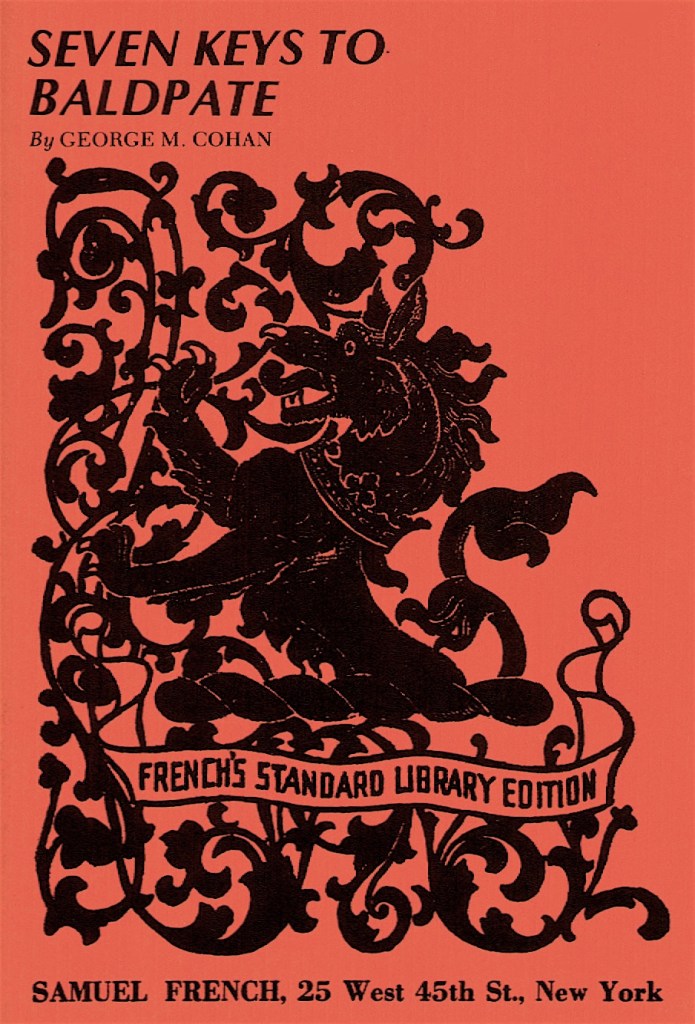
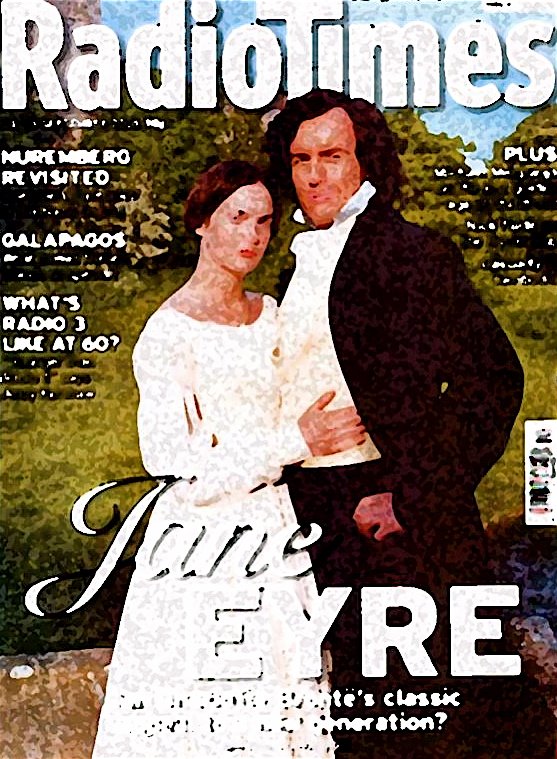
Well, I feel rather less prickly than yesterday. My cold seems to be on its way out and, having spent some time out of doors in the warmth of the autumn sun, I feel somewhat more serene and benevolent. Speaking of doors (a transition more creaky than the farce I am writing about today): Having complained previously (and elsewhere) about the conventional and therefore superfluous adaptation of Jane Eyre now flickering in weekly installments on British television, I am going to mark the anniversary of a decidedly more inspired variation on what was once a similarly familiar work of fiction, Seven Keys to Baldpate, a crowd-pleaser that was revived for radio on this day, 26 September, in 1938.

Granted, it is easier to rework a piece that does not warrant the reverence befitting a literary classic such as Jane Eyre, a respect that can be artistically stifling when it comes to revisiting or revising what seems to demand fidelity rather than felicitous tinkering. A mystery novel conceived by Earl Derr Biggers, the creator of Charlie Chan, Seven Keys opened many more doors after going through the smithy of theater legend George M. Cohan. Unlike Biggers, Mr. Cohan did not play it straight, but turned the thriller into what he then sold as a “Mysterious Melodramatic Farce”—starring himself.

In Cohan’s farce, the thriller writer Bill Magee accepts the $5000 challenge of a friend who dares him to pen a novel within twenty-four hours. To achieve this, the author is being given what he believes to be peace and quiet—the only key to a remote resort shut down for the winter.

During his night at Baldpate Inn, the supposedly single guest is disturbed by an assortment of singular strangers, lunatics and villains, until his friend shows up to confess that the bizarre goings-on were a practical joke designed to illustrate the ridiculousness of the author’s improbable plots. The epilogue of Seven Keys discloses, however, that the action of the play was a dramatization of the novel Magee actually managed to complete that night. He won the wager by fictionalizing the challenge.

Opening on 22 September in 1913, the play became an immediate and oft-restaged favorite with American theatregoers. It was subsequently adapted for screen and radio. When, some twenty-five years after its premiere, the producers of the Cecil B. DeMille hosted Lux Radio Theatre got their hands on this potboiler, they slyly revamped it as a commercial property fit for the latest medium of dramatic expression.

In his introductory remarks, DeMille promises the listener a “special treatment” of the play—and that, for once, was no overstatement. As I have discussed at length in Etherized Victorians, my study on old-time radio, the broadcast revision is not so much a rehash as it is an media-savvy update of the original.

Whereas Cohan’s version celebrates the victory of popular entertainment, of readily digested pulp fictions churned out for a quick buck, Lux writer-adaptor George Wells transforms Seven Keys into a radio story—a story about radio that parodies the anxiety of former vaudevillians-turned-broadcast artists to achieve lasting success, to be remembered long after the shows in which they starred week after week had gone off the air—to become cultural icons despite their invisibility. And those keys to uncertainty were handed to the man who had been through it all and stayed on top by knocking himself down, fall guy comedian Jack Benny.

Instead of a successful novelist, the artist now up for a crazy night at Baldpate is Jack Benny, as “himself,” a frustrated thespian who accepts the challenge of developing a suitable dramatic vehicle for himself after having been turned down for serious dramatic parts time and again. Benny’s challenger is no other than Mr. DeMille, who, in a rare stunt, not only introduces and narrates the play, but acts in it, and that without having to drop his director-producer persona. Throw in a few Lux Flakes and it comes out a clever bit of promotion all round.

The unpretentious yet self-conscious reworking of a play as old hat as Baldpate into a comment on the recycling business of radio entertainment—and a demonstration of how to lather, rinse, and repeat successfully—is one of Lux‘s most ingenious and engaging productions.

Eyrebrushing: The BBC’s Dull New Copy of Charlotte Brontë’s Bold Portrait

Well, I could blame it on the medication. Or it might be this holiday souvenir of a cold that is dulling my senses. I sure haven’t been able to savor my meals lately. So why should I thrill to yet another warmed over helping of Jane Eyre, a story I have read, written about, and taught, that I have heard and seen more often than any other work of English fiction? Why should anyone get excited about such a much chewed on and oft-reconstituted chestnut? Save college students, perhaps, who may take the BBC’s new television production as an occasion to keep their assigned editions unopened and to watch the plot unravel in four readily digested hour-long installments. If I sound cantankerous, it is neither bronchitis nor Ms. Brontë, I assure you: it is Sandy Welch’s bland rehash of one of the most daring and delicious growing-up stories ever concocted.

So, what’s wrong with this version, apart from production values and camera work reminiscent of 1970s television, apart from plain Jane’s sculptured eyebrows (brought to the job by Rossetti-lipped Ruth Wilson) and swarthy Rochester’s Darcyish looks (courtesy of Toby Stephens), apart from its skimming of some ten chapters (or eight years) and the half-hearted rendering of the novel’s relished if easily overcooked gothic mystery? Perhaps I had expected something rather more dynamic and radical after last year’s sensational adaptation of Bleak House.

Jane Eyre, to be sure, is not a Dickensian novel. It does not depend on bathos and caricature to elicit our responses; it relies instead—and succeeds in relying—on the intimacy of its portrait, the self-portrait of an inexperienced, self-conscious young woman who is given a voice to tell her tale.

That was radical in 1847—and it is still remarkable today, despite millions of blogs reveling in or bogged down by the mundane. Indeed, readers of Brontë’s pseudonymously published tale wondered whether this was fiction at all, or whether it was, perhaps, a thinly veiled if highly romanticized version of a real governess (in the employ of Mr. Thackeray, perhaps?). They wondered, too, whether this story was penned by a woman, considering its frank account of a socially unequal and as such questionable relationship.

Adaptations of Jane Eyre—any reworking worth our while—should make an effort to recreate this sense of realism, which is not found in the novel’s gothic situations, in the screaming but otherwise voiceless character of the presumably mad, Sargasso Sea-swept Bertha, in the fire that consumes Thornfield Hall and temporarily blinds its owner, or in the telepathic connection that reunites a mature Jane with her now helpless and emasculated master. The realism lies in the first-person narration, in the observations of a woman who has the nerve to tell her story, a story of teenage angst filled with humiliation, unease, and doubt. In short, a real story.

Voice-over narration, so closely associated with film noir, assists viewers to reach where the novel invites us to go: under the surface of conventions, beyond appearances, and as straight as Victorians could possibly permit themselves to pry into the heart and mind of a woman whose story is taken from her once she is not permitted to tell it herself.

Even radio, the medium best suited for the exploration of Jane’s mind, often resorted to an omniscient narrator such as this one by Walter Hackett, as performed in the US by the Yankee Players and broadcast in the early 1950s over the Yankee-Mutual Network:

The courtyard of the King George at Millcote is deserted with but the exception of the young girl standing at the entrance. She shivers as the rawness of the late November afternoon strikes through her thin cloak. Suddenly the door of the inn opens and a large-boned, powerfully-built, sullen-featured woman walks across the cobblestones toward the young girl.

It is time to return the story to that “young girl”—or leave it with Charlotte Brontë, who tells it so well. So, would-be dramatists of radio, film and television, take heed: let Jane Eyre speak up, or shut up!

Istanbul (Not Constantinople); or, There’s No Boat "Sailing to Byzantium"

Well, I have returned from a weeklong trip to Istanbul, Turkey. I did not bother to go in search of the aforementioned Rocky Jordan or look for his Café Tambourine in the Grand Bazaar, a shopping maze I, being slightly claustrophobic and averse to haggling, was glad to escape. A man like Jordan bey would probably be lost as well in present-day Istanbul, a sprawling metropolis whose population continues to grow at an environment and infrastructure challenging rate and may well have surpassed twelve million. And yet, you are not likely to encounter the populace in Sultanahmet, the old part of town, which, despite its ancient buildings and monuments, comes across as spurious—and thoroughly commercial—as an American pulp serial like A Man Named Jordan—a western reconception of Istanbul as a Disney theme park.

Walking from the Blue Mosque to the Haghia Sophia, the erstwhile site of the Byzantine Hippodrome, you will find yourself amid hordes of British, American, Australian, and German tourists. I rarely got an opportunity to pull out the Turkish phrase book I had purchased for the occasion. Nor did the dishes served at restaurants just off the Hippodrome strike me as authentic; then again, many of the menus were written in English or German, however ill spelled. You will have to cross the Golden Horn to Beyoğlu better to appreciate that foreign influences other than commercial tourism have been shaping the city for centuries.

Tourism might have been somewhat more discreet and less detrimental when the Orient Express first stopped in Istanbul, but the tracks for the seasonal invaders, many of whom flock to the cinematically commodified Topkapi (it having been on worldwide display since the 1964 movie of the same name), were already being laid during the late-19th century.

One of the oldest hotels catering to western visitors is the Pera Palas, where, among other well-known personages including Mata Hari and her Hollywood impersonatrix Greta Garbo, the previously discussed whodunit writer Agatha Christie stayed during the journey that inspired her Murder on the Orient Express. On the anniversary of her birth (15 September 1890), an enterprising concierge took us up into her room, now itself shrouded in a mystery contrived, no doubt, by the operators of said establishment; but more about that another time.

I grew up among Turks who were lured to Germany by the thousands during the post-World War II economic boom known as the Wirtschaftswunder and stayed there despite much hostility and humiliation. I lived among Turks, but rarely got to interact with them. I cannot say from experience how the situation is nowadays; but until I left Germany in 1990, Turks were still regarded as little more than servants who cleaned our streets and tidied our houses, a cleanliness ascribed to German efficiency but actually owning to foreign guest workers desperate enough get their empty hands dirty for a people known for its ethnic cleansing, a supposedly reformed nation enjoying the US support that ought to have gone to Blitzkrieg-devastated ally Britain.

Apparently, Germans have not reformed altogether. After strolling around remnants of glorious Constantinople and Byzantine ruins such as the Medusa head that, lying upside down, adorns the cavernous 6th century Basilica Cistern (pictured above) or taking a ferryboat across the Bosphorus to the Asian side of Istanbul, where we enjoyed lunch talking culture and politics with a descendant of the Ottoman rulers, CNN kept us up-to-date about the return of the Nazis in Germany’s local elections and gave us the jitters when the German Pope, who is supposed to visit Turkey in November, made some inflammable remarks about Islamic faith.

To avoid having to explain that I spent most of my adult life in the United States and just where my present home, Wales, is on the map and in relation to England, I often found myself replying “Germany” to the often voiced query “Where are you from?”—but I could not say it either with pride or a sense of veracity.

To be sure, as today’s news reminded me, Turkey faces its own struggle to match the ideals of Western democracy, ideals rarely met anywhere but most conveniently found wanting elsewhere. Apparently, it is still deemed a criminal offence for any Turkish citizen openly to criticize the state, past or present, so that even a fictional character’s voicing of controversial remarks may get its author-creator into serious legal trouble.

Turkey might be a more dangerous place than Agatha Christie or the creators of A Man Named Jordan could have dared to imagine, lest they were prepared to divest this gateway to the Orient of its fabled and profitable enchantments.

As I have always insisted writing this journal, I am not one to be carried away by bouts of nostalgia. When poet William Butler Yeats imagined “Sailing to Byzantium,” one year before Constantinople’s name was officially changed to Istanbul, he talked of visiting antiquity by reading about an illustrious golden age so that he might dwell in the “artifice of eternity.” Arriving by plane and walking in present-day Istanbul, such reveries seem out of place.

What kind of place is Istanbul now? What is its place in the West as Turkey strives to join the European Union but rejects or refuses to embrace much of what strikes us as Western (money and consumerism aside)? Having caught a couple of fragmentary chapters of the country’s history, I, for one, will stay tuned . . .

On-the-Air Travel: Meeting A Man Named Jordan at the Café Tambourine

Well, I am off to Istanbul tomorrow; and instead of studying my travel guide or practicing my language skills for the inevitable bartering, I am once again delving into popular culture for some dubious impressions of my destination. Earlier this year, I picked up Daphne Du Maurier’s Jamaica Inn to learn about Cornwall. I shall probably comment on that reading experience later this fall, considering that I recently found a contemporary article on the release of the film version starring Maureen O’Hara. Last summer, I watched Charlie Chan in Eran Trece to prepare for my trip to Madrid. Once again, I learned little and ended up eating tapas for a week.

Tuning in for some make-believe Turkish delights as offered to American radio listeners in the 1940s and early 1950s, I had my share of unreliable travel companions. I would have enjoyed going astray with Marlene Dietrich in her radio adventures at the Café Istanbul. Yet unlike its follow-up, the globetrotting romance Time for Love, the Café is no longer open for inspection; nor was it located in the city from which it took its name. A Man Called X (played by wooden-legged Herbert Marshall) ventured to Istanbul on at least one occasion and there is an episode of The Chase called “Flight to Istanbul.” The most obvious choice for some Istanbul escapes, however, is A Man Named Jordan, the serialized precursor of the episodic Rocky Jordan adventures.

Starring Jack Moyles and airing from January 1945 to April 1947, A Man Named Jordan took listeners to the Café Tambourine, which was initially located in Istanbul before being relocated to Cairo. That alone should suffice in answering any questions about the authenticity of such adventures set in a world gradually becoming open once more to tourists, rather than the military. That it was still an uncertain world seems to have been exploited by the spy thrillers of the day, cloak and dagger adventures that not so much romanced the world as relied on and fostered the audience’s suspicion of foreign places.

“In those places in the world where intrigue and danger still go hand in hand, where death and disaster are the rewards of weakness—in such places will be found, A Man Named Jordan,” the announcer-narrator introduced each installment. The location was as easily set as it was later changed. In those early days, Jordan’s establishment, the Café Tambourine, was to be found in “a narrow street of Istanbul’s Grand Bazaar not far from the Mosque Valide Sultan.” The Bazaar, more Byzantine than the plot of the serial, was established some five hundred years before Jordan opened his fictional Café there, a hazardous locale “clouded with the smoke of oriental tobaccos, crowded with humanity, alive with the battle of many languages.”

No doubt, I am going to have my share of linguistic challenges and will fail as miserably as on my trip to Morocco many years ago to negotiate the streets or haggle with the peddlers with dignity and success. Once back at the hotel Tash Konak, I shall pick up my iPod to compare notes with Rocky and that Man Called X before filing my report at the end of next week.

"Panic" Shopping at the Argosy

Sure I love books; but even more than reading, I enjoy hunting them down. It must be an instinct stronger than intellect that makes me want to sniff out volume after volume, many of which remain unread. Last Friday, for instance, en route to Birmingham International Airport to pick up two old friends from Germany who came to visit me for the first time here in Wales, we spent some two hours at Sunnycroft, a late-Victorian suburban villa once owned by a well-to-do, upper middle-class family.

As is often the case on such National Trust properties, there was a second-hand bookstore on the premises, however small and dingy. The piles of paperback romances did not bode well; and still I could not resist and stepped inside what, if I read the map right, was formerly the Sunnycroft boiler room. For something amounting to less than a dollar, to be left in a basket standing in for a salesperson, I snatched up a bound volume of The Snow Image, a British edition of some of Nathaniel Hawthorne’s Twice-told Tales, probably as old as Sunnycroft itself. Here it lies, next to me, waiting for some wintry evening by the fire or such time I deem fit for its perusal.

Nineteenth-century treasures like this one aside, I am thoroughly modern in my choice of books, my library consisting chiefly of texts on that mid-20th century phenomenon known as radio drama. And while I do much of my shopping online nowadays, I still prefer walking around town—be it New York City or Hay-on-Wye—in search of well-worn volumes on my favorite subject.

On the Upper East Side in Manhattan, just around the corner from Bloomingdales, one such supplier of old books on film, theater, and radio is the aptly named Argosy. As I mentioned in the comments section of a previous journal entry, the store is run by the wife of Stuart Hample, whose all the sincerity in Hollywood is a fine introduction to the wit of radio comedian Fred Allen.

On my tour of the Manhattan’s fast disappearing used and antiquarian bookstores a few weeks ago, I was pleased to discover that the Argosy had one of its themed sales, the theme being drama and television. Among the $3 items displayed in front of the store, I found a 1944 copy of Behind the Microphone by one John J. Floherty, a prolific writer of supposed non-fictions like Inside the FBI, Your Daily Paper, and Board the Airline. I expected neither insights nor entertainment; this, I thought, was merely one for the collection. As it turns out, Mr. Floherty was quite the storyteller. Listen to this Daphne du Maurier rivalling introduction to the miracle of Marconi, whose Poldhu station I failed to visit during my Cornwall trip earlier this year:

The State Troopers’ lodge at Montauk Point on the easternmost tip of Long Island stands on one of the loneliest spots along this seaboard. Rolling sand dunes and high bluffs, at which the Atlantic has gnawed for centuries, stretch drearily westward to Montauk village nine miles away. 

It was here that Captain Flynn of the New York State Troopers had me enthralled one stormy Sabbath night with tales of the early days in the lumber towns on the Canadian border, when troopers and lumberjacks fought it out with the accepted weapons of the period and place—bare knuckles. 

Outside the night was storm mad. A sixty-five mile gale machine-gunned rain pellets with battering force against the windowpanes. The pounding surf on the beach a few steps from the door vied with the thunder that came in frequent peals. The crackling fire of driftwood gave the room a coziness for which I was thankful on such a night. 

The captain was in the middle of a story when the door was flung open violently and a woman, tall and blonde, hurled herself into the room in an onslaught of rain and wind. At that hour, on such a night and in such a place, it was as if she had been flung from another planet. She was drenched and dishevelled. Terror was in her eyes. She tried to speak, but gasped instead. She was followed presently by a bedraggled wisp of a man and a thoroughly frightened boy. 

“What’s all the excitement?” the captain said, as calmly as if he had been asking the time. The intruders stared at him for a moment with popping eyes. The woman spoke. “Haven’t you heard, Captain!? Haven’t you heard!!? Thousands of people are being killed in New York and New Jersey. Twenty of your troopers have been murdered. People are jumping into the Hudson River and drowning like rats. It’s a gas or something? Our children are in Brooklyn—do you think they are safe? Do you think the soldiers, or whatever they are, will attack over there?”

I have never read a more melodramatic—yet supposedly authentic—account of the “War of the Worlds” panic. I am glad the industrious Mr. Floherty had enough zest to spin such a yarn, which surely deserves a mention in Etherized, my study on old-time radio. And I am glad I returned to the Argosy, which, after some eighty years, is still afloat in a sea of corporate sameness.

Where Silent Partners Join for Noisy Crime

White trousers may be out of fashion; but there are still a lot of ways to tell that summer is officially over. And I am not even talking about the mist rolling in from the Irish Sea this afternoon. After all, I am reporting from New York City, even though my reports are filed a few weeks late and some three thousand three hundred miles away.

In the United States, the summer season traditionally ends on the first weekend in September, a time when millions of college students abandon beaches for bookstores and a certain band of players reclaims its space behind the shelves. Unlike those students I used to teach during my ten years of adjunct lecturing in the metropolis, the W-WOW! troupe only frequents one exclusive—if academically less than sound—venue: the Partners & Crime bookstore in the West Village.

Ever since the mid-1990s, when the city that presumably never sleeps still bore a slight resemblance to the bawdy and raucous town it had been before naps (and a lot else) became mandatory or derigueur, the W-WOW! players have been gathering on the first Saturday of each month (summer excepting) to re-enact the cases of Sherlock Holmes, Harry Lime, Philip Marlowe, and The Shadow as they were heard on US radio during the 1940s and early 1950s. You know, those days when the city had so much character to spare that a shadier one of it could be knocked off and tossed into the East River without causing more than a RIP-ple. Those days when the city was divided into distinct and clashing neighborhoods rather than being homogenized for the purpose of corporate milking. Those pre-television days during which keeping ones eyes shut to the world to share an imagined one was a national pastime rather than a geo-political hazard.

Anyway. Partners & Crime is a terrific store, one of the few sites that somehow managed to withstand the pressures imposed by chains like Borders or Barnes and Noble. One day, when the millennium was still very young and terrorism something that, from an American perspective, happened mainly to people in Europe and the distant Middle East, I discovered that Partners & Crime had become somewhat of an old-time radio institution—without ever going on the air. In short, it was an intriguing anachronism in a town about to trade in its past for clean facades and the promise of crime-free streets. I’d rather look at the scar above my left eye, dating back to a nightly stroll anno 1989, than walk what now goes for 42nd Street. But, back to fictitious felonies . . .

I was probably browsing for an old copy of Seven Keys to Baldpate or some such chestnut brought to light in my dissertation, when, much to my astonishment and joy, I spotted a microphone at the back of the store. As it turned out, there was an entire studio in the tiny, windowless backroom, a space modelled after station WXYZ in Detroit, as the playbill informed me.

I don’t suppose the goings-on behind the shelves do much for the sales at Partners & Crime. I, for one, immediately forgot all about the volumes around me and inquired about the microphone and its purpose. I was thrilled to learn that it was not set up for a reading of a contemporary crime novel, but for some old-fashioned radio mystery, to be performed for the benefit of a small group of theater-of-the-mind goers who eagerly squeezed into this nook beyond the books. I joined them, of course.

The W-WOW! players recreate old-time radio thrillers—commercials ‘n all—by placing their audience inside the make-believe Studio B of the equally imaginary W-WOW Broadcast Building. It may not further or elevate the art of radio drama and be done largely for camp (a way of misreading I can do without); but watching the performers as audiences once watched live broadcasts over at Radio City is nonetheless an enjoyable experience, particularly if you happen to eye the sound effects artist eager to elicit a few laughs while playing to the onlookers.

It is unfortunate that the W-WOW! troupe, unlike the Gotham Radio Players, do not go on the air to put their skills to the ultimate test of prominent invisibility. Theatrical training insures that some of the voices are fit for radio; and the actors are passionate even when the scripts are ho-hum. One among them, a certain Darin Dunston, not only appeared in a production of Under Milk Wood, but was the lead in Radioman, an award-winning student film about drama.

For a mere five bucks (less than one tenth of the cost of a half-price theater ticket), you may still take in a double feature of thrillers, transcribed from original recordings. Never mind that most of those in attendance at Partners & Crime seem more interested in the corny sales talk than in the plot of the mysteries or in the history of radio dramatics. I, for one, often listen to audio plays to get lost in sound instead of bothering to find much sense in them; and the noise made in the back of that West Village bookstore is quite in keeping with the shots, thuds, and wisecracks heard on US radio during the 1940s.